
2026 Wildfire Awareness Month: Emergency Preparedness Campaign
Date/Time: May 1–31, 2026 (Available Throughout May)
Oregon is facing one of the driest wildfire seasons in over a decade with nine counties already under emergency drought declarations. The Oregon Department of Emergency Management urges all residents to get ready now by packing go-bags, knowing evacuation routes, signing up for emergency alerts, and ensuring adequate wildfire insurance.
Pack Your Go-Bag: Essential Wildfire Preparedness
A properly prepared go-bag can make the difference between safe evacuation and dangerous delays. Each household member—including pets and livestock—should have an easy-to-carry emergency bag assembled and ready before wildfire season peaks. OEM provides a comprehensive checklist of essential items from water and food supplies to important documents, medications, first aid, flashlights, and backup power sources.
Cost: FREE
Evacuation Planning: Know Your Routes and Communication Strategy
Effective evacuation planning requires knowing multiple exit routes, establishing a family meeting place, identifying transportation for pets and livestock, and developing a communication strategy for when cell towers may be damaged. OEM recommends creating a PACE plan (Primary, Alternate, Contingency, Emergency) for staying connected, including options like Starlink satellite service, satellite communicators, and hand-crank radios.
Additional Support: Red Cross resources available for individuals with disabilities; Ready.gov/pets provides livestock evacuation guidance; Oregon Department of Agriculture offers specialized resources for farmers and ranchers.
Cost: FREE
Understanding Oregon’s Three-Level Evacuation System
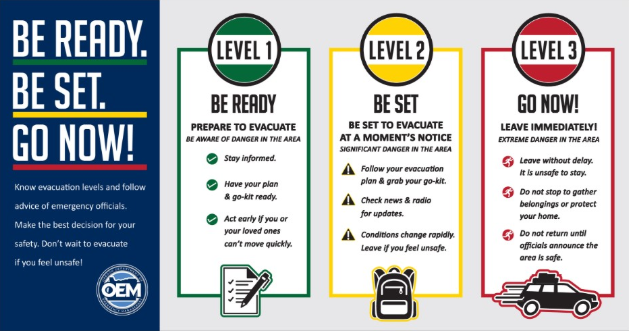
Oregon uses a clear, three-level evacuation alert system: Level 1 (BE READY—Green) means stay aware and prepare; Level 2 (BE SET—Yellow) indicates significant danger and voluntary evacuation is encouraged; Level 3 (GO NOW—Red) means evacuate immediately as extreme danger is present. Understanding these levels and the differences between voluntary and mandatory evacuation orders is critical for family safety.
Format: Online Educational Resource
Cost: FREE
Register for Emergency Alerts and Backup Communication
Sign up with ORAlert.gov to receive location-specific emergency alerts by zip code. Ensure wireless emergency alerts are enabled on your phone and follow local emergency services on social media. Have a backup communication plan in case cell service fails, including contact with loved ones, printed emergency information, and alternative communication methods.
Resources: ORAlert.gov, TripCheck.com, local county emergency management websites
Cost: FREE
Insurance and Recovery Planning: Protect Your Future
Standard renters’ or homeowners’ insurance policies do not cover wildfires, floods, or landslides. Now is the time to verify you have adequate wildfire insurance coverage. Talk with your insurance agent about the right type and amount of coverage. Have a documented recovery plan that identifies what needs to be replaced and how you will recover financially through insurance, savings, loans, and community support.
Cost: FREE planning resources; insurance premiums vary
OEM Wildfire Preparedness Resources
OEM Wildfire Awareness Campaign — https://wildfire.oregon.gov/prepare · Complete evacuation checklists, preparedness guides, and educational resources
Be2WeeksReady Toolkit — https://www.oregon.gov/oem · Comprehensive emergency preparedness planning tools for families
Wildfire Alert Graphics — https://www.oregon.gov/oem · Downloadable evacuation level infographics
Media Contact — Phone: 503-934-3310 · Email: [email protected]
External Emergency Preparedness Resources
Red Cross Disaster Preparedness — https://www.redcross.org · Resources for families, individuals with disabilities, and service animals
Ready.gov Pet Evacuation Planning — https://www.ready.gov/pets · Pet emergency kits and evacuation strategies
Oregon Department of Agriculture Livestock Resources — https://www.oregon.gov/ODA · Livestock evacuation and care resources
Insurance and Financial Recovery Resources
Insurance Institute for Business and Home Safety (IBHS) – Wildfire Ready — https://www.ibhs.org · Home hardening and insurance resources
Oregon Division of Financial Regulation – Wildfire Insurance Resources — https://dfr.oregon.gov · Insurance claim guidance and consumer protections
Crisis Support and Information
988 Suicide & Crisis Lifeline — Call or text 988 · 24/7 crisis support (especially important during evacuations and recovery)
TripCheck Road Conditions — https://www.tripcheck.com or call 511 · Real-time evacuation route information
About the Oregon Department of Emergency Management
The Oregon Department of Emergency Management (OEM) was established in 1981 and became a standalone cabinet-level department in July 2022. OEM leads collaborative statewide efforts with local, tribal, state, and federal partners to ensure Oregonians can access help in emergencies and are protected, prepared, and able to recover from disasters regardless of cause.
OEM’s mission is to protect lives, property, and the environment through prevention, preparedness, mitigation, response, and recovery from all hazards. The agency coordinates with over 50 county, city, and tribal emergency management offices across Oregon, awards grant funding to local governments, and supports 18 Emergency Support Functions. OEM prioritizes an equitable and inclusive culture of preparedness that empowers all Oregonians to thrive during crises.
Director: Erin McMahon. Website: https://www.oregon.gov/oem. Phone: 503-934-3310.