
Calendar Event Sorting
At the top, the 24/7/365 SAMHSA Disaster Helpline and similar links.
Next, Bundled “All Day” Events
Some organizations (like 12 step recovery programs, AA, NA, AlAnon, etc.) have so many events happening throughout the day that they need to be in a bundled listing to spare endless scrolling. Often there is a link to look up events by zip code and other criteria.
Lastly, Time-Specific Events
So you can see what’s happening in the next hours, time specific events are tagged and listed by start time from 12:01am early morning to 11:59pm late night. There can be events and warmlines operating in different time zones, though we try to list all in Oregon’s Pacific Time Zone.
Page Advancement
The calendar displays ~50 listings per page. To advance to next page with ~50 more listings, click the right arrow in the lower left corner of the calendar

Poison Help: Free 24/7 Guidance for Poison Emergencies
Reach out right away for any possible poisoning, even a minor or unexpected encounter with a medicine, product, plant, or creature.
Get free, confidential guidance any time, day or night, either online through webPOISONCONTROL or by phone at your regional poison center.
Primary Resources
webPOISONCONTROL — Get help online · Free, confidential, fully-automated triage tool available 24/7; provides a recommendation in under 3 minutes based on age, substance, amount, and symptoms.
Poison Control Phone Line — 1-800-222-1222 · Routes to the poison center serving your region; free, expert, and confidential, available 24/7.
Poison Control Website — poison.org · Central hub for poison prevention information, first aid guidance, and the webPOISONCONTROL tool.
Educational & Resource Programs
First Aid for Poisonings — Read the guide · Immediate steps to take before help arrives.
Is It a Poison? Substance Library — Search the library · Searchable articles on the safety of specific substances.
How to Get Help Online or by Phone — Learn more · Overview of both ways to reach Poison Control.
The Poison Post® Newsletter — Subscribe · Free quarterly e-newsletter with poison prevention tips.
Poison Control App — Apple App Store · Google Play
Support Services & Contact Information
Feedback Survey — Share your thoughts
Donate — Support Poison Control · Donations to this 501(c)(3) organization fund free, confidential poison emergency guidance.
Administrative & Media Inquiries — 202-362-3867 or email · For administrative or media inquiries only; not for poisoning advice.
About National Capital Poison Center
The National Capital Poison Center (NCPC) was founded in 1980 at the request of the Metropolitan Washington Council of Governments and is an independent 501(c)(3) nonprofit affiliated with The George Washington University School of Medicine; it closed its telephone call center in 2025 to become the nation’s first fully-automated, all-digital Poison Control.
Its mission is to prevent poisonings, save lives, and limit injury from poisoning by providing free, expert guidance 24/7.
NCPC serves the general public across the entire United States through webPOISONCONTROL, with more than half of reported cases involving children younger than six years old.
Its services include online triage guidance for poison exposures, poison prevention education, and hazard detection and surveillance work with regulators and industry.
Disclaimer: This listing is shared for community information only. The event is organized and hosted by the listed organization, not by PeerGalaxy. Dates, times, and access links are subject to change — please confirm details with the organizer before attending.

Getting Help in a Disaster or Emergency
Natural disasters can strike with little or no warning, and Medicare offers resources to help people get the care they need if an emergency is declared and evacuation becomes necessary. This posting outlines how to access prescriptions, doctors, and critical equipment during a declared emergency.
Getting Care
Original Medicare members can see any doctor who accepts Medicare, while Medicare Advantage members should contact their plan about temporary access options. The following resources outline what to do for prescriptions, doctor visits, and critical care during a declared emergency.
Date(s): Available year-round; applies whenever a federal, state, or local emergency or disaster is declared
Format: Virtual
Platform: Medicare.gov/emergency
Prescription Drugs
You can transfer most prescriptions to another in-network pharmacy during an emergency, then return to your regular pharmacy afterward. If you need an out-of-network pharmacy, contact your Medicare drug plan.
Seeing a Doctor
With Original Medicare, you can see any doctor who accepts Medicare. If you have a Medicare Advantage Plan or other Medicare health plan, contact your plan about temporary options, such as using an out-of-network provider.
Critical Care & Equipment
Need access to cancer treatments, dialysis, or a replacement wheelchair or walker? Visit Medicare.gov/emergency to learn more about getting the care and equipment you need during an emergency.
Primary Resources
Medicare Emergency Preparedness — Medicare.gov/emergency · Plan ahead and find resources for getting care during a declared emergency
Getting Care in a Disaster — Medicare.gov/providers-services/disaster-emergency · Detailed guidance on doctors, prescriptions, dialysis, cancer treatment, equipment, and enrollment during a declared emergency
Support Services & Contact Information
Medicare Drug Plan Assistance — 1-800-MEDICARE (1-800-633-4227) · Contact your Medicare drug plan to find an out-of-network pharmacy during an emergency
Manage Email Subscription Preferences — Medicare.gov email preferences · Update preferences or unsubscribe from Medicare Team email updates
About the Centers for Medicare & Medicaid Services
The Centers for Medicare & Medicaid Services (CMS) is the federal agency within the U.S. Department of Health and Human Services that administers the Medicare program, providing health coverage to people age 65 and older and to some younger people with disabilities.
CMS works to ensure Medicare beneficiaries can access medical care, prescription drugs, and necessary equipment during declared emergencies and natural disasters, including through special enrollment periods and temporary network flexibilities.
Disclaimer: This listing is shared for community information only. The event is organized and hosted by the listed organization, not by PeerGalaxy. Dates, times, and access links are subject to change — please confirm details with the organizer before attending.
OREGON STATEWIDE WEATHER & FIRE CONDITIONS
Public Safety Resource · Weather Alerts · Fire Danger · Air Quality · Flooding
“Know the hazard. Find the right resource. Stay safe.”
All resources listed are free and publicly available · Verify current conditions directly with official sources below
CALL 911
For anyone experiencing an active wildfire, flooding, or immediate threat to life or property
CALL OR TEXT 988
For anyone in emotional distress or mental health crisis related to a disaster or evacuation · Free · Confidential · 24/7
YOUR FIRST THREE STEPS WHEN A HAZARD IS POSSIBLE
1 · Check NWS Active Alerts for Oregon NWS Oregon Active Alerts
Every active watch, warning, and advisory in Oregon — in one place. Check here first whenever you hear about a hazard in your area.
2 · Check Your Fire Danger Level and Burn Restrictions ODF Fire Restrictions Interactive Map
Tap your location on the interactive map to see your local fire danger level and whether any burn restrictions apply. Works on mobile. Check before any outdoor burning — any time of year.
3 · Sign Up for County Emergency Alerts Oregon Emergency Alert Registration
Register your phone and home address so wildfire, flood, and evacuation alerts reach you directly — without having to check anything. Takes less than two minutes.
NWS ALERT TYPE DEFINITIONS
When a hazard is issued for your area, it will carry one of these labels. Knowing what each term means tells you how urgently to act.
🔴 WARNING
Hazardous conditions are occurring or imminent. Take protective action NOW — do not wait.
🟡 WATCH
Conditions are favorable for a hazard to develop. Prepare now and monitor updates closely.
🟠 ADVISORY
Conditions will be hazardous but below warning thresholds. Use extra caution outdoors.
🔵 SPECIAL WEATHER STATEMENT
Noteworthy conditions that require public awareness but do not meet warning or advisory thresholds. Stay aware and check for updates.
🏖 BEACH HAZARDS STATEMENT
Dangerous ocean or beach conditions — sneaker waves, rip currents, or extreme surf. Stay well back from the water’s edge regardless of how calm the ocean looks.
🔥 RED FLAG WARNING
Critical fire weather: low humidity + high winds + dry fuels = extreme fire danger. No outdoor burning of any kind. Avoid all spark-producing activity.
🌊 SMALL CRAFT ADVISORY
Hazardous conditions for small vessels. Inexperienced mariners should stay off coastal and Columbia River Bar waters until the advisory expires.
💧 FLOOD WATCH
Flooding is possible. Prepare now — know your evacuation route and monitor river gauge levels.
💧 FLOOD WARNING
Flooding is occurring or imminent. Move to higher ground now. Turn Around, Don’t Drown — never drive through a flooded road.
FIRE DANGER LEVELS — WHAT THEY MEAN
The Oregon Department of Forestry uses a five-level fire danger scale. Your local level determines which activities may be restricted on public and private forestlands. Danger levels can vary significantly over short distances — always check your specific location on the ODF map before any outdoor burning or spark-producing activity.
-
LOW
Fires are unlikely to start or spread rapidly. Normal outdoor caution applies.
-
MODERATE
Fires can start and spread under dry or windy conditions. Use caution near any ignition source outdoors.
-
HIGH
Fires start easily and spread quickly. Check ODF burn restrictions before any outdoor burning. Debris fires must be fully extinguished — never left to smolder.
-
VERY HIGH
Fires start very easily from almost any spark. Outdoor burning is typically prohibited. Check ODF restrictions for your specific location before any outdoor activity.
-
EXTREME
Maximum fire danger. Any fire can quickly become uncontrollable. All outdoor burning prohibited. Avoid all spark-producing activity entirely.
Check your current fire danger level and burn restrictions: ODF Fire Restrictions Interactive Map
OREGON SEASONAL HAZARD GUIDE
Oregon faces different hazards throughout the year. Use this guide to know what to watch for in any given season and which resources to check most closely.
❄ WINTER — December through February
Ice storms and freezing rain in the Willamette Valley · Heavy snow in the Cascades and eastern Oregon · Coastal wind events and large surf · Sneaker waves year-round · River flooding from rain-on-snow events
🌱 SPRING — March through May
Early Red Flag fire weather as fuels dry before green-up · Snowmelt flooding along Cascade-fed rivers · Prescribed burn smoke · High surf and sneaker waves on the coast
🔥 SUMMER — June through September
Wildfire season peaks statewide · Red Flag Warnings common in south-central and eastern Oregon · Smoke events affecting air quality across the state · Extreme heat in the Willamette Valley and eastern Oregon · Lightning-caused fires in the mountains
🍂 FALL — October through November
Wildfires may remain active into October · Coastal wind events return · Early ice and snow in the mountains · Transition back to rainy-season flooding risk · First major wind events of the season
REGIONAL HAZARD CONTEXT
Western Oregon & Portland Metro
Willamette Valley weather is generally mild but can shift quickly. Watch for winter ice storms and wind events that cause widespread power outages, summer heat waves, and river flooding during rain-on-snow events in the mountains. The Columbia River Gorge is a natural wind corridor — conditions there can be dramatically different from surrounding areas.
Oregon Coast
Sneaker waves are the leading cause of ocean drowning deaths on the Oregon coast and occur year-round — including on days when the surf appears completely calm. Stay well back from the water’s edge. Never turn your back on the ocean. Stay off rocks, jetties, and logs at the surf line at all times. Watch for NWS Beach Hazards Statements before any coastal visit. The Columbia River Bar is one of the most hazardous river mouths in North America — always check bar conditions with the U.S. Coast Guard before any crossing attempt.
South-Central Oregon — Lake, Klamath & Harney Counties
This region is among Oregon’s most fire-prone. Red Flag Warnings are common in spring and summer when low humidity, high winds, and dry grass create extreme ignition conditions. The pre-green-up period in late winter and early spring — before new vegetation replaces last year’s dead grass — is particularly dangerous. Even a small spark can start a fast-moving fire. Always check ODF restrictions before any outdoor burning or use of spark-producing equipment.
Central Oregon — Bend, Redmond, Prineville, Madras
Central Oregon’s dry high-desert climate means fire risk arrives early and persists late into the season. Prescribed burns on the Deschutes and Ochoco national forests and the Crooked River National Grassland can produce smoke affecting communities along the Highway 26 and Highway 97 corridors. Check air quality at oregon.gov/deq before extended outdoor activity whenever smoke is visible.
Eastern Oregon
Eastern Oregon faces both wildfire risk and flash flood potential. Summer thunderstorms over the Blue Mountains and Wallowas can produce lightning-caused fires and rapid runoff into steep canyon drainages. Rivers fed by east-slope snowpack — including the John Day, Malheur, Owyhee, and Deschutes — can rise quickly during spring snowmelt events. Check river gauges at water.noaa.gov before recreating near any waterway.
Southern Oregon — Rogue Valley, Medford, Ashland, Grants Pass
Southern Oregon sits in a fire-prone interface zone where forested mountains meet populated valleys. Fire season can begin as early as June and extend into October. Smoke from both Oregon and northern California wildfires regularly affects air quality in late summer. Years with below-average snowpack significantly increase fire risk beginning as early as spring.
WILDFIRE SMOKE & AIR QUALITY GUIDE
Wildfire smoke contains fine particles that penetrate deep into the lungs and cannot be filtered by an ordinary dust mask. Groups at elevated risk include children, older adults, pregnant women, and anyone with heart or lung conditions. Check air quality before any outdoor activity during a smoke event — conditions can change within hours.
Air Quality Index (AQI) — What the Colors Mean
-
GREEN (0–50) — Good
Air quality is satisfactory. Outdoor activity is fine for everyone.
-
YELLOW (51–100) — Moderate
Sensitive groups should consider limiting prolonged outdoor exertion.
-
ORANGE (101–150) — Unhealthy for Sensitive Groups
Children, older adults, and anyone with heart or lung conditions should reduce time outdoors.
-
RED (151–200) — Unhealthy
Everyone should reduce prolonged outdoor exertion. Sensitive groups should remain indoors.
-
PURPLE (201–300) — Very Unhealthy
Avoid all outdoor activity. Keep windows and doors closed.
-
MAROON (301+) — Hazardous
Health emergency conditions. Everyone should stay indoors with windows closed.
Simple indoor air filtration during a smoke event: Tape a MERV-13 furnace filter to the back of a standard box fan. This creates an effective air cleaner at very low cost and is safe to run with windows closed.
Check current air quality: Oregon DEQ Air Quality Index · AirNow.gov · OregonAIR Mobile App
NO CELL SERVICE OR INTERNET? USE NOAA WEATHER RADIO
A NOAA Weather Radio receiver broadcasts continuous NWS alerts, weather forecasts, fire weather warnings, and emergency messages 24 hours a day · 7 days a week on 162.400 – 162.550 MHz. It is the most reliable alert system for rural Oregon when cell coverage or internet is unavailable. A dedicated receiver is required — available at hardware and electronics retailers for under $30. Find the transmitter frequency for your location at weather.gov/nwr.
MONITOR & STAY INFORMED — COMPLETE RESOURCE LIST
All resources below are free and publicly available 24 hours a day · 7 days a week unless otherwise noted.
WEATHER — WATCHES, WARNINGS & FORECASTS
NWS Active Alerts — All of Oregon
Every active NWS watch, warning, and advisory currently in effect anywhere in Oregon — in one place. Check here first.
NWS Portland — Western Oregon
Current alerts and forecasts for the Portland metro, Willamette Valley, northern coast, and Columbia River Gorge.
NWS Medford — Southern Oregon
Alerts and forecasts for the Rogue Valley, Klamath Basin, Crater Lake area, and south-central Oregon.
NWS Pendleton — Eastern & Central Oregon
Alerts and forecasts for eastern Oregon, the Blue Mountains, Cascades east slopes, and the central Oregon high desert.
NOAA Marine Forecast — Oregon Coast
Coastal and offshore forecasts, small craft advisories, and Columbia River Bar conditions.
NOAA Weather Radio Frequency Finder
Find your local 162 MHz NOAA Weather Radio frequency. Continuous 24/7 NWS broadcasts — the most reliable alert system when cell coverage or internet fails.
FIRE DANGER, RESTRICTIONS & ACTIVE WILDFIRES
ODF Fire Danger & Burn Restrictions Map
Interactive map — tap or click your location to see your current fire danger level and active burn restrictions. Works on mobile. Check before any outdoor burning.
Oregon Dept. of Forestry — Fire & Weather
Official ODF fire weather forecasts, statewide danger ratings, and fire news and press releases.
Before You Burn — Debris Burning Check
Check daily whether outdoor debris burning is allowed in your area before lighting anything. Debris burning is the leading cause of human-caused wildfires in Oregon.
BLM Oregon & Washington — Fire Restrictions
Fire restrictions for Bureau of Land Management lands. Note: BLM restrictions may differ from ODF restrictions on adjacent land — check both for your location.
InciWeb — Active Oregon Wildfires
Active wildfire locations, acreage, containment status, road closures, and evacuation orders across Oregon.
Northwest Interagency Coordination Center
Regional fire situation reports and preparedness levels for Oregon and Washington.
AIR QUALITY & WILDFIRE SMOKE
Oregon DEQ — Air Quality Index
Real-time statewide air quality readings. Check before outdoor activity during any smoke event — especially for children, older adults, and anyone with heart or lung conditions.
AirNow.gov — Federal Air Quality
Current and forecast AQI by location. Includes smoke forecasts during wildfire events. Available 24 hours a day · 7 days a week.
OregonAIR Mobile App
Free mobile app for real-time Oregon air quality readings and alerts. Available for iOS and Android.
FLOODING & RIVER LEVELS
NOAA River Levels & Flood Monitoring
Live river gauge readings, flood stage forecasts, and inundation maps for rivers across Oregon. Enter any river name or city. Available 24 hours a day · 7 days a week.
EMERGENCY ALERTS & PREPAREDNESS
Oregon Emergency Alerts — Sign Up
Register your phone and address to receive county emergency alerts for wildfires, floods, and evacuations directly — without having to seek them out.
Oregon Office of Emergency Management
Statewide emergency preparedness resources, disaster declarations, and guidance for individuals, families, and communities.
Oregon Emergency Management — Make a Plan
Step-by-step guidance for building a household emergency plan, go-bag, and communication strategy before a disaster strikes.
KEY PHONE NUMBERS
Save these numbers before a disaster occurs. Cell networks may be congested during an active emergency.
Life-Safety Emergency
CALL: 911
For anyone experiencing or witnessing an active wildfire, flooding, structure fire, or any immediate threat to life or property.
Mental Health Crisis Line
CALL OR TEXT: 988
For anyone in emotional distress or mental health crisis related to a disaster or evacuation. Free · Confidential · Available 24 hours a day · 7 days a week.
Oregon Emergency Management — Duty Officer
CALL: 1-503-378-2911
For local emergency managers and public officials requesting state assistance during an active emergency or declared disaster.
NWS Portland — Western Oregon Recorded Forecast
CALL: 503-261-9246
For anyone in the Portland metro, Willamette Valley, or northern coast. Recorded forecast updated several times daily.
NWS Medford — Southern Oregon
CALL: 541-773-1067
For anyone in southern Oregon or the Rogue Valley seeking a current recorded forecast.
NWS Pendleton — Eastern & Central Oregon
CALL: 541-276-4493
For anyone in eastern or central Oregon seeking a current recorded forecast.
Central Oregon Fire Information Line
CALL: 1-800-523-4737
For anyone in central Oregon seeking current fire danger levels, active burn restrictions, or incident information.
NOAA Weather Radio
162.400 – 162.550 MHz (receiver required)
For anyone in a rural area without reliable cell or internet coverage. A dedicated weather radio receiver is required — available at hardware and electronics retailers. Find your local frequency at weather.gov/nwr. Available 24 hours a day · 7 days a week.
PREPAREDNESS ACTIONS YOU CAN TAKE NOW
Sign Up for Emergency Alerts
Register at Oregon Emergency Alert Registration — oralert.gov to receive county alerts for wildfires, floods, and evacuations directly on your phone. Also enable Wireless Emergency Alerts in your phone’s notification settings — these require no registration and can reach you even without data service.
Know Your Evacuation Route
Identify at least two ways out of your neighborhood before a disaster occurs. One route may be blocked by fire or floodwater. Know where you would go and how you would reach family members if you are separated. In a fast-moving wildfire, there may be very little warning time — have your plan ready now.
Build a Go-Bag
Keep a ready bag near your door or in your vehicle during fire season. Include: prescription medications and medical supplies · copies of important documents · phone charger and backup battery · water and food for three days · cash · a change of clothing · N95 masks for smoke protection. A go-bag prepared in advance saves critical time during an emergency evacuation.
For Outdoor Burns — Check Before You Light
Debris burning is the leading cause of human-caused wildfires in Oregon — and any escaped fire can result in full liability for suppression costs, which can reach millions of dollars. Before any outdoor burn, check BeforeYouBurn.com and the ODF Fire Restrictions Map. When in doubt, do not burn.
Turn Around, Don’t Drown
Never drive through a flooded road — even if it looks passable. Just six inches of moving water can knock a person off their feet. Two feet of water can carry away most vehicles. If a road ahead is flooded, turn around and find another route. Most flood-related deaths in Oregon occur in vehicles.
Check on Neighbors
Older adults, people with disabilities, and those who live alone may not receive alerts or may need help evacuating. Check on neighbors before a known hazard arrives in your area.
DISCLAIMER: Information is shared solely as a public courtesy. All resources listed are publicly available through official government agencies. This document is not a product of, nor endorsed by, the National Weather Service, Oregon Department of Forestry, Oregon Emergency Management, or any other agency listed. Content is subject to change — always verify current conditions directly with official sources before making any decisions. This is not a substitute for official emergency broadcasts, professional weather services, or instructions from local emergency management authorities. If a person is in immediate danger, call 911. For mental health emergencies, call or text 988 (Suicide & Crisis Lifeline) — free · confidential · available 24 hours a day · 7 days a week. All services listed are free and publicly available.
2026 Wildfire Awareness Month: Emergency Preparedness Campaign
Date/Time: May 1–31, 2026 (Available Throughout May)
Oregon is facing one of the driest wildfire seasons in over a decade with nine counties already under emergency drought declarations. The Oregon Department of Emergency Management urges all residents to get ready now by packing go-bags, knowing evacuation routes, signing up for emergency alerts, and ensuring adequate wildfire insurance.
Pack Your Go-Bag: Essential Wildfire Preparedness
A properly prepared go-bag can make the difference between safe evacuation and dangerous delays. Each household member—including pets and livestock—should have an easy-to-carry emergency bag assembled and ready before wildfire season peaks. OEM provides a comprehensive checklist of essential items from water and food supplies to important documents, medications, first aid, flashlights, and backup power sources.
Cost: FREE
Evacuation Planning: Know Your Routes and Communication Strategy
Effective evacuation planning requires knowing multiple exit routes, establishing a family meeting place, identifying transportation for pets and livestock, and developing a communication strategy for when cell towers may be damaged. OEM recommends creating a PACE plan (Primary, Alternate, Contingency, Emergency) for staying connected, including options like Starlink satellite service, satellite communicators, and hand-crank radios.
Additional Support: Red Cross resources available for individuals with disabilities; Ready.gov/pets provides livestock evacuation guidance; Oregon Department of Agriculture offers specialized resources for farmers and ranchers.
Cost: FREE
Understanding Oregon’s Three-Level Evacuation System
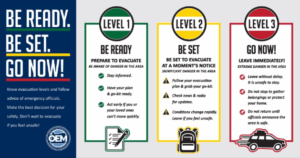
Oregon uses a clear, three-level evacuation alert system: Level 1 (BE READY—Green) means stay aware and prepare; Level 2 (BE SET—Yellow) indicates significant danger and voluntary evacuation is encouraged; Level 3 (GO NOW—Red) means evacuate immediately as extreme danger is present. Understanding these levels and the differences between voluntary and mandatory evacuation orders is critical for family safety.
Format: Online Educational Resource
Cost: FREE
Register for Emergency Alerts and Backup Communication
Sign up with ORAlert.gov to receive location-specific emergency alerts by zip code. Ensure wireless emergency alerts are enabled on your phone and follow local emergency services on social media. Have a backup communication plan in case cell service fails, including contact with loved ones, printed emergency information, and alternative communication methods.
Resources: ORAlert.gov, TripCheck.com, local county emergency management websites
Cost: FREE
Insurance and Recovery Planning: Protect Your Future
Standard renters’ or homeowners’ insurance policies do not cover wildfires, floods, or landslides. Now is the time to verify you have adequate wildfire insurance coverage. Talk with your insurance agent about the right type and amount of coverage. Have a documented recovery plan that identifies what needs to be replaced and how you will recover financially through insurance, savings, loans, and community support.
Cost: FREE planning resources; insurance premiums vary
OEM Wildfire Preparedness Resources
OEM Wildfire Awareness Campaign — https://wildfire.oregon.gov/prepare · Complete evacuation checklists, preparedness guides, and educational resources
Be2WeeksReady Toolkit — https://www.oregon.gov/oem · Comprehensive emergency preparedness planning tools for families
Wildfire Alert Graphics — https://www.oregon.gov/oem · Downloadable evacuation level infographics
Media Contact — Phone: 503-934-3310 · Email: [email protected]
External Emergency Preparedness Resources
Red Cross Disaster Preparedness — https://www.redcross.org · Resources for families, individuals with disabilities, and service animals
Ready.gov Pet Evacuation Planning — https://www.ready.gov/pets · Pet emergency kits and evacuation strategies
Oregon Department of Agriculture Livestock Resources — https://www.oregon.gov/ODA · Livestock evacuation and care resources
Insurance and Financial Recovery Resources
Insurance Institute for Business and Home Safety (IBHS) – Wildfire Ready — https://www.ibhs.org · Home hardening and insurance resources
Oregon Division of Financial Regulation – Wildfire Insurance Resources — https://dfr.oregon.gov · Insurance claim guidance and consumer protections
Crisis Support and Information
988 Suicide & Crisis Lifeline — Call or text 988 · 24/7 crisis support (especially important during evacuations and recovery)
TripCheck Road Conditions — https://www.tripcheck.com or call 511 · Real-time evacuation route information
About the Oregon Department of Emergency Management
The Oregon Department of Emergency Management (OEM) was established in 1981 and became a standalone cabinet-level department in July 2022. OEM leads collaborative statewide efforts with local, tribal, state, and federal partners to ensure Oregonians can access help in emergencies and are protected, prepared, and able to recover from disasters regardless of cause.
OEM’s mission is to protect lives, property, and the environment through prevention, preparedness, mitigation, response, and recovery from all hazards. The agency coordinates with over 50 county, city, and tribal emergency management offices across Oregon, awards grant funding to local governments, and supports 18 Emergency Support Functions. OEM prioritizes an equitable and inclusive culture of preparedness that empowers all Oregonians to thrive during crises.
Director: Erin McMahon. Website: https://www.oregon.gov/oem. Phone: 503-934-3310.
Poison Help: Free 24/7 Guidance for Poison Emergencies
Reach out right away for any possible poisoning, even a minor or unexpected encounter with a medicine, product, plant, or creature.
Get free, confidential guidance any time, day or night, either online through webPOISONCONTROL or by phone at your regional poison center.
Primary Resources
webPOISONCONTROL — Get help online · Free, confidential, fully-automated triage tool available 24/7; provides a recommendation in under 3 minutes based on age, substance, amount, and symptoms.
Poison Control Phone Line — 1-800-222-1222 · Routes to the poison center serving your region; free, expert, and confidential, available 24/7.
Poison Control Website — poison.org · Central hub for poison prevention information, first aid guidance, and the webPOISONCONTROL tool.
Educational & Resource Programs
First Aid for Poisonings — Read the guide · Immediate steps to take before help arrives.
Is It a Poison? Substance Library — Search the library · Searchable articles on the safety of specific substances.
How to Get Help Online or by Phone — Learn more · Overview of both ways to reach Poison Control.
The Poison Post® Newsletter — Subscribe · Free quarterly e-newsletter with poison prevention tips.
Poison Control App — Apple App Store · Google Play
Support Services & Contact Information
Feedback Survey — Share your thoughts
Donate — Support Poison Control · Donations to this 501(c)(3) organization fund free, confidential poison emergency guidance.
Administrative & Media Inquiries — 202-362-3867 or email · For administrative or media inquiries only; not for poisoning advice.
About National Capital Poison Center
The National Capital Poison Center (NCPC) was founded in 1980 at the request of the Metropolitan Washington Council of Governments and is an independent 501(c)(3) nonprofit affiliated with The George Washington University School of Medicine; it closed its telephone call center in 2025 to become the nation’s first fully-automated, all-digital Poison Control.
Its mission is to prevent poisonings, save lives, and limit injury from poisoning by providing free, expert guidance 24/7.
NCPC serves the general public across the entire United States through webPOISONCONTROL, with more than half of reported cases involving children younger than six years old.
Its services include online triage guidance for poison exposures, poison prevention education, and hazard detection and surveillance work with regulators and industry.
Disclaimer: This listing is shared for community information only. The event is organized and hosted by the listed organization, not by PeerGalaxy. Dates, times, and access links are subject to change — please confirm details with the organizer before attending.
Getting Help in a Disaster or Emergency
Natural disasters can strike with little or no warning, and Medicare offers resources to help people get the care they need if an emergency is declared and evacuation becomes necessary. This posting outlines how to access prescriptions, doctors, and critical equipment during a declared emergency.
Getting Care
Original Medicare members can see any doctor who accepts Medicare, while Medicare Advantage members should contact their plan about temporary access options. The following resources outline what to do for prescriptions, doctor visits, and critical care during a declared emergency.
Date(s): Available year-round; applies whenever a federal, state, or local emergency or disaster is declared
Format: Virtual
Platform: Medicare.gov/emergency
Prescription Drugs
You can transfer most prescriptions to another in-network pharmacy during an emergency, then return to your regular pharmacy afterward. If you need an out-of-network pharmacy, contact your Medicare drug plan.
Seeing a Doctor
With Original Medicare, you can see any doctor who accepts Medicare. If you have a Medicare Advantage Plan or other Medicare health plan, contact your plan about temporary options, such as using an out-of-network provider.
Critical Care & Equipment
Need access to cancer treatments, dialysis, or a replacement wheelchair or walker? Visit Medicare.gov/emergency to learn more about getting the care and equipment you need during an emergency.
Primary Resources
Medicare Emergency Preparedness — Medicare.gov/emergency · Plan ahead and find resources for getting care during a declared emergency
Getting Care in a Disaster — Medicare.gov/providers-services/disaster-emergency · Detailed guidance on doctors, prescriptions, dialysis, cancer treatment, equipment, and enrollment during a declared emergency
Support Services & Contact Information
Medicare Drug Plan Assistance — 1-800-MEDICARE (1-800-633-4227) · Contact your Medicare drug plan to find an out-of-network pharmacy during an emergency
Manage Email Subscription Preferences — Medicare.gov email preferences · Update preferences or unsubscribe from Medicare Team email updates
About the Centers for Medicare & Medicaid Services
The Centers for Medicare & Medicaid Services (CMS) is the federal agency within the U.S. Department of Health and Human Services that administers the Medicare program, providing health coverage to people age 65 and older and to some younger people with disabilities.
CMS works to ensure Medicare beneficiaries can access medical care, prescription drugs, and necessary equipment during declared emergencies and natural disasters, including through special enrollment periods and temporary network flexibilities.
Disclaimer: This listing is shared for community information only. The event is organized and hosted by the listed organization, not by PeerGalaxy. Dates, times, and access links are subject to change — please confirm details with the organizer before attending.
OREGON STATEWIDE WEATHER & FIRE CONDITIONS
Public Safety Resource · Weather Alerts · Fire Danger · Air Quality · Flooding
“Know the hazard. Find the right resource. Stay safe.”
All resources listed are free and publicly available · Verify current conditions directly with official sources below
CALL 911
For anyone experiencing an active wildfire, flooding, or immediate threat to life or property
CALL OR TEXT 988
For anyone in emotional distress or mental health crisis related to a disaster or evacuation · Free · Confidential · 24/7
YOUR FIRST THREE STEPS WHEN A HAZARD IS POSSIBLE
1 · Check NWS Active Alerts for Oregon NWS Oregon Active Alerts
Every active watch, warning, and advisory in Oregon — in one place. Check here first whenever you hear about a hazard in your area.
2 · Check Your Fire Danger Level and Burn Restrictions ODF Fire Restrictions Interactive Map
Tap your location on the interactive map to see your local fire danger level and whether any burn restrictions apply. Works on mobile. Check before any outdoor burning — any time of year.
3 · Sign Up for County Emergency Alerts Oregon Emergency Alert Registration
Register your phone and home address so wildfire, flood, and evacuation alerts reach you directly — without having to check anything. Takes less than two minutes.
NWS ALERT TYPE DEFINITIONS
When a hazard is issued for your area, it will carry one of these labels. Knowing what each term means tells you how urgently to act.
🔴 WARNING
Hazardous conditions are occurring or imminent. Take protective action NOW — do not wait.
🟡 WATCH
Conditions are favorable for a hazard to develop. Prepare now and monitor updates closely.
🟠 ADVISORY
Conditions will be hazardous but below warning thresholds. Use extra caution outdoors.
🔵 SPECIAL WEATHER STATEMENT
Noteworthy conditions that require public awareness but do not meet warning or advisory thresholds. Stay aware and check for updates.
🏖 BEACH HAZARDS STATEMENT
Dangerous ocean or beach conditions — sneaker waves, rip currents, or extreme surf. Stay well back from the water’s edge regardless of how calm the ocean looks.
🔥 RED FLAG WARNING
Critical fire weather: low humidity + high winds + dry fuels = extreme fire danger. No outdoor burning of any kind. Avoid all spark-producing activity.
🌊 SMALL CRAFT ADVISORY
Hazardous conditions for small vessels. Inexperienced mariners should stay off coastal and Columbia River Bar waters until the advisory expires.
💧 FLOOD WATCH
Flooding is possible. Prepare now — know your evacuation route and monitor river gauge levels.
💧 FLOOD WARNING
Flooding is occurring or imminent. Move to higher ground now. Turn Around, Don’t Drown — never drive through a flooded road.
FIRE DANGER LEVELS — WHAT THEY MEAN
The Oregon Department of Forestry uses a five-level fire danger scale. Your local level determines which activities may be restricted on public and private forestlands. Danger levels can vary significantly over short distances — always check your specific location on the ODF map before any outdoor burning or spark-producing activity.
-
LOW
Fires are unlikely to start or spread rapidly. Normal outdoor caution applies.
-
MODERATE
Fires can start and spread under dry or windy conditions. Use caution near any ignition source outdoors.
-
HIGH
Fires start easily and spread quickly. Check ODF burn restrictions before any outdoor burning. Debris fires must be fully extinguished — never left to smolder.
-
VERY HIGH
Fires start very easily from almost any spark. Outdoor burning is typically prohibited. Check ODF restrictions for your specific location before any outdoor activity.
-
EXTREME
Maximum fire danger. Any fire can quickly become uncontrollable. All outdoor burning prohibited. Avoid all spark-producing activity entirely.
Check your current fire danger level and burn restrictions: ODF Fire Restrictions Interactive Map
OREGON SEASONAL HAZARD GUIDE
Oregon faces different hazards throughout the year. Use this guide to know what to watch for in any given season and which resources to check most closely.
❄ WINTER — December through February
Ice storms and freezing rain in the Willamette Valley · Heavy snow in the Cascades and eastern Oregon · Coastal wind events and large surf · Sneaker waves year-round · River flooding from rain-on-snow events
🌱 SPRING — March through May
Early Red Flag fire weather as fuels dry before green-up · Snowmelt flooding along Cascade-fed rivers · Prescribed burn smoke · High surf and sneaker waves on the coast
🔥 SUMMER — June through September
Wildfire season peaks statewide · Red Flag Warnings common in south-central and eastern Oregon · Smoke events affecting air quality across the state · Extreme heat in the Willamette Valley and eastern Oregon · Lightning-caused fires in the mountains
🍂 FALL — October through November
Wildfires may remain active into October · Coastal wind events return · Early ice and snow in the mountains · Transition back to rainy-season flooding risk · First major wind events of the season
REGIONAL HAZARD CONTEXT
Western Oregon & Portland Metro
Willamette Valley weather is generally mild but can shift quickly. Watch for winter ice storms and wind events that cause widespread power outages, summer heat waves, and river flooding during rain-on-snow events in the mountains. The Columbia River Gorge is a natural wind corridor — conditions there can be dramatically different from surrounding areas.
Oregon Coast
Sneaker waves are the leading cause of ocean drowning deaths on the Oregon coast and occur year-round — including on days when the surf appears completely calm. Stay well back from the water’s edge. Never turn your back on the ocean. Stay off rocks, jetties, and logs at the surf line at all times. Watch for NWS Beach Hazards Statements before any coastal visit. The Columbia River Bar is one of the most hazardous river mouths in North America — always check bar conditions with the U.S. Coast Guard before any crossing attempt.
South-Central Oregon — Lake, Klamath & Harney Counties
This region is among Oregon’s most fire-prone. Red Flag Warnings are common in spring and summer when low humidity, high winds, and dry grass create extreme ignition conditions. The pre-green-up period in late winter and early spring — before new vegetation replaces last year’s dead grass — is particularly dangerous. Even a small spark can start a fast-moving fire. Always check ODF restrictions before any outdoor burning or use of spark-producing equipment.
Central Oregon — Bend, Redmond, Prineville, Madras
Central Oregon’s dry high-desert climate means fire risk arrives early and persists late into the season. Prescribed burns on the Deschutes and Ochoco national forests and the Crooked River National Grassland can produce smoke affecting communities along the Highway 26 and Highway 97 corridors. Check air quality at oregon.gov/deq before extended outdoor activity whenever smoke is visible.
Eastern Oregon
Eastern Oregon faces both wildfire risk and flash flood potential. Summer thunderstorms over the Blue Mountains and Wallowas can produce lightning-caused fires and rapid runoff into steep canyon drainages. Rivers fed by east-slope snowpack — including the John Day, Malheur, Owyhee, and Deschutes — can rise quickly during spring snowmelt events. Check river gauges at water.noaa.gov before recreating near any waterway.
Southern Oregon — Rogue Valley, Medford, Ashland, Grants Pass
Southern Oregon sits in a fire-prone interface zone where forested mountains meet populated valleys. Fire season can begin as early as June and extend into October. Smoke from both Oregon and northern California wildfires regularly affects air quality in late summer. Years with below-average snowpack significantly increase fire risk beginning as early as spring.
WILDFIRE SMOKE & AIR QUALITY GUIDE
Wildfire smoke contains fine particles that penetrate deep into the lungs and cannot be filtered by an ordinary dust mask. Groups at elevated risk include children, older adults, pregnant women, and anyone with heart or lung conditions. Check air quality before any outdoor activity during a smoke event — conditions can change within hours.
Air Quality Index (AQI) — What the Colors Mean
-
GREEN (0–50) — Good
Air quality is satisfactory. Outdoor activity is fine for everyone.
-
YELLOW (51–100) — Moderate
Sensitive groups should consider limiting prolonged outdoor exertion.
-
ORANGE (101–150) — Unhealthy for Sensitive Groups
Children, older adults, and anyone with heart or lung conditions should reduce time outdoors.
-
RED (151–200) — Unhealthy
Everyone should reduce prolonged outdoor exertion. Sensitive groups should remain indoors.
-
PURPLE (201–300) — Very Unhealthy
Avoid all outdoor activity. Keep windows and doors closed.
-
MAROON (301+) — Hazardous
Health emergency conditions. Everyone should stay indoors with windows closed.
Simple indoor air filtration during a smoke event: Tape a MERV-13 furnace filter to the back of a standard box fan. This creates an effective air cleaner at very low cost and is safe to run with windows closed.
Check current air quality: Oregon DEQ Air Quality Index · AirNow.gov · OregonAIR Mobile App
NO CELL SERVICE OR INTERNET? USE NOAA WEATHER RADIO
A NOAA Weather Radio receiver broadcasts continuous NWS alerts, weather forecasts, fire weather warnings, and emergency messages 24 hours a day · 7 days a week on 162.400 – 162.550 MHz. It is the most reliable alert system for rural Oregon when cell coverage or internet is unavailable. A dedicated receiver is required — available at hardware and electronics retailers for under $30. Find the transmitter frequency for your location at weather.gov/nwr.
MONITOR & STAY INFORMED — COMPLETE RESOURCE LIST
All resources below are free and publicly available 24 hours a day · 7 days a week unless otherwise noted.
WEATHER — WATCHES, WARNINGS & FORECASTS
NWS Active Alerts — All of Oregon
Every active NWS watch, warning, and advisory currently in effect anywhere in Oregon — in one place. Check here first.
NWS Portland — Western Oregon
Current alerts and forecasts for the Portland metro, Willamette Valley, northern coast, and Columbia River Gorge.
NWS Medford — Southern Oregon
Alerts and forecasts for the Rogue Valley, Klamath Basin, Crater Lake area, and south-central Oregon.
NWS Pendleton — Eastern & Central Oregon
Alerts and forecasts for eastern Oregon, the Blue Mountains, Cascades east slopes, and the central Oregon high desert.
NOAA Marine Forecast — Oregon Coast
Coastal and offshore forecasts, small craft advisories, and Columbia River Bar conditions.
NOAA Weather Radio Frequency Finder
Find your local 162 MHz NOAA Weather Radio frequency. Continuous 24/7 NWS broadcasts — the most reliable alert system when cell coverage or internet fails.
FIRE DANGER, RESTRICTIONS & ACTIVE WILDFIRES
ODF Fire Danger & Burn Restrictions Map
Interactive map — tap or click your location to see your current fire danger level and active burn restrictions. Works on mobile. Check before any outdoor burning.
Oregon Dept. of Forestry — Fire & Weather
Official ODF fire weather forecasts, statewide danger ratings, and fire news and press releases.
Before You Burn — Debris Burning Check
Check daily whether outdoor debris burning is allowed in your area before lighting anything. Debris burning is the leading cause of human-caused wildfires in Oregon.
BLM Oregon & Washington — Fire Restrictions
Fire restrictions for Bureau of Land Management lands. Note: BLM restrictions may differ from ODF restrictions on adjacent land — check both for your location.
InciWeb — Active Oregon Wildfires
Active wildfire locations, acreage, containment status, road closures, and evacuation orders across Oregon.
Northwest Interagency Coordination Center
Regional fire situation reports and preparedness levels for Oregon and Washington.
AIR QUALITY & WILDFIRE SMOKE
Oregon DEQ — Air Quality Index
Real-time statewide air quality readings. Check before outdoor activity during any smoke event — especially for children, older adults, and anyone with heart or lung conditions.
AirNow.gov — Federal Air Quality
Current and forecast AQI by location. Includes smoke forecasts during wildfire events. Available 24 hours a day · 7 days a week.
OregonAIR Mobile App
Free mobile app for real-time Oregon air quality readings and alerts. Available for iOS and Android.
FLOODING & RIVER LEVELS
NOAA River Levels & Flood Monitoring
Live river gauge readings, flood stage forecasts, and inundation maps for rivers across Oregon. Enter any river name or city. Available 24 hours a day · 7 days a week.
EMERGENCY ALERTS & PREPAREDNESS
Oregon Emergency Alerts — Sign Up
Register your phone and address to receive county emergency alerts for wildfires, floods, and evacuations directly — without having to seek them out.
Oregon Office of Emergency Management
Statewide emergency preparedness resources, disaster declarations, and guidance for individuals, families, and communities.
Oregon Emergency Management — Make a Plan
Step-by-step guidance for building a household emergency plan, go-bag, and communication strategy before a disaster strikes.
KEY PHONE NUMBERS
Save these numbers before a disaster occurs. Cell networks may be congested during an active emergency.
Life-Safety Emergency
CALL: 911
For anyone experiencing or witnessing an active wildfire, flooding, structure fire, or any immediate threat to life or property.
Mental Health Crisis Line
CALL OR TEXT: 988
For anyone in emotional distress or mental health crisis related to a disaster or evacuation. Free · Confidential · Available 24 hours a day · 7 days a week.
Oregon Emergency Management — Duty Officer
CALL: 1-503-378-2911
For local emergency managers and public officials requesting state assistance during an active emergency or declared disaster.
NWS Portland — Western Oregon Recorded Forecast
CALL: 503-261-9246
For anyone in the Portland metro, Willamette Valley, or northern coast. Recorded forecast updated several times daily.
NWS Medford — Southern Oregon
CALL: 541-773-1067
For anyone in southern Oregon or the Rogue Valley seeking a current recorded forecast.
NWS Pendleton — Eastern & Central Oregon
CALL: 541-276-4493
For anyone in eastern or central Oregon seeking a current recorded forecast.
Central Oregon Fire Information Line
CALL: 1-800-523-4737
For anyone in central Oregon seeking current fire danger levels, active burn restrictions, or incident information.
NOAA Weather Radio
162.400 – 162.550 MHz (receiver required)
For anyone in a rural area without reliable cell or internet coverage. A dedicated weather radio receiver is required — available at hardware and electronics retailers. Find your local frequency at weather.gov/nwr. Available 24 hours a day · 7 days a week.
PREPAREDNESS ACTIONS YOU CAN TAKE NOW
Sign Up for Emergency Alerts
Register at Oregon Emergency Alert Registration — oralert.gov to receive county alerts for wildfires, floods, and evacuations directly on your phone. Also enable Wireless Emergency Alerts in your phone’s notification settings — these require no registration and can reach you even without data service.
Know Your Evacuation Route
Identify at least two ways out of your neighborhood before a disaster occurs. One route may be blocked by fire or floodwater. Know where you would go and how you would reach family members if you are separated. In a fast-moving wildfire, there may be very little warning time — have your plan ready now.
Build a Go-Bag
Keep a ready bag near your door or in your vehicle during fire season. Include: prescription medications and medical supplies · copies of important documents · phone charger and backup battery · water and food for three days · cash · a change of clothing · N95 masks for smoke protection. A go-bag prepared in advance saves critical time during an emergency evacuation.
For Outdoor Burns — Check Before You Light
Debris burning is the leading cause of human-caused wildfires in Oregon — and any escaped fire can result in full liability for suppression costs, which can reach millions of dollars. Before any outdoor burn, check BeforeYouBurn.com and the ODF Fire Restrictions Map. When in doubt, do not burn.
Turn Around, Don’t Drown
Never drive through a flooded road — even if it looks passable. Just six inches of moving water can knock a person off their feet. Two feet of water can carry away most vehicles. If a road ahead is flooded, turn around and find another route. Most flood-related deaths in Oregon occur in vehicles.
Check on Neighbors
Older adults, people with disabilities, and those who live alone may not receive alerts or may need help evacuating. Check on neighbors before a known hazard arrives in your area.
DISCLAIMER: Information is shared solely as a public courtesy. All resources listed are publicly available through official government agencies. This document is not a product of, nor endorsed by, the National Weather Service, Oregon Department of Forestry, Oregon Emergency Management, or any other agency listed. Content is subject to change — always verify current conditions directly with official sources before making any decisions. This is not a substitute for official emergency broadcasts, professional weather services, or instructions from local emergency management authorities. If a person is in immediate danger, call 911. For mental health emergencies, call or text 988 (Suicide & Crisis Lifeline) — free · confidential · available 24 hours a day · 7 days a week. All services listed are free and publicly available.
2026 Wildfire Awareness Month: Emergency Preparedness Campaign
Date/Time: May 1–31, 2026 (Available Throughout May)
Oregon is facing one of the driest wildfire seasons in over a decade with nine counties already under emergency drought declarations. The Oregon Department of Emergency Management urges all residents to get ready now by packing go-bags, knowing evacuation routes, signing up for emergency alerts, and ensuring adequate wildfire insurance.
Pack Your Go-Bag: Essential Wildfire Preparedness
A properly prepared go-bag can make the difference between safe evacuation and dangerous delays. Each household member—including pets and livestock—should have an easy-to-carry emergency bag assembled and ready before wildfire season peaks. OEM provides a comprehensive checklist of essential items from water and food supplies to important documents, medications, first aid, flashlights, and backup power sources.
Cost: FREE
Evacuation Planning: Know Your Routes and Communication Strategy
Effective evacuation planning requires knowing multiple exit routes, establishing a family meeting place, identifying transportation for pets and livestock, and developing a communication strategy for when cell towers may be damaged. OEM recommends creating a PACE plan (Primary, Alternate, Contingency, Emergency) for staying connected, including options like Starlink satellite service, satellite communicators, and hand-crank radios.
Additional Support: Red Cross resources available for individuals with disabilities; Ready.gov/pets provides livestock evacuation guidance; Oregon Department of Agriculture offers specialized resources for farmers and ranchers.
Cost: FREE
Understanding Oregon’s Three-Level Evacuation System
Oregon uses a clear, three-level evacuation alert system: Level 1 (BE READY—Green) means stay aware and prepare; Level 2 (BE SET—Yellow) indicates significant danger and voluntary evacuation is encouraged; Level 3 (GO NOW—Red) means evacuate immediately as extreme danger is present. Understanding these levels and the differences between voluntary and mandatory evacuation orders is critical for family safety.
Format: Online Educational Resource
Cost: FREE
Register for Emergency Alerts and Backup Communication
Sign up with ORAlert.gov to receive location-specific emergency alerts by zip code. Ensure wireless emergency alerts are enabled on your phone and follow local emergency services on social media. Have a backup communication plan in case cell service fails, including contact with loved ones, printed emergency information, and alternative communication methods.
Resources: ORAlert.gov, TripCheck.com, local county emergency management websites
Cost: FREE
Insurance and Recovery Planning: Protect Your Future
Standard renters’ or homeowners’ insurance policies do not cover wildfires, floods, or landslides. Now is the time to verify you have adequate wildfire insurance coverage. Talk with your insurance agent about the right type and amount of coverage. Have a documented recovery plan that identifies what needs to be replaced and how you will recover financially through insurance, savings, loans, and community support.
Cost: FREE planning resources; insurance premiums vary
OEM Wildfire Preparedness Resources
OEM Wildfire Awareness Campaign — https://wildfire.oregon.gov/prepare · Complete evacuation checklists, preparedness guides, and educational resources
Be2WeeksReady Toolkit — https://www.oregon.gov/oem · Comprehensive emergency preparedness planning tools for families
Wildfire Alert Graphics — https://www.oregon.gov/oem · Downloadable evacuation level infographics
Media Contact — Phone: 503-934-3310 · Email: [email protected]
External Emergency Preparedness Resources
Red Cross Disaster Preparedness — https://www.redcross.org · Resources for families, individuals with disabilities, and service animals
Ready.gov Pet Evacuation Planning — https://www.ready.gov/pets · Pet emergency kits and evacuation strategies
Oregon Department of Agriculture Livestock Resources — https://www.oregon.gov/ODA · Livestock evacuation and care resources
Insurance and Financial Recovery Resources
Insurance Institute for Business and Home Safety (IBHS) – Wildfire Ready — https://www.ibhs.org · Home hardening and insurance resources
Oregon Division of Financial Regulation – Wildfire Insurance Resources — https://dfr.oregon.gov · Insurance claim guidance and consumer protections
Crisis Support and Information
988 Suicide & Crisis Lifeline — Call or text 988 · 24/7 crisis support (especially important during evacuations and recovery)
TripCheck Road Conditions — https://www.tripcheck.com or call 511 · Real-time evacuation route information
About the Oregon Department of Emergency Management
The Oregon Department of Emergency Management (OEM) was established in 1981 and became a standalone cabinet-level department in July 2022. OEM leads collaborative statewide efforts with local, tribal, state, and federal partners to ensure Oregonians can access help in emergencies and are protected, prepared, and able to recover from disasters regardless of cause.
OEM’s mission is to protect lives, property, and the environment through prevention, preparedness, mitigation, response, and recovery from all hazards. The agency coordinates with over 50 county, city, and tribal emergency management offices across Oregon, awards grant funding to local governments, and supports 18 Emergency Support Functions. OEM prioritizes an equitable and inclusive culture of preparedness that empowers all Oregonians to thrive during crises.
Director: Erin McMahon. Website: https://www.oregon.gov/oem. Phone: 503-934-3310.
Poison Help: Free 24/7 Guidance for Poison Emergencies
Reach out right away for any possible poisoning, even a minor or unexpected encounter with a medicine, product, plant, or creature.
Get free, confidential guidance any time, day or night, either online through webPOISONCONTROL or by phone at your regional poison center.
Primary Resources
webPOISONCONTROL — Get help online · Free, confidential, fully-automated triage tool available 24/7; provides a recommendation in under 3 minutes based on age, substance, amount, and symptoms.
Poison Control Phone Line — 1-800-222-1222 · Routes to the poison center serving your region; free, expert, and confidential, available 24/7.
Poison Control Website — poison.org · Central hub for poison prevention information, first aid guidance, and the webPOISONCONTROL tool.
Educational & Resource Programs
First Aid for Poisonings — Read the guide · Immediate steps to take before help arrives.
Is It a Poison? Substance Library — Search the library · Searchable articles on the safety of specific substances.
How to Get Help Online or by Phone — Learn more · Overview of both ways to reach Poison Control.
The Poison Post® Newsletter — Subscribe · Free quarterly e-newsletter with poison prevention tips.
Poison Control App — Apple App Store · Google Play
Support Services & Contact Information
Feedback Survey — Share your thoughts
Donate — Support Poison Control · Donations to this 501(c)(3) organization fund free, confidential poison emergency guidance.
Administrative & Media Inquiries — 202-362-3867 or email · For administrative or media inquiries only; not for poisoning advice.
About National Capital Poison Center
The National Capital Poison Center (NCPC) was founded in 1980 at the request of the Metropolitan Washington Council of Governments and is an independent 501(c)(3) nonprofit affiliated with The George Washington University School of Medicine; it closed its telephone call center in 2025 to become the nation’s first fully-automated, all-digital Poison Control.
Its mission is to prevent poisonings, save lives, and limit injury from poisoning by providing free, expert guidance 24/7.
NCPC serves the general public across the entire United States through webPOISONCONTROL, with more than half of reported cases involving children younger than six years old.
Its services include online triage guidance for poison exposures, poison prevention education, and hazard detection and surveillance work with regulators and industry.
Disclaimer: This listing is shared for community information only. The event is organized and hosted by the listed organization, not by PeerGalaxy. Dates, times, and access links are subject to change — please confirm details with the organizer before attending.
Getting Help in a Disaster or Emergency
Natural disasters can strike with little or no warning, and Medicare offers resources to help people get the care they need if an emergency is declared and evacuation becomes necessary. This posting outlines how to access prescriptions, doctors, and critical equipment during a declared emergency.
Getting Care
Original Medicare members can see any doctor who accepts Medicare, while Medicare Advantage members should contact their plan about temporary access options. The following resources outline what to do for prescriptions, doctor visits, and critical care during a declared emergency.
Date(s): Available year-round; applies whenever a federal, state, or local emergency or disaster is declared
Format: Virtual
Platform: Medicare.gov/emergency
Prescription Drugs
You can transfer most prescriptions to another in-network pharmacy during an emergency, then return to your regular pharmacy afterward. If you need an out-of-network pharmacy, contact your Medicare drug plan.
Seeing a Doctor
With Original Medicare, you can see any doctor who accepts Medicare. If you have a Medicare Advantage Plan or other Medicare health plan, contact your plan about temporary options, such as using an out-of-network provider.
Critical Care & Equipment
Need access to cancer treatments, dialysis, or a replacement wheelchair or walker? Visit Medicare.gov/emergency to learn more about getting the care and equipment you need during an emergency.
Primary Resources
Medicare Emergency Preparedness — Medicare.gov/emergency · Plan ahead and find resources for getting care during a declared emergency
Getting Care in a Disaster — Medicare.gov/providers-services/disaster-emergency · Detailed guidance on doctors, prescriptions, dialysis, cancer treatment, equipment, and enrollment during a declared emergency
Support Services & Contact Information
Medicare Drug Plan Assistance — 1-800-MEDICARE (1-800-633-4227) · Contact your Medicare drug plan to find an out-of-network pharmacy during an emergency
Manage Email Subscription Preferences — Medicare.gov email preferences · Update preferences or unsubscribe from Medicare Team email updates
About the Centers for Medicare & Medicaid Services
The Centers for Medicare & Medicaid Services (CMS) is the federal agency within the U.S. Department of Health and Human Services that administers the Medicare program, providing health coverage to people age 65 and older and to some younger people with disabilities.
CMS works to ensure Medicare beneficiaries can access medical care, prescription drugs, and necessary equipment during declared emergencies and natural disasters, including through special enrollment periods and temporary network flexibilities.
Disclaimer: This listing is shared for community information only. The event is organized and hosted by the listed organization, not by PeerGalaxy. Dates, times, and access links are subject to change — please confirm details with the organizer before attending.
OREGON STATEWIDE WEATHER & FIRE CONDITIONS
Public Safety Resource · Weather Alerts · Fire Danger · Air Quality · Flooding
“Know the hazard. Find the right resource. Stay safe.”
All resources listed are free and publicly available · Verify current conditions directly with official sources below
CALL 911
For anyone experiencing an active wildfire, flooding, or immediate threat to life or property
CALL OR TEXT 988
For anyone in emotional distress or mental health crisis related to a disaster or evacuation · Free · Confidential · 24/7
YOUR FIRST THREE STEPS WHEN A HAZARD IS POSSIBLE
1 · Check NWS Active Alerts for Oregon NWS Oregon Active Alerts
Every active watch, warning, and advisory in Oregon — in one place. Check here first whenever you hear about a hazard in your area.
2 · Check Your Fire Danger Level and Burn Restrictions ODF Fire Restrictions Interactive Map
Tap your location on the interactive map to see your local fire danger level and whether any burn restrictions apply. Works on mobile. Check before any outdoor burning — any time of year.
3 · Sign Up for County Emergency Alerts Oregon Emergency Alert Registration
Register your phone and home address so wildfire, flood, and evacuation alerts reach you directly — without having to check anything. Takes less than two minutes.
NWS ALERT TYPE DEFINITIONS
When a hazard is issued for your area, it will carry one of these labels. Knowing what each term means tells you how urgently to act.
🔴 WARNING
Hazardous conditions are occurring or imminent. Take protective action NOW — do not wait.
🟡 WATCH
Conditions are favorable for a hazard to develop. Prepare now and monitor updates closely.
🟠 ADVISORY
Conditions will be hazardous but below warning thresholds. Use extra caution outdoors.
🔵 SPECIAL WEATHER STATEMENT
Noteworthy conditions that require public awareness but do not meet warning or advisory thresholds. Stay aware and check for updates.
🏖 BEACH HAZARDS STATEMENT
Dangerous ocean or beach conditions — sneaker waves, rip currents, or extreme surf. Stay well back from the water’s edge regardless of how calm the ocean looks.
🔥 RED FLAG WARNING
Critical fire weather: low humidity + high winds + dry fuels = extreme fire danger. No outdoor burning of any kind. Avoid all spark-producing activity.
🌊 SMALL CRAFT ADVISORY
Hazardous conditions for small vessels. Inexperienced mariners should stay off coastal and Columbia River Bar waters until the advisory expires.
💧 FLOOD WATCH
Flooding is possible. Prepare now — know your evacuation route and monitor river gauge levels.
💧 FLOOD WARNING
Flooding is occurring or imminent. Move to higher ground now. Turn Around, Don’t Drown — never drive through a flooded road.
FIRE DANGER LEVELS — WHAT THEY MEAN
The Oregon Department of Forestry uses a five-level fire danger scale. Your local level determines which activities may be restricted on public and private forestlands. Danger levels can vary significantly over short distances — always check your specific location on the ODF map before any outdoor burning or spark-producing activity.
-
LOW
Fires are unlikely to start or spread rapidly. Normal outdoor caution applies.
-
MODERATE
Fires can start and spread under dry or windy conditions. Use caution near any ignition source outdoors.
-
HIGH
Fires start easily and spread quickly. Check ODF burn restrictions before any outdoor burning. Debris fires must be fully extinguished — never left to smolder.
-
VERY HIGH
Fires start very easily from almost any spark. Outdoor burning is typically prohibited. Check ODF restrictions for your specific location before any outdoor activity.
-
EXTREME
Maximum fire danger. Any fire can quickly become uncontrollable. All outdoor burning prohibited. Avoid all spark-producing activity entirely.
Check your current fire danger level and burn restrictions: ODF Fire Restrictions Interactive Map
OREGON SEASONAL HAZARD GUIDE
Oregon faces different hazards throughout the year. Use this guide to know what to watch for in any given season and which resources to check most closely.
❄ WINTER — December through February
Ice storms and freezing rain in the Willamette Valley · Heavy snow in the Cascades and eastern Oregon · Coastal wind events and large surf · Sneaker waves year-round · River flooding from rain-on-snow events
🌱 SPRING — March through May
Early Red Flag fire weather as fuels dry before green-up · Snowmelt flooding along Cascade-fed rivers · Prescribed burn smoke · High surf and sneaker waves on the coast
🔥 SUMMER — June through September
Wildfire season peaks statewide · Red Flag Warnings common in south-central and eastern Oregon · Smoke events affecting air quality across the state · Extreme heat in the Willamette Valley and eastern Oregon · Lightning-caused fires in the mountains
🍂 FALL — October through November
Wildfires may remain active into October · Coastal wind events return · Early ice and snow in the mountains · Transition back to rainy-season flooding risk · First major wind events of the season
REGIONAL HAZARD CONTEXT
Western Oregon & Portland Metro
Willamette Valley weather is generally mild but can shift quickly. Watch for winter ice storms and wind events that cause widespread power outages, summer heat waves, and river flooding during rain-on-snow events in the mountains. The Columbia River Gorge is a natural wind corridor — conditions there can be dramatically different from surrounding areas.
Oregon Coast
Sneaker waves are the leading cause of ocean drowning deaths on the Oregon coast and occur year-round — including on days when the surf appears completely calm. Stay well back from the water’s edge. Never turn your back on the ocean. Stay off rocks, jetties, and logs at the surf line at all times. Watch for NWS Beach Hazards Statements before any coastal visit. The Columbia River Bar is one of the most hazardous river mouths in North America — always check bar conditions with the U.S. Coast Guard before any crossing attempt.
South-Central Oregon — Lake, Klamath & Harney Counties
This region is among Oregon’s most fire-prone. Red Flag Warnings are common in spring and summer when low humidity, high winds, and dry grass create extreme ignition conditions. The pre-green-up period in late winter and early spring — before new vegetation replaces last year’s dead grass — is particularly dangerous. Even a small spark can start a fast-moving fire. Always check ODF restrictions before any outdoor burning or use of spark-producing equipment.
Central Oregon — Bend, Redmond, Prineville, Madras
Central Oregon’s dry high-desert climate means fire risk arrives early and persists late into the season. Prescribed burns on the Deschutes and Ochoco national forests and the Crooked River National Grassland can produce smoke affecting communities along the Highway 26 and Highway 97 corridors. Check air quality at oregon.gov/deq before extended outdoor activity whenever smoke is visible.
Eastern Oregon
Eastern Oregon faces both wildfire risk and flash flood potential. Summer thunderstorms over the Blue Mountains and Wallowas can produce lightning-caused fires and rapid runoff into steep canyon drainages. Rivers fed by east-slope snowpack — including the John Day, Malheur, Owyhee, and Deschutes — can rise quickly during spring snowmelt events. Check river gauges at water.noaa.gov before recreating near any waterway.
Southern Oregon — Rogue Valley, Medford, Ashland, Grants Pass
Southern Oregon sits in a fire-prone interface zone where forested mountains meet populated valleys. Fire season can begin as early as June and extend into October. Smoke from both Oregon and northern California wildfires regularly affects air quality in late summer. Years with below-average snowpack significantly increase fire risk beginning as early as spring.
WILDFIRE SMOKE & AIR QUALITY GUIDE
Wildfire smoke contains fine particles that penetrate deep into the lungs and cannot be filtered by an ordinary dust mask. Groups at elevated risk include children, older adults, pregnant women, and anyone with heart or lung conditions. Check air quality before any outdoor activity during a smoke event — conditions can change within hours.
Air Quality Index (AQI) — What the Colors Mean
-
GREEN (0–50) — Good
Air quality is satisfactory. Outdoor activity is fine for everyone.
-
YELLOW (51–100) — Moderate
Sensitive groups should consider limiting prolonged outdoor exertion.
-
ORANGE (101–150) — Unhealthy for Sensitive Groups
Children, older adults, and anyone with heart or lung conditions should reduce time outdoors.
-
RED (151–200) — Unhealthy
Everyone should reduce prolonged outdoor exertion. Sensitive groups should remain indoors.
-
PURPLE (201–300) — Very Unhealthy
Avoid all outdoor activity. Keep windows and doors closed.
-
MAROON (301+) — Hazardous
Health emergency conditions. Everyone should stay indoors with windows closed.
Simple indoor air filtration during a smoke event: Tape a MERV-13 furnace filter to the back of a standard box fan. This creates an effective air cleaner at very low cost and is safe to run with windows closed.
Check current air quality: Oregon DEQ Air Quality Index · AirNow.gov · OregonAIR Mobile App
NO CELL SERVICE OR INTERNET? USE NOAA WEATHER RADIO
A NOAA Weather Radio receiver broadcasts continuous NWS alerts, weather forecasts, fire weather warnings, and emergency messages 24 hours a day · 7 days a week on 162.400 – 162.550 MHz. It is the most reliable alert system for rural Oregon when cell coverage or internet is unavailable. A dedicated receiver is required — available at hardware and electronics retailers for under $30. Find the transmitter frequency for your location at weather.gov/nwr.
MONITOR & STAY INFORMED — COMPLETE RESOURCE LIST
All resources below are free and publicly available 24 hours a day · 7 days a week unless otherwise noted.
WEATHER — WATCHES, WARNINGS & FORECASTS
NWS Active Alerts — All of Oregon
Every active NWS watch, warning, and advisory currently in effect anywhere in Oregon — in one place. Check here first.
NWS Portland — Western Oregon
Current alerts and forecasts for the Portland metro, Willamette Valley, northern coast, and Columbia River Gorge.
NWS Medford — Southern Oregon
Alerts and forecasts for the Rogue Valley, Klamath Basin, Crater Lake area, and south-central Oregon.
NWS Pendleton — Eastern & Central Oregon
Alerts and forecasts for eastern Oregon, the Blue Mountains, Cascades east slopes, and the central Oregon high desert.
NOAA Marine Forecast — Oregon Coast
Coastal and offshore forecasts, small craft advisories, and Columbia River Bar conditions.
NOAA Weather Radio Frequency Finder
Find your local 162 MHz NOAA Weather Radio frequency. Continuous 24/7 NWS broadcasts — the most reliable alert system when cell coverage or internet fails.
FIRE DANGER, RESTRICTIONS & ACTIVE WILDFIRES
ODF Fire Danger & Burn Restrictions Map
Interactive map — tap or click your location to see your current fire danger level and active burn restrictions. Works on mobile. Check before any outdoor burning.
Oregon Dept. of Forestry — Fire & Weather
Official ODF fire weather forecasts, statewide danger ratings, and fire news and press releases.
Before You Burn — Debris Burning Check
Check daily whether outdoor debris burning is allowed in your area before lighting anything. Debris burning is the leading cause of human-caused wildfires in Oregon.
BLM Oregon & Washington — Fire Restrictions
Fire restrictions for Bureau of Land Management lands. Note: BLM restrictions may differ from ODF restrictions on adjacent land — check both for your location.
InciWeb — Active Oregon Wildfires
Active wildfire locations, acreage, containment status, road closures, and evacuation orders across Oregon.
Northwest Interagency Coordination Center
Regional fire situation reports and preparedness levels for Oregon and Washington.
AIR QUALITY & WILDFIRE SMOKE
Oregon DEQ — Air Quality Index
Real-time statewide air quality readings. Check before outdoor activity during any smoke event — especially for children, older adults, and anyone with heart or lung conditions.
AirNow.gov — Federal Air Quality
Current and forecast AQI by location. Includes smoke forecasts during wildfire events. Available 24 hours a day · 7 days a week.
OregonAIR Mobile App
Free mobile app for real-time Oregon air quality readings and alerts. Available for iOS and Android.
FLOODING & RIVER LEVELS
NOAA River Levels & Flood Monitoring
Live river gauge readings, flood stage forecasts, and inundation maps for rivers across Oregon. Enter any river name or city. Available 24 hours a day · 7 days a week.
EMERGENCY ALERTS & PREPAREDNESS
Oregon Emergency Alerts — Sign Up
Register your phone and address to receive county emergency alerts for wildfires, floods, and evacuations directly — without having to seek them out.
Oregon Office of Emergency Management
Statewide emergency preparedness resources, disaster declarations, and guidance for individuals, families, and communities.
Oregon Emergency Management — Make a Plan
Step-by-step guidance for building a household emergency plan, go-bag, and communication strategy before a disaster strikes.
KEY PHONE NUMBERS
Save these numbers before a disaster occurs. Cell networks may be congested during an active emergency.
Life-Safety Emergency
CALL: 911
For anyone experiencing or witnessing an active wildfire, flooding, structure fire, or any immediate threat to life or property.
Mental Health Crisis Line
CALL OR TEXT: 988
For anyone in emotional distress or mental health crisis related to a disaster or evacuation. Free · Confidential · Available 24 hours a day · 7 days a week.
Oregon Emergency Management — Duty Officer
CALL: 1-503-378-2911
For local emergency managers and public officials requesting state assistance during an active emergency or declared disaster.
NWS Portland — Western Oregon Recorded Forecast
CALL: 503-261-9246
For anyone in the Portland metro, Willamette Valley, or northern coast. Recorded forecast updated several times daily.
NWS Medford — Southern Oregon
CALL: 541-773-1067
For anyone in southern Oregon or the Rogue Valley seeking a current recorded forecast.
NWS Pendleton — Eastern & Central Oregon
CALL: 541-276-4493
For anyone in eastern or central Oregon seeking a current recorded forecast.
Central Oregon Fire Information Line
CALL: 1-800-523-4737
For anyone in central Oregon seeking current fire danger levels, active burn restrictions, or incident information.
NOAA Weather Radio
162.400 – 162.550 MHz (receiver required)
For anyone in a rural area without reliable cell or internet coverage. A dedicated weather radio receiver is required — available at hardware and electronics retailers. Find your local frequency at weather.gov/nwr. Available 24 hours a day · 7 days a week.
PREPAREDNESS ACTIONS YOU CAN TAKE NOW
Sign Up for Emergency Alerts
Register at Oregon Emergency Alert Registration — oralert.gov to receive county alerts for wildfires, floods, and evacuations directly on your phone. Also enable Wireless Emergency Alerts in your phone’s notification settings — these require no registration and can reach you even without data service.
Know Your Evacuation Route
Identify at least two ways out of your neighborhood before a disaster occurs. One route may be blocked by fire or floodwater. Know where you would go and how you would reach family members if you are separated. In a fast-moving wildfire, there may be very little warning time — have your plan ready now.
Build a Go-Bag
Keep a ready bag near your door or in your vehicle during fire season. Include: prescription medications and medical supplies · copies of important documents · phone charger and backup battery · water and food for three days · cash · a change of clothing · N95 masks for smoke protection. A go-bag prepared in advance saves critical time during an emergency evacuation.
For Outdoor Burns — Check Before You Light
Debris burning is the leading cause of human-caused wildfires in Oregon — and any escaped fire can result in full liability for suppression costs, which can reach millions of dollars. Before any outdoor burn, check BeforeYouBurn.com and the ODF Fire Restrictions Map. When in doubt, do not burn.
Turn Around, Don’t Drown
Never drive through a flooded road — even if it looks passable. Just six inches of moving water can knock a person off their feet. Two feet of water can carry away most vehicles. If a road ahead is flooded, turn around and find another route. Most flood-related deaths in Oregon occur in vehicles.
Check on Neighbors
Older adults, people with disabilities, and those who live alone may not receive alerts or may need help evacuating. Check on neighbors before a known hazard arrives in your area.
DISCLAIMER: Information is shared solely as a public courtesy. All resources listed are publicly available through official government agencies. This document is not a product of, nor endorsed by, the National Weather Service, Oregon Department of Forestry, Oregon Emergency Management, or any other agency listed. Content is subject to change — always verify current conditions directly with official sources before making any decisions. This is not a substitute for official emergency broadcasts, professional weather services, or instructions from local emergency management authorities. If a person is in immediate danger, call 911. For mental health emergencies, call or text 988 (Suicide & Crisis Lifeline) — free · confidential · available 24 hours a day · 7 days a week. All services listed are free and publicly available.
2026 Wildfire Awareness Month: Emergency Preparedness Campaign
Date/Time: May 1–31, 2026 (Available Throughout May)
Oregon is facing one of the driest wildfire seasons in over a decade with nine counties already under emergency drought declarations. The Oregon Department of Emergency Management urges all residents to get ready now by packing go-bags, knowing evacuation routes, signing up for emergency alerts, and ensuring adequate wildfire insurance.
Pack Your Go-Bag: Essential Wildfire Preparedness
A properly prepared go-bag can make the difference between safe evacuation and dangerous delays. Each household member—including pets and livestock—should have an easy-to-carry emergency bag assembled and ready before wildfire season peaks. OEM provides a comprehensive checklist of essential items from water and food supplies to important documents, medications, first aid, flashlights, and backup power sources.
Cost: FREE
Evacuation Planning: Know Your Routes and Communication Strategy
Effective evacuation planning requires knowing multiple exit routes, establishing a family meeting place, identifying transportation for pets and livestock, and developing a communication strategy for when cell towers may be damaged. OEM recommends creating a PACE plan (Primary, Alternate, Contingency, Emergency) for staying connected, including options like Starlink satellite service, satellite communicators, and hand-crank radios.
Additional Support: Red Cross resources available for individuals with disabilities; Ready.gov/pets provides livestock evacuation guidance; Oregon Department of Agriculture offers specialized resources for farmers and ranchers.
Cost: FREE
Understanding Oregon’s Three-Level Evacuation System
Oregon uses a clear, three-level evacuation alert system: Level 1 (BE READY—Green) means stay aware and prepare; Level 2 (BE SET—Yellow) indicates significant danger and voluntary evacuation is encouraged; Level 3 (GO NOW—Red) means evacuate immediately as extreme danger is present. Understanding these levels and the differences between voluntary and mandatory evacuation orders is critical for family safety.
Format: Online Educational Resource
Cost: FREE
Register for Emergency Alerts and Backup Communication
Sign up with ORAlert.gov to receive location-specific emergency alerts by zip code. Ensure wireless emergency alerts are enabled on your phone and follow local emergency services on social media. Have a backup communication plan in case cell service fails, including contact with loved ones, printed emergency information, and alternative communication methods.
Resources: ORAlert.gov, TripCheck.com, local county emergency management websites
Cost: FREE
Insurance and Recovery Planning: Protect Your Future
Standard renters’ or homeowners’ insurance policies do not cover wildfires, floods, or landslides. Now is the time to verify you have adequate wildfire insurance coverage. Talk with your insurance agent about the right type and amount of coverage. Have a documented recovery plan that identifies what needs to be replaced and how you will recover financially through insurance, savings, loans, and community support.
Cost: FREE planning resources; insurance premiums vary
OEM Wildfire Preparedness Resources
OEM Wildfire Awareness Campaign — https://wildfire.oregon.gov/prepare · Complete evacuation checklists, preparedness guides, and educational resources
Be2WeeksReady Toolkit — https://www.oregon.gov/oem · Comprehensive emergency preparedness planning tools for families
Wildfire Alert Graphics — https://www.oregon.gov/oem · Downloadable evacuation level infographics
Media Contact — Phone: 503-934-3310 · Email: [email protected]
External Emergency Preparedness Resources
Red Cross Disaster Preparedness — https://www.redcross.org · Resources for families, individuals with disabilities, and service animals
Ready.gov Pet Evacuation Planning — https://www.ready.gov/pets · Pet emergency kits and evacuation strategies
Oregon Department of Agriculture Livestock Resources — https://www.oregon.gov/ODA · Livestock evacuation and care resources
Insurance and Financial Recovery Resources
Insurance Institute for Business and Home Safety (IBHS) – Wildfire Ready — https://www.ibhs.org · Home hardening and insurance resources
Oregon Division of Financial Regulation – Wildfire Insurance Resources — https://dfr.oregon.gov · Insurance claim guidance and consumer protections
Crisis Support and Information
988 Suicide & Crisis Lifeline — Call or text 988 · 24/7 crisis support (especially important during evacuations and recovery)
TripCheck Road Conditions — https://www.tripcheck.com or call 511 · Real-time evacuation route information
About the Oregon Department of Emergency Management
The Oregon Department of Emergency Management (OEM) was established in 1981 and became a standalone cabinet-level department in July 2022. OEM leads collaborative statewide efforts with local, tribal, state, and federal partners to ensure Oregonians can access help in emergencies and are protected, prepared, and able to recover from disasters regardless of cause.
OEM’s mission is to protect lives, property, and the environment through prevention, preparedness, mitigation, response, and recovery from all hazards. The agency coordinates with over 50 county, city, and tribal emergency management offices across Oregon, awards grant funding to local governments, and supports 18 Emergency Support Functions. OEM prioritizes an equitable and inclusive culture of preparedness that empowers all Oregonians to thrive during crises.
Director: Erin McMahon. Website: https://www.oregon.gov/oem. Phone: 503-934-3310.
Poison Help: Free 24/7 Guidance for Poison Emergencies
Reach out right away for any possible poisoning, even a minor or unexpected encounter with a medicine, product, plant, or creature.
Get free, confidential guidance any time, day or night, either online through webPOISONCONTROL or by phone at your regional poison center.
Primary Resources
webPOISONCONTROL — Get help online · Free, confidential, fully-automated triage tool available 24/7; provides a recommendation in under 3 minutes based on age, substance, amount, and symptoms.
Poison Control Phone Line — 1-800-222-1222 · Routes to the poison center serving your region; free, expert, and confidential, available 24/7.
Poison Control Website — poison.org · Central hub for poison prevention information, first aid guidance, and the webPOISONCONTROL tool.
Educational & Resource Programs
First Aid for Poisonings — Read the guide · Immediate steps to take before help arrives.
Is It a Poison? Substance Library — Search the library · Searchable articles on the safety of specific substances.
How to Get Help Online or by Phone — Learn more · Overview of both ways to reach Poison Control.
The Poison Post® Newsletter — Subscribe · Free quarterly e-newsletter with poison prevention tips.
Poison Control App — Apple App Store · Google Play
Support Services & Contact Information
Feedback Survey — Share your thoughts
Donate — Support Poison Control · Donations to this 501(c)(3) organization fund free, confidential poison emergency guidance.
Administrative & Media Inquiries — 202-362-3867 or email · For administrative or media inquiries only; not for poisoning advice.
About National Capital Poison Center
The National Capital Poison Center (NCPC) was founded in 1980 at the request of the Metropolitan Washington Council of Governments and is an independent 501(c)(3) nonprofit affiliated with The George Washington University School of Medicine; it closed its telephone call center in 2025 to become the nation’s first fully-automated, all-digital Poison Control.
Its mission is to prevent poisonings, save lives, and limit injury from poisoning by providing free, expert guidance 24/7.
NCPC serves the general public across the entire United States through webPOISONCONTROL, with more than half of reported cases involving children younger than six years old.
Its services include online triage guidance for poison exposures, poison prevention education, and hazard detection and surveillance work with regulators and industry.
Disclaimer: This listing is shared for community information only. The event is organized and hosted by the listed organization, not by PeerGalaxy. Dates, times, and access links are subject to change — please confirm details with the organizer before attending.
Getting Help in a Disaster or Emergency
Natural disasters can strike with little or no warning, and Medicare offers resources to help people get the care they need if an emergency is declared and evacuation becomes necessary. This posting outlines how to access prescriptions, doctors, and critical equipment during a declared emergency.
Getting Care
Original Medicare members can see any doctor who accepts Medicare, while Medicare Advantage members should contact their plan about temporary access options. The following resources outline what to do for prescriptions, doctor visits, and critical care during a declared emergency.
Date(s): Available year-round; applies whenever a federal, state, or local emergency or disaster is declared
Format: Virtual
Platform: Medicare.gov/emergency
Prescription Drugs
You can transfer most prescriptions to another in-network pharmacy during an emergency, then return to your regular pharmacy afterward. If you need an out-of-network pharmacy, contact your Medicare drug plan.
Seeing a Doctor
With Original Medicare, you can see any doctor who accepts Medicare. If you have a Medicare Advantage Plan or other Medicare health plan, contact your plan about temporary options, such as using an out-of-network provider.
Critical Care & Equipment
Need access to cancer treatments, dialysis, or a replacement wheelchair or walker? Visit Medicare.gov/emergency to learn more about getting the care and equipment you need during an emergency.
Primary Resources
Medicare Emergency Preparedness — Medicare.gov/emergency · Plan ahead and find resources for getting care during a declared emergency
Getting Care in a Disaster — Medicare.gov/providers-services/disaster-emergency · Detailed guidance on doctors, prescriptions, dialysis, cancer treatment, equipment, and enrollment during a declared emergency
Support Services & Contact Information
Medicare Drug Plan Assistance — 1-800-MEDICARE (1-800-633-4227) · Contact your Medicare drug plan to find an out-of-network pharmacy during an emergency
Manage Email Subscription Preferences — Medicare.gov email preferences · Update preferences or unsubscribe from Medicare Team email updates
About the Centers for Medicare & Medicaid Services
The Centers for Medicare & Medicaid Services (CMS) is the federal agency within the U.S. Department of Health and Human Services that administers the Medicare program, providing health coverage to people age 65 and older and to some younger people with disabilities.
CMS works to ensure Medicare beneficiaries can access medical care, prescription drugs, and necessary equipment during declared emergencies and natural disasters, including through special enrollment periods and temporary network flexibilities.
Disclaimer: This listing is shared for community information only. The event is organized and hosted by the listed organization, not by PeerGalaxy. Dates, times, and access links are subject to change — please confirm details with the organizer before attending.
OREGON STATEWIDE WEATHER & FIRE CONDITIONS
Public Safety Resource · Weather Alerts · Fire Danger · Air Quality · Flooding
“Know the hazard. Find the right resource. Stay safe.”
All resources listed are free and publicly available · Verify current conditions directly with official sources below
CALL 911
For anyone experiencing an active wildfire, flooding, or immediate threat to life or property
CALL OR TEXT 988
For anyone in emotional distress or mental health crisis related to a disaster or evacuation · Free · Confidential · 24/7
YOUR FIRST THREE STEPS WHEN A HAZARD IS POSSIBLE
1 · Check NWS Active Alerts for Oregon NWS Oregon Active Alerts
Every active watch, warning, and advisory in Oregon — in one place. Check here first whenever you hear about a hazard in your area.
2 · Check Your Fire Danger Level and Burn Restrictions ODF Fire Restrictions Interactive Map
Tap your location on the interactive map to see your local fire danger level and whether any burn restrictions apply. Works on mobile. Check before any outdoor burning — any time of year.
3 · Sign Up for County Emergency Alerts Oregon Emergency Alert Registration
Register your phone and home address so wildfire, flood, and evacuation alerts reach you directly — without having to check anything. Takes less than two minutes.
NWS ALERT TYPE DEFINITIONS
When a hazard is issued for your area, it will carry one of these labels. Knowing what each term means tells you how urgently to act.
🔴 WARNING
Hazardous conditions are occurring or imminent. Take protective action NOW — do not wait.
🟡 WATCH
Conditions are favorable for a hazard to develop. Prepare now and monitor updates closely.
🟠 ADVISORY
Conditions will be hazardous but below warning thresholds. Use extra caution outdoors.
🔵 SPECIAL WEATHER STATEMENT
Noteworthy conditions that require public awareness but do not meet warning or advisory thresholds. Stay aware and check for updates.
🏖 BEACH HAZARDS STATEMENT
Dangerous ocean or beach conditions — sneaker waves, rip currents, or extreme surf. Stay well back from the water’s edge regardless of how calm the ocean looks.
🔥 RED FLAG WARNING
Critical fire weather: low humidity + high winds + dry fuels = extreme fire danger. No outdoor burning of any kind. Avoid all spark-producing activity.
🌊 SMALL CRAFT ADVISORY
Hazardous conditions for small vessels. Inexperienced mariners should stay off coastal and Columbia River Bar waters until the advisory expires.
💧 FLOOD WATCH
Flooding is possible. Prepare now — know your evacuation route and monitor river gauge levels.
💧 FLOOD WARNING
Flooding is occurring or imminent. Move to higher ground now. Turn Around, Don’t Drown — never drive through a flooded road.
FIRE DANGER LEVELS — WHAT THEY MEAN
The Oregon Department of Forestry uses a five-level fire danger scale. Your local level determines which activities may be restricted on public and private forestlands. Danger levels can vary significantly over short distances — always check your specific location on the ODF map before any outdoor burning or spark-producing activity.
-
LOW
Fires are unlikely to start or spread rapidly. Normal outdoor caution applies.
-
MODERATE
Fires can start and spread under dry or windy conditions. Use caution near any ignition source outdoors.
-
HIGH
Fires start easily and spread quickly. Check ODF burn restrictions before any outdoor burning. Debris fires must be fully extinguished — never left to smolder.
-
VERY HIGH
Fires start very easily from almost any spark. Outdoor burning is typically prohibited. Check ODF restrictions for your specific location before any outdoor activity.
-
EXTREME
Maximum fire danger. Any fire can quickly become uncontrollable. All outdoor burning prohibited. Avoid all spark-producing activity entirely.
Check your current fire danger level and burn restrictions: ODF Fire Restrictions Interactive Map
OREGON SEASONAL HAZARD GUIDE
Oregon faces different hazards throughout the year. Use this guide to know what to watch for in any given season and which resources to check most closely.
❄ WINTER — December through February
Ice storms and freezing rain in the Willamette Valley · Heavy snow in the Cascades and eastern Oregon · Coastal wind events and large surf · Sneaker waves year-round · River flooding from rain-on-snow events
🌱 SPRING — March through May
Early Red Flag fire weather as fuels dry before green-up · Snowmelt flooding along Cascade-fed rivers · Prescribed burn smoke · High surf and sneaker waves on the coast
🔥 SUMMER — June through September
Wildfire season peaks statewide · Red Flag Warnings common in south-central and eastern Oregon · Smoke events affecting air quality across the state · Extreme heat in the Willamette Valley and eastern Oregon · Lightning-caused fires in the mountains
🍂 FALL — October through November
Wildfires may remain active into October · Coastal wind events return · Early ice and snow in the mountains · Transition back to rainy-season flooding risk · First major wind events of the season
REGIONAL HAZARD CONTEXT
Western Oregon & Portland Metro
Willamette Valley weather is generally mild but can shift quickly. Watch for winter ice storms and wind events that cause widespread power outages, summer heat waves, and river flooding during rain-on-snow events in the mountains. The Columbia River Gorge is a natural wind corridor — conditions there can be dramatically different from surrounding areas.
Oregon Coast
Sneaker waves are the leading cause of ocean drowning deaths on the Oregon coast and occur year-round — including on days when the surf appears completely calm. Stay well back from the water’s edge. Never turn your back on the ocean. Stay off rocks, jetties, and logs at the surf line at all times. Watch for NWS Beach Hazards Statements before any coastal visit. The Columbia River Bar is one of the most hazardous river mouths in North America — always check bar conditions with the U.S. Coast Guard before any crossing attempt.
South-Central Oregon — Lake, Klamath & Harney Counties
This region is among Oregon’s most fire-prone. Red Flag Warnings are common in spring and summer when low humidity, high winds, and dry grass create extreme ignition conditions. The pre-green-up period in late winter and early spring — before new vegetation replaces last year’s dead grass — is particularly dangerous. Even a small spark can start a fast-moving fire. Always check ODF restrictions before any outdoor burning or use of spark-producing equipment.
Central Oregon — Bend, Redmond, Prineville, Madras
Central Oregon’s dry high-desert climate means fire risk arrives early and persists late into the season. Prescribed burns on the Deschutes and Ochoco national forests and the Crooked River National Grassland can produce smoke affecting communities along the Highway 26 and Highway 97 corridors. Check air quality at oregon.gov/deq before extended outdoor activity whenever smoke is visible.
Eastern Oregon
Eastern Oregon faces both wildfire risk and flash flood potential. Summer thunderstorms over the Blue Mountains and Wallowas can produce lightning-caused fires and rapid runoff into steep canyon drainages. Rivers fed by east-slope snowpack — including the John Day, Malheur, Owyhee, and Deschutes — can rise quickly during spring snowmelt events. Check river gauges at water.noaa.gov before recreating near any waterway.
Southern Oregon — Rogue Valley, Medford, Ashland, Grants Pass
Southern Oregon sits in a fire-prone interface zone where forested mountains meet populated valleys. Fire season can begin as early as June and extend into October. Smoke from both Oregon and northern California wildfires regularly affects air quality in late summer. Years with below-average snowpack significantly increase fire risk beginning as early as spring.
WILDFIRE SMOKE & AIR QUALITY GUIDE
Wildfire smoke contains fine particles that penetrate deep into the lungs and cannot be filtered by an ordinary dust mask. Groups at elevated risk include children, older adults, pregnant women, and anyone with heart or lung conditions. Check air quality before any outdoor activity during a smoke event — conditions can change within hours.
Air Quality Index (AQI) — What the Colors Mean
-
GREEN (0–50) — Good
Air quality is satisfactory. Outdoor activity is fine for everyone.
-
YELLOW (51–100) — Moderate
Sensitive groups should consider limiting prolonged outdoor exertion.
-
ORANGE (101–150) — Unhealthy for Sensitive Groups
Children, older adults, and anyone with heart or lung conditions should reduce time outdoors.
-
RED (151–200) — Unhealthy
Everyone should reduce prolonged outdoor exertion. Sensitive groups should remain indoors.
-
PURPLE (201–300) — Very Unhealthy
Avoid all outdoor activity. Keep windows and doors closed.
-
MAROON (301+) — Hazardous
Health emergency conditions. Everyone should stay indoors with windows closed.
Simple indoor air filtration during a smoke event: Tape a MERV-13 furnace filter to the back of a standard box fan. This creates an effective air cleaner at very low cost and is safe to run with windows closed.
Check current air quality: Oregon DEQ Air Quality Index · AirNow.gov · OregonAIR Mobile App
NO CELL SERVICE OR INTERNET? USE NOAA WEATHER RADIO
A NOAA Weather Radio receiver broadcasts continuous NWS alerts, weather forecasts, fire weather warnings, and emergency messages 24 hours a day · 7 days a week on 162.400 – 162.550 MHz. It is the most reliable alert system for rural Oregon when cell coverage or internet is unavailable. A dedicated receiver is required — available at hardware and electronics retailers for under $30. Find the transmitter frequency for your location at weather.gov/nwr.
MONITOR & STAY INFORMED — COMPLETE RESOURCE LIST
All resources below are free and publicly available 24 hours a day · 7 days a week unless otherwise noted.
WEATHER — WATCHES, WARNINGS & FORECASTS
NWS Active Alerts — All of Oregon
Every active NWS watch, warning, and advisory currently in effect anywhere in Oregon — in one place. Check here first.
NWS Portland — Western Oregon
Current alerts and forecasts for the Portland metro, Willamette Valley, northern coast, and Columbia River Gorge.
NWS Medford — Southern Oregon
Alerts and forecasts for the Rogue Valley, Klamath Basin, Crater Lake area, and south-central Oregon.
NWS Pendleton — Eastern & Central Oregon
Alerts and forecasts for eastern Oregon, the Blue Mountains, Cascades east slopes, and the central Oregon high desert.
NOAA Marine Forecast — Oregon Coast
Coastal and offshore forecasts, small craft advisories, and Columbia River Bar conditions.
NOAA Weather Radio Frequency Finder
Find your local 162 MHz NOAA Weather Radio frequency. Continuous 24/7 NWS broadcasts — the most reliable alert system when cell coverage or internet fails.
FIRE DANGER, RESTRICTIONS & ACTIVE WILDFIRES
ODF Fire Danger & Burn Restrictions Map
Interactive map — tap or click your location to see your current fire danger level and active burn restrictions. Works on mobile. Check before any outdoor burning.
Oregon Dept. of Forestry — Fire & Weather
Official ODF fire weather forecasts, statewide danger ratings, and fire news and press releases.
Before You Burn — Debris Burning Check
Check daily whether outdoor debris burning is allowed in your area before lighting anything. Debris burning is the leading cause of human-caused wildfires in Oregon.
BLM Oregon & Washington — Fire Restrictions
Fire restrictions for Bureau of Land Management lands. Note: BLM restrictions may differ from ODF restrictions on adjacent land — check both for your location.
InciWeb — Active Oregon Wildfires
Active wildfire locations, acreage, containment status, road closures, and evacuation orders across Oregon.
Northwest Interagency Coordination Center
Regional fire situation reports and preparedness levels for Oregon and Washington.
AIR QUALITY & WILDFIRE SMOKE
Oregon DEQ — Air Quality Index
Real-time statewide air quality readings. Check before outdoor activity during any smoke event — especially for children, older adults, and anyone with heart or lung conditions.
AirNow.gov — Federal Air Quality
Current and forecast AQI by location. Includes smoke forecasts during wildfire events. Available 24 hours a day · 7 days a week.
OregonAIR Mobile App
Free mobile app for real-time Oregon air quality readings and alerts. Available for iOS and Android.
FLOODING & RIVER LEVELS
NOAA River Levels & Flood Monitoring
Live river gauge readings, flood stage forecasts, and inundation maps for rivers across Oregon. Enter any river name or city. Available 24 hours a day · 7 days a week.
EMERGENCY ALERTS & PREPAREDNESS
Oregon Emergency Alerts — Sign Up
Register your phone and address to receive county emergency alerts for wildfires, floods, and evacuations directly — without having to seek them out.
Oregon Office of Emergency Management
Statewide emergency preparedness resources, disaster declarations, and guidance for individuals, families, and communities.
Oregon Emergency Management — Make a Plan
Step-by-step guidance for building a household emergency plan, go-bag, and communication strategy before a disaster strikes.
KEY PHONE NUMBERS
Save these numbers before a disaster occurs. Cell networks may be congested during an active emergency.
Life-Safety Emergency
CALL: 911
For anyone experiencing or witnessing an active wildfire, flooding, structure fire, or any immediate threat to life or property.
Mental Health Crisis Line
CALL OR TEXT: 988
For anyone in emotional distress or mental health crisis related to a disaster or evacuation. Free · Confidential · Available 24 hours a day · 7 days a week.
Oregon Emergency Management — Duty Officer
CALL: 1-503-378-2911
For local emergency managers and public officials requesting state assistance during an active emergency or declared disaster.
NWS Portland — Western Oregon Recorded Forecast
CALL: 503-261-9246
For anyone in the Portland metro, Willamette Valley, or northern coast. Recorded forecast updated several times daily.
NWS Medford — Southern Oregon
CALL: 541-773-1067
For anyone in southern Oregon or the Rogue Valley seeking a current recorded forecast.
NWS Pendleton — Eastern & Central Oregon
CALL: 541-276-4493
For anyone in eastern or central Oregon seeking a current recorded forecast.
Central Oregon Fire Information Line
CALL: 1-800-523-4737
For anyone in central Oregon seeking current fire danger levels, active burn restrictions, or incident information.
NOAA Weather Radio
162.400 – 162.550 MHz (receiver required)
For anyone in a rural area without reliable cell or internet coverage. A dedicated weather radio receiver is required — available at hardware and electronics retailers. Find your local frequency at weather.gov/nwr. Available 24 hours a day · 7 days a week.
PREPAREDNESS ACTIONS YOU CAN TAKE NOW
Sign Up for Emergency Alerts
Register at Oregon Emergency Alert Registration — oralert.gov to receive county alerts for wildfires, floods, and evacuations directly on your phone. Also enable Wireless Emergency Alerts in your phone’s notification settings — these require no registration and can reach you even without data service.
Know Your Evacuation Route
Identify at least two ways out of your neighborhood before a disaster occurs. One route may be blocked by fire or floodwater. Know where you would go and how you would reach family members if you are separated. In a fast-moving wildfire, there may be very little warning time — have your plan ready now.
Build a Go-Bag
Keep a ready bag near your door or in your vehicle during fire season. Include: prescription medications and medical supplies · copies of important documents · phone charger and backup battery · water and food for three days · cash · a change of clothing · N95 masks for smoke protection. A go-bag prepared in advance saves critical time during an emergency evacuation.
For Outdoor Burns — Check Before You Light
Debris burning is the leading cause of human-caused wildfires in Oregon — and any escaped fire can result in full liability for suppression costs, which can reach millions of dollars. Before any outdoor burn, check BeforeYouBurn.com and the ODF Fire Restrictions Map. When in doubt, do not burn.
Turn Around, Don’t Drown
Never drive through a flooded road — even if it looks passable. Just six inches of moving water can knock a person off their feet. Two feet of water can carry away most vehicles. If a road ahead is flooded, turn around and find another route. Most flood-related deaths in Oregon occur in vehicles.
Check on Neighbors
Older adults, people with disabilities, and those who live alone may not receive alerts or may need help evacuating. Check on neighbors before a known hazard arrives in your area.
DISCLAIMER: Information is shared solely as a public courtesy. All resources listed are publicly available through official government agencies. This document is not a product of, nor endorsed by, the National Weather Service, Oregon Department of Forestry, Oregon Emergency Management, or any other agency listed. Content is subject to change — always verify current conditions directly with official sources before making any decisions. This is not a substitute for official emergency broadcasts, professional weather services, or instructions from local emergency management authorities. If a person is in immediate danger, call 911. For mental health emergencies, call or text 988 (Suicide & Crisis Lifeline) — free · confidential · available 24 hours a day · 7 days a week. All services listed are free and publicly available.
2026 Wildfire Awareness Month: Emergency Preparedness Campaign
Date/Time: May 1–31, 2026 (Available Throughout May)
Oregon is facing one of the driest wildfire seasons in over a decade with nine counties already under emergency drought declarations. The Oregon Department of Emergency Management urges all residents to get ready now by packing go-bags, knowing evacuation routes, signing up for emergency alerts, and ensuring adequate wildfire insurance.
Pack Your Go-Bag: Essential Wildfire Preparedness
A properly prepared go-bag can make the difference between safe evacuation and dangerous delays. Each household member—including pets and livestock—should have an easy-to-carry emergency bag assembled and ready before wildfire season peaks. OEM provides a comprehensive checklist of essential items from water and food supplies to important documents, medications, first aid, flashlights, and backup power sources.
Cost: FREE
Evacuation Planning: Know Your Routes and Communication Strategy
Effective evacuation planning requires knowing multiple exit routes, establishing a family meeting place, identifying transportation for pets and livestock, and developing a communication strategy for when cell towers may be damaged. OEM recommends creating a PACE plan (Primary, Alternate, Contingency, Emergency) for staying connected, including options like Starlink satellite service, satellite communicators, and hand-crank radios.
Additional Support: Red Cross resources available for individuals with disabilities; Ready.gov/pets provides livestock evacuation guidance; Oregon Department of Agriculture offers specialized resources for farmers and ranchers.
Cost: FREE
Understanding Oregon’s Three-Level Evacuation System
Oregon uses a clear, three-level evacuation alert system: Level 1 (BE READY—Green) means stay aware and prepare; Level 2 (BE SET—Yellow) indicates significant danger and voluntary evacuation is encouraged; Level 3 (GO NOW—Red) means evacuate immediately as extreme danger is present. Understanding these levels and the differences between voluntary and mandatory evacuation orders is critical for family safety.
Format: Online Educational Resource
Cost: FREE
Register for Emergency Alerts and Backup Communication
Sign up with ORAlert.gov to receive location-specific emergency alerts by zip code. Ensure wireless emergency alerts are enabled on your phone and follow local emergency services on social media. Have a backup communication plan in case cell service fails, including contact with loved ones, printed emergency information, and alternative communication methods.
Resources: ORAlert.gov, TripCheck.com, local county emergency management websites
Cost: FREE
Insurance and Recovery Planning: Protect Your Future
Standard renters’ or homeowners’ insurance policies do not cover wildfires, floods, or landslides. Now is the time to verify you have adequate wildfire insurance coverage. Talk with your insurance agent about the right type and amount of coverage. Have a documented recovery plan that identifies what needs to be replaced and how you will recover financially through insurance, savings, loans, and community support.
Cost: FREE planning resources; insurance premiums vary
OEM Wildfire Preparedness Resources
OEM Wildfire Awareness Campaign — https://wildfire.oregon.gov/prepare · Complete evacuation checklists, preparedness guides, and educational resources
Be2WeeksReady Toolkit — https://www.oregon.gov/oem · Comprehensive emergency preparedness planning tools for families
Wildfire Alert Graphics — https://www.oregon.gov/oem · Downloadable evacuation level infographics
Media Contact — Phone: 503-934-3310 · Email: [email protected]
External Emergency Preparedness Resources
Red Cross Disaster Preparedness — https://www.redcross.org · Resources for families, individuals with disabilities, and service animals
Ready.gov Pet Evacuation Planning — https://www.ready.gov/pets · Pet emergency kits and evacuation strategies
Oregon Department of Agriculture Livestock Resources — https://www.oregon.gov/ODA · Livestock evacuation and care resources
Insurance and Financial Recovery Resources
Insurance Institute for Business and Home Safety (IBHS) – Wildfire Ready — https://www.ibhs.org · Home hardening and insurance resources
Oregon Division of Financial Regulation – Wildfire Insurance Resources — https://dfr.oregon.gov · Insurance claim guidance and consumer protections
Crisis Support and Information
988 Suicide & Crisis Lifeline — Call or text 988 · 24/7 crisis support (especially important during evacuations and recovery)
TripCheck Road Conditions — https://www.tripcheck.com or call 511 · Real-time evacuation route information
About the Oregon Department of Emergency Management
The Oregon Department of Emergency Management (OEM) was established in 1981 and became a standalone cabinet-level department in July 2022. OEM leads collaborative statewide efforts with local, tribal, state, and federal partners to ensure Oregonians can access help in emergencies and are protected, prepared, and able to recover from disasters regardless of cause.
OEM’s mission is to protect lives, property, and the environment through prevention, preparedness, mitigation, response, and recovery from all hazards. The agency coordinates with over 50 county, city, and tribal emergency management offices across Oregon, awards grant funding to local governments, and supports 18 Emergency Support Functions. OEM prioritizes an equitable and inclusive culture of preparedness that empowers all Oregonians to thrive during crises.
Director: Erin McMahon. Website: https://www.oregon.gov/oem. Phone: 503-934-3310.
Poison Help: Free 24/7 Guidance for Poison Emergencies
Reach out right away for any possible poisoning, even a minor or unexpected encounter with a medicine, product, plant, or creature.
Get free, confidential guidance any time, day or night, either online through webPOISONCONTROL or by phone at your regional poison center.
Primary Resources
webPOISONCONTROL — Get help online · Free, confidential, fully-automated triage tool available 24/7; provides a recommendation in under 3 minutes based on age, substance, amount, and symptoms.
Poison Control Phone Line — 1-800-222-1222 · Routes to the poison center serving your region; free, expert, and confidential, available 24/7.
Poison Control Website — poison.org · Central hub for poison prevention information, first aid guidance, and the webPOISONCONTROL tool.
Educational & Resource Programs
First Aid for Poisonings — Read the guide · Immediate steps to take before help arrives.
Is It a Poison? Substance Library — Search the library · Searchable articles on the safety of specific substances.
How to Get Help Online or by Phone — Learn more · Overview of both ways to reach Poison Control.
The Poison Post® Newsletter — Subscribe · Free quarterly e-newsletter with poison prevention tips.
Poison Control App — Apple App Store · Google Play
Support Services & Contact Information
Feedback Survey — Share your thoughts
Donate — Support Poison Control · Donations to this 501(c)(3) organization fund free, confidential poison emergency guidance.
Administrative & Media Inquiries — 202-362-3867 or email · For administrative or media inquiries only; not for poisoning advice.
About National Capital Poison Center
The National Capital Poison Center (NCPC) was founded in 1980 at the request of the Metropolitan Washington Council of Governments and is an independent 501(c)(3) nonprofit affiliated with The George Washington University School of Medicine; it closed its telephone call center in 2025 to become the nation’s first fully-automated, all-digital Poison Control.
Its mission is to prevent poisonings, save lives, and limit injury from poisoning by providing free, expert guidance 24/7.
NCPC serves the general public across the entire United States through webPOISONCONTROL, with more than half of reported cases involving children younger than six years old.
Its services include online triage guidance for poison exposures, poison prevention education, and hazard detection and surveillance work with regulators and industry.
Disclaimer: This listing is shared for community information only. The event is organized and hosted by the listed organization, not by PeerGalaxy. Dates, times, and access links are subject to change — please confirm details with the organizer before attending.
Getting Help in a Disaster or Emergency
Natural disasters can strike with little or no warning, and Medicare offers resources to help people get the care they need if an emergency is declared and evacuation becomes necessary. This posting outlines how to access prescriptions, doctors, and critical equipment during a declared emergency.
Getting Care
Original Medicare members can see any doctor who accepts Medicare, while Medicare Advantage members should contact their plan about temporary access options. The following resources outline what to do for prescriptions, doctor visits, and critical care during a declared emergency.
Date(s): Available year-round; applies whenever a federal, state, or local emergency or disaster is declared
Format: Virtual
Platform: Medicare.gov/emergency
Prescription Drugs
You can transfer most prescriptions to another in-network pharmacy during an emergency, then return to your regular pharmacy afterward. If you need an out-of-network pharmacy, contact your Medicare drug plan.
Seeing a Doctor
With Original Medicare, you can see any doctor who accepts Medicare. If you have a Medicare Advantage Plan or other Medicare health plan, contact your plan about temporary options, such as using an out-of-network provider.
Critical Care & Equipment
Need access to cancer treatments, dialysis, or a replacement wheelchair or walker? Visit Medicare.gov/emergency to learn more about getting the care and equipment you need during an emergency.
Primary Resources
Medicare Emergency Preparedness — Medicare.gov/emergency · Plan ahead and find resources for getting care during a declared emergency
Getting Care in a Disaster — Medicare.gov/providers-services/disaster-emergency · Detailed guidance on doctors, prescriptions, dialysis, cancer treatment, equipment, and enrollment during a declared emergency
Support Services & Contact Information
Medicare Drug Plan Assistance — 1-800-MEDICARE (1-800-633-4227) · Contact your Medicare drug plan to find an out-of-network pharmacy during an emergency
Manage Email Subscription Preferences — Medicare.gov email preferences · Update preferences or unsubscribe from Medicare Team email updates
About the Centers for Medicare & Medicaid Services
The Centers for Medicare & Medicaid Services (CMS) is the federal agency within the U.S. Department of Health and Human Services that administers the Medicare program, providing health coverage to people age 65 and older and to some younger people with disabilities.
CMS works to ensure Medicare beneficiaries can access medical care, prescription drugs, and necessary equipment during declared emergencies and natural disasters, including through special enrollment periods and temporary network flexibilities.
Disclaimer: This listing is shared for community information only. The event is organized and hosted by the listed organization, not by PeerGalaxy. Dates, times, and access links are subject to change — please confirm details with the organizer before attending.
OREGON STATEWIDE WEATHER & FIRE CONDITIONS
Public Safety Resource · Weather Alerts · Fire Danger · Air Quality · Flooding
“Know the hazard. Find the right resource. Stay safe.”
All resources listed are free and publicly available · Verify current conditions directly with official sources below
CALL 911
For anyone experiencing an active wildfire, flooding, or immediate threat to life or property
CALL OR TEXT 988
For anyone in emotional distress or mental health crisis related to a disaster or evacuation · Free · Confidential · 24/7
YOUR FIRST THREE STEPS WHEN A HAZARD IS POSSIBLE
1 · Check NWS Active Alerts for Oregon NWS Oregon Active Alerts
Every active watch, warning, and advisory in Oregon — in one place. Check here first whenever you hear about a hazard in your area.
2 · Check Your Fire Danger Level and Burn Restrictions ODF Fire Restrictions Interactive Map
Tap your location on the interactive map to see your local fire danger level and whether any burn restrictions apply. Works on mobile. Check before any outdoor burning — any time of year.
3 · Sign Up for County Emergency Alerts Oregon Emergency Alert Registration
Register your phone and home address so wildfire, flood, and evacuation alerts reach you directly — without having to check anything. Takes less than two minutes.
NWS ALERT TYPE DEFINITIONS
When a hazard is issued for your area, it will carry one of these labels. Knowing what each term means tells you how urgently to act.
🔴 WARNING
Hazardous conditions are occurring or imminent. Take protective action NOW — do not wait.
🟡 WATCH
Conditions are favorable for a hazard to develop. Prepare now and monitor updates closely.
🟠 ADVISORY
Conditions will be hazardous but below warning thresholds. Use extra caution outdoors.
🔵 SPECIAL WEATHER STATEMENT
Noteworthy conditions that require public awareness but do not meet warning or advisory thresholds. Stay aware and check for updates.
🏖 BEACH HAZARDS STATEMENT
Dangerous ocean or beach conditions — sneaker waves, rip currents, or extreme surf. Stay well back from the water’s edge regardless of how calm the ocean looks.
🔥 RED FLAG WARNING
Critical fire weather: low humidity + high winds + dry fuels = extreme fire danger. No outdoor burning of any kind. Avoid all spark-producing activity.
🌊 SMALL CRAFT ADVISORY
Hazardous conditions for small vessels. Inexperienced mariners should stay off coastal and Columbia River Bar waters until the advisory expires.
💧 FLOOD WATCH
Flooding is possible. Prepare now — know your evacuation route and monitor river gauge levels.
💧 FLOOD WARNING
Flooding is occurring or imminent. Move to higher ground now. Turn Around, Don’t Drown — never drive through a flooded road.
FIRE DANGER LEVELS — WHAT THEY MEAN
The Oregon Department of Forestry uses a five-level fire danger scale. Your local level determines which activities may be restricted on public and private forestlands. Danger levels can vary significantly over short distances — always check your specific location on the ODF map before any outdoor burning or spark-producing activity.
-
LOW
Fires are unlikely to start or spread rapidly. Normal outdoor caution applies.
-
MODERATE
Fires can start and spread under dry or windy conditions. Use caution near any ignition source outdoors.
-
HIGH
Fires start easily and spread quickly. Check ODF burn restrictions before any outdoor burning. Debris fires must be fully extinguished — never left to smolder.
-
VERY HIGH
Fires start very easily from almost any spark. Outdoor burning is typically prohibited. Check ODF restrictions for your specific location before any outdoor activity.
-
EXTREME
Maximum fire danger. Any fire can quickly become uncontrollable. All outdoor burning prohibited. Avoid all spark-producing activity entirely.
Check your current fire danger level and burn restrictions: ODF Fire Restrictions Interactive Map
OREGON SEASONAL HAZARD GUIDE
Oregon faces different hazards throughout the year. Use this guide to know what to watch for in any given season and which resources to check most closely.
❄ WINTER — December through February
Ice storms and freezing rain in the Willamette Valley · Heavy snow in the Cascades and eastern Oregon · Coastal wind events and large surf · Sneaker waves year-round · River flooding from rain-on-snow events
🌱 SPRING — March through May
Early Red Flag fire weather as fuels dry before green-up · Snowmelt flooding along Cascade-fed rivers · Prescribed burn smoke · High surf and sneaker waves on the coast
🔥 SUMMER — June through September
Wildfire season peaks statewide · Red Flag Warnings common in south-central and eastern Oregon · Smoke events affecting air quality across the state · Extreme heat in the Willamette Valley and eastern Oregon · Lightning-caused fires in the mountains
🍂 FALL — October through November
Wildfires may remain active into October · Coastal wind events return · Early ice and snow in the mountains · Transition back to rainy-season flooding risk · First major wind events of the season
REGIONAL HAZARD CONTEXT
Western Oregon & Portland Metro
Willamette Valley weather is generally mild but can shift quickly. Watch for winter ice storms and wind events that cause widespread power outages, summer heat waves, and river flooding during rain-on-snow events in the mountains. The Columbia River Gorge is a natural wind corridor — conditions there can be dramatically different from surrounding areas.
Oregon Coast
Sneaker waves are the leading cause of ocean drowning deaths on the Oregon coast and occur year-round — including on days when the surf appears completely calm. Stay well back from the water’s edge. Never turn your back on the ocean. Stay off rocks, jetties, and logs at the surf line at all times. Watch for NWS Beach Hazards Statements before any coastal visit. The Columbia River Bar is one of the most hazardous river mouths in North America — always check bar conditions with the U.S. Coast Guard before any crossing attempt.
South-Central Oregon — Lake, Klamath & Harney Counties
This region is among Oregon’s most fire-prone. Red Flag Warnings are common in spring and summer when low humidity, high winds, and dry grass create extreme ignition conditions. The pre-green-up period in late winter and early spring — before new vegetation replaces last year’s dead grass — is particularly dangerous. Even a small spark can start a fast-moving fire. Always check ODF restrictions before any outdoor burning or use of spark-producing equipment.
Central Oregon — Bend, Redmond, Prineville, Madras
Central Oregon’s dry high-desert climate means fire risk arrives early and persists late into the season. Prescribed burns on the Deschutes and Ochoco national forests and the Crooked River National Grassland can produce smoke affecting communities along the Highway 26 and Highway 97 corridors. Check air quality at oregon.gov/deq before extended outdoor activity whenever smoke is visible.
Eastern Oregon
Eastern Oregon faces both wildfire risk and flash flood potential. Summer thunderstorms over the Blue Mountains and Wallowas can produce lightning-caused fires and rapid runoff into steep canyon drainages. Rivers fed by east-slope snowpack — including the John Day, Malheur, Owyhee, and Deschutes — can rise quickly during spring snowmelt events. Check river gauges at water.noaa.gov before recreating near any waterway.
Southern Oregon — Rogue Valley, Medford, Ashland, Grants Pass
Southern Oregon sits in a fire-prone interface zone where forested mountains meet populated valleys. Fire season can begin as early as June and extend into October. Smoke from both Oregon and northern California wildfires regularly affects air quality in late summer. Years with below-average snowpack significantly increase fire risk beginning as early as spring.
WILDFIRE SMOKE & AIR QUALITY GUIDE
Wildfire smoke contains fine particles that penetrate deep into the lungs and cannot be filtered by an ordinary dust mask. Groups at elevated risk include children, older adults, pregnant women, and anyone with heart or lung conditions. Check air quality before any outdoor activity during a smoke event — conditions can change within hours.
Air Quality Index (AQI) — What the Colors Mean
-
GREEN (0–50) — Good
Air quality is satisfactory. Outdoor activity is fine for everyone.
-
YELLOW (51–100) — Moderate
Sensitive groups should consider limiting prolonged outdoor exertion.
-
ORANGE (101–150) — Unhealthy for Sensitive Groups
Children, older adults, and anyone with heart or lung conditions should reduce time outdoors.
-
RED (151–200) — Unhealthy
Everyone should reduce prolonged outdoor exertion. Sensitive groups should remain indoors.
-
PURPLE (201–300) — Very Unhealthy
Avoid all outdoor activity. Keep windows and doors closed.
-
MAROON (301+) — Hazardous
Health emergency conditions. Everyone should stay indoors with windows closed.
Simple indoor air filtration during a smoke event: Tape a MERV-13 furnace filter to the back of a standard box fan. This creates an effective air cleaner at very low cost and is safe to run with windows closed.
Check current air quality: Oregon DEQ Air Quality Index · AirNow.gov · OregonAIR Mobile App
NO CELL SERVICE OR INTERNET? USE NOAA WEATHER RADIO
A NOAA Weather Radio receiver broadcasts continuous NWS alerts, weather forecasts, fire weather warnings, and emergency messages 24 hours a day · 7 days a week on 162.400 – 162.550 MHz. It is the most reliable alert system for rural Oregon when cell coverage or internet is unavailable. A dedicated receiver is required — available at hardware and electronics retailers for under $30. Find the transmitter frequency for your location at weather.gov/nwr.
MONITOR & STAY INFORMED — COMPLETE RESOURCE LIST
All resources below are free and publicly available 24 hours a day · 7 days a week unless otherwise noted.
WEATHER — WATCHES, WARNINGS & FORECASTS
NWS Active Alerts — All of Oregon
Every active NWS watch, warning, and advisory currently in effect anywhere in Oregon — in one place. Check here first.
NWS Portland — Western Oregon
Current alerts and forecasts for the Portland metro, Willamette Valley, northern coast, and Columbia River Gorge.
NWS Medford — Southern Oregon
Alerts and forecasts for the Rogue Valley, Klamath Basin, Crater Lake area, and south-central Oregon.
NWS Pendleton — Eastern & Central Oregon
Alerts and forecasts for eastern Oregon, the Blue Mountains, Cascades east slopes, and the central Oregon high desert.
NOAA Marine Forecast — Oregon Coast
Coastal and offshore forecasts, small craft advisories, and Columbia River Bar conditions.
NOAA Weather Radio Frequency Finder
Find your local 162 MHz NOAA Weather Radio frequency. Continuous 24/7 NWS broadcasts — the most reliable alert system when cell coverage or internet fails.
FIRE DANGER, RESTRICTIONS & ACTIVE WILDFIRES
ODF Fire Danger & Burn Restrictions Map
Interactive map — tap or click your location to see your current fire danger level and active burn restrictions. Works on mobile. Check before any outdoor burning.
Oregon Dept. of Forestry — Fire & Weather
Official ODF fire weather forecasts, statewide danger ratings, and fire news and press releases.
Before You Burn — Debris Burning Check
Check daily whether outdoor debris burning is allowed in your area before lighting anything. Debris burning is the leading cause of human-caused wildfires in Oregon.
BLM Oregon & Washington — Fire Restrictions
Fire restrictions for Bureau of Land Management lands. Note: BLM restrictions may differ from ODF restrictions on adjacent land — check both for your location.
InciWeb — Active Oregon Wildfires
Active wildfire locations, acreage, containment status, road closures, and evacuation orders across Oregon.
Northwest Interagency Coordination Center
Regional fire situation reports and preparedness levels for Oregon and Washington.
AIR QUALITY & WILDFIRE SMOKE
Oregon DEQ — Air Quality Index
Real-time statewide air quality readings. Check before outdoor activity during any smoke event — especially for children, older adults, and anyone with heart or lung conditions.
AirNow.gov — Federal Air Quality
Current and forecast AQI by location. Includes smoke forecasts during wildfire events. Available 24 hours a day · 7 days a week.
OregonAIR Mobile App
Free mobile app for real-time Oregon air quality readings and alerts. Available for iOS and Android.
FLOODING & RIVER LEVELS
NOAA River Levels & Flood Monitoring
Live river gauge readings, flood stage forecasts, and inundation maps for rivers across Oregon. Enter any river name or city. Available 24 hours a day · 7 days a week.
EMERGENCY ALERTS & PREPAREDNESS
Oregon Emergency Alerts — Sign Up
Register your phone and address to receive county emergency alerts for wildfires, floods, and evacuations directly — without having to seek them out.
Oregon Office of Emergency Management
Statewide emergency preparedness resources, disaster declarations, and guidance for individuals, families, and communities.
Oregon Emergency Management — Make a Plan
Step-by-step guidance for building a household emergency plan, go-bag, and communication strategy before a disaster strikes.
KEY PHONE NUMBERS
Save these numbers before a disaster occurs. Cell networks may be congested during an active emergency.
Life-Safety Emergency
CALL: 911
For anyone experiencing or witnessing an active wildfire, flooding, structure fire, or any immediate threat to life or property.
Mental Health Crisis Line
CALL OR TEXT: 988
For anyone in emotional distress or mental health crisis related to a disaster or evacuation. Free · Confidential · Available 24 hours a day · 7 days a week.
Oregon Emergency Management — Duty Officer
CALL: 1-503-378-2911
For local emergency managers and public officials requesting state assistance during an active emergency or declared disaster.
NWS Portland — Western Oregon Recorded Forecast
CALL: 503-261-9246
For anyone in the Portland metro, Willamette Valley, or northern coast. Recorded forecast updated several times daily.
NWS Medford — Southern Oregon
CALL: 541-773-1067
For anyone in southern Oregon or the Rogue Valley seeking a current recorded forecast.
NWS Pendleton — Eastern & Central Oregon
CALL: 541-276-4493
For anyone in eastern or central Oregon seeking a current recorded forecast.
Central Oregon Fire Information Line
CALL: 1-800-523-4737
For anyone in central Oregon seeking current fire danger levels, active burn restrictions, or incident information.
NOAA Weather Radio
162.400 – 162.550 MHz (receiver required)
For anyone in a rural area without reliable cell or internet coverage. A dedicated weather radio receiver is required — available at hardware and electronics retailers. Find your local frequency at weather.gov/nwr. Available 24 hours a day · 7 days a week.
PREPAREDNESS ACTIONS YOU CAN TAKE NOW
Sign Up for Emergency Alerts
Register at Oregon Emergency Alert Registration — oralert.gov to receive county alerts for wildfires, floods, and evacuations directly on your phone. Also enable Wireless Emergency Alerts in your phone’s notification settings — these require no registration and can reach you even without data service.
Know Your Evacuation Route
Identify at least two ways out of your neighborhood before a disaster occurs. One route may be blocked by fire or floodwater. Know where you would go and how you would reach family members if you are separated. In a fast-moving wildfire, there may be very little warning time — have your plan ready now.
Build a Go-Bag
Keep a ready bag near your door or in your vehicle during fire season. Include: prescription medications and medical supplies · copies of important documents · phone charger and backup battery · water and food for three days · cash · a change of clothing · N95 masks for smoke protection. A go-bag prepared in advance saves critical time during an emergency evacuation.
For Outdoor Burns — Check Before You Light
Debris burning is the leading cause of human-caused wildfires in Oregon — and any escaped fire can result in full liability for suppression costs, which can reach millions of dollars. Before any outdoor burn, check BeforeYouBurn.com and the ODF Fire Restrictions Map. When in doubt, do not burn.
Turn Around, Don’t Drown
Never drive through a flooded road — even if it looks passable. Just six inches of moving water can knock a person off their feet. Two feet of water can carry away most vehicles. If a road ahead is flooded, turn around and find another route. Most flood-related deaths in Oregon occur in vehicles.
Check on Neighbors
Older adults, people with disabilities, and those who live alone may not receive alerts or may need help evacuating. Check on neighbors before a known hazard arrives in your area.
DISCLAIMER: Information is shared solely as a public courtesy. All resources listed are publicly available through official government agencies. This document is not a product of, nor endorsed by, the National Weather Service, Oregon Department of Forestry, Oregon Emergency Management, or any other agency listed. Content is subject to change — always verify current conditions directly with official sources before making any decisions. This is not a substitute for official emergency broadcasts, professional weather services, or instructions from local emergency management authorities. If a person is in immediate danger, call 911. For mental health emergencies, call or text 988 (Suicide & Crisis Lifeline) — free · confidential · available 24 hours a day · 7 days a week. All services listed are free and publicly available.
2026 Wildfire Awareness Month: Emergency Preparedness Campaign
Date/Time: May 1–31, 2026 (Available Throughout May)
Oregon is facing one of the driest wildfire seasons in over a decade with nine counties already under emergency drought declarations. The Oregon Department of Emergency Management urges all residents to get ready now by packing go-bags, knowing evacuation routes, signing up for emergency alerts, and ensuring adequate wildfire insurance.
Pack Your Go-Bag: Essential Wildfire Preparedness
A properly prepared go-bag can make the difference between safe evacuation and dangerous delays. Each household member—including pets and livestock—should have an easy-to-carry emergency bag assembled and ready before wildfire season peaks. OEM provides a comprehensive checklist of essential items from water and food supplies to important documents, medications, first aid, flashlights, and backup power sources.
Cost: FREE
Evacuation Planning: Know Your Routes and Communication Strategy
Effective evacuation planning requires knowing multiple exit routes, establishing a family meeting place, identifying transportation for pets and livestock, and developing a communication strategy for when cell towers may be damaged. OEM recommends creating a PACE plan (Primary, Alternate, Contingency, Emergency) for staying connected, including options like Starlink satellite service, satellite communicators, and hand-crank radios.
Additional Support: Red Cross resources available for individuals with disabilities; Ready.gov/pets provides livestock evacuation guidance; Oregon Department of Agriculture offers specialized resources for farmers and ranchers.
Cost: FREE
Understanding Oregon’s Three-Level Evacuation System
Oregon uses a clear, three-level evacuation alert system: Level 1 (BE READY—Green) means stay aware and prepare; Level 2 (BE SET—Yellow) indicates significant danger and voluntary evacuation is encouraged; Level 3 (GO NOW—Red) means evacuate immediately as extreme danger is present. Understanding these levels and the differences between voluntary and mandatory evacuation orders is critical for family safety.
Format: Online Educational Resource
Cost: FREE
Register for Emergency Alerts and Backup Communication
Sign up with ORAlert.gov to receive location-specific emergency alerts by zip code. Ensure wireless emergency alerts are enabled on your phone and follow local emergency services on social media. Have a backup communication plan in case cell service fails, including contact with loved ones, printed emergency information, and alternative communication methods.
Resources: ORAlert.gov, TripCheck.com, local county emergency management websites
Cost: FREE
Insurance and Recovery Planning: Protect Your Future
Standard renters’ or homeowners’ insurance policies do not cover wildfires, floods, or landslides. Now is the time to verify you have adequate wildfire insurance coverage. Talk with your insurance agent about the right type and amount of coverage. Have a documented recovery plan that identifies what needs to be replaced and how you will recover financially through insurance, savings, loans, and community support.
Cost: FREE planning resources; insurance premiums vary
OEM Wildfire Preparedness Resources
OEM Wildfire Awareness Campaign — https://wildfire.oregon.gov/prepare · Complete evacuation checklists, preparedness guides, and educational resources
Be2WeeksReady Toolkit — https://www.oregon.gov/oem · Comprehensive emergency preparedness planning tools for families
Wildfire Alert Graphics — https://www.oregon.gov/oem · Downloadable evacuation level infographics
Media Contact — Phone: 503-934-3310 · Email: [email protected]
External Emergency Preparedness Resources
Red Cross Disaster Preparedness — https://www.redcross.org · Resources for families, individuals with disabilities, and service animals
Ready.gov Pet Evacuation Planning — https://www.ready.gov/pets · Pet emergency kits and evacuation strategies
Oregon Department of Agriculture Livestock Resources — https://www.oregon.gov/ODA · Livestock evacuation and care resources
Insurance and Financial Recovery Resources
Insurance Institute for Business and Home Safety (IBHS) – Wildfire Ready — https://www.ibhs.org · Home hardening and insurance resources
Oregon Division of Financial Regulation – Wildfire Insurance Resources — https://dfr.oregon.gov · Insurance claim guidance and consumer protections
Crisis Support and Information
988 Suicide & Crisis Lifeline — Call or text 988 · 24/7 crisis support (especially important during evacuations and recovery)
TripCheck Road Conditions — https://www.tripcheck.com or call 511 · Real-time evacuation route information
About the Oregon Department of Emergency Management
The Oregon Department of Emergency Management (OEM) was established in 1981 and became a standalone cabinet-level department in July 2022. OEM leads collaborative statewide efforts with local, tribal, state, and federal partners to ensure Oregonians can access help in emergencies and are protected, prepared, and able to recover from disasters regardless of cause.
OEM’s mission is to protect lives, property, and the environment through prevention, preparedness, mitigation, response, and recovery from all hazards. The agency coordinates with over 50 county, city, and tribal emergency management offices across Oregon, awards grant funding to local governments, and supports 18 Emergency Support Functions. OEM prioritizes an equitable and inclusive culture of preparedness that empowers all Oregonians to thrive during crises.
Director: Erin McMahon. Website: https://www.oregon.gov/oem. Phone: 503-934-3310.
Poison Help: Free 24/7 Guidance for Poison Emergencies
Reach out right away for any possible poisoning, even a minor or unexpected encounter with a medicine, product, plant, or creature.
Get free, confidential guidance any time, day or night, either online through webPOISONCONTROL or by phone at your regional poison center.
Primary Resources
webPOISONCONTROL — Get help online · Free, confidential, fully-automated triage tool available 24/7; provides a recommendation in under 3 minutes based on age, substance, amount, and symptoms.
Poison Control Phone Line — 1-800-222-1222 · Routes to the poison center serving your region; free, expert, and confidential, available 24/7.
Poison Control Website — poison.org · Central hub for poison prevention information, first aid guidance, and the webPOISONCONTROL tool.
Educational & Resource Programs
First Aid for Poisonings — Read the guide · Immediate steps to take before help arrives.
Is It a Poison? Substance Library — Search the library · Searchable articles on the safety of specific substances.
How to Get Help Online or by Phone — Learn more · Overview of both ways to reach Poison Control.
The Poison Post® Newsletter — Subscribe · Free quarterly e-newsletter with poison prevention tips.
Poison Control App — Apple App Store · Google Play
Support Services & Contact Information
Feedback Survey — Share your thoughts
Donate — Support Poison Control · Donations to this 501(c)(3) organization fund free, confidential poison emergency guidance.
Administrative & Media Inquiries — 202-362-3867 or email · For administrative or media inquiries only; not for poisoning advice.
About National Capital Poison Center
The National Capital Poison Center (NCPC) was founded in 1980 at the request of the Metropolitan Washington Council of Governments and is an independent 501(c)(3) nonprofit affiliated with The George Washington University School of Medicine; it closed its telephone call center in 2025 to become the nation’s first fully-automated, all-digital Poison Control.
Its mission is to prevent poisonings, save lives, and limit injury from poisoning by providing free, expert guidance 24/7.
NCPC serves the general public across the entire United States through webPOISONCONTROL, with more than half of reported cases involving children younger than six years old.
Its services include online triage guidance for poison exposures, poison prevention education, and hazard detection and surveillance work with regulators and industry.
Disclaimer: This listing is shared for community information only. The event is organized and hosted by the listed organization, not by PeerGalaxy. Dates, times, and access links are subject to change — please confirm details with the organizer before attending.
Getting Help in a Disaster or Emergency
Natural disasters can strike with little or no warning, and Medicare offers resources to help people get the care they need if an emergency is declared and evacuation becomes necessary. This posting outlines how to access prescriptions, doctors, and critical equipment during a declared emergency.
Getting Care
Original Medicare members can see any doctor who accepts Medicare, while Medicare Advantage members should contact their plan about temporary access options. The following resources outline what to do for prescriptions, doctor visits, and critical care during a declared emergency.
Date(s): Available year-round; applies whenever a federal, state, or local emergency or disaster is declared
Format: Virtual
Platform: Medicare.gov/emergency
Prescription Drugs
You can transfer most prescriptions to another in-network pharmacy during an emergency, then return to your regular pharmacy afterward. If you need an out-of-network pharmacy, contact your Medicare drug plan.
Seeing a Doctor
With Original Medicare, you can see any doctor who accepts Medicare. If you have a Medicare Advantage Plan or other Medicare health plan, contact your plan about temporary options, such as using an out-of-network provider.
Critical Care & Equipment
Need access to cancer treatments, dialysis, or a replacement wheelchair or walker? Visit Medicare.gov/emergency to learn more about getting the care and equipment you need during an emergency.
Primary Resources
Medicare Emergency Preparedness — Medicare.gov/emergency · Plan ahead and find resources for getting care during a declared emergency
Getting Care in a Disaster — Medicare.gov/providers-services/disaster-emergency · Detailed guidance on doctors, prescriptions, dialysis, cancer treatment, equipment, and enrollment during a declared emergency
Support Services & Contact Information
Medicare Drug Plan Assistance — 1-800-MEDICARE (1-800-633-4227) · Contact your Medicare drug plan to find an out-of-network pharmacy during an emergency
Manage Email Subscription Preferences — Medicare.gov email preferences · Update preferences or unsubscribe from Medicare Team email updates
About the Centers for Medicare & Medicaid Services
The Centers for Medicare & Medicaid Services (CMS) is the federal agency within the U.S. Department of Health and Human Services that administers the Medicare program, providing health coverage to people age 65 and older and to some younger people with disabilities.
CMS works to ensure Medicare beneficiaries can access medical care, prescription drugs, and necessary equipment during declared emergencies and natural disasters, including through special enrollment periods and temporary network flexibilities.
Disclaimer: This listing is shared for community information only. The event is organized and hosted by the listed organization, not by PeerGalaxy. Dates, times, and access links are subject to change — please confirm details with the organizer before attending.
OREGON STATEWIDE WEATHER & FIRE CONDITIONS
Public Safety Resource · Weather Alerts · Fire Danger · Air Quality · Flooding
“Know the hazard. Find the right resource. Stay safe.”
All resources listed are free and publicly available · Verify current conditions directly with official sources below
CALL 911
For anyone experiencing an active wildfire, flooding, or immediate threat to life or property
CALL OR TEXT 988
For anyone in emotional distress or mental health crisis related to a disaster or evacuation · Free · Confidential · 24/7
YOUR FIRST THREE STEPS WHEN A HAZARD IS POSSIBLE
1 · Check NWS Active Alerts for Oregon NWS Oregon Active Alerts
Every active watch, warning, and advisory in Oregon — in one place. Check here first whenever you hear about a hazard in your area.
2 · Check Your Fire Danger Level and Burn Restrictions ODF Fire Restrictions Interactive Map
Tap your location on the interactive map to see your local fire danger level and whether any burn restrictions apply. Works on mobile. Check before any outdoor burning — any time of year.
3 · Sign Up for County Emergency Alerts Oregon Emergency Alert Registration
Register your phone and home address so wildfire, flood, and evacuation alerts reach you directly — without having to check anything. Takes less than two minutes.
NWS ALERT TYPE DEFINITIONS
When a hazard is issued for your area, it will carry one of these labels. Knowing what each term means tells you how urgently to act.
🔴 WARNING
Hazardous conditions are occurring or imminent. Take protective action NOW — do not wait.
🟡 WATCH
Conditions are favorable for a hazard to develop. Prepare now and monitor updates closely.
🟠 ADVISORY
Conditions will be hazardous but below warning thresholds. Use extra caution outdoors.
🔵 SPECIAL WEATHER STATEMENT
Noteworthy conditions that require public awareness but do not meet warning or advisory thresholds. Stay aware and check for updates.
🏖 BEACH HAZARDS STATEMENT
Dangerous ocean or beach conditions — sneaker waves, rip currents, or extreme surf. Stay well back from the water’s edge regardless of how calm the ocean looks.
🔥 RED FLAG WARNING
Critical fire weather: low humidity + high winds + dry fuels = extreme fire danger. No outdoor burning of any kind. Avoid all spark-producing activity.
🌊 SMALL CRAFT ADVISORY
Hazardous conditions for small vessels. Inexperienced mariners should stay off coastal and Columbia River Bar waters until the advisory expires.
💧 FLOOD WATCH
Flooding is possible. Prepare now — know your evacuation route and monitor river gauge levels.
💧 FLOOD WARNING
Flooding is occurring or imminent. Move to higher ground now. Turn Around, Don’t Drown — never drive through a flooded road.
FIRE DANGER LEVELS — WHAT THEY MEAN
The Oregon Department of Forestry uses a five-level fire danger scale. Your local level determines which activities may be restricted on public and private forestlands. Danger levels can vary significantly over short distances — always check your specific location on the ODF map before any outdoor burning or spark-producing activity.
-
LOW
Fires are unlikely to start or spread rapidly. Normal outdoor caution applies.
-
MODERATE
Fires can start and spread under dry or windy conditions. Use caution near any ignition source outdoors.
-
HIGH
Fires start easily and spread quickly. Check ODF burn restrictions before any outdoor burning. Debris fires must be fully extinguished — never left to smolder.
-
VERY HIGH
Fires start very easily from almost any spark. Outdoor burning is typically prohibited. Check ODF restrictions for your specific location before any outdoor activity.
-
EXTREME
Maximum fire danger. Any fire can quickly become uncontrollable. All outdoor burning prohibited. Avoid all spark-producing activity entirely.
Check your current fire danger level and burn restrictions: ODF Fire Restrictions Interactive Map
OREGON SEASONAL HAZARD GUIDE
Oregon faces different hazards throughout the year. Use this guide to know what to watch for in any given season and which resources to check most closely.
❄ WINTER — December through February
Ice storms and freezing rain in the Willamette Valley · Heavy snow in the Cascades and eastern Oregon · Coastal wind events and large surf · Sneaker waves year-round · River flooding from rain-on-snow events
🌱 SPRING — March through May
Early Red Flag fire weather as fuels dry before green-up · Snowmelt flooding along Cascade-fed rivers · Prescribed burn smoke · High surf and sneaker waves on the coast
🔥 SUMMER — June through September
Wildfire season peaks statewide · Red Flag Warnings common in south-central and eastern Oregon · Smoke events affecting air quality across the state · Extreme heat in the Willamette Valley and eastern Oregon · Lightning-caused fires in the mountains
🍂 FALL — October through November
Wildfires may remain active into October · Coastal wind events return · Early ice and snow in the mountains · Transition back to rainy-season flooding risk · First major wind events of the season
REGIONAL HAZARD CONTEXT
Western Oregon & Portland Metro
Willamette Valley weather is generally mild but can shift quickly. Watch for winter ice storms and wind events that cause widespread power outages, summer heat waves, and river flooding during rain-on-snow events in the mountains. The Columbia River Gorge is a natural wind corridor — conditions there can be dramatically different from surrounding areas.
Oregon Coast
Sneaker waves are the leading cause of ocean drowning deaths on the Oregon coast and occur year-round — including on days when the surf appears completely calm. Stay well back from the water’s edge. Never turn your back on the ocean. Stay off rocks, jetties, and logs at the surf line at all times. Watch for NWS Beach Hazards Statements before any coastal visit. The Columbia River Bar is one of the most hazardous river mouths in North America — always check bar conditions with the U.S. Coast Guard before any crossing attempt.
South-Central Oregon — Lake, Klamath & Harney Counties
This region is among Oregon’s most fire-prone. Red Flag Warnings are common in spring and summer when low humidity, high winds, and dry grass create extreme ignition conditions. The pre-green-up period in late winter and early spring — before new vegetation replaces last year’s dead grass — is particularly dangerous. Even a small spark can start a fast-moving fire. Always check ODF restrictions before any outdoor burning or use of spark-producing equipment.
Central Oregon — Bend, Redmond, Prineville, Madras
Central Oregon’s dry high-desert climate means fire risk arrives early and persists late into the season. Prescribed burns on the Deschutes and Ochoco national forests and the Crooked River National Grassland can produce smoke affecting communities along the Highway 26 and Highway 97 corridors. Check air quality at oregon.gov/deq before extended outdoor activity whenever smoke is visible.
Eastern Oregon
Eastern Oregon faces both wildfire risk and flash flood potential. Summer thunderstorms over the Blue Mountains and Wallowas can produce lightning-caused fires and rapid runoff into steep canyon drainages. Rivers fed by east-slope snowpack — including the John Day, Malheur, Owyhee, and Deschutes — can rise quickly during spring snowmelt events. Check river gauges at water.noaa.gov before recreating near any waterway.
Southern Oregon — Rogue Valley, Medford, Ashland, Grants Pass
Southern Oregon sits in a fire-prone interface zone where forested mountains meet populated valleys. Fire season can begin as early as June and extend into October. Smoke from both Oregon and northern California wildfires regularly affects air quality in late summer. Years with below-average snowpack significantly increase fire risk beginning as early as spring.
WILDFIRE SMOKE & AIR QUALITY GUIDE
Wildfire smoke contains fine particles that penetrate deep into the lungs and cannot be filtered by an ordinary dust mask. Groups at elevated risk include children, older adults, pregnant women, and anyone with heart or lung conditions. Check air quality before any outdoor activity during a smoke event — conditions can change within hours.
Air Quality Index (AQI) — What the Colors Mean
-
GREEN (0–50) — Good
Air quality is satisfactory. Outdoor activity is fine for everyone.
-
YELLOW (51–100) — Moderate
Sensitive groups should consider limiting prolonged outdoor exertion.
-
ORANGE (101–150) — Unhealthy for Sensitive Groups
Children, older adults, and anyone with heart or lung conditions should reduce time outdoors.
-
RED (151–200) — Unhealthy
Everyone should reduce prolonged outdoor exertion. Sensitive groups should remain indoors.
-
PURPLE (201–300) — Very Unhealthy
Avoid all outdoor activity. Keep windows and doors closed.
-
MAROON (301+) — Hazardous
Health emergency conditions. Everyone should stay indoors with windows closed.
Simple indoor air filtration during a smoke event: Tape a MERV-13 furnace filter to the back of a standard box fan. This creates an effective air cleaner at very low cost and is safe to run with windows closed.
Check current air quality: Oregon DEQ Air Quality Index · AirNow.gov · OregonAIR Mobile App
NO CELL SERVICE OR INTERNET? USE NOAA WEATHER RADIO
A NOAA Weather Radio receiver broadcasts continuous NWS alerts, weather forecasts, fire weather warnings, and emergency messages 24 hours a day · 7 days a week on 162.400 – 162.550 MHz. It is the most reliable alert system for rural Oregon when cell coverage or internet is unavailable. A dedicated receiver is required — available at hardware and electronics retailers for under $30. Find the transmitter frequency for your location at weather.gov/nwr.
MONITOR & STAY INFORMED — COMPLETE RESOURCE LIST
All resources below are free and publicly available 24 hours a day · 7 days a week unless otherwise noted.
WEATHER — WATCHES, WARNINGS & FORECASTS
NWS Active Alerts — All of Oregon
Every active NWS watch, warning, and advisory currently in effect anywhere in Oregon — in one place. Check here first.
NWS Portland — Western Oregon
Current alerts and forecasts for the Portland metro, Willamette Valley, northern coast, and Columbia River Gorge.
NWS Medford — Southern Oregon
Alerts and forecasts for the Rogue Valley, Klamath Basin, Crater Lake area, and south-central Oregon.
NWS Pendleton — Eastern & Central Oregon
Alerts and forecasts for eastern Oregon, the Blue Mountains, Cascades east slopes, and the central Oregon high desert.
NOAA Marine Forecast — Oregon Coast
Coastal and offshore forecasts, small craft advisories, and Columbia River Bar conditions.
NOAA Weather Radio Frequency Finder
Find your local 162 MHz NOAA Weather Radio frequency. Continuous 24/7 NWS broadcasts — the most reliable alert system when cell coverage or internet fails.
FIRE DANGER, RESTRICTIONS & ACTIVE WILDFIRES
ODF Fire Danger & Burn Restrictions Map
Interactive map — tap or click your location to see your current fire danger level and active burn restrictions. Works on mobile. Check before any outdoor burning.
Oregon Dept. of Forestry — Fire & Weather
Official ODF fire weather forecasts, statewide danger ratings, and fire news and press releases.
Before You Burn — Debris Burning Check
Check daily whether outdoor debris burning is allowed in your area before lighting anything. Debris burning is the leading cause of human-caused wildfires in Oregon.
BLM Oregon & Washington — Fire Restrictions
Fire restrictions for Bureau of Land Management lands. Note: BLM restrictions may differ from ODF restrictions on adjacent land — check both for your location.
InciWeb — Active Oregon Wildfires
Active wildfire locations, acreage, containment status, road closures, and evacuation orders across Oregon.
Northwest Interagency Coordination Center
Regional fire situation reports and preparedness levels for Oregon and Washington.
AIR QUALITY & WILDFIRE SMOKE
Oregon DEQ — Air Quality Index
Real-time statewide air quality readings. Check before outdoor activity during any smoke event — especially for children, older adults, and anyone with heart or lung conditions.
AirNow.gov — Federal Air Quality
Current and forecast AQI by location. Includes smoke forecasts during wildfire events. Available 24 hours a day · 7 days a week.
OregonAIR Mobile App
Free mobile app for real-time Oregon air quality readings and alerts. Available for iOS and Android.
FLOODING & RIVER LEVELS
NOAA River Levels & Flood Monitoring
Live river gauge readings, flood stage forecasts, and inundation maps for rivers across Oregon. Enter any river name or city. Available 24 hours a day · 7 days a week.
EMERGENCY ALERTS & PREPAREDNESS
Oregon Emergency Alerts — Sign Up
Register your phone and address to receive county emergency alerts for wildfires, floods, and evacuations directly — without having to seek them out.
Oregon Office of Emergency Management
Statewide emergency preparedness resources, disaster declarations, and guidance for individuals, families, and communities.
Oregon Emergency Management — Make a Plan
Step-by-step guidance for building a household emergency plan, go-bag, and communication strategy before a disaster strikes.
KEY PHONE NUMBERS
Save these numbers before a disaster occurs. Cell networks may be congested during an active emergency.
Life-Safety Emergency
CALL: 911
For anyone experiencing or witnessing an active wildfire, flooding, structure fire, or any immediate threat to life or property.
Mental Health Crisis Line
CALL OR TEXT: 988
For anyone in emotional distress or mental health crisis related to a disaster or evacuation. Free · Confidential · Available 24 hours a day · 7 days a week.
Oregon Emergency Management — Duty Officer
CALL: 1-503-378-2911
For local emergency managers and public officials requesting state assistance during an active emergency or declared disaster.
NWS Portland — Western Oregon Recorded Forecast
CALL: 503-261-9246
For anyone in the Portland metro, Willamette Valley, or northern coast. Recorded forecast updated several times daily.
NWS Medford — Southern Oregon
CALL: 541-773-1067
For anyone in southern Oregon or the Rogue Valley seeking a current recorded forecast.
NWS Pendleton — Eastern & Central Oregon
CALL: 541-276-4493
For anyone in eastern or central Oregon seeking a current recorded forecast.
Central Oregon Fire Information Line
CALL: 1-800-523-4737
For anyone in central Oregon seeking current fire danger levels, active burn restrictions, or incident information.
NOAA Weather Radio
162.400 – 162.550 MHz (receiver required)
For anyone in a rural area without reliable cell or internet coverage. A dedicated weather radio receiver is required — available at hardware and electronics retailers. Find your local frequency at weather.gov/nwr. Available 24 hours a day · 7 days a week.
PREPAREDNESS ACTIONS YOU CAN TAKE NOW
Sign Up for Emergency Alerts
Register at Oregon Emergency Alert Registration — oralert.gov to receive county alerts for wildfires, floods, and evacuations directly on your phone. Also enable Wireless Emergency Alerts in your phone’s notification settings — these require no registration and can reach you even without data service.
Know Your Evacuation Route
Identify at least two ways out of your neighborhood before a disaster occurs. One route may be blocked by fire or floodwater. Know where you would go and how you would reach family members if you are separated. In a fast-moving wildfire, there may be very little warning time — have your plan ready now.
Build a Go-Bag
Keep a ready bag near your door or in your vehicle during fire season. Include: prescription medications and medical supplies · copies of important documents · phone charger and backup battery · water and food for three days · cash · a change of clothing · N95 masks for smoke protection. A go-bag prepared in advance saves critical time during an emergency evacuation.
For Outdoor Burns — Check Before You Light
Debris burning is the leading cause of human-caused wildfires in Oregon — and any escaped fire can result in full liability for suppression costs, which can reach millions of dollars. Before any outdoor burn, check BeforeYouBurn.com and the ODF Fire Restrictions Map. When in doubt, do not burn.
Turn Around, Don’t Drown
Never drive through a flooded road — even if it looks passable. Just six inches of moving water can knock a person off their feet. Two feet of water can carry away most vehicles. If a road ahead is flooded, turn around and find another route. Most flood-related deaths in Oregon occur in vehicles.
Check on Neighbors
Older adults, people with disabilities, and those who live alone may not receive alerts or may need help evacuating. Check on neighbors before a known hazard arrives in your area.
DISCLAIMER: Information is shared solely as a public courtesy. All resources listed are publicly available through official government agencies. This document is not a product of, nor endorsed by, the National Weather Service, Oregon Department of Forestry, Oregon Emergency Management, or any other agency listed. Content is subject to change — always verify current conditions directly with official sources before making any decisions. This is not a substitute for official emergency broadcasts, professional weather services, or instructions from local emergency management authorities. If a person is in immediate danger, call 911. For mental health emergencies, call or text 988 (Suicide & Crisis Lifeline) — free · confidential · available 24 hours a day · 7 days a week. All services listed are free and publicly available.
2026 Wildfire Awareness Month: Emergency Preparedness Campaign
Date/Time: May 1–31, 2026 (Available Throughout May)
Oregon is facing one of the driest wildfire seasons in over a decade with nine counties already under emergency drought declarations. The Oregon Department of Emergency Management urges all residents to get ready now by packing go-bags, knowing evacuation routes, signing up for emergency alerts, and ensuring adequate wildfire insurance.
Pack Your Go-Bag: Essential Wildfire Preparedness
A properly prepared go-bag can make the difference between safe evacuation and dangerous delays. Each household member—including pets and livestock—should have an easy-to-carry emergency bag assembled and ready before wildfire season peaks. OEM provides a comprehensive checklist of essential items from water and food supplies to important documents, medications, first aid, flashlights, and backup power sources.
Cost: FREE
Evacuation Planning: Know Your Routes and Communication Strategy
Effective evacuation planning requires knowing multiple exit routes, establishing a family meeting place, identifying transportation for pets and livestock, and developing a communication strategy for when cell towers may be damaged. OEM recommends creating a PACE plan (Primary, Alternate, Contingency, Emergency) for staying connected, including options like Starlink satellite service, satellite communicators, and hand-crank radios.
Additional Support: Red Cross resources available for individuals with disabilities; Ready.gov/pets provides livestock evacuation guidance; Oregon Department of Agriculture offers specialized resources for farmers and ranchers.
Cost: FREE
Understanding Oregon’s Three-Level Evacuation System
Oregon uses a clear, three-level evacuation alert system: Level 1 (BE READY—Green) means stay aware and prepare; Level 2 (BE SET—Yellow) indicates significant danger and voluntary evacuation is encouraged; Level 3 (GO NOW—Red) means evacuate immediately as extreme danger is present. Understanding these levels and the differences between voluntary and mandatory evacuation orders is critical for family safety.
Format: Online Educational Resource
Cost: FREE
Register for Emergency Alerts and Backup Communication
Sign up with ORAlert.gov to receive location-specific emergency alerts by zip code. Ensure wireless emergency alerts are enabled on your phone and follow local emergency services on social media. Have a backup communication plan in case cell service fails, including contact with loved ones, printed emergency information, and alternative communication methods.
Resources: ORAlert.gov, TripCheck.com, local county emergency management websites
Cost: FREE
Insurance and Recovery Planning: Protect Your Future
Standard renters’ or homeowners’ insurance policies do not cover wildfires, floods, or landslides. Now is the time to verify you have adequate wildfire insurance coverage. Talk with your insurance agent about the right type and amount of coverage. Have a documented recovery plan that identifies what needs to be replaced and how you will recover financially through insurance, savings, loans, and community support.
Cost: FREE planning resources; insurance premiums vary
OEM Wildfire Preparedness Resources
OEM Wildfire Awareness Campaign — https://wildfire.oregon.gov/prepare · Complete evacuation checklists, preparedness guides, and educational resources
Be2WeeksReady Toolkit — https://www.oregon.gov/oem · Comprehensive emergency preparedness planning tools for families
Wildfire Alert Graphics — https://www.oregon.gov/oem · Downloadable evacuation level infographics
Media Contact — Phone: 503-934-3310 · Email: [email protected]
External Emergency Preparedness Resources
Red Cross Disaster Preparedness — https://www.redcross.org · Resources for families, individuals with disabilities, and service animals
Ready.gov Pet Evacuation Planning — https://www.ready.gov/pets · Pet emergency kits and evacuation strategies
Oregon Department of Agriculture Livestock Resources — https://www.oregon.gov/ODA · Livestock evacuation and care resources
Insurance and Financial Recovery Resources
Insurance Institute for Business and Home Safety (IBHS) – Wildfire Ready — https://www.ibhs.org · Home hardening and insurance resources
Oregon Division of Financial Regulation – Wildfire Insurance Resources — https://dfr.oregon.gov · Insurance claim guidance and consumer protections
Crisis Support and Information
988 Suicide & Crisis Lifeline — Call or text 988 · 24/7 crisis support (especially important during evacuations and recovery)
TripCheck Road Conditions — https://www.tripcheck.com or call 511 · Real-time evacuation route information
About the Oregon Department of Emergency Management
The Oregon Department of Emergency Management (OEM) was established in 1981 and became a standalone cabinet-level department in July 2022. OEM leads collaborative statewide efforts with local, tribal, state, and federal partners to ensure Oregonians can access help in emergencies and are protected, prepared, and able to recover from disasters regardless of cause.
OEM’s mission is to protect lives, property, and the environment through prevention, preparedness, mitigation, response, and recovery from all hazards. The agency coordinates with over 50 county, city, and tribal emergency management offices across Oregon, awards grant funding to local governments, and supports 18 Emergency Support Functions. OEM prioritizes an equitable and inclusive culture of preparedness that empowers all Oregonians to thrive during crises.
Director: Erin McMahon. Website: https://www.oregon.gov/oem. Phone: 503-934-3310.
Poison Help: Free 24/7 Guidance for Poison Emergencies
Reach out right away for any possible poisoning, even a minor or unexpected encounter with a medicine, product, plant, or creature.
Get free, confidential guidance any time, day or night, either online through webPOISONCONTROL or by phone at your regional poison center.
Primary Resources
webPOISONCONTROL — Get help online · Free, confidential, fully-automated triage tool available 24/7; provides a recommendation in under 3 minutes based on age, substance, amount, and symptoms.
Poison Control Phone Line — 1-800-222-1222 · Routes to the poison center serving your region; free, expert, and confidential, available 24/7.
Poison Control Website — poison.org · Central hub for poison prevention information, first aid guidance, and the webPOISONCONTROL tool.
Educational & Resource Programs
First Aid for Poisonings — Read the guide · Immediate steps to take before help arrives.
Is It a Poison? Substance Library — Search the library · Searchable articles on the safety of specific substances.
How to Get Help Online or by Phone — Learn more · Overview of both ways to reach Poison Control.
The Poison Post® Newsletter — Subscribe · Free quarterly e-newsletter with poison prevention tips.
Poison Control App — Apple App Store · Google Play
Support Services & Contact Information
Feedback Survey — Share your thoughts
Donate — Support Poison Control · Donations to this 501(c)(3) organization fund free, confidential poison emergency guidance.
Administrative & Media Inquiries — 202-362-3867 or email · For administrative or media inquiries only; not for poisoning advice.
About National Capital Poison Center
The National Capital Poison Center (NCPC) was founded in 1980 at the request of the Metropolitan Washington Council of Governments and is an independent 501(c)(3) nonprofit affiliated with The George Washington University School of Medicine; it closed its telephone call center in 2025 to become the nation’s first fully-automated, all-digital Poison Control.
Its mission is to prevent poisonings, save lives, and limit injury from poisoning by providing free, expert guidance 24/7.
NCPC serves the general public across the entire United States through webPOISONCONTROL, with more than half of reported cases involving children younger than six years old.
Its services include online triage guidance for poison exposures, poison prevention education, and hazard detection and surveillance work with regulators and industry.
Disclaimer: This listing is shared for community information only. The event is organized and hosted by the listed organization, not by PeerGalaxy. Dates, times, and access links are subject to change — please confirm details with the organizer before attending.