
Calendar Event Sorting
At the top, the 24/7/365 SAMHSA Disaster Helpline and similar links.
Next, Bundled “All Day” Events
Some organizations (like 12 step recovery programs, AA, NA, AlAnon, etc.) have so many events happening throughout the day that they need to be in a bundled listing to spare endless scrolling. Often there is a link to look up events by zip code and other criteria.
Lastly, Time-Specific Events
So you can see what’s happening in the next hours, time specific events are tagged and listed by start time from 12:01am early morning to 11:59pm late night. There can be events and warmlines operating in different time zones, though we try to list all in Oregon’s Pacific Time Zone.
Page Advancement
The calendar displays ~50 listings per page. To advance to next page with ~50 more listings, click the right arrow in the lower left corner of the calendar


JOB / CAREER FAIRS, EVENTS, OPENINGS, AND INTERNSHIPS
Peer support, recovery, and wellness roles across Oregon turn lived experience of mental health and addiction recovery into meaningful work that helps others move forward on their own journeys. This posting gathers current openings, funded training and internship pathways, and professional development from eleven participating organizations statewide, followed by crisis and cross-cutting resources.
Cascadia Health
Cascadia Health is Oregon’s largest community-based behavioral health and substance use treatment provider, delivering integrated mental health, primary care, housing, and crisis services as a Certified Community Behavioral Health Center and Federally Qualified Health Center.
Current Openings
Peer Provider (Wellness)
Uses lived experience to support clients in setting and pursuing person-driven wellness goals within an outpatient mental health team.
Certification: Peer Support Specialist or Peer Wellness Specialist; active Traditional Health Worker registry
Location: Portland, OR (onsite)
Pay: approximately $23.57–$24.37 per hour
Apply: https://cascadia.wd12.myworkdayjobs.com/cascadiahealth
Peer Navigator II
Helps individuals navigate behavioral health, housing, and community services, drawing on shared lived experience.
Certification: Peer Support Specialist or Peer Wellness Specialist; Traditional Health Worker registry
Location: Portland, OR (onsite)
Pay: approximately $26.45–$27.65 per hour
Apply: https://cascadia.wd12.myworkdayjobs.com/cascadiahealth
Mobile Peer Provider — Project Respond (Per Diem)
Provides mobile, community-based peer support alongside Cascadia’s Project Respond crisis team.
Certification: Peer Support Specialist or Peer Wellness Specialist; Traditional Health Worker registry
Location: Portland, OR (mobile / community)
Pay: approximately $26.45–$27.65 per hour
Apply: https://cascadia.wd12.myworkdayjobs.com/cascadiahealth
Central City Concern
Central City Concern is a Portland nonprofit providing housing, healthcare, and recovery-oriented services to single adults and families affected by homelessness, poverty, and addiction.
Current Openings
Peer Support Specialist / Recovery Mentor
Provides direct peer support, case management, and referral linkage to clients in housing and recovery programs, including street outreach roles.
Certification: Certified Recovery Mentor (MHACBO), or Peer Support / Peer Wellness Specialist plus Traditional Health Worker registry; valid driver’s license required
Location: Portland, OR (onsite / community)
Apply: https://centralcityconcern.org/services/jobs/
Recovery Mentor Specialist
Conducts recovery interventions with clients at Madrona Studios and other treatment settings.
Certification: Certified Recovery Mentor or Peer Support Specialist
Location: Portland, OR (onsite)
Apply: https://centralcityconcern.org/services/jobs/
Community Counseling Solutions
Community Counseling Solutions is a behavioral health provider serving rural eastern and central Oregon counties and operating regional crisis and peer warmline services.
Current Openings
Peer-Delivered Services Roles
Peer support and recovery roles posted across CCS programs in Morrow, Gilliam, Wheeler, Grant, and surrounding counties; current peer openings are listed on the live careers board.
Certification: Peer Support Specialist, Peer Wellness Specialist, or Certified Recovery Mentor as specified per role
Location: Eastern / central Oregon (varies by program)
Apply: https://communitycounselingsolutions.org/job-openings/
Confederated Tribes of Grand Ronde
The Confederated Tribes of Grand Ronde is a sovereign tribal government in northwest Oregon providing health, behavioral health, and social services to tribal members and the surrounding community.
Current Openings
Peer Support Specialist
Provides peer support services to families and youth engaged with the Tribe’s Behavioral Health and Children & Family programs.
Certification: Peer Support Specialist (state-approved); tribal preference applies, non-tribal candidates considered by business need
Location: Grand Ronde, OR (onsite)
Pay: approximately $56,264–$72,696 annually
Apply: https://www.grandronde.org/government/employment/
Folktime
Folktime is a Portland-area peer-run nonprofit, founded in 1986, that connects people with lived experience of mental health and substance use challenges through peer support and community-based activities.
Current Openings
Caring Contact Peer Support Specialist
Provides outreach to individuals within 48 hours of discharge from Unity Center’s Psychiatric Emergency Services, supporting their recovery and connection to care.
Certification: 40-hour Oregon-approved peer support training (or within 6 months of hire)
Location: Unity Center for Behavioral Health, Portland, OR (onsite)
Pay: approximately $17.50–$19.50 per hour
Apply: https://folktime.org/employment/
Clinic Peer Support Specialists (Hilltop, Sandy & Stewart)
Embeds with Clackamas County Behavioral Health adult teams to support individuals with significant mental health challenges using a trauma-informed, holistic recovery model.
Certification: 40-hour Oregon-approved peer support training
Location: Clackamas County, OR (onsite)
Pay: starting at $17.50 per hour
Apply: https://folktime.org/employment/
Youth Peer Support Specialist
Supports youth receiving mental health services on the Clackamas County Child and Family team, drawing on lived experience as a young person who received support.
Certification: 40-hour Oregon-approved peer support training
Location: Clackamas County, OR (onsite)
Pay: starting at $17.50 per hour
Apply: https://folktime.org/employment/
LifeWorks NW
LifeWorks NW is a nonprofit providing prevention, mental health, and substance use services to youth, adults, and older adults across Multnomah, Washington, and Clackamas counties.
Current Openings
Peer Support Specialist — Enhanced Adult Mental Health
Supports individuals with serious and persistent mental illness in an outpatient and community setting using a team-based recovery model.
Certification: Peer Support Specialist (state-approved; training can be completed after hire)
Location: Portland metro, OR (onsite / community)
Apply: https://lifeworksnw.e3applicants.com/careers/
Peer Wellness Specialist (#932)
Works within an integrated primary care and mental health team to coach enrolled individuals toward person-driven health and wellness goals.
Certification: Peer Support Specialist certification from a state-approved program
Location: Hillsboro (Walnut), OR (onsite)
Apply: https://lifeworksnw.e3applicants.com/careers/
Peer Support Specialist — Assertive Community Treatment (ACT)
Joins LifeWorks NW’s intensive ACT fidelity team providing wraparound community support to individuals with complex needs.
Certification: Peer Support Specialist (state-approved)
Location: Portland metro, OR (onsite / community)
Apply: https://lifeworksnw.e3applicants.com/careers/
The Pathfinder Network
The Pathfinder Network, established in 1993, serves justice-system-impacted individuals and their families with reentry, parenting, and peer support programs across Oregon.
Current Openings
Peer Support Specialist (Bilingual roles available)
Provides one-on-one and group peer support to justice-system-involved individuals; bilingual (Spanish) candidates are encouraged, and a hiring bonus is currently offered.
Certification: Peer Support Specialist or Certified Recovery Mentor (state-approved); valid driver’s license required
Location: Salem and Portland metro (Multnomah, Marion, Clackamas, Jackson counties)
Pay: approximately $23.33–$24.03 per hour, plus an approximately $3,000 hiring bonus
The Peer Company
The Peer Company — formerly the Mental Health & Addiction Association of Oregon, renamed in September 2025 — is a statewide peer-run organization where about 90% of staff hold lived experience, providing peer services, training, and workforce development.
Current Openings
Peer-Delivered Services Roles
Recruits for peer support and peer-delivered services positions statewide; open roles and partner job boards are maintained on the careers page.
Certification: Peer Support Specialist, Peer Wellness Specialist, or Certified Recovery Mentor per role
Location: Portland and statewide (varies by role)
Apply: https://www.mhaoforegon.org/careers
Internships, Training & Professional Development
Project PEER II — Funded Training + Paid Internship
An HRSA-funded pathway that grows the peer workforce in under-served Oregon communities. It covers peer certification tuition, provides a Chromebook and a $6,000 living-expense stipend, then pairs training with a 6-month, 100-hour experiential internship at four hours per week — with help finding a placement if you need one. The program is currently closed to new participants.
Application Window: Opens Saturday, August 1, 2026; closes Sunday, August 16, 2026 (or once 45 applications are received)
Eligibility: Especially encourages applicants with lived experience of substance use or mental health recovery, youth, people with disabilities, multilingual speakers, and residents of rural or frontier Oregon
Format: Hybrid (virtual training plus an internship placement)
Access: https://www.mhaoforegon.org/project-peer
Peer Wellness Specialist (PWS) Training
An 80-hour, state-approved Peer Wellness Specialist training (Adult Mental Health or Addiction), recognized by MHACBO as Certified Recovery Mentor–eligible, offered for those who do not want to wait for the next Project PEER II cycle.
Format: Hybrid (in-person and virtual options)
Access: https://www.mhaoforegon.org/current-trainings
Peerpocalypse 2026 — “Rooted & Rising”
The 13th annual national peer support conference, offering four days of workshops, CEUs, and networking; scholarships are available for Oregon residents who identify as peers or consumers of behavioral health services.
Dates: Monday, May 4 – Thursday, May 7, 2026
Format: Hybrid (Seaside, OR and virtual)
Registration: https://www.mhaoforegon.org/peerpocalypse-participate
Project ABLE
Project ABLE is a peer-run recovery nonprofit operating ABLE House, one of Oregon’s first peer-run respite homes, on the central Oregon coast.
Current Openings
Peer Respite Support Specialist
Provides 24/7 peer support at ABLE House for guests experiencing or nearing a mental health crisis, meeting people where they are in a non-clinical, peer-run respite setting.
Certification: Must identify as a person with lived experience in mental health recovery; Peer Support Specialist training within 6 months of hire (training provided)
Location: ABLE House, between Lincoln City and Depoe Bay, OR (onsite)
Pay: starting at approximately $20 per hour, with a $2 per hour overnight differential
Apply: https://www.projectable.org/
Providence
Providence is a health system operating hospitals and behavioral health services across Oregon, including peer support embedded within its Behavioral Health team.
Current Openings
Peer Support Specialist (Full Time, Day)
Provides telephonic and in-person peer support and warm connection to outpatient behavioral health and community services for patients recently discharged from the hospital.
Certification: Peer Support Specialist (state-approved)
Location: Portland, OR (hybrid — hospital, clinic, community, and telephonic)
Apply: https://evac.fa.us2.oraclecloud.com/hcmUI/CandidateExperience/en/sites/CX_1/job/400272
TendWell
TendWell is an Oregon nonprofit developing an accessible, queer- and disability-affirming peer support certification and mentorship program for people whose lived experience includes complex trauma, neurodivergence, and chronic or invisible illness.
Internships, Training & Professional Development
Peer Support Certification + Mentorship Program (launching 2026)
A planned three-tier peer certification program that pairs Oregon-aligned training with ongoing mentorship, scholarships, and flexible learning, and connects graduates with partner organizations for real-world support. Enrollment is not yet open.
Status: Launching in 2026; interest list available to be notified when enrollment opens
Format: Virtual (flexible learning with mentorship)
Access: https://www.tendwellnonprofit.org/become-a-peer
Section B: General & Cross-Cutting Resources
Crisis & Immediate Support
988 Suicide & Crisis Lifeline — https://988lifeline.org · Call or text 988, 24/7
Crisis Text Line — https://www.crisistextline.org · Text HOME to 741741, 24/7
SAMHSA National Helpline — https://www.samhsa.gov/find-help/national-helpline · 1-800-662-4357, 24/7
Statewide Job Boards & Directories
MHACBO Job Board — https://www.mhacbo.org/en/jobs/ · Peer and recovery roles statewide
State of Oregon Careers — https://oregon.wd5.myworkdayjobs.com/SOR_External_Career_Site · State government positions
Mac’s List — https://www.macslist.org/ · Oregon nonprofit opportunities
Partners in Diversity — https://jobs.partnersindiversity.org/ · Equity-focused job board
Training & Certification
Oregon Health Authority — Peer Delivered Services — https://www.oregon.gov/oha/HSD/AMH-PD/Pages/Training-Certification.aspx · Peer training and certification requirements

Medicaid Complaint & Grievance Process Administrator Recruitment
Recruitment open — apply now; confirm the closing date with the recruiter before submitting.
The Oregon Health Authority is hiring a Complaint & Grievance Process Administrator to oversee the Medicaid Division’s complaint process for Oregon Health Plan members and providers. This role champions fairness and equity by investigating concerns, resolving issues, and driving improvements that strengthen accountability and the member experience.
Complaint & Grievance Process Administrator (Operations & Policy Analyst 3)
The Medicaid Division designs, administers, and continually improves Oregon Health Plan (OHP) programs so services are delivered effectively, equitably, and in alignment with state and federal requirements. Within the division, the CCO Services Unit supports Coordinated Care Organizations (CCOs) through technical assistance, resolution of complex operational issues, and collaboration with partners to strengthen policies, systems, and service delivery.
The Complaint & Grievance Process Administrator oversees the Medicaid Division’s complaint process for OHP members and providers. The position monitors compliance with federal and state requirements, identifies and analyzes complaint trends, and supports quality improvement initiatives that strengthen accountability and member experience. It ensures alignment of complaint processes across OHA and ODHS programs; provides training, guidance, and technical assistance to internal and external partners; and represents the division by communicating policy, program, and regulatory information to legislators, state and federal partners, and community organizations. All actions strictly comply with state, federal, and CMS regulations.
This position collaborates with populations most harmed by social injustice and inequities, building and stewarding positive, partnership-based relationships with diverse communities — including communities of color, immigrant groups, the disability and neurodivergent communities, veterans, older adults, individuals identifying as LGBTQIA2S+, and other communities that have been traditionally marginalized.
Division: Medicaid Division — CCO Services Unit
Location: Salem, Oregon (OHA, 500 Summer Street NE)
Format: Online application via Workday
Apply – External Candidates: Workday application (REQ-201952) — follow all submission requirements.
Apply – Internal Candidates: Current State of Oregon employees apply through the employee Workday login, following all submission requirements.
Position Description: Full position description (PDF/DOCX)
Application Support & Contact Information
Recruiter: Stephanie Mitchell — [email protected] · Phone (text friendly): (503) 979-7679
Accommodation Requests (ADA): OHA provides reasonable accommodations under the ADA, which may include alternative formats of materials or language support. If you need an accommodation to apply or participate in the selection process, contact the recruiter listed above.
Learn More About the Employer
Oregon Health Authority — Careers: https://www.oregon.gov/oha/Jobs
Oregon Health Plan (OHP / Medicaid): https://www.oregon.gov/oha/hsd/ohp
About the Oregon Health Authority
The Oregon Health Authority (OHA) was established in 2009 through House Bill 2009, which separated most health-related programs from the Oregon Department of Human Services into a single agency. It is headquartered in Salem, Oregon.
OHA is the first health agency in the country to declare a statewide goal of eliminating health inequities, working toward a system in which all people in Oregon can reach their full health potential and well-being regardless of race, ethnicity, language, disability, age, gender, gender identity, sexual orientation, geography, or social class.
OHA administers the Oregon Health Plan — Oregon’s Medicaid program — which serves more than one million members through a network of coordinated care organizations operating in all 36 Oregon counties. The agency also oversees public health, behavioral health (mental health and substance use services), and the Oregon State Hospital.
Disclaimer: This listing is shared for community information only. The event is organized and hosted by the listed organization, not by PeerGalaxy. Dates, times, and access links are subject to change — please confirm details with the organizer before attending.

Oregon Department of Veterans’ Affairs Expands Program to Aid Veterans Pursuing Higher Education or Vocational Training
The Oregon Department of Veterans’ Affairs has expanded the Oregon Veterans Educational Bridge Grant (VEBG) Program, doubling the maximum lifetime award to $10,000 and broadening eligibility for veterans facing financial hardship that could interrupt their education or training.
Effective July 1, 2026, Oregon resident veterans enrolled in eligible degree, apprenticeship, or training programs can apply for grant assistance to remain enrolled and complete their educational or vocational goals.
Program Information & Application
Oregon Veterans Educational Bridge Grant Webpage — https://www.oregon.gov/odva/agency-programs/grants/Pages/Educational-Bridge-Grant.aspx · Eligibility requirements, application materials, and full program details
Program Coordinator: [email protected]
About the Grant Expansion
The VEBG was established by the Oregon Legislature in 2019 to provide financial assistance grants to eligible veterans during gap periods when required courses or training hours are unavailable, allowing them to remain enrolled in school or apprenticeship training. With the Legislature’s passage of House Bill 4132, the original $5,000 lifetime maximum has doubled to $10,000 beginning July 1, 2026, and eligibility now also covers veterans experiencing financial hardships that could endanger their continued enrollment in a degree, apprenticeship, or training program — expanding beyond the prior limits of unavailable coursework or outstanding student debt.
The grant is available to Oregon resident veterans enrolled in eligible education and training programs statewide, including federal GI Bill®-approved degree programs, licensed private career schools, registered apprenticeships, and qualifying public employer on-the-job training programs. Veterans who are not eligible for federal GI Bill® benefits may still qualify if they meet Oregon’s definition of a veteran under Oregon Revised Statutes (ORS) 407.087.
About the Oregon Department of Veterans’ Affairs
Established in 1945 by the Oregon Legislative Assembly to support returning World War II veterans, the Oregon Department of Veterans’ Affairs (ODVA) has since grown to serve veterans of all eras and their families statewide.
ODVA’s mission is to serve and honor veterans through leadership, advocacy, and strong partnerships, uniting government agencies, nonprofits, and veteran service organizations around shared goals.
The agency provides statewide access to earned veteran benefits and administers state veteran programs and services benefiting nearly 300,000 Oregon veterans and their families.
ODVA’s programs span aging veteran services, home loans, educational and emergency aid, conservatorship services, and statewide veteran service coordination.
Disclaimer: This listing is shared for community information only. The event is organized and hosted by the listed organization, not by PeerGalaxy. Dates, times, and access links are subject to change — please confirm details with the organizer before attending.
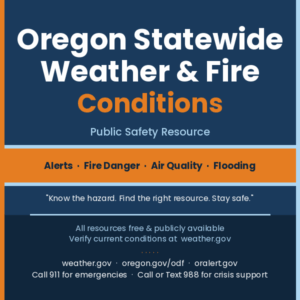
OREGON STATEWIDE WEATHER & FIRE CONDITIONS
Public Safety Resource · Weather Alerts · Fire Danger · Air Quality · Flooding
“Know the hazard. Find the right resource. Stay safe.”
All resources listed are free and publicly available · Verify current conditions directly with official sources below
CALL 911
For anyone experiencing an active wildfire, flooding, or immediate threat to life or property
CALL OR TEXT 988
For anyone in emotional distress or mental health crisis related to a disaster or evacuation · Free · Confidential · 24/7
YOUR FIRST THREE STEPS WHEN A HAZARD IS POSSIBLE
1 · Check NWS Active Alerts for Oregon NWS Oregon Active Alerts
Every active watch, warning, and advisory in Oregon — in one place. Check here first whenever you hear about a hazard in your area.
2 · Check Your Fire Danger Level and Burn Restrictions ODF Fire Restrictions Interactive Map
Tap your location on the interactive map to see your local fire danger level and whether any burn restrictions apply. Works on mobile. Check before any outdoor burning — any time of year.
3 · Sign Up for County Emergency Alerts Oregon Emergency Alert Registration
Register your phone and home address so wildfire, flood, and evacuation alerts reach you directly — without having to check anything. Takes less than two minutes.
NWS ALERT TYPE DEFINITIONS
When a hazard is issued for your area, it will carry one of these labels. Knowing what each term means tells you how urgently to act.
🔴 WARNING
Hazardous conditions are occurring or imminent. Take protective action NOW — do not wait.
🟡 WATCH
Conditions are favorable for a hazard to develop. Prepare now and monitor updates closely.
🟠 ADVISORY
Conditions will be hazardous but below warning thresholds. Use extra caution outdoors.
🔵 SPECIAL WEATHER STATEMENT
Noteworthy conditions that require public awareness but do not meet warning or advisory thresholds. Stay aware and check for updates.
🏖 BEACH HAZARDS STATEMENT
Dangerous ocean or beach conditions — sneaker waves, rip currents, or extreme surf. Stay well back from the water’s edge regardless of how calm the ocean looks.
🔥 RED FLAG WARNING
Critical fire weather: low humidity + high winds + dry fuels = extreme fire danger. No outdoor burning of any kind. Avoid all spark-producing activity.
🌊 SMALL CRAFT ADVISORY
Hazardous conditions for small vessels. Inexperienced mariners should stay off coastal and Columbia River Bar waters until the advisory expires.
💧 FLOOD WATCH
Flooding is possible. Prepare now — know your evacuation route and monitor river gauge levels.
💧 FLOOD WARNING
Flooding is occurring or imminent. Move to higher ground now. Turn Around, Don’t Drown — never drive through a flooded road.
FIRE DANGER LEVELS — WHAT THEY MEAN
The Oregon Department of Forestry uses a five-level fire danger scale. Your local level determines which activities may be restricted on public and private forestlands. Danger levels can vary significantly over short distances — always check your specific location on the ODF map before any outdoor burning or spark-producing activity.
-
LOW
Fires are unlikely to start or spread rapidly. Normal outdoor caution applies.
-
MODERATE
Fires can start and spread under dry or windy conditions. Use caution near any ignition source outdoors.
-
HIGH
Fires start easily and spread quickly. Check ODF burn restrictions before any outdoor burning. Debris fires must be fully extinguished — never left to smolder.
-
VERY HIGH
Fires start very easily from almost any spark. Outdoor burning is typically prohibited. Check ODF restrictions for your specific location before any outdoor activity.
-
EXTREME
Maximum fire danger. Any fire can quickly become uncontrollable. All outdoor burning prohibited. Avoid all spark-producing activity entirely.
Check your current fire danger level and burn restrictions: ODF Fire Restrictions Interactive Map
OREGON SEASONAL HAZARD GUIDE
Oregon faces different hazards throughout the year. Use this guide to know what to watch for in any given season and which resources to check most closely.
❄ WINTER — December through February
Ice storms and freezing rain in the Willamette Valley · Heavy snow in the Cascades and eastern Oregon · Coastal wind events and large surf · Sneaker waves year-round · River flooding from rain-on-snow events
🌱 SPRING — March through May
Early Red Flag fire weather as fuels dry before green-up · Snowmelt flooding along Cascade-fed rivers · Prescribed burn smoke · High surf and sneaker waves on the coast
🔥 SUMMER — June through September
Wildfire season peaks statewide · Red Flag Warnings common in south-central and eastern Oregon · Smoke events affecting air quality across the state · Extreme heat in the Willamette Valley and eastern Oregon · Lightning-caused fires in the mountains
🍂 FALL — October through November
Wildfires may remain active into October · Coastal wind events return · Early ice and snow in the mountains · Transition back to rainy-season flooding risk · First major wind events of the season
REGIONAL HAZARD CONTEXT
Western Oregon & Portland Metro
Willamette Valley weather is generally mild but can shift quickly. Watch for winter ice storms and wind events that cause widespread power outages, summer heat waves, and river flooding during rain-on-snow events in the mountains. The Columbia River Gorge is a natural wind corridor — conditions there can be dramatically different from surrounding areas.
Oregon Coast
Sneaker waves are the leading cause of ocean drowning deaths on the Oregon coast and occur year-round — including on days when the surf appears completely calm. Stay well back from the water’s edge. Never turn your back on the ocean. Stay off rocks, jetties, and logs at the surf line at all times. Watch for NWS Beach Hazards Statements before any coastal visit. The Columbia River Bar is one of the most hazardous river mouths in North America — always check bar conditions with the U.S. Coast Guard before any crossing attempt.
South-Central Oregon — Lake, Klamath & Harney Counties
This region is among Oregon’s most fire-prone. Red Flag Warnings are common in spring and summer when low humidity, high winds, and dry grass create extreme ignition conditions. The pre-green-up period in late winter and early spring — before new vegetation replaces last year’s dead grass — is particularly dangerous. Even a small spark can start a fast-moving fire. Always check ODF restrictions before any outdoor burning or use of spark-producing equipment.
Central Oregon — Bend, Redmond, Prineville, Madras
Central Oregon’s dry high-desert climate means fire risk arrives early and persists late into the season. Prescribed burns on the Deschutes and Ochoco national forests and the Crooked River National Grassland can produce smoke affecting communities along the Highway 26 and Highway 97 corridors. Check air quality at oregon.gov/deq before extended outdoor activity whenever smoke is visible.
Eastern Oregon
Eastern Oregon faces both wildfire risk and flash flood potential. Summer thunderstorms over the Blue Mountains and Wallowas can produce lightning-caused fires and rapid runoff into steep canyon drainages. Rivers fed by east-slope snowpack — including the John Day, Malheur, Owyhee, and Deschutes — can rise quickly during spring snowmelt events. Check river gauges at water.noaa.gov before recreating near any waterway.
Southern Oregon — Rogue Valley, Medford, Ashland, Grants Pass
Southern Oregon sits in a fire-prone interface zone where forested mountains meet populated valleys. Fire season can begin as early as June and extend into October. Smoke from both Oregon and northern California wildfires regularly affects air quality in late summer. Years with below-average snowpack significantly increase fire risk beginning as early as spring.
WILDFIRE SMOKE & AIR QUALITY GUIDE
Wildfire smoke contains fine particles that penetrate deep into the lungs and cannot be filtered by an ordinary dust mask. Groups at elevated risk include children, older adults, pregnant women, and anyone with heart or lung conditions. Check air quality before any outdoor activity during a smoke event — conditions can change within hours.
Air Quality Index (AQI) — What the Colors Mean
-
GREEN (0–50) — Good
Air quality is satisfactory. Outdoor activity is fine for everyone.
-
YELLOW (51–100) — Moderate
Sensitive groups should consider limiting prolonged outdoor exertion.
-
ORANGE (101–150) — Unhealthy for Sensitive Groups
Children, older adults, and anyone with heart or lung conditions should reduce time outdoors.
-
RED (151–200) — Unhealthy
Everyone should reduce prolonged outdoor exertion. Sensitive groups should remain indoors.
-
PURPLE (201–300) — Very Unhealthy
Avoid all outdoor activity. Keep windows and doors closed.
-
MAROON (301+) — Hazardous
Health emergency conditions. Everyone should stay indoors with windows closed.
Simple indoor air filtration during a smoke event: Tape a MERV-13 furnace filter to the back of a standard box fan. This creates an effective air cleaner at very low cost and is safe to run with windows closed.
Check current air quality: Oregon DEQ Air Quality Index · AirNow.gov · OregonAIR Mobile App
NO CELL SERVICE OR INTERNET? USE NOAA WEATHER RADIO
A NOAA Weather Radio receiver broadcasts continuous NWS alerts, weather forecasts, fire weather warnings, and emergency messages 24 hours a day · 7 days a week on 162.400 – 162.550 MHz. It is the most reliable alert system for rural Oregon when cell coverage or internet is unavailable. A dedicated receiver is required — available at hardware and electronics retailers for under $30. Find the transmitter frequency for your location at weather.gov/nwr.
MONITOR & STAY INFORMED — COMPLETE RESOURCE LIST
All resources below are free and publicly available 24 hours a day · 7 days a week unless otherwise noted.
WEATHER — WATCHES, WARNINGS & FORECASTS
NWS Active Alerts — All of Oregon
Every active NWS watch, warning, and advisory currently in effect anywhere in Oregon — in one place. Check here first.
NWS Portland — Western Oregon
Current alerts and forecasts for the Portland metro, Willamette Valley, northern coast, and Columbia River Gorge.
NWS Medford — Southern Oregon
Alerts and forecasts for the Rogue Valley, Klamath Basin, Crater Lake area, and south-central Oregon.
NWS Pendleton — Eastern & Central Oregon
Alerts and forecasts for eastern Oregon, the Blue Mountains, Cascades east slopes, and the central Oregon high desert.
NOAA Marine Forecast — Oregon Coast
Coastal and offshore forecasts, small craft advisories, and Columbia River Bar conditions.
NOAA Weather Radio Frequency Finder
Find your local 162 MHz NOAA Weather Radio frequency. Continuous 24/7 NWS broadcasts — the most reliable alert system when cell coverage or internet fails.
FIRE DANGER, RESTRICTIONS & ACTIVE WILDFIRES
ODF Fire Danger & Burn Restrictions Map
Interactive map — tap or click your location to see your current fire danger level and active burn restrictions. Works on mobile. Check before any outdoor burning.
Oregon Dept. of Forestry — Fire & Weather
Official ODF fire weather forecasts, statewide danger ratings, and fire news and press releases.
Before You Burn — Debris Burning Check
Check daily whether outdoor debris burning is allowed in your area before lighting anything. Debris burning is the leading cause of human-caused wildfires in Oregon.
BLM Oregon & Washington — Fire Restrictions
Fire restrictions for Bureau of Land Management lands. Note: BLM restrictions may differ from ODF restrictions on adjacent land — check both for your location.
InciWeb — Active Oregon Wildfires
Active wildfire locations, acreage, containment status, road closures, and evacuation orders across Oregon.
Northwest Interagency Coordination Center
Regional fire situation reports and preparedness levels for Oregon and Washington.
AIR QUALITY & WILDFIRE SMOKE
Oregon DEQ — Air Quality Index
Real-time statewide air quality readings. Check before outdoor activity during any smoke event — especially for children, older adults, and anyone with heart or lung conditions.
AirNow.gov — Federal Air Quality
Current and forecast AQI by location. Includes smoke forecasts during wildfire events. Available 24 hours a day · 7 days a week.
OregonAIR Mobile App
Free mobile app for real-time Oregon air quality readings and alerts. Available for iOS and Android.
FLOODING & RIVER LEVELS
NOAA River Levels & Flood Monitoring
Live river gauge readings, flood stage forecasts, and inundation maps for rivers across Oregon. Enter any river name or city. Available 24 hours a day · 7 days a week.
EMERGENCY ALERTS & PREPAREDNESS
Oregon Emergency Alerts — Sign Up
Register your phone and address to receive county emergency alerts for wildfires, floods, and evacuations directly — without having to seek them out.
Oregon Office of Emergency Management
Statewide emergency preparedness resources, disaster declarations, and guidance for individuals, families, and communities.
Oregon Emergency Management — Make a Plan
Step-by-step guidance for building a household emergency plan, go-bag, and communication strategy before a disaster strikes.
KEY PHONE NUMBERS
Save these numbers before a disaster occurs. Cell networks may be congested during an active emergency.
Life-Safety Emergency
CALL: 911
For anyone experiencing or witnessing an active wildfire, flooding, structure fire, or any immediate threat to life or property.
Mental Health Crisis Line
CALL OR TEXT: 988
For anyone in emotional distress or mental health crisis related to a disaster or evacuation. Free · Confidential · Available 24 hours a day · 7 days a week.
Oregon Emergency Management — Duty Officer
CALL: 1-503-378-2911
For local emergency managers and public officials requesting state assistance during an active emergency or declared disaster.
NWS Portland — Western Oregon Recorded Forecast
CALL: 503-261-9246
For anyone in the Portland metro, Willamette Valley, or northern coast. Recorded forecast updated several times daily.
NWS Medford — Southern Oregon
CALL: 541-773-1067
For anyone in southern Oregon or the Rogue Valley seeking a current recorded forecast.
NWS Pendleton — Eastern & Central Oregon
CALL: 541-276-4493
For anyone in eastern or central Oregon seeking a current recorded forecast.
Central Oregon Fire Information Line
CALL: 1-800-523-4737
For anyone in central Oregon seeking current fire danger levels, active burn restrictions, or incident information.
NOAA Weather Radio
162.400 – 162.550 MHz (receiver required)
For anyone in a rural area without reliable cell or internet coverage. A dedicated weather radio receiver is required — available at hardware and electronics retailers. Find your local frequency at weather.gov/nwr. Available 24 hours a day · 7 days a week.
PREPAREDNESS ACTIONS YOU CAN TAKE NOW
Sign Up for Emergency Alerts
Register at Oregon Emergency Alert Registration — oralert.gov to receive county alerts for wildfires, floods, and evacuations directly on your phone. Also enable Wireless Emergency Alerts in your phone’s notification settings — these require no registration and can reach you even without data service.
Know Your Evacuation Route
Identify at least two ways out of your neighborhood before a disaster occurs. One route may be blocked by fire or floodwater. Know where you would go and how you would reach family members if you are separated. In a fast-moving wildfire, there may be very little warning time — have your plan ready now.
Build a Go-Bag
Keep a ready bag near your door or in your vehicle during fire season. Include: prescription medications and medical supplies · copies of important documents · phone charger and backup battery · water and food for three days · cash · a change of clothing · N95 masks for smoke protection. A go-bag prepared in advance saves critical time during an emergency evacuation.
For Outdoor Burns — Check Before You Light
Debris burning is the leading cause of human-caused wildfires in Oregon — and any escaped fire can result in full liability for suppression costs, which can reach millions of dollars. Before any outdoor burn, check BeforeYouBurn.com and the ODF Fire Restrictions Map. When in doubt, do not burn.
Turn Around, Don’t Drown
Never drive through a flooded road — even if it looks passable. Just six inches of moving water can knock a person off their feet. Two feet of water can carry away most vehicles. If a road ahead is flooded, turn around and find another route. Most flood-related deaths in Oregon occur in vehicles.
Check on Neighbors
Older adults, people with disabilities, and those who live alone may not receive alerts or may need help evacuating. Check on neighbors before a known hazard arrives in your area.
DISCLAIMER: Information is shared solely as a public courtesy. All resources listed are publicly available through official government agencies. This document is not a product of, nor endorsed by, the National Weather Service, Oregon Department of Forestry, Oregon Emergency Management, or any other agency listed. Content is subject to change — always verify current conditions directly with official sources before making any decisions. This is not a substitute for official emergency broadcasts, professional weather services, or instructions from local emergency management authorities. If a person is in immediate danger, call 911. For mental health emergencies, call or text 988 (Suicide & Crisis Lifeline) — free · confidential · available 24 hours a day · 7 days a week. All services listed are free and publicly available.

READ THIS FIRST — FLOOD EMERGENCY CHECK
If you are in immediate danger, call 911.
If you need shelter, sandbags, cleanup help, or local instructions, call Oregon 211 (211 or 866-698-6155).
If toilets, sinks, or floor drains are backing up, stop using all water and shut off household water.
If water is touching outlets, cords, or appliances, shut off electricity (only if safe).
FOOD PREPARATION AND RESOURCES
RIGHT NOW (0–15 minutes)
Move to higher ground.
Avoid flooded roads and bridges. Cars may stall if water enters the muffler.
Stop using water if drains or toilets back up.
Shut off electricity if water is approaching outlets (only if safe).
Call 911 if anyone is in danger.
NEXT 1–3 HOURS
Prepare to evacuate if advised.
Set sandbags or barriers.
Charge phones and backup batteries.
TODAY / TONIGHT
Monitor NWS (National Weather Service) Portland updates at this link: https://www.weather.gov/pqr/
Avoid unnecessary travel.
Keep plumbing use minimal.
Critical Shutoffs & Life Safety
DISCLAIMER: Information is provided solely as a courtesy without warranty or guarantee of any kind whatsoever. You aee hereby notified and advised to seek counsel from qualified professionals at your own risk and expense. WARNING / CAUTION / DANGER ALERT: There could be life and death risks, harms, dangers, penalties, fines or other consequences for shutting off utilities and/or other activities..
When and Why to Shut Off Household Water
Shut off household water if floodwater enters the home, sewer backups occur, pipes burst, or evacuation is likely.
When and Why to Shut Off Electrical Service
Shut off electricity if water enters living areas or approaches the electrical panel.
Natural Gas Shutoff (Only When Necessary)
Shut off gas only if you smell gas or floodwater reaches gas equipment.
Protecting the Home From Flood Water
Use sandbags and plastic sheeting (e.g. tarps) at doors, garages, and crawlspaces.
Seal foundation cracks and cover basement window wells.
Protect drains with backflow prevention and test sump pumps.
Sewer, Sink, Toilet & Drain Backups
Stop using all plumbing immediately.
Shut off household water and electricity if safe.
Treat all backup water as contaminated.
Call Oregon 211 for cleanup help.
Preparation Before Flood Season
Label utility shutoffs.
Maintain gutters, drains, and sump pumps.
Prepare emergency kits and evacuation plans.
Flood Insurance (Ready.gov / FEMA Guidance)
Standard homeowners and renters insurance does not cover flooding.
Consider flood insurance through the National Flood Insurance Program.
FloodSmart / NFIP: https://www.floodsmart.gov
Ready.gov Flood Guidance: https://www.ready.gov/floods
After the Flood
Avoid standing water and downed wires.
Document damage before cleanup.
Have utilities inspected before restoring service.
Federal Disaster Resources & Support
Emotional and mental health support during disasters.
SAMHSA Disaster Distress Helpline: 1-800-985-5990 or text TalkWithUs to 66746
Link: https://www.samhsa.gov/find-help/helplines/disaster-distress-helpline
FEMA Disaster Assistance — apply for housing, repairs, and recovery aid.
Phone: 800-621-3362
Link: https://www.disasterassistance.gov
Ready.gov Floods — preparedness, response, and recovery guidance.
Link: https://www.ready.gov/floods
FloodSmart / NFIP — flood insurance education and risk awareness.
Link: https://www.floodsmart.gov
EPA (Environmental Protection Agency) – Flood Cleanup & Air Safety Information
Link: https://www.epa.gov/indoor-air-quality-iaq/resources-flood-cleanup-and-indoor-air-quality
Other Information
State of Oregon Flood Hazard Prep Information:
Link: https://www.oregon.gov/oem/hazardsprep/pages/floods.aspx
IHS Additional Flood Cleanup Information
Link: https://www.ihs.gov/california/index.cfm/offices/oehe/dehs/emergency-management/flood/

Oregon Food and Food Resources List
Section 1 – Immediate Food Access — “Food Today”
Important Notice: Temporary SNAP Benefit Disruption
Because of the ongoing federal government shutdown, Oregon SNAP (food) benefits are temporarily unavailable until federal funding resumes.
This list is offered to help individuals and families find alternate food resources during the shutdown period.
(Official source: Oregon Department of Human Services — SNAP Updates, last viewed Oct 27 2025: https://www.oregon.gov/odhs/news/pages/snap-updates.aspx)
“The federal government shutdown is affecting funding for the Supplemental Nutrition Assistance Program (SNAP). If the shutdown continues into November, SNAP benefits will not be issued in Oregon until federal funding resumes.”
ODHS Free Food Events (Statewide)
The Oregon Department of Human Services hosts free food-distribution events across the state.
Everyone is welcome — you do not need to bring identification or be receiving ODHS benefits.
Please bring your own bags or boxes to carry food or other items.
Website: https://www.oregon.gov/odhs/food/Pages/default.aspx
Oregon Food Bank (Statewide Network)
Provides free groceries through regional warehouses and more than 1,400 partner agencies statewide. Open to everyone — no ID or proof of income required.
Website: www.oregonfoodbank.org | (503) 282-0555
Address: 7900 NE 33rd Dr, Portland OR 97211
211info (Statewide Hotline & Online Map)
Free 24-hour hotline and website listing all food pantries, meal sites, delivery programs, and shelters. Multilingual and text support available.
Website: www.211info.org | Phone: 211 (text ZIP code to 898211)
Marion-Polk Food Share (Regional Hub)
Supplies groceries to food pantries in Marion and Polk Counties and runs senior meal and garden programs.
Website: www.marionpolkfoodshare.org | (503) 581-3855
Address: 1660 Industrial St SE, Salem OR 97302
ACCESS Food Share (Southern Oregon)
Regional food distribution for Jackson County, offering groceries and nutrition classes.
Website: www.accesshelps.org | (541) 779-6691
Linn-Benton Food Share (Willamette Valley)
Coordinates emergency food distribution for Linn and Benton Counties.
Website: www.communityservices.us | (541) 928-6335
Tillamook Food Pantries Coalition (Coastal Region)
Network of community pantries providing coastal food access, including fresh local catch when available.
Website: tillamookcountyresources.org | (503) 842-3154
Mid-Columbia Community Action Council (Gorge Region)
Operates pantries, mobile distribution, and farm-to-table partnerships in The Dalles and Hood River.
Website: mccac.com | (541) 298-5131
Lincoln County Food Share (Central Coast)
Provides food distribution and meal programs through partner sites.
Website: www.foodsharelincolncounty.org | (541) 265-8578
Community Meal Sites and Soup Kitchens (Statewide)
Free hot meals served daily or weekly at churches, shelters, and nonprofits.
Website: www.211info.org | Phone: 211
Faith-Based and Cultural Food Programs
Churches, mosques, temples, and community centers host free pantries and meals, many in partnership with Oregon Food Bank.
OSU Seed to Supper Program
A beginner-friendly gardening and food-budget education program that helps participants grow fresh produce and stretch food dollars. Offered through Oregon State University Extension Service and local partners.
Website: https://extension.oregonstate.edu/seed-supper
More Resources: map.oregonfoodbank.org | 211info.org/food | feedingamerica.org/find-your-local-foodbank
Section 2 – Home-Delivered Meals and Targeted Nutrition Help
Meals on Wheels People — www.mowp.org | (503) 736-6325
Lasagna Love — www.lasagnalove.org
Oregon WIC (Women, Infants & Children) — wic.oregon.gov | 1-800-723-3638
Senior Farmers Market Nutrition Program (SFMNP) — oregon.gov/oda | (503) 986-4550
USDA Commodity Supplemental Food Program (CSFP) — oregonfoodbank.org | (503) 282-0555
Tribal and Indigenous Food Programs
CTUIR FDPIR – ctuir.org/fdpir | (541) 276-3165
Grand Ronde Food Bank – grandronde.org | (503) 879-3663
Klamath Tribes Wellness Center – klamathtribes.org | (541) 882-1487
Immigrant and Refugee Organizations
IRCO – irco.org | (503) 234-1541
APANO – apano.org | (971) 340-4861
Latino Network – latnet.org | (503) 283-6881
Veterans’ Meal Delivery and Grocery Support
ODVA – oregon.gov/odva | (800) 692-9666
Meals for Mothers and Infants
County health departments and hospitals provide nutrition support, meal kits, infant formula, and breastfeeding guidance through WIC.
In Central Oregon, Deschutes County Health Services offers WIC nutrition support and postpartum resources. Call (541) 322-7435 or visit deschutes.org/health
Faith-Based Delivery Ministries
In the Portland region, Catholic Charities of Oregon coordinates meal delivery and food-security programs for low-income families, refugees, and seniors. (503) 231-4866 | catholiccharitiesoregon.org
More Resources: mowp.org/locations | oregon.gov/tribes | wic.benefits.gov
Section 3 – Financial and Emergency Assistance
ODHS – oregon.gov/dhs | (503) 945-5600
OHA – oregon.gov/oha | (503) 947-2340
OHCS – oregon.gov/ohcs | (503) 986-2000
Community Action Agencies – capeco-works.org
United Way of Oregon – unitedway-pdx.org | (503) 228-9131
St. Vincent de Paul of Oregon – svdp.us | (541) 687-5820
Salvation Army Cascade Division – portland.salvationarmy.org | (503) 239-1221
Mutual-Aid and Grassroots Funds
The Portland Mutual Aid Network organizes weekly food and survival-supply distributions for unhoused residents and low-income households. Instagram @portlandmutualaid
Energy and Water Bill Support: oregon.gov/ohcs/energy-assistance
American Red Cross – Oregon Region: redcross.org/local/oregon | 1-800-733-2767
More Resources: 211info.org/emergency | capeco-works.org | unitedway-pdx.org
Section 4 – Community Food Production and Education
OSU Extension Service – extension.oregonstate.edu
Oregon Tilth – tilth.org
Zenger Farm – zengerfarm.org
Oregon Food Bank Learning Gardens – oregonfoodbank.org
Marion-Polk Food Share Community Gardens – marionpolkfoodshare.org
Growing Gardens – growing-gardens.org
PNW CSA Coalition – pnwcsa.org
Urban Gleaners – urbangleaners.org
Seed Libraries – multcolib.org
Cooking Matters Oregon – cookingmatters.org
More Resources: extension.oregonstate.edu/find-us | pnwcsa.org
Section 5 – Pet and Companion Animal Food Support
Oregon Humane Society – oregonhumane.org | (503) 285-7722
FIDO Pet Food Bank – fidoanimeals.org | (503) 655-4666
Humane Society of Central Oregon – hsco.org | (541) 382-3537
Greenhill Humane Society – green-hill.org
Humane Society of the Ochocos – humanesocietyochocos.org
Josephine County Animal Shelter – jocosheriff.org/animalcontrol
SafeHaven Humane Society – safehavenhumane.org
Animal Aid Inc. – animalaidpdx.org
Senior Pet Assistance Network (SPOT) – spotoregon.org
Meals on Wheels AniMeals Program – mowp.org
More Resources: oregonhumane.org/programs | fidoanimeals.org | mowp.org/programs
Section 6 – Donating and Giving Back — “Help Feed Oregon”
Oregon Food Bank – oregonfoodbank.org
Feeding America – feedingamerica.org
211info Volunteer Listings – 211info.org/givehelp
Community Action Agencies & Faith Partners – capeco-works.org/about.html
Portland Rescue Mission – portlandrescuemission.org
Blanchet House of Hospitality – blanchethouse.org
St. Vincent de Paul of Lane County – svdp.us
Marion-Polk Food Share – marionpolkfoodshare.org
Urban Gleaners – urbangleaners.org
Restaurant Pay-It-Forward Programs – oregonpublichouse.com
Food-Date Guidance for Donors
“Best By,” “Sell By,” and “Use By” dates refer to quality, not safety. Donate canned or boxed foods if sealed and intact.
• Oregon Food Bank Shelf Life Guide (PDF): https://www.oregonfoodbank.org/wp-content/uploads/2023/07/OFB-Shelf-Life-Guide.pdf
• OFB Food Safety Manual (PDF): [https://www.oregonfoodbank.org/wp-content/uploads/2023/07/OFB-Food-Safety-Manual.pdf](https://www.oregonfoodbank.org/wp-content/uploads
/2023/07/OFB-Food-Safety-Manual.pdf)
• USDA “Food Product Dating” Resource: https://www.fsis.usda.gov/food-safety/safe-food-handling-and-preparation/food-product-dating
DISCLAIMER:
Information is provided solely as a courtesy, without warranty or guarantee of any kind whatsoever.
NOTE: Program details, hours, and eligibility can change at any time. Always confirm directly with each organization before visiting or donating. Listing here does not imply endorsement, partnership, or guarantee of service availability.

Oregon Tenant Information & Resources: Free Legal Help, Hotlines, and Renters’ Rights
Renters across Oregon facing an eviction notice, needed repairs, a rent increase, or housing discrimination can reach free, noncommercial help from legal aid programs, tenant associations, and public agencies.
Community Alliance of Tenants, Disability Rights Oregon, Fair Housing Council of Oregon, Legal Aid Services of Oregon, Manufactured Housing/Oregon State Tenants Association, Oregon Law Center, Oregon Renter’s Rights, Portland Tenants United, and the Springfield Eugene Tenant Association offer renters’ rights hotlines, free eviction defense, fair housing complaint support, recorded fair housing trainings, self-help guidebooks, and tenant organizing, alongside state, court, federal, and City of Portland resources for rental assistance, habitability, mediation, and the 2027 rent increase cap.
Community Alliance of Tenants
Community Alliance of Tenants is a statewide renters’ rights nonprofit, founded in 1996, that runs a Renters’ Rights Hotline and offers tenant education through workshops and handouts.
Programs & Services
Renters’ Rights Hotline
Hotline specialists answer renters’ questions about fair housing protections, evictions, terminations, repairs, security deposits, and rent increase limits; the line does not serve landlords. Callers dial (503) 288-0130 and leave a message, and a specialist calls back. Intake and callbacks run Monday, Wednesday, Friday, and Saturday from 1:00 p.m. to 5:00 p.m., and Tuesday from 5:00 p.m. to 8:00 p.m., Pacific time.
Eligibility: Open to Oregon renters, with priority given to renters in Southern and Central Oregon, the Mid-Valley, and the Portland Tri-County area; renters in other regions can become members for prioritized help.
Access: https://www.oregoncat.org
Resources & Links
Know Your Rights
Tenant rights information and handouts from the Community Alliance of Tenants.
Access: https://www.oregoncat.org/know-your-rights
Disability Rights Oregon
Disability Rights Oregon is the state’s Protection and Advocacy System, helping people who have a disability-related legal issue in Oregon, including housing concerns.
Programs & Services
Disability-Related Legal Help
Oregonians with a disability-related legal issue can apply online or call 503-243-2081 or 1-800-452-1694, Monday through Friday, 9:00 a.m. to 11:00 a.m. and 1:00 p.m. to 4:00 p.m. Pacific time. Services are provided by appointment only.
Access: https://www.droregon.org
Resources & Links
Fair Housing Handbook: Reasonable Accommodations & Modifications
A guide to requesting disability-related accommodations and modifications in rental housing, including assistance animals and accessible parking.
Fair Housing Council of Oregon
The Fair Housing Council of Oregon evaluates potential violations of the federal Fair Housing Act and related state and local laws. It is not a law office, and it refers general landlord-tenant questions to legal aid and current eviction cases to the Eviction Defense Project.
Programs & Services
Report Housing Discrimination
Renters who believe they were treated differently because of a protected status, such as race, national origin, religion, sex, familial status, disability, marital status, domestic violence survivorship, sexual orientation, gender expression, or source of income, can submit an online report to fair housing enforcement staff. Questions go to the intake line at (503) 223-8197, ext. 2, or 1-800-424-3247, ext. 2, on Thursdays from 9:00 a.m. to noon Pacific time.
Access: https://fhco.org/report-housing-discrimination/
On-Demand Resources
Fair Housing and Assistance Animals
Type: Recorded Webinar
Covers disability under the Fair Housing Act, who can have an assistance animal, which kinds of animals qualify, and how to request one.
Access: https://fhco.org/online-courses/
Fair Housing and the Intersection with Tribal Law
Type: Recorded Webinar
Duration: 1 hour, 56 minutes
Covers fair housing protected classes and how the law applies, Oregon tribal history, the unique challenges and benefits for Native American tribes, and tribal funding for housing. A Spanish recording and an English recording with ASL are also listed on FHCO’s Pre-Recorded Courses page.
Access: https://vimeo.com/1121343370
Fair Housing Discrimination in Oregon
Type: Recorded Webinar
Duration: 2 hours
Explores how Oregon’s history of displacement, segregation, and harassment shapes housing inequity today, and the current policies and practices working to address it.
Access: https://vimeo.com/1096404314
Fair Housing for Aging Populations
Type: Recorded Webinar
Duration: 54 minutes
Covers fair housing basics, the crisis of livability, and the laws that protect people with disabilities. This link opens the ASL recording; English and Spanish recordings are also listed on FHCO’s Pre-Recorded Courses page.
Access: https://vimeo.com/1010019872
Fair Housing for Immigrants and Refugees
Type: Recorded Webinar
Duration: 1 hour, 46 minutes
Covers the history of housing discrimination, the protected class of national origin, and harassment in rental housing. Spanish and ASL recordings are also listed on FHCO’s Pre-Recorded Courses page.
Access: https://vimeo.com/1079607960
Fair Housing for LGBTQIA+ Folx
Type: Recorded Webinar
Duration: 1 hour, 30 minutes
Covers fair housing basics, the protected classes of sexual orientation, gender identity, and disability, and harassment in rental housing.
Access: https://vimeo.com/1091076184
Fair Housing for Renters with Disabilities
Type: Recorded Webinar
Duration: 1 hour, 23 minutes
Covers red flags of discrimination, housing rights for people with disabilities with a focus on intellectual and developmental disabilities, and protections against hate and harassment.
Access: https://vimeo.com/1082742337
Moving Forward with a Past
Type: Recorded Webinar
Duration: 2 hours, 2 minutes
Covers fair housing basics, disability accommodations, disparate impact involving domestic violence, national origin, and criminal history, and advocating for people whose criminal history is a barrier to housing. Spanish and ASL recordings are also listed on FHCO’s Pre-Recorded Courses page.
Access: https://vimeo.com/1026265341
Legal Aid Services of Oregon
Legal Aid Services of Oregon provides free civil legal help to low-income communities across Oregon, including tenants living in substandard housing.
Programs & Services
Find a Legal Aid Office
Renters with a landlord-tenant problem can use this map to find their regional office, along with the counties served by other legal aid organizations. The Portland Regional Office can be reached at (503) 224-4086.
Eligibility: Low-income Oregonians.
Access: https://lasoregon.org/igmap/locations/
Manufactured Housing/Oregon State Tenants Association
Manufactured Housing/Oregon State Tenants Association is a statewide organization of Oregon residents who own manufactured or floating homes and rent the space beneath them, advocating for residents’ rights in parks and marinas.
Programs & Services
Membership and Resident Advocacy
Park and marina residents can join the association and find information on landlord responsibilities, evictions, disability rights, and legal help. Call 541-508-0404 for membership information. The association’s new website is in preview, so some pages lead to a contact form for now.
Access: https://oregontenants.com/
Oregon Law Center
Oregon Law Center provides free legal help to Oregonians with low incomes on matters involving their homes, livelihoods, medical care, and safety from domestic violence.
Programs & Services
Eviction Defense Project
A joint project of Legal Aid Services of Oregon, Oregon Law Center, and the Center for Non-Profit Legal Services, the Eviction Defense Project offers free legal help to low-income tenants in every Oregon county who have an eviction court case. Tenants should call 888-585-9638, email [email protected], or use the online form before their first court appearance, with their court case number and hearing date ready. Help is available regardless of immigration status, and receiving it carries no immigration consequence.
Eligibility: Low-income tenants with an active eviction court case; in Multnomah County, help may be available after a termination notice and before a case is filed. Tenants outside Multnomah County without court papers can contact their local legal aid office, and renters seeking rent assistance only should contact 211.
Access: https://oregonlawcenter.org/eviction-defense-project/
Oregon Renter’s Rights
Oregon Renter’s Rights is a resource hub for Oregon tenants offering self-help guidebooks, sample letters, and legal resources in English, Spanish, and several other languages; the guides are not a substitute for legal advice.
Resources & Links
Guías de Vivienda en Español
Housing guides, legal resources, and a rent increase calculator in Spanish.
Access: https://www.oregonrentersrights.org/espanol
Housing Self-Help Handbooks
Guidebooks on applications and fees, repairs and safety, discrimination protections, rent increases and relocation, termination and eviction notices, and court processes.
Access: https://www.oregonrentersrights.org/handbooks
Rent Increase Calculator
A tool for checking whether a rent increase notice is valid under Oregon law.
Access: https://www.oregonrentersrights.org/rent-calculator
Portland Tenants United
Portland Tenants United is an all-volunteer tenant union that organizes renters in the Portland metro area to challenge harmful housing policies and practices and to press for housing stability, security, and dignity. PTU cannot give legal advice or help pay rent.
Programs & Services
Join the Union
Tenants can become members of PTU and get support organizing their building into a tenant association.
Access: https://www.pdxtu.org/join_the_union
Resources & Links
Contact and Resources
A curated list of Portland-area help for evictions, repairs and inspectors, mediation, security deposits, rent assistance, free or low-cost legal help, and other local tenant unions.
Access: https://www.pdxtu.org/resources
Springfield Eugene Tenant Association
The Springfield Eugene Tenant Association is a 501(c)(3) nonprofit dedicated to renters’ rights, assisting, educating, and empowering tenants in Lane County and beyond.
Programs & Services
SETA Tenant Hotline
Renters can call 541-972-3715 and leave a voicemail at any time with a brief overview of their issue; staff research each question before returning the call, which can take up to 24 hours. Callers who have received an urgent notice should mention it so their call is prioritized. Help in Spanish is available.
Access: https://www.springfieldeugenetenantassociation.com/hotline
Resources & Links
Renters’ Rights Guides
Guides on finding a rental, moving in and security deposits, habitability and repairs, evictions and terminations, and discrimination and retaliation.
Access: https://www.springfieldeugenetenantassociation.com/renters_rights
General & Cross-Cutting Resources
Directories & Hubs
211info — https://www.211info.org · Dial 211 or 866-698-6155, or text a ZIP code to 898211, for rental assistance and other housing help; core phone hours are Monday through Friday, 8:00 a.m. to 6:00 p.m. Pacific time, and interpreters are available.
Oregon Law Help — https://oregonlawhelp.org · Free legal information on rental housing, repairs, deposits, illegal discrimination, and protections for survivors of domestic violence, sexual assault, or stalking. Find a local legal aid office: https://oregonlawhelp.org/resource/oregon-legal-aid-offices
State of Oregon Resources
Oregon Housing and Community Services, Landlord & Tenant Resources — https://www.oregon.gov/ohcs/housing-assistance/pages/landlord-tenant-resources.aspx · A referral hub for rental assistance, legal help, fair housing, manufactured home park resources, and mediation.
Oregon Housing and Community Services, Need Housing Help Now? — https://www.oregon.gov/ohcs/pages/housing-resources.aspx · Rental assistance, eviction-related help, and utility bill assistance through local Community Action Agencies.
Oregon Housing and Community Services, Housing Health & Safety — https://www.oregon.gov/ohcs/housing-assistance/pages/housing-health-safety.aspx · Explains Oregon’s habitability standards for rental housing; residents of project-based Section 8 housing can call the Oregon Health and Safety Hotline at 1-800-453-5511, option 4, Monday through Friday, 8:00 a.m. to 5:00 p.m. Pacific time.
Manufactured & Marina Communities Resource Center — https://www.oregon.gov/ohcs/mmcrc/pages/index.aspx · Information and training for tenants and landlords in manufactured home parks and marinas, with dispute resolution and mediation; hotline 1-800-453-5511, option 2.
Oregon Judicial Department, Landlord-Tenant Self-Help — https://www.courts.oregon.gov/help/pages/landlord-tenant.aspx · Tenant instructions for the eviction process and statewide court forms accepted in all circuit courts, including interactive iForms for some filings.
Oregon Bureau of Labor and Industries, Fair Housing — https://www.oregon.gov/boli/civil-rights/pages/fair-housing.aspx · Takes and investigates housing discrimination complaints; for questions, call 971-245-3844.
Oregon Department of Administrative Services, Rent Stabilization — https://www.oregon.gov/das/oea/pages/rent-stabilization.aspx · The maximum allowable rent increase for calendar year 2027 is 10%, up from 9.5% in 2026; manufactured dwelling and marina facilities with more than 30 spaces are capped at 6%. Questions about the cap go to Oregon Housing and Community Services.
Federal Resources
U.S. Department of Housing and Urban Development, Oregon — https://www.hud.gov/states/oregon · Links to the HUD Resource Locator for affordable housing, HUD-approved housing counselors at (800) 569-4287, and energy assistance for renters.
HUD Multifamily Housing Complaint Line — https://www.hud.gov/contactus/multifamily-housing-complaint · Residents of HUD-insured and HUD-assisted properties can report poor maintenance, health and safety dangers, mismanagement, or fraud at 1-800-685-8470, with specialists who speak English and Spanish.
HUD, Report Housing Discrimination — https://www.hud.gov/contactus/file-complaint · File a fair housing complaint online or call 1-800-669-9777.
City of Portland Resources
Portland Housing Bureau, Eviction Legal Defense Program — https://www.portland.gov/phb/rental-services/eviction-help-renters/eviction-legal-support-tenants · Free legal help for low-income renters (at or below 60% of Area Median Income) within Portland city limits, available as soon as a termination notice arrives; call 888-585-9638 or email [email protected].
Portland Housing Bureau, Resources for Landlords and Tenants — https://www.portland.gov/phb/rental-services/helpdesk/resources · Rental services information for Portland renters, including free landlord-tenant mediation through Resolutions NW.
Disclaimer: This listing is shared for community information only. The offerings are organized and hosted by the listed organizations, not by PeerGalaxy. Details such as dates, times, availability, and access links are subject to change — please confirm with the relevant organization before attending or applying.

Promise Response Hotline
Talk to Us
Whether it happened to you or to someone else, we can all help track sanctuary promise violations.
Everyone has the right to live safely in Oregon. Oregon’s sanctuary laws promise safety, human rights, and dignity for all. If you or someone you know was targeted in violation of Oregon’s Sanctuary Promise laws, please call 1-844-924-STAY/1-844-6-AMPARO or report online at SanctuaryPromise.Oregon.gov or PromesaSantuario.Oregon.gov. On the Oregon Department of Justice’s Sanctuary Promise hotline, you can report a suspected violation, receive support, and be connected to resources. The Oregon Department of Justice may open an investigation into the violation.

Sanctuary Promise Response Hotline
1-844-924-STAY (1-844-924-7829)
Spanish Direct Line: 1-844-626-AMPARO (1-844-626-7276)
Operators are standing by
9am to 5pm Pacific time, Monday – Friday.
Interpreters in over 240 languages.
After hours? Leave a message and we’ll return your call.
We accept all Relay Calls.
Since 1987, Oregon has officially been a sanctuary state that supports immigrant and refugee communities by prioritizing human rights, dignity, and safety.
The Sanctuary Promise Act », signed into law on July 19, 2021, strengthens the existing state sanctuary laws. It restricts the collection and prohibits sharing of information related to a person’s national origin, immigration, or citizenship status. Oregon state and local public resources and personnel, including state and local government offices and law enforcement agencies, are prohibited from being used for immigration enforcement.
If you suspect a violation of Oregon’s sanctuary laws, we want to hear from you. Suspected violations can be reported through this online portal (available in 8 languages by using the language menu in the upper right hand corner of this screen) or the Sanctuary Promise Hotline at 1-844-924-STAY (1-844-924-7829). Call us in any language. We have a direct access Spanish language website at PromesaSantuario.Oregon.gov with a Spanish direct dial hotline at 1-844-6-AMPARO (1-844-626-7276).
To report ICE activity in the community, contact Portland Immigrant Rights Coalition, PIRC » at 1-888-622-1510.
Examples of violations to Oregon Sanctuary Promise Laws include:
- Investigation or interrogation by police for immigration enforcement purposes;
- Most inquiries, storing, or sharing of information about national origin, immigration, or citizenship status by police or state or local government;
- Civil arrest without a judicial warrant/order from a court facility;
- Arrests by federal immigration of a person on their way to or from court or while at court;
- Police collaboration with federal authorities for immigration enforcement purposes;
- Denial of services, benefits, or privileges to a person in jail or on probation/parole based on immigration status;
- Police establishing coordinated traffic stops or traffic perimeters to enforce federal immigration laws; or
- State or local government or police failing to document or report requests from a federal immigration agency relating to immigration enforcement;
Report a Sanctuary Promise Violation
Information About The Victim/Targeted Person
Note: The targeted person’s identity will not be shared publicly by ODOJ, but will be used and shared with the state/local government agency during the course of any investigation ODOJ opens. It will not be shared with federal immigration agencies or otherwise be shared to assist with immigration enforcement. If a specific person was not targeted in the violation, you can simply put “general public” as first and last names.
Use This Link to Report A Violation of the Sanctuary Promise Violation

2026 Wildfire Awareness Month: Emergency Preparedness Campaign
Date/Time: May 1–31, 2026 (Available Throughout May)
Oregon is facing one of the driest wildfire seasons in over a decade with nine counties already under emergency drought declarations. The Oregon Department of Emergency Management urges all residents to get ready now by packing go-bags, knowing evacuation routes, signing up for emergency alerts, and ensuring adequate wildfire insurance.
Pack Your Go-Bag: Essential Wildfire Preparedness
A properly prepared go-bag can make the difference between safe evacuation and dangerous delays. Each household member—including pets and livestock—should have an easy-to-carry emergency bag assembled and ready before wildfire season peaks. OEM provides a comprehensive checklist of essential items from water and food supplies to important documents, medications, first aid, flashlights, and backup power sources.
Cost: FREE
Evacuation Planning: Know Your Routes and Communication Strategy
Effective evacuation planning requires knowing multiple exit routes, establishing a family meeting place, identifying transportation for pets and livestock, and developing a communication strategy for when cell towers may be damaged. OEM recommends creating a PACE plan (Primary, Alternate, Contingency, Emergency) for staying connected, including options like Starlink satellite service, satellite communicators, and hand-crank radios.
Additional Support: Red Cross resources available for individuals with disabilities; Ready.gov/pets provides livestock evacuation guidance; Oregon Department of Agriculture offers specialized resources for farmers and ranchers.
Cost: FREE
Understanding Oregon’s Three-Level Evacuation System
Oregon uses a clear, three-level evacuation alert system: Level 1 (BE READY—Green) means stay aware and prepare; Level 2 (BE SET—Yellow) indicates significant danger and voluntary evacuation is encouraged; Level 3 (GO NOW—Red) means evacuate immediately as extreme danger is present. Understanding these levels and the differences between voluntary and mandatory evacuation orders is critical for family safety.
Format: Online Educational Resource
Cost: FREE
Register for Emergency Alerts and Backup Communication
Sign up with ORAlert.gov to receive location-specific emergency alerts by zip code. Ensure wireless emergency alerts are enabled on your phone and follow local emergency services on social media. Have a backup communication plan in case cell service fails, including contact with loved ones, printed emergency information, and alternative communication methods.
Resources: ORAlert.gov, TripCheck.com, local county emergency management websites
Cost: FREE
Insurance and Recovery Planning: Protect Your Future
Standard renters’ or homeowners’ insurance policies do not cover wildfires, floods, or landslides. Now is the time to verify you have adequate wildfire insurance coverage. Talk with your insurance agent about the right type and amount of coverage. Have a documented recovery plan that identifies what needs to be replaced and how you will recover financially through insurance, savings, loans, and community support.
Cost: FREE planning resources; insurance premiums vary
OEM Wildfire Preparedness Resources
OEM Wildfire Awareness Campaign — https://wildfire.oregon.gov/prepare · Complete evacuation checklists, preparedness guides, and educational resources
Be2WeeksReady Toolkit — https://www.oregon.gov/oem · Comprehensive emergency preparedness planning tools for families
Wildfire Alert Graphics — https://www.oregon.gov/oem · Downloadable evacuation level infographics
Media Contact — Phone: 503-934-3310 · Email: [email protected]
External Emergency Preparedness Resources
Red Cross Disaster Preparedness — https://www.redcross.org · Resources for families, individuals with disabilities, and service animals
Ready.gov Pet Evacuation Planning — https://www.ready.gov/pets · Pet emergency kits and evacuation strategies
Oregon Department of Agriculture Livestock Resources — https://www.oregon.gov/ODA · Livestock evacuation and care resources
Insurance and Financial Recovery Resources
Insurance Institute for Business and Home Safety (IBHS) – Wildfire Ready — https://www.ibhs.org · Home hardening and insurance resources
Oregon Division of Financial Regulation – Wildfire Insurance Resources — https://dfr.oregon.gov · Insurance claim guidance and consumer protections
Crisis Support and Information
988 Suicide & Crisis Lifeline — Call or text 988 · 24/7 crisis support (especially important during evacuations and recovery)
TripCheck Road Conditions — https://www.tripcheck.com or call 511 · Real-time evacuation route information
About the Oregon Department of Emergency Management
The Oregon Department of Emergency Management (OEM) was established in 1981 and became a standalone cabinet-level department in July 2022. OEM leads collaborative statewide efforts with local, tribal, state, and federal partners to ensure Oregonians can access help in emergencies and are protected, prepared, and able to recover from disasters regardless of cause.
OEM’s mission is to protect lives, property, and the environment through prevention, preparedness, mitigation, response, and recovery from all hazards. The agency coordinates with over 50 county, city, and tribal emergency management offices across Oregon, awards grant funding to local governments, and supports 18 Emergency Support Functions. OEM prioritizes an equitable and inclusive culture of preparedness that empowers all Oregonians to thrive during crises.
Director: Erin McMahon. Website: https://www.oregon.gov/oem. Phone: 503-934-3310.

Selected Peer Workforce Training and Continuing Education – Virtual, Fre, Sliding Scale, or with Scholarship Support
Event times are shown in Pacific time.
These trainings resources are for Peer Support Specialists, Peer Wellness Specialists, Family and Youth Support Specialists, support group facilitators, and others in the peer workforce who want to grow their skills and keep their certifications current.
Offerings range from live webinars and facilitator think tanks to multi-session virtual trainings and self-paced courses, all free or offered on a sliding scale, and many of them count toward continuing education hours, including Oregon’s suicide-prevention requirement for Traditional Health Workers.
ACORN
ACORN is an online continuing education provider approved by the Mental Health & Addiction Certification Board of Oregon (MHACBO), offering courses free of charge courtesy of the Oregon Health Authority.
Training & Professional Development
Suicide Prevention: Responding with Care
A self-paced course introducing the 5 Action Steps model, direct conversations about suicidal thoughts, referrals and follow-up within your role, and sociocultural attunement. The course addresses Oregon’s suicide-prevention continuing education requirement under ORS 676.866.
Eligibility: Traditional Health Workers, including Peer Support Specialists, Peer Wellness Specialists, Community Health Workers, Birth Doulas, and Qualified Mental Health Associates
Cost: Free, 3 CE hours, approved by OHA and MHACBO
Format: Virtual, on demand
Access: https://www.acorncourses.org/courses/suicide-prevention
Copeland Center for Wellness and Recovery — Doors to Wellbeing
The Copeland Center’s Doors to Wellbeing program hosts a free monthly Peer Specialist Webinar Series that brings peer leaders and people with lived experience together to expand peer specialist skills and practices.
Events & Meetings
Peer Specialist Webinar Series
One-hour webinars presented by peer specialist leaders and subject matter experts. Posted sessions are “When Someone Needs You: Tools for Staying Well While Supporting Others” on September 29 and “The Power and Importance of Belonging” on October 27. The series usually meets on the last Tuesday of each month except December, and new dates are posted on the Copeland Center’s training calendar.
Time: Tuesday, 11:00 AM – 12:00 PM PST
Date(s): September 29 and October 27, 2026
Format: Virtual
Platform: Zoom — https://us06web.zoom.us/webinar/register/WN_CJC7wSiJRmCqsnH4fMNAaA
On-Demand Resources
Peer Specialist Webinar Recordings
Type: Recorded Webinar
Duration: About 1 hour each; two special sessions run 2 hours
More than 100 past webinars on topics such as ethics in peer support, healthy boundaries, gender inclusive facilitation, and building community support groups. Every recording includes an automatic certificate; most are free, and a few carry a $2.50 fee.
Access: https://copelandcenter.com/doors-wellbeing/peer-specialist-webinar-series
Depression and Bipolar Support Alliance (DBSA)
DBSA is a national peer-directed organization that provides hope, help, support, and education to improve the lives of people who have mood disorders, including through a network of chapters and support groups.
Events & Meetings
Facilitator Think Tank
A one-hour discussion where DBSA support group facilitators bring questions or topics and share ideas with one another. Please register at least one day in advance.
Time: Thursday, 4:00 PM – 5:00 PM PST
Date(s): August 13, October 8, and December 10, 2026
Format: Virtual
Platform: Zoom — https://app.smartsheet.com/b/form/16a205394f5b440396fbd58e4d1596c0
Chapter Think Tank
A one-hour discussion for DBSA chapter leaders to share questions, topics, and ideas. Please register at least one day in advance.
Time: Thursday, 4:00 PM – 5:00 PM PST
Date(s): September 10 and November 12, 2026
Format: Virtual
Platform: Zoom — https://app.smartsheet.com/b/form/01975b38900a775682b0aa18c61dac02
Next Level Thinking: Facilitator Resources
A 90-minute session led by National Support Group Facilitator Trainer Shannon Emerich of DBSA Lehigh Valley, exploring DBSA facilitator resources and brainstorming ways to use them in support groups and with chapter members.
Time: Thursday, 4:00 PM – 5:30 PM PST
Date(s): September 17, 2026
Format: Virtual
Platform: Zoom — https://app.smartsheet.com/b/form/0ffd639b81784bd0b76b23b0e8f13b26
Next Level Thinking: Sticky Situations
A 90-minute session hosted by experienced DBSA support group facilitator trainers, focused on navigating challenging moments in support groups. Registration details are posted on DBSA’s facilitator resources page.
Time: Thursday, 4:00 PM – 5:30 PM PST
Date(s): November 19, 2026
Format: Virtual
Platform: Zoom — https://www.dbsalliance.org/support/facilitatorresources/
Training & Professional Development
Basic Support Group Facilitator Training
An 8-hour introductory training taught by experienced facilitators across two to three sessions, with lecture, question-and-answer segments, and mock facilitation practice. Participants must attend all sessions to receive a certificate of participation.
Application Window or Dates: Saturday and Sunday, August 22 and 23, 2026, 10:00 AM – 2:00 PM PST each day; fourth-quarter sessions in November or December 2026, with dates posted on DBSA’s facilitator resources page
Eligibility: Peers working with a DBSA chapter or support group, endorsed or referred by a chapter leader
Cost: Free
Format: Virtual
Access: https://app.smartsheet.com/b/form/f41f1e5e2dc94dc6b8c0137ca7309052
HealtheKnowledge
HealtheKnowledge is a free online learning platform managed by the Collaborative to Advance Health Services at the University of Missouri–Kansas City, hosting self-paced courses from SAMHSA-funded technical assistance centers.
Training & Professional Development
Family Peer Specialist Through the Lifespan
An 8-hour self-paced course from the National Family Support Technical Assistance Center exploring the family peer specialist role across every stage of life.
Cost: Free with a certificate of completion; optional CE credit is $5 per credit hour
Format: Virtual, on demand
Access: https://www.healtheknowledge.org/course/view.php?id=921
Family Peer Specialist Role Modules
Five 45-minute courses from the National Family Support Technical Assistance Center, each focused on a different family peer perspective: parents and caregivers, kinship caregivers, siblings, adult children, and partners or spouses.
Cost: Free with a certificate of completion; optional CE credit is $5 per credit hour
Format: Virtual, on demand
Access: https://healtheknowledge.org/course/search.php?search=peer
Peer Integration into Treatment and Recovery Courts
A 6-hour SAMHSA-funded course on bringing peer support into treatment and recovery court programs.
Cost: Free with a certificate of completion; optional CE credit is $5 per credit hour
Format: Virtual, on demand
Access: https://www.healtheknowledge.org/course/view.php?id=657
Supporting Recovery from Opioid Use: A Peer’s Guide to Person-Centered Care
A 1-hour course from the Northwest Addiction Technology Transfer Center on person-centered peer support for people in recovery from opioid use.
Cost: Free with a certificate of completion; optional CE credit is $5 per credit hour
Format: Virtual, on demand
Access: https://www.healtheknowledge.org/course/view.php?id=448
NAADAC, the Association for Addiction Professionals
NAADAC is a national membership organization for addiction and recovery professionals, including peer recovery support specialists, and offers a free webinar series open to all.
On-Demand Resources
Peer Recovery Support Webinar Series
Type: Recorded Webinar
Duration: About 1 hour each
Fifteen recorded webinars for peer recovery professionals, covering storytelling, peer supervision, telehealth, ethics and boundaries, and problem-solving skills.
Access: https://www.naadac.org/peer-recovery-support-webinars
Peer-Focused Recorded Webinars
Type: Recorded Webinar
Duration: About 1 hour each
Six additional free recordings for the peer workforce: Navigating Ethical Boundaries: Decision Making for Peer Support Specialists and Addiction Counselors; Supporting Individuals Engaged in Opioid Use Disorder Treatment for Peers; Essential Clinical and Peer Supervision Practices in Substance Use Disorder Services; The Peer Model: The Ethics in Efficacy; Sequential Intercept Model of Peer Support in Criminal Justice; and Interdisciplinary Care in Opioid Treatment: The Role of Peers.
Access: https://www.naadac.org/on-demand-webinars
Northwest Addiction Technology Transfer Center (ATTC)
The Northwest ATTC hosts free monthly webinars for addiction treatment and recovery support workers across the region, with presentations on a wide range of topics.
Events & Meetings
Mindfulness-Based Relapse Prevention for Addictive Behavior
Neha Chawla, PhD, Joel Grow, PhD, and Erinn McGraw, BFA, of the University of Washington share core mindfulness practices and exercises that help people work with triggers and cravings in recovery.
Time: Wednesday, 12:00 PM – 1:00 PM PST
Date(s): September 30, 2026
Format: Virtual
Platform: Zoom — https://washington.zoom.us/webinar/register/WN_t6rJX0zDSJmoknSq-cMKUw
Therapeutic Potential of GLP-1 Receptor Agonists for Substance Use Disorders
Christian Hendershot, PhD, of the Keck School of Medicine at USC shares current research on GLP-1 medications and substance use, co-sponsored by the Northwest and Pacific Southwest ATTCs and the Western States Node of the NIDA Clinical Trials Network. Up to 1.5 CE/CME credits are available.
Time: Wednesday, 11:00 AM – 12:30 PM PST
Date(s): October 28, 2026
Format: Virtual
Platform: Zoom — https://washington.zoom.us/webinar/register/WN_FaWdFAwWR1ChXJ3i1iPuGg
Northwest Prevention Technology Transfer Center (PTTC)
The Northwest PTTC is a SAMHSA-funded center that supports prevention practitioners, allied partners, and community members working to prevent substance misuse in Alaska, Idaho, Oregon, and Washington.
Events & Meetings
Promoting Healthy Digital Media Use in Adolescence to Support Mental and Behavioral Health
Dr. Lucía Magis-Weinberg of the University of Washington explores how digital technology and social media affect young people, with strategies for supporting healthy digital habits at home, at school, and among peers. Participants receive a 1-hour certificate of attendance.
Time: Tuesday, 11:00 AM – 12:00 PM PST
Date(s): October 20, 2026
Format: Virtual
Platform: Zoom — https://us06web.zoom.us/webinar/register/WN_1rvc_mv7SdSQXb5dAUZW-Q
Training & Professional Development
Building Protection Using the Social Development Strategy
An interactive five-week learning series on shared protective factors and how the Social Development Strategy helps families, schools, coalitions, and communities build protection. Participants attend all five sessions, complete up to one hour of independent work between sessions, and stay on camera for most of each session.
Application Window or Dates: Thursdays, October 22, October 29, November 5, November 12, and November 19, 2026, 12:30 PM – 2:00 PM PST; registration closes October 8, 2026
Eligibility: Prevention practitioners, coalition coordinators, and allied partners in Alaska, Idaho, Oregon, and Washington; limited to 25 participants
Cost: Free, 12.5-hour certificate of attendance
Format: Virtual
Access: https://pttclearning.org/building-protection-using-the-social-development-strategy-sds-registration/
University of Minnesota Center for Practice Transformation
The Center for Practice Transformation, part of the University of Minnesota School of Social Work, supports evidence-based practice through a free webinar series that includes sessions for peer support specialists.
On-Demand Resources
Peer Support Specialists Webinar Archive
Type: Recorded Webinar
Duration: About 1 hour each
Past webinars in the Center’s Peer Support Specialists category are free to stream at any time, and most offer one CEU through a purchased post-test. New live webinars are announced on the Center’s continuing education page.
Access: https://practicetransformation.umn.edu/webinars/category/peer-support-specialists/
Wildflower Alliance
The Wildflower Alliance is a grassroots peer support, advocacy, and training organization with a focus on harm reduction and human rights.
Training & Professional Development
When Conversation Turns to Suicide
A 16-hour training grounded in the Alternatives to Suicide approach, covering myth-busting, frameworks for conversation, connections between trauma and suicide, and power-sharing. Participants receive a certificate after attending all sessions, and the training is not recorded.
Application Window or Dates: Tuesdays and Thursdays, January 12, 14, 19, and 21, 2027, 8:00 AM – 12:00 PM PST
Eligibility: Open to providers, family members, peer supporters, first responders, and anyone who wants to support people experiencing suicidal thoughts
Cost: Sliding scale
Format: Virtual (Zoom)
Access: https://www.eventbrite.com/e/when-conversation-turns-to-suicide-january-2027-tickets-2000418562771
General & Cross-Cutting Resources
Crisis & Immediate Support
988 Suicide & Crisis Lifeline — https://988lifeline.org · Call or text 988, available 24/7
SAMHSA National Helpline — https://www.samhsa.gov/find-help/national-helpline · 1-800-662-4357, free and confidential, available 24/7
Disclaimer: This listing is shared for community information only. The offerings are organized and hosted by the listed organizations, not by PeerGalaxy. Details such as dates, times, availability, and access links are subject to change — please confirm with the relevant organization before attending or applying.

Missed the SNAP Income Check Deadline? How to Get Help Restoring Your Benefits
On September 16, the Oregon Department of Human Services (ODHS) began sending notices that some SNAP and TANF recipients may need to provide information by September 28 to keep their benefits. The notices went to more than 1,700 of the nearly 640,000 people on SNAP in Oregon, in households that reported income below 130 percent of the federal poverty level while The Work Number, an employment and income database, showed their income may be at or above that level. Households that did not respond may see SNAP, and TANF if they receive it, reduced or closed starting with October benefits. ODHS is running these checks to improve benefit accuracy and lower Oregon’s SNAP payment error rate, which is above 14 percent, and it expects more income checks over the next 12 to 15 months.
If you missed this reporting date, you may still be able to find assistance with your benefits. A notice does not automatically mean you will lose benefits, and ODHS says people who missed the deadline should still reach out because a worker may be able to help.
Contact ODHS to Update Your Case
If you missed the September 28 deadline, contact ODHS as soon as you can. Respond even if you think the information is wrong, since an eligibility worker can review it with you. You do not need to contact your employer; send the information ODHS asked for. Reporting online through a ONE Online account is often the fastest way.
Time: Monday. 7:00AM – 6:00pm PST, recurring weekly, Monday through Friday.
Format: Virtual
Platform: Online and phone — ONE Online (Report a Change) · Report Changes for SNAP
Phone/Alternative Access: Call the ONE Customer Service Center at 800-699-9075. Relay calls are welcome. You can also call or visit a local office, Monday to Friday, 8:00 AM to 5:00 PM PST, using the ODHS Office Finder, or mail your papers to the address shown on your SNAP notice.
Ask for a Hearing If You Disagree with a Decision
If ODHS reduces or closes your benefits, it will send a notice that explains the decision, the next steps, and your rights. You have the right to challenge the decision by asking for a hearing, which is held by the Office of Administrative Hearings, separate from ODHS. For SNAP, you can ask for a hearing by phone, in writing, in person, or on form MSC 0443. Your decision notice lists your deadlines, including the deadline to ask that your benefits stay the same until the hearing decision. If you keep receiving benefits and the hearing does not go your way, you may need to pay back benefits you should not have received. For SNAP, you can also ask for a hearing at any time during your certification period if you disagree with your current benefit amount.
Time: Monday. 7:00AM – 6:00pm PST, recurring weekly, Monday through Friday.
Format: Virtual
Platform: Phone, mail, or in person — Administrative Hearing Request (MSC 0443) · ODHS Benefits Help
Phone/Alternative Access: Call 800-699-9075 or your local ODHS office to request a hearing by phone.
Free Legal Help
Public Benefits Hotline — oregonlawhelp.org Public Benefits Hotline · Run by Legal Aid Services of Oregon and the Oregon Law Center. Call 800-520-5292 or 503-241-4111: Monday and Thursday, 1:00 PM to 4:00 PM PST; Tuesday and Wednesday, 9:30 AM to 12:30 PM PST. Jackson County callers are referred to the Center for Non-Profit Legal Services.
What to Do If You Have a Problem Getting Benefits with ODHS — Oregon Law Help guide · Your rights with ODHS and how to appeal a decision.
How to Prepare for an Oregon Administrative Hearing — Oregon Law Help hearing guide
ODHS Resources
Apply for SNAP or Update Your Benefits — benefits.oregon.gov
ODHS Benefits Help — Benefits Help page · For ONE Online account problems such as a locked account or password reset, call 833-978-1073, Monday to Friday, 7:00 AM to 6:00 PM PST.
Find a Local ODHS Office — ODHS Office Finder
Help With Food and Basic Needs
211info — 211info.org · Dial 211 or 866-698-6155, Monday to Friday, 8:00 AM to 6:00 PM PST. Text your zip code to 898211, Monday to Friday, 9:00 AM to 5:00 PM PST.
ODHS Food Resources — Food Resources page · Food options beyond SNAP.
Contact Oregon Department of Human Services
Phone: 800-699-9075
Address: 500 Summer Street NE, E15, Salem, OR 97301
Website: www.oregon.gov/odhs
Disclaimer: This listing is shared for community information only. The event is organized and hosted by the listed organization, not by PeerGalaxy. Dates, times, and access links are subject to change — please confirm details with the organizer before attending.
Getting and Keeping SNAP Food Benefits in Oregon:
Where to Find Help
SNAP food benefits help Oregon households buy groceries, and the rules for applying, reporting, and renewing can feel complicated. Whether you are applying for the first time, received a notice asking for more information, or had your benefits reduced or stopped, a worker may be able to help you sort it out.
We share how to apply for SNAP, respond to notices and report changes, complete your Periodic Report and renewal, ask for a hearing if you disagree with a decision, and find free legal help and food support in the meantime.
The Oregon Department of Human Services is the state agency that runs SNAP food benefits, TANF cash assistance, and other programs that help Oregonians meet basic needs.
Apply for SNAP
You can apply online, by phone, in person, or by mail or fax. To qualify, you must live in Oregon, meet income limits, and be a U.S. citizen or an eligible non-citizen, and some adults ages 18 to 64 without children under 14 must meet work rules. After you apply, ODHS contacts you to schedule an interview in person or by phone to go over your information. Free help with your application is available by phone or in person from ODHS community partners.
Time: Monday. 7:00AM – 6:00pm PST, recurring weekly, Monday through Friday.
Format: Virtual
Platform: Online and phone — Apply at benefits.oregon.gov · SNAP Food Benefits
Phone/Alternative Access: Call the ONE Customer Service Center at 800-699-9075. Relay calls are welcome. You can also call or visit a local office, Monday to Friday, 8:00 AM to 5:00 PM PST, using the ODHS Office Finder, or call 211 for help finding application support near you.
Keep Your Benefits Current
If you get a notice asking for more information, read it carefully and respond by the date listed, even if you think the information is wrong. An eligibility worker can review it with you, and if you miss a deadline, contact ODHS anyway because a worker may still be able to help. Some changes, such as household income rising above the limit for your household size, must be reported by the 10th of the next month. About halfway through your benefit period, ODHS mails a Periodic Report, and you will get a renewal notice 45 days before your benefits end. Turning these in on time keeps your benefits from stopping or arriving late. Reporting online through a ONE Online account is often the fastest way.
Time: Monday. 7:00AM – 6:00pm PST, recurring weekly, Monday through Friday.
Format: Virtual
Platform: Online and phone — ONE Online (Report a Change) · Report Changes for SNAP · Periodic Report
Phone/Alternative Access: Call the ONE Customer Service Center at 800-699-9075. Relay calls are welcome. You can also call or visit a local office, Monday to Friday, 8:00 AM to 5:00 PM PST, using the ODHS Office Finder, or mail your papers to the address shown on your SNAP notice.
Ask for a Hearing If You Disagree With a Decision
If ODHS reduces, stops, or denies your benefits, it will send a notice that explains the decision, the next steps, and your rights. You have the right to challenge the decision by asking for a hearing, which is held by the Office of Administrative Hearings, separate from ODHS. For SNAP, you can ask for a hearing by phone, in writing, in person, or on form MSC 0443. Your decision notice lists your deadlines, including the deadline to ask that your benefits stay the same until the hearing decision. If you keep receiving benefits and the hearing does not go your way, you may need to pay back benefits you should not have received. For SNAP, you can also ask for a hearing at any time during your certification period if you disagree with your current benefit amount.
Time: Monday. 7:00AM – 6:00pm PST, recurring weekly, Monday through Friday.
Format: Virtual
Platform: Phone, mail, or in person — Administrative Hearing Request (MSC 0443) · ODHS Benefits Help
Phone/Alternative Access: Call 800-699-9075 or your local ODHS office to request a hearing by phone.
Free Legal Help
Public Benefits Hotline — oregonlawhelp.org Public Benefits Hotline · Run by Legal Aid Services of Oregon and the Oregon Law Center. Call 800-520-5292 or 503-241-4111: Monday and Thursday, 1:00 PM to 4:00 PM PST; Tuesday and Wednesday, 9:30 AM to 12:30 PM PST. Jackson County callers are referred to the Center for Non-Profit Legal Services.
What to Do If You Have a Problem Getting Benefits with ODHS — Oregon Law Help guide · Your rights with ODHS and how to appeal a decision.
How to Prepare for an Oregon Administrative Hearing — Oregon Law Help hearing guide
ODHS Resources
Apply for SNAP or Update Your Benefits — benefits.oregon.gov
Get Help Applying for SNAP — SNAP application help · Free help from ODHS community partners.
SNAP Work Rules — Work Rules page
ODHS Benefits Help — Benefits Help page · For ONE Online account problems such as a locked account or password reset, call 833-978-1073, Monday to Friday, 7:00 AM to 6:00 PM PST.
Find a Local ODHS Office — ODHS Office Finder
Help With Food and Basic Needs
211info — 211info.org · Dial 211 or 866-698-6155, Monday to Friday, 8:00 AM to 6:00 PM PST. Text your zip code to 898211, Monday to Friday, 9:00 AM to 5:00 PM PST.
ODHS Food Resources — Food Resources page · Food options beyond SNAP.
Aging and Disability Resource Connection of Oregon — adrcoforegon.org · Help for older adults and people with disabilities. Call 855-673-2372.
Contact Oregon Department of Human Services
Phone: 800-699-9075
Address: 500 Summer Street NE, E15, Salem, OR 97301
Website: www.oregon.gov/odhs
Disclaimer: This listing is shared for community information only. The event is organized and hosted by the listed organization, not by PeerGalaxy. Dates, times, and access links are subject to change — please confirm details with the organizer before attending.

How You Can Support Oregon Communities Affected by Wildfires
As wildfires continue to affect communities across Oregon, the Oregon Department of Emergency Management is urging residents to support response and recovery efforts through safe, effective actions like financial giving, volunteering with recognized organizations, and staying informed.
OEM outlines trusted donation and volunteer opportunities, disaster preparedness resources, and emotional support options for those affected.
Ways to Give: Nonprofit Organizations Collecting Wildfire Donations
Oregon Voluntary Organizations Active in Disaster — https://orvoad.org/ · Coordinates Oregon’s statewide network of nonprofit and faith-based disaster response partners.
Oregon Community Foundation — https://oregoncf.org/ · Accepts donations through its Disaster Readiness and Response Fund.
Wildland Firefighter Foundation — https://wffoundation.org/ · Supports injured wildland firefighters and the families of those killed in the line of duty.
United Way Pacific Northwest Disaster Recovery Fund — https://www.uwpnw.org/disaster_recovery · Funds food, shelter, childcare, and other critical needs for families displaced by disaster.
American Red Cross Cascades Region — https://www.redcross.org/local/oregon.html · Serves Oregon and Southwest Washington with disaster relief, shelter, and blood donation programs.
211info — https://www.211info.org/ · Dial 211 or visit the site for a current list of trusted organizations accepting wildfire donations, including material goods once specific needs are announced.
Volunteer Through Recognized Organizations
Oregon Volunteers in Disaster (ORVID) — https://orvid.oregon.gov/ · Connects volunteers with disaster response organizations across the state.
SERV-OR — https://serv-or.org/ · Registers licensed and previously licensed health care professionals to volunteer during declared emergencies, including the Medical Reserve Corps network.
Emotional Support Resources
Disaster Distress Helpline — https://www.samhsa.gov/find-help/disaster-distress-helpline · Call 1-800-985-5990 or text “TalkWithUs” to 66746 for 24/7 crisis counseling related to disasters.
Suicide and Crisis Lifeline — https://988lifeline.org/ · Call, text, or chat 988 anytime for 24/7 crisis support.
The AgriStress Helpline – AgriSafe Network — https://www.agrisafe.org/agristress-helpline/ · Call or text 1-833-897-2474 for crisis support tailored to farming, ranching, fisheries, and forestry communities.
Oregon Health Authority’s Help Page — https://www.oregon.gov/oha/HSD/AMH/Pages/Get-Help.aspx · Lists additional behavioral health and crisis support lines, including guidance for supporting children and teens after a disaster.
Stay Informed and Prepared
Keep Oregon Green — https://keeporegongreen.org/ · Wildfire prevention education and tips to reduce human-caused fires.
OR-Alert — https://oralert.gov · Sign up for local emergency notifications and enable Wireless Emergency Alerts on your mobile device. Understand evacuation levels — 1 Ready, 2 Set, 3 GO! — and pack a go bag before an alert arrives; you can evacuate early if needed.
TripCheck — https://www.tripcheck.com · Check current road conditions before traveling, or call 511.
State of Oregon Fires Dashboard — https://geo.maps.arcgis.com/apps/instant/portfolio/index.html?appid=22d04c007866419c91ccf00d097526c8 · Real-time hazard updates, maps, and fire information.
Oregon Wildfire Response and Recovery — https://wildfire.oregon.gov/ · Wildfire preparedness, evacuation, and recovery resources.
Oregon Department of Emergency Management — https://www.oregon.gov/oem · Be 2 Weeks Ready by preparing an emergency plan and supplies for at least two weeks after a disaster; follow your county, city, or Tribal office of emergency management and OEM on social media.
About the Oregon Department of Emergency Management
OEM traces its roots to the state’s Emergency Management Division, created by the Oregon Legislature in 1981, and became its own standalone state department on July 1, 2022.
Its mission is to lead collaborative statewide efforts, inclusive of all partners and the communities it serves, to protect, mitigate, prepare for, respond to, and recover from emergencies or disasters, with a focus on an equitable and inclusive culture of preparedness.
OEM coordinates emergency management for all Oregonians, working with more than 50 county, city, and Tribal emergency management offices statewide.
The agency supports 18 Emergency Support Functions, the statewide OR-Alert notification system, and coordinated response and recovery efforts during declared emergencies.
Disclaimer: This listing is shared for community information only. The event is organized and hosted by the listed organization, not by PeerGalaxy. Dates, times, and access links are subject to change — please confirm details with the organizer before attending.
JOB / CAREER FAIRS, EVENTS, OPENINGS, AND INTERNSHIPS
Peer support, recovery, and wellness roles across Oregon turn lived experience of mental health and addiction recovery into meaningful work that helps others move forward on their own journeys. This posting gathers current openings, funded training and internship pathways, and professional development from eleven participating organizations statewide, followed by crisis and cross-cutting resources.
Cascadia Health
Cascadia Health is Oregon’s largest community-based behavioral health and substance use treatment provider, delivering integrated mental health, primary care, housing, and crisis services as a Certified Community Behavioral Health Center and Federally Qualified Health Center.
Current Openings
Peer Provider (Wellness)
Uses lived experience to support clients in setting and pursuing person-driven wellness goals within an outpatient mental health team.
Certification: Peer Support Specialist or Peer Wellness Specialist; active Traditional Health Worker registry
Location: Portland, OR (onsite)
Pay: approximately $23.57–$24.37 per hour
Apply: https://cascadia.wd12.myworkdayjobs.com/cascadiahealth
Peer Navigator II
Helps individuals navigate behavioral health, housing, and community services, drawing on shared lived experience.
Certification: Peer Support Specialist or Peer Wellness Specialist; Traditional Health Worker registry
Location: Portland, OR (onsite)
Pay: approximately $26.45–$27.65 per hour
Apply: https://cascadia.wd12.myworkdayjobs.com/cascadiahealth
Mobile Peer Provider — Project Respond (Per Diem)
Provides mobile, community-based peer support alongside Cascadia’s Project Respond crisis team.
Certification: Peer Support Specialist or Peer Wellness Specialist; Traditional Health Worker registry
Location: Portland, OR (mobile / community)
Pay: approximately $26.45–$27.65 per hour
Apply: https://cascadia.wd12.myworkdayjobs.com/cascadiahealth
Central City Concern
Central City Concern is a Portland nonprofit providing housing, healthcare, and recovery-oriented services to single adults and families affected by homelessness, poverty, and addiction.
Current Openings
Peer Support Specialist / Recovery Mentor
Provides direct peer support, case management, and referral linkage to clients in housing and recovery programs, including street outreach roles.
Certification: Certified Recovery Mentor (MHACBO), or Peer Support / Peer Wellness Specialist plus Traditional Health Worker registry; valid driver’s license required
Location: Portland, OR (onsite / community)
Apply: https://centralcityconcern.org/services/jobs/
Recovery Mentor Specialist
Conducts recovery interventions with clients at Madrona Studios and other treatment settings.
Certification: Certified Recovery Mentor or Peer Support Specialist
Location: Portland, OR (onsite)
Apply: https://centralcityconcern.org/services/jobs/
Community Counseling Solutions
Community Counseling Solutions is a behavioral health provider serving rural eastern and central Oregon counties and operating regional crisis and peer warmline services.
Current Openings
Peer-Delivered Services Roles
Peer support and recovery roles posted across CCS programs in Morrow, Gilliam, Wheeler, Grant, and surrounding counties; current peer openings are listed on the live careers board.
Certification: Peer Support Specialist, Peer Wellness Specialist, or Certified Recovery Mentor as specified per role
Location: Eastern / central Oregon (varies by program)
Apply: https://communitycounselingsolutions.org/job-openings/
Confederated Tribes of Grand Ronde
The Confederated Tribes of Grand Ronde is a sovereign tribal government in northwest Oregon providing health, behavioral health, and social services to tribal members and the surrounding community.
Current Openings
Peer Support Specialist
Provides peer support services to families and youth engaged with the Tribe’s Behavioral Health and Children & Family programs.
Certification: Peer Support Specialist (state-approved); tribal preference applies, non-tribal candidates considered by business need
Location: Grand Ronde, OR (onsite)
Pay: approximately $56,264–$72,696 annually
Apply: https://www.grandronde.org/government/employment/
Folktime
Folktime is a Portland-area peer-run nonprofit, founded in 1986, that connects people with lived experience of mental health and substance use challenges through peer support and community-based activities.
Current Openings
Caring Contact Peer Support Specialist
Provides outreach to individuals within 48 hours of discharge from Unity Center’s Psychiatric Emergency Services, supporting their recovery and connection to care.
Certification: 40-hour Oregon-approved peer support training (or within 6 months of hire)
Location: Unity Center for Behavioral Health, Portland, OR (onsite)
Pay: approximately $17.50–$19.50 per hour
Apply: https://folktime.org/employment/
Clinic Peer Support Specialists (Hilltop, Sandy & Stewart)
Embeds with Clackamas County Behavioral Health adult teams to support individuals with significant mental health challenges using a trauma-informed, holistic recovery model.
Certification: 40-hour Oregon-approved peer support training
Location: Clackamas County, OR (onsite)
Pay: starting at $17.50 per hour
Apply: https://folktime.org/employment/
Youth Peer Support Specialist
Supports youth receiving mental health services on the Clackamas County Child and Family team, drawing on lived experience as a young person who received support.
Certification: 40-hour Oregon-approved peer support training
Location: Clackamas County, OR (onsite)
Pay: starting at $17.50 per hour
Apply: https://folktime.org/employment/
LifeWorks NW
LifeWorks NW is a nonprofit providing prevention, mental health, and substance use services to youth, adults, and older adults across Multnomah, Washington, and Clackamas counties.
Current Openings
Peer Support Specialist — Enhanced Adult Mental Health
Supports individuals with serious and persistent mental illness in an outpatient and community setting using a team-based recovery model.
Certification: Peer Support Specialist (state-approved; training can be completed after hire)
Location: Portland metro, OR (onsite / community)
Apply: https://lifeworksnw.e3applicants.com/careers/
Peer Wellness Specialist (#932)
Works within an integrated primary care and mental health team to coach enrolled individuals toward person-driven health and wellness goals.
Certification: Peer Support Specialist certification from a state-approved program
Location: Hillsboro (Walnut), OR (onsite)
Apply: https://lifeworksnw.e3applicants.com/careers/
Peer Support Specialist — Assertive Community Treatment (ACT)
Joins LifeWorks NW’s intensive ACT fidelity team providing wraparound community support to individuals with complex needs.
Certification: Peer Support Specialist (state-approved)
Location: Portland metro, OR (onsite / community)
Apply: https://lifeworksnw.e3applicants.com/careers/
The Pathfinder Network
The Pathfinder Network, established in 1993, serves justice-system-impacted individuals and their families with reentry, parenting, and peer support programs across Oregon.
Current Openings
Peer Support Specialist (Bilingual roles available)
Provides one-on-one and group peer support to justice-system-involved individuals; bilingual (Spanish) candidates are encouraged, and a hiring bonus is currently offered.
Certification: Peer Support Specialist or Certified Recovery Mentor (state-approved); valid driver’s license required
Location: Salem and Portland metro (Multnomah, Marion, Clackamas, Jackson counties)
Pay: approximately $23.33–$24.03 per hour, plus an approximately $3,000 hiring bonus
The Peer Company
The Peer Company — formerly the Mental Health & Addiction Association of Oregon, renamed in September 2025 — is a statewide peer-run organization where about 90% of staff hold lived experience, providing peer services, training, and workforce development.
Current Openings
Peer-Delivered Services Roles
Recruits for peer support and peer-delivered services positions statewide; open roles and partner job boards are maintained on the careers page.
Certification: Peer Support Specialist, Peer Wellness Specialist, or Certified Recovery Mentor per role
Location: Portland and statewide (varies by role)
Apply: https://www.mhaoforegon.org/careers
Internships, Training & Professional Development
Project PEER II — Funded Training + Paid Internship
An HRSA-funded pathway that grows the peer workforce in under-served Oregon communities. It covers peer certification tuition, provides a Chromebook and a $6,000 living-expense stipend, then pairs training with a 6-month, 100-hour experiential internship at four hours per week — with help finding a placement if you need one. The program is currently closed to new participants.
Application Window: Opens Saturday, August 1, 2026; closes Sunday, August 16, 2026 (or once 45 applications are received)
Eligibility: Especially encourages applicants with lived experience of substance use or mental health recovery, youth, people with disabilities, multilingual speakers, and residents of rural or frontier Oregon
Format: Hybrid (virtual training plus an internship placement)
Access: https://www.mhaoforegon.org/project-peer
Peer Wellness Specialist (PWS) Training
An 80-hour, state-approved Peer Wellness Specialist training (Adult Mental Health or Addiction), recognized by MHACBO as Certified Recovery Mentor–eligible, offered for those who do not want to wait for the next Project PEER II cycle.
Format: Hybrid (in-person and virtual options)
Access: https://www.mhaoforegon.org/current-trainings
Peerpocalypse 2026 — “Rooted & Rising”
The 13th annual national peer support conference, offering four days of workshops, CEUs, and networking; scholarships are available for Oregon residents who identify as peers or consumers of behavioral health services.
Dates: Monday, May 4 – Thursday, May 7, 2026
Format: Hybrid (Seaside, OR and virtual)
Registration: https://www.mhaoforegon.org/peerpocalypse-participate
Project ABLE
Project ABLE is a peer-run recovery nonprofit operating ABLE House, one of Oregon’s first peer-run respite homes, on the central Oregon coast.
Current Openings
Peer Respite Support Specialist
Provides 24/7 peer support at ABLE House for guests experiencing or nearing a mental health crisis, meeting people where they are in a non-clinical, peer-run respite setting.
Certification: Must identify as a person with lived experience in mental health recovery; Peer Support Specialist training within 6 months of hire (training provided)
Location: ABLE House, between Lincoln City and Depoe Bay, OR (onsite)
Pay: starting at approximately $20 per hour, with a $2 per hour overnight differential
Apply: https://www.projectable.org/
Providence
Providence is a health system operating hospitals and behavioral health services across Oregon, including peer support embedded within its Behavioral Health team.
Current Openings
Peer Support Specialist (Full Time, Day)
Provides telephonic and in-person peer support and warm connection to outpatient behavioral health and community services for patients recently discharged from the hospital.
Certification: Peer Support Specialist (state-approved)
Location: Portland, OR (hybrid — hospital, clinic, community, and telephonic)
Apply: https://evac.fa.us2.oraclecloud.com/hcmUI/CandidateExperience/en/sites/CX_1/job/400272
TendWell
TendWell is an Oregon nonprofit developing an accessible, queer- and disability-affirming peer support certification and mentorship program for people whose lived experience includes complex trauma, neurodivergence, and chronic or invisible illness.
Internships, Training & Professional Development
Peer Support Certification + Mentorship Program (launching 2026)
A planned three-tier peer certification program that pairs Oregon-aligned training with ongoing mentorship, scholarships, and flexible learning, and connects graduates with partner organizations for real-world support. Enrollment is not yet open.
Status: Launching in 2026; interest list available to be notified when enrollment opens
Format: Virtual (flexible learning with mentorship)
Access: https://www.tendwellnonprofit.org/become-a-peer
Section B: General & Cross-Cutting Resources
Crisis & Immediate Support
988 Suicide & Crisis Lifeline — https://988lifeline.org · Call or text 988, 24/7
Crisis Text Line — https://www.crisistextline.org · Text HOME to 741741, 24/7
SAMHSA National Helpline — https://www.samhsa.gov/find-help/national-helpline · 1-800-662-4357, 24/7
Statewide Job Boards & Directories
MHACBO Job Board — https://www.mhacbo.org/en/jobs/ · Peer and recovery roles statewide
State of Oregon Careers — https://oregon.wd5.myworkdayjobs.com/SOR_External_Career_Site · State government positions
Mac’s List — https://www.macslist.org/ · Oregon nonprofit opportunities
Partners in Diversity — https://jobs.partnersindiversity.org/ · Equity-focused job board
Training & Certification
Oregon Health Authority — Peer Delivered Services — https://www.oregon.gov/oha/HSD/AMH-PD/Pages/Training-Certification.aspx · Peer training and certification requirements
Medicaid Complaint & Grievance Process Administrator Recruitment
Recruitment open — apply now; confirm the closing date with the recruiter before submitting.
The Oregon Health Authority is hiring a Complaint & Grievance Process Administrator to oversee the Medicaid Division’s complaint process for Oregon Health Plan members and providers. This role champions fairness and equity by investigating concerns, resolving issues, and driving improvements that strengthen accountability and the member experience.
Complaint & Grievance Process Administrator (Operations & Policy Analyst 3)
The Medicaid Division designs, administers, and continually improves Oregon Health Plan (OHP) programs so services are delivered effectively, equitably, and in alignment with state and federal requirements. Within the division, the CCO Services Unit supports Coordinated Care Organizations (CCOs) through technical assistance, resolution of complex operational issues, and collaboration with partners to strengthen policies, systems, and service delivery.
The Complaint & Grievance Process Administrator oversees the Medicaid Division’s complaint process for OHP members and providers. The position monitors compliance with federal and state requirements, identifies and analyzes complaint trends, and supports quality improvement initiatives that strengthen accountability and member experience. It ensures alignment of complaint processes across OHA and ODHS programs; provides training, guidance, and technical assistance to internal and external partners; and represents the division by communicating policy, program, and regulatory information to legislators, state and federal partners, and community organizations. All actions strictly comply with state, federal, and CMS regulations.
This position collaborates with populations most harmed by social injustice and inequities, building and stewarding positive, partnership-based relationships with diverse communities — including communities of color, immigrant groups, the disability and neurodivergent communities, veterans, older adults, individuals identifying as LGBTQIA2S+, and other communities that have been traditionally marginalized.
Division: Medicaid Division — CCO Services Unit
Location: Salem, Oregon (OHA, 500 Summer Street NE)
Format: Online application via Workday
Apply – External Candidates: Workday application (REQ-201952) — follow all submission requirements.
Apply – Internal Candidates: Current State of Oregon employees apply through the employee Workday login, following all submission requirements.
Position Description: Full position description (PDF/DOCX)
Application Support & Contact Information
Recruiter: Stephanie Mitchell — [email protected] · Phone (text friendly): (503) 979-7679
Accommodation Requests (ADA): OHA provides reasonable accommodations under the ADA, which may include alternative formats of materials or language support. If you need an accommodation to apply or participate in the selection process, contact the recruiter listed above.
Learn More About the Employer
Oregon Health Authority — Careers: https://www.oregon.gov/oha/Jobs
Oregon Health Plan (OHP / Medicaid): https://www.oregon.gov/oha/hsd/ohp
About the Oregon Health Authority
The Oregon Health Authority (OHA) was established in 2009 through House Bill 2009, which separated most health-related programs from the Oregon Department of Human Services into a single agency. It is headquartered in Salem, Oregon.
OHA is the first health agency in the country to declare a statewide goal of eliminating health inequities, working toward a system in which all people in Oregon can reach their full health potential and well-being regardless of race, ethnicity, language, disability, age, gender, gender identity, sexual orientation, geography, or social class.
OHA administers the Oregon Health Plan — Oregon’s Medicaid program — which serves more than one million members through a network of coordinated care organizations operating in all 36 Oregon counties. The agency also oversees public health, behavioral health (mental health and substance use services), and the Oregon State Hospital.
Disclaimer: This listing is shared for community information only. The event is organized and hosted by the listed organization, not by PeerGalaxy. Dates, times, and access links are subject to change — please confirm details with the organizer before attending.
Oregon Department of Veterans’ Affairs Expands Program to Aid Veterans Pursuing Higher Education or Vocational Training
The Oregon Department of Veterans’ Affairs has expanded the Oregon Veterans Educational Bridge Grant (VEBG) Program, doubling the maximum lifetime award to $10,000 and broadening eligibility for veterans facing financial hardship that could interrupt their education or training.
Effective July 1, 2026, Oregon resident veterans enrolled in eligible degree, apprenticeship, or training programs can apply for grant assistance to remain enrolled and complete their educational or vocational goals.
Program Information & Application
Oregon Veterans Educational Bridge Grant Webpage — https://www.oregon.gov/odva/agency-programs/grants/Pages/Educational-Bridge-Grant.aspx · Eligibility requirements, application materials, and full program details
Program Coordinator: [email protected]
About the Grant Expansion
The VEBG was established by the Oregon Legislature in 2019 to provide financial assistance grants to eligible veterans during gap periods when required courses or training hours are unavailable, allowing them to remain enrolled in school or apprenticeship training. With the Legislature’s passage of House Bill 4132, the original $5,000 lifetime maximum has doubled to $10,000 beginning July 1, 2026, and eligibility now also covers veterans experiencing financial hardships that could endanger their continued enrollment in a degree, apprenticeship, or training program — expanding beyond the prior limits of unavailable coursework or outstanding student debt.
The grant is available to Oregon resident veterans enrolled in eligible education and training programs statewide, including federal GI Bill®-approved degree programs, licensed private career schools, registered apprenticeships, and qualifying public employer on-the-job training programs. Veterans who are not eligible for federal GI Bill® benefits may still qualify if they meet Oregon’s definition of a veteran under Oregon Revised Statutes (ORS) 407.087.
About the Oregon Department of Veterans’ Affairs
Established in 1945 by the Oregon Legislative Assembly to support returning World War II veterans, the Oregon Department of Veterans’ Affairs (ODVA) has since grown to serve veterans of all eras and their families statewide.
ODVA’s mission is to serve and honor veterans through leadership, advocacy, and strong partnerships, uniting government agencies, nonprofits, and veteran service organizations around shared goals.
The agency provides statewide access to earned veteran benefits and administers state veteran programs and services benefiting nearly 300,000 Oregon veterans and their families.
ODVA’s programs span aging veteran services, home loans, educational and emergency aid, conservatorship services, and statewide veteran service coordination.
Disclaimer: This listing is shared for community information only. The event is organized and hosted by the listed organization, not by PeerGalaxy. Dates, times, and access links are subject to change — please confirm details with the organizer before attending.
OREGON STATEWIDE WEATHER & FIRE CONDITIONS
Public Safety Resource · Weather Alerts · Fire Danger · Air Quality · Flooding
“Know the hazard. Find the right resource. Stay safe.”
All resources listed are free and publicly available · Verify current conditions directly with official sources below
CALL 911
For anyone experiencing an active wildfire, flooding, or immediate threat to life or property
CALL OR TEXT 988
For anyone in emotional distress or mental health crisis related to a disaster or evacuation · Free · Confidential · 24/7
YOUR FIRST THREE STEPS WHEN A HAZARD IS POSSIBLE
1 · Check NWS Active Alerts for Oregon NWS Oregon Active Alerts
Every active watch, warning, and advisory in Oregon — in one place. Check here first whenever you hear about a hazard in your area.
2 · Check Your Fire Danger Level and Burn Restrictions ODF Fire Restrictions Interactive Map
Tap your location on the interactive map to see your local fire danger level and whether any burn restrictions apply. Works on mobile. Check before any outdoor burning — any time of year.
3 · Sign Up for County Emergency Alerts Oregon Emergency Alert Registration
Register your phone and home address so wildfire, flood, and evacuation alerts reach you directly — without having to check anything. Takes less than two minutes.
NWS ALERT TYPE DEFINITIONS
When a hazard is issued for your area, it will carry one of these labels. Knowing what each term means tells you how urgently to act.
🔴 WARNING
Hazardous conditions are occurring or imminent. Take protective action NOW — do not wait.
🟡 WATCH
Conditions are favorable for a hazard to develop. Prepare now and monitor updates closely.
🟠 ADVISORY
Conditions will be hazardous but below warning thresholds. Use extra caution outdoors.
🔵 SPECIAL WEATHER STATEMENT
Noteworthy conditions that require public awareness but do not meet warning or advisory thresholds. Stay aware and check for updates.
🏖 BEACH HAZARDS STATEMENT
Dangerous ocean or beach conditions — sneaker waves, rip currents, or extreme surf. Stay well back from the water’s edge regardless of how calm the ocean looks.
🔥 RED FLAG WARNING
Critical fire weather: low humidity + high winds + dry fuels = extreme fire danger. No outdoor burning of any kind. Avoid all spark-producing activity.
🌊 SMALL CRAFT ADVISORY
Hazardous conditions for small vessels. Inexperienced mariners should stay off coastal and Columbia River Bar waters until the advisory expires.
💧 FLOOD WATCH
Flooding is possible. Prepare now — know your evacuation route and monitor river gauge levels.
💧 FLOOD WARNING
Flooding is occurring or imminent. Move to higher ground now. Turn Around, Don’t Drown — never drive through a flooded road.
FIRE DANGER LEVELS — WHAT THEY MEAN
The Oregon Department of Forestry uses a five-level fire danger scale. Your local level determines which activities may be restricted on public and private forestlands. Danger levels can vary significantly over short distances — always check your specific location on the ODF map before any outdoor burning or spark-producing activity.
-
LOW
Fires are unlikely to start or spread rapidly. Normal outdoor caution applies.
-
MODERATE
Fires can start and spread under dry or windy conditions. Use caution near any ignition source outdoors.
-
HIGH
Fires start easily and spread quickly. Check ODF burn restrictions before any outdoor burning. Debris fires must be fully extinguished — never left to smolder.
-
VERY HIGH
Fires start very easily from almost any spark. Outdoor burning is typically prohibited. Check ODF restrictions for your specific location before any outdoor activity.
-
EXTREME
Maximum fire danger. Any fire can quickly become uncontrollable. All outdoor burning prohibited. Avoid all spark-producing activity entirely.
Check your current fire danger level and burn restrictions: ODF Fire Restrictions Interactive Map
OREGON SEASONAL HAZARD GUIDE
Oregon faces different hazards throughout the year. Use this guide to know what to watch for in any given season and which resources to check most closely.
❄ WINTER — December through February
Ice storms and freezing rain in the Willamette Valley · Heavy snow in the Cascades and eastern Oregon · Coastal wind events and large surf · Sneaker waves year-round · River flooding from rain-on-snow events
🌱 SPRING — March through May
Early Red Flag fire weather as fuels dry before green-up · Snowmelt flooding along Cascade-fed rivers · Prescribed burn smoke · High surf and sneaker waves on the coast
🔥 SUMMER — June through September
Wildfire season peaks statewide · Red Flag Warnings common in south-central and eastern Oregon · Smoke events affecting air quality across the state · Extreme heat in the Willamette Valley and eastern Oregon · Lightning-caused fires in the mountains
🍂 FALL — October through November
Wildfires may remain active into October · Coastal wind events return · Early ice and snow in the mountains · Transition back to rainy-season flooding risk · First major wind events of the season
REGIONAL HAZARD CONTEXT
Western Oregon & Portland Metro
Willamette Valley weather is generally mild but can shift quickly. Watch for winter ice storms and wind events that cause widespread power outages, summer heat waves, and river flooding during rain-on-snow events in the mountains. The Columbia River Gorge is a natural wind corridor — conditions there can be dramatically different from surrounding areas.
Oregon Coast
Sneaker waves are the leading cause of ocean drowning deaths on the Oregon coast and occur year-round — including on days when the surf appears completely calm. Stay well back from the water’s edge. Never turn your back on the ocean. Stay off rocks, jetties, and logs at the surf line at all times. Watch for NWS Beach Hazards Statements before any coastal visit. The Columbia River Bar is one of the most hazardous river mouths in North America — always check bar conditions with the U.S. Coast Guard before any crossing attempt.
South-Central Oregon — Lake, Klamath & Harney Counties
This region is among Oregon’s most fire-prone. Red Flag Warnings are common in spring and summer when low humidity, high winds, and dry grass create extreme ignition conditions. The pre-green-up period in late winter and early spring — before new vegetation replaces last year’s dead grass — is particularly dangerous. Even a small spark can start a fast-moving fire. Always check ODF restrictions before any outdoor burning or use of spark-producing equipment.
Central Oregon — Bend, Redmond, Prineville, Madras
Central Oregon’s dry high-desert climate means fire risk arrives early and persists late into the season. Prescribed burns on the Deschutes and Ochoco national forests and the Crooked River National Grassland can produce smoke affecting communities along the Highway 26 and Highway 97 corridors. Check air quality at oregon.gov/deq before extended outdoor activity whenever smoke is visible.
Eastern Oregon
Eastern Oregon faces both wildfire risk and flash flood potential. Summer thunderstorms over the Blue Mountains and Wallowas can produce lightning-caused fires and rapid runoff into steep canyon drainages. Rivers fed by east-slope snowpack — including the John Day, Malheur, Owyhee, and Deschutes — can rise quickly during spring snowmelt events. Check river gauges at water.noaa.gov before recreating near any waterway.
Southern Oregon — Rogue Valley, Medford, Ashland, Grants Pass
Southern Oregon sits in a fire-prone interface zone where forested mountains meet populated valleys. Fire season can begin as early as June and extend into October. Smoke from both Oregon and northern California wildfires regularly affects air quality in late summer. Years with below-average snowpack significantly increase fire risk beginning as early as spring.
WILDFIRE SMOKE & AIR QUALITY GUIDE
Wildfire smoke contains fine particles that penetrate deep into the lungs and cannot be filtered by an ordinary dust mask. Groups at elevated risk include children, older adults, pregnant women, and anyone with heart or lung conditions. Check air quality before any outdoor activity during a smoke event — conditions can change within hours.
Air Quality Index (AQI) — What the Colors Mean
-
GREEN (0–50) — Good
Air quality is satisfactory. Outdoor activity is fine for everyone.
-
YELLOW (51–100) — Moderate
Sensitive groups should consider limiting prolonged outdoor exertion.
-
ORANGE (101–150) — Unhealthy for Sensitive Groups
Children, older adults, and anyone with heart or lung conditions should reduce time outdoors.
-
RED (151–200) — Unhealthy
Everyone should reduce prolonged outdoor exertion. Sensitive groups should remain indoors.
-
PURPLE (201–300) — Very Unhealthy
Avoid all outdoor activity. Keep windows and doors closed.
-
MAROON (301+) — Hazardous
Health emergency conditions. Everyone should stay indoors with windows closed.
Simple indoor air filtration during a smoke event: Tape a MERV-13 furnace filter to the back of a standard box fan. This creates an effective air cleaner at very low cost and is safe to run with windows closed.
Check current air quality: Oregon DEQ Air Quality Index · AirNow.gov · OregonAIR Mobile App
NO CELL SERVICE OR INTERNET? USE NOAA WEATHER RADIO
A NOAA Weather Radio receiver broadcasts continuous NWS alerts, weather forecasts, fire weather warnings, and emergency messages 24 hours a day · 7 days a week on 162.400 – 162.550 MHz. It is the most reliable alert system for rural Oregon when cell coverage or internet is unavailable. A dedicated receiver is required — available at hardware and electronics retailers for under $30. Find the transmitter frequency for your location at weather.gov/nwr.
MONITOR & STAY INFORMED — COMPLETE RESOURCE LIST
All resources below are free and publicly available 24 hours a day · 7 days a week unless otherwise noted.
WEATHER — WATCHES, WARNINGS & FORECASTS
NWS Active Alerts — All of Oregon
Every active NWS watch, warning, and advisory currently in effect anywhere in Oregon — in one place. Check here first.
NWS Portland — Western Oregon
Current alerts and forecasts for the Portland metro, Willamette Valley, northern coast, and Columbia River Gorge.
NWS Medford — Southern Oregon
Alerts and forecasts for the Rogue Valley, Klamath Basin, Crater Lake area, and south-central Oregon.
NWS Pendleton — Eastern & Central Oregon
Alerts and forecasts for eastern Oregon, the Blue Mountains, Cascades east slopes, and the central Oregon high desert.
NOAA Marine Forecast — Oregon Coast
Coastal and offshore forecasts, small craft advisories, and Columbia River Bar conditions.
NOAA Weather Radio Frequency Finder
Find your local 162 MHz NOAA Weather Radio frequency. Continuous 24/7 NWS broadcasts — the most reliable alert system when cell coverage or internet fails.
FIRE DANGER, RESTRICTIONS & ACTIVE WILDFIRES
ODF Fire Danger & Burn Restrictions Map
Interactive map — tap or click your location to see your current fire danger level and active burn restrictions. Works on mobile. Check before any outdoor burning.
Oregon Dept. of Forestry — Fire & Weather
Official ODF fire weather forecasts, statewide danger ratings, and fire news and press releases.
Before You Burn — Debris Burning Check
Check daily whether outdoor debris burning is allowed in your area before lighting anything. Debris burning is the leading cause of human-caused wildfires in Oregon.
BLM Oregon & Washington — Fire Restrictions
Fire restrictions for Bureau of Land Management lands. Note: BLM restrictions may differ from ODF restrictions on adjacent land — check both for your location.
InciWeb — Active Oregon Wildfires
Active wildfire locations, acreage, containment status, road closures, and evacuation orders across Oregon.
Northwest Interagency Coordination Center
Regional fire situation reports and preparedness levels for Oregon and Washington.
AIR QUALITY & WILDFIRE SMOKE
Oregon DEQ — Air Quality Index
Real-time statewide air quality readings. Check before outdoor activity during any smoke event — especially for children, older adults, and anyone with heart or lung conditions.
AirNow.gov — Federal Air Quality
Current and forecast AQI by location. Includes smoke forecasts during wildfire events. Available 24 hours a day · 7 days a week.
OregonAIR Mobile App
Free mobile app for real-time Oregon air quality readings and alerts. Available for iOS and Android.
FLOODING & RIVER LEVELS
NOAA River Levels & Flood Monitoring
Live river gauge readings, flood stage forecasts, and inundation maps for rivers across Oregon. Enter any river name or city. Available 24 hours a day · 7 days a week.
EMERGENCY ALERTS & PREPAREDNESS
Oregon Emergency Alerts — Sign Up
Register your phone and address to receive county emergency alerts for wildfires, floods, and evacuations directly — without having to seek them out.
Oregon Office of Emergency Management
Statewide emergency preparedness resources, disaster declarations, and guidance for individuals, families, and communities.
Oregon Emergency Management — Make a Plan
Step-by-step guidance for building a household emergency plan, go-bag, and communication strategy before a disaster strikes.
KEY PHONE NUMBERS
Save these numbers before a disaster occurs. Cell networks may be congested during an active emergency.
Life-Safety Emergency
CALL: 911
For anyone experiencing or witnessing an active wildfire, flooding, structure fire, or any immediate threat to life or property.
Mental Health Crisis Line
CALL OR TEXT: 988
For anyone in emotional distress or mental health crisis related to a disaster or evacuation. Free · Confidential · Available 24 hours a day · 7 days a week.
Oregon Emergency Management — Duty Officer
CALL: 1-503-378-2911
For local emergency managers and public officials requesting state assistance during an active emergency or declared disaster.
NWS Portland — Western Oregon Recorded Forecast
CALL: 503-261-9246
For anyone in the Portland metro, Willamette Valley, or northern coast. Recorded forecast updated several times daily.
NWS Medford — Southern Oregon
CALL: 541-773-1067
For anyone in southern Oregon or the Rogue Valley seeking a current recorded forecast.
NWS Pendleton — Eastern & Central Oregon
CALL: 541-276-4493
For anyone in eastern or central Oregon seeking a current recorded forecast.
Central Oregon Fire Information Line
CALL: 1-800-523-4737
For anyone in central Oregon seeking current fire danger levels, active burn restrictions, or incident information.
NOAA Weather Radio
162.400 – 162.550 MHz (receiver required)
For anyone in a rural area without reliable cell or internet coverage. A dedicated weather radio receiver is required — available at hardware and electronics retailers. Find your local frequency at weather.gov/nwr. Available 24 hours a day · 7 days a week.
PREPAREDNESS ACTIONS YOU CAN TAKE NOW
Sign Up for Emergency Alerts
Register at Oregon Emergency Alert Registration — oralert.gov to receive county alerts for wildfires, floods, and evacuations directly on your phone. Also enable Wireless Emergency Alerts in your phone’s notification settings — these require no registration and can reach you even without data service.
Know Your Evacuation Route
Identify at least two ways out of your neighborhood before a disaster occurs. One route may be blocked by fire or floodwater. Know where you would go and how you would reach family members if you are separated. In a fast-moving wildfire, there may be very little warning time — have your plan ready now.
Build a Go-Bag
Keep a ready bag near your door or in your vehicle during fire season. Include: prescription medications and medical supplies · copies of important documents · phone charger and backup battery · water and food for three days · cash · a change of clothing · N95 masks for smoke protection. A go-bag prepared in advance saves critical time during an emergency evacuation.
For Outdoor Burns — Check Before You Light
Debris burning is the leading cause of human-caused wildfires in Oregon — and any escaped fire can result in full liability for suppression costs, which can reach millions of dollars. Before any outdoor burn, check BeforeYouBurn.com and the ODF Fire Restrictions Map. When in doubt, do not burn.
Turn Around, Don’t Drown
Never drive through a flooded road — even if it looks passable. Just six inches of moving water can knock a person off their feet. Two feet of water can carry away most vehicles. If a road ahead is flooded, turn around and find another route. Most flood-related deaths in Oregon occur in vehicles.
Check on Neighbors
Older adults, people with disabilities, and those who live alone may not receive alerts or may need help evacuating. Check on neighbors before a known hazard arrives in your area.
DISCLAIMER: Information is shared solely as a public courtesy. All resources listed are publicly available through official government agencies. This document is not a product of, nor endorsed by, the National Weather Service, Oregon Department of Forestry, Oregon Emergency Management, or any other agency listed. Content is subject to change — always verify current conditions directly with official sources before making any decisions. This is not a substitute for official emergency broadcasts, professional weather services, or instructions from local emergency management authorities. If a person is in immediate danger, call 911. For mental health emergencies, call or text 988 (Suicide & Crisis Lifeline) — free · confidential · available 24 hours a day · 7 days a week. All services listed are free and publicly available.
READ THIS FIRST — FLOOD EMERGENCY CHECK
If you are in immediate danger, call 911.
If you need shelter, sandbags, cleanup help, or local instructions, call Oregon 211 (211 or 866-698-6155).
If toilets, sinks, or floor drains are backing up, stop using all water and shut off household water.
If water is touching outlets, cords, or appliances, shut off electricity (only if safe).
FOOD PREPARATION AND RESOURCES
RIGHT NOW (0–15 minutes)
Move to higher ground.
Avoid flooded roads and bridges. Cars may stall if water enters the muffler.
Stop using water if drains or toilets back up.
Shut off electricity if water is approaching outlets (only if safe).
Call 911 if anyone is in danger.
NEXT 1–3 HOURS
Prepare to evacuate if advised.
Set sandbags or barriers.
Charge phones and backup batteries.
TODAY / TONIGHT
Monitor NWS (National Weather Service) Portland updates at this link: https://www.weather.gov/pqr/
Avoid unnecessary travel.
Keep plumbing use minimal.
Critical Shutoffs & Life Safety
DISCLAIMER: Information is provided solely as a courtesy without warranty or guarantee of any kind whatsoever. You aee hereby notified and advised to seek counsel from qualified professionals at your own risk and expense. WARNING / CAUTION / DANGER ALERT: There could be life and death risks, harms, dangers, penalties, fines or other consequences for shutting off utilities and/or other activities..
When and Why to Shut Off Household Water
Shut off household water if floodwater enters the home, sewer backups occur, pipes burst, or evacuation is likely.
When and Why to Shut Off Electrical Service
Shut off electricity if water enters living areas or approaches the electrical panel.
Natural Gas Shutoff (Only When Necessary)
Shut off gas only if you smell gas or floodwater reaches gas equipment.
Protecting the Home From Flood Water
Use sandbags and plastic sheeting (e.g. tarps) at doors, garages, and crawlspaces.
Seal foundation cracks and cover basement window wells.
Protect drains with backflow prevention and test sump pumps.
Sewer, Sink, Toilet & Drain Backups
Stop using all plumbing immediately.
Shut off household water and electricity if safe.
Treat all backup water as contaminated.
Call Oregon 211 for cleanup help.
Preparation Before Flood Season
Label utility shutoffs.
Maintain gutters, drains, and sump pumps.
Prepare emergency kits and evacuation plans.
Flood Insurance (Ready.gov / FEMA Guidance)
Standard homeowners and renters insurance does not cover flooding.
Consider flood insurance through the National Flood Insurance Program.
FloodSmart / NFIP: https://www.floodsmart.gov
Ready.gov Flood Guidance: https://www.ready.gov/floods
After the Flood
Avoid standing water and downed wires.
Document damage before cleanup.
Have utilities inspected before restoring service.
Federal Disaster Resources & Support
Emotional and mental health support during disasters.
SAMHSA Disaster Distress Helpline: 1-800-985-5990 or text TalkWithUs to 66746
Link: https://www.samhsa.gov/find-help/helplines/disaster-distress-helpline
FEMA Disaster Assistance — apply for housing, repairs, and recovery aid.
Phone: 800-621-3362
Link: https://www.disasterassistance.gov
Ready.gov Floods — preparedness, response, and recovery guidance.
Link: https://www.ready.gov/floods
FloodSmart / NFIP — flood insurance education and risk awareness.
Link: https://www.floodsmart.gov
EPA (Environmental Protection Agency) – Flood Cleanup & Air Safety Information
Link: https://www.epa.gov/indoor-air-quality-iaq/resources-flood-cleanup-and-indoor-air-quality
Other Information
State of Oregon Flood Hazard Prep Information:
Link: https://www.oregon.gov/oem/hazardsprep/pages/floods.aspx
IHS Additional Flood Cleanup Information
Link: https://www.ihs.gov/california/index.cfm/offices/oehe/dehs/emergency-management/flood/
Oregon Food and Food Resources List
Section 1 – Immediate Food Access — “Food Today”
Important Notice: Temporary SNAP Benefit Disruption
Because of the ongoing federal government shutdown, Oregon SNAP (food) benefits are temporarily unavailable until federal funding resumes.
This list is offered to help individuals and families find alternate food resources during the shutdown period.
(Official source: Oregon Department of Human Services — SNAP Updates, last viewed Oct 27 2025: https://www.oregon.gov/odhs/news/pages/snap-updates.aspx)
“The federal government shutdown is affecting funding for the Supplemental Nutrition Assistance Program (SNAP). If the shutdown continues into November, SNAP benefits will not be issued in Oregon until federal funding resumes.”
ODHS Free Food Events (Statewide)
The Oregon Department of Human Services hosts free food-distribution events across the state.
Everyone is welcome — you do not need to bring identification or be receiving ODHS benefits.
Please bring your own bags or boxes to carry food or other items.
Website: https://www.oregon.gov/odhs/food/Pages/default.aspx
Oregon Food Bank (Statewide Network)
Provides free groceries through regional warehouses and more than 1,400 partner agencies statewide. Open to everyone — no ID or proof of income required.
Website: www.oregonfoodbank.org | (503) 282-0555
Address: 7900 NE 33rd Dr, Portland OR 97211
211info (Statewide Hotline & Online Map)
Free 24-hour hotline and website listing all food pantries, meal sites, delivery programs, and shelters. Multilingual and text support available.
Website: www.211info.org | Phone: 211 (text ZIP code to 898211)
Marion-Polk Food Share (Regional Hub)
Supplies groceries to food pantries in Marion and Polk Counties and runs senior meal and garden programs.
Website: www.marionpolkfoodshare.org | (503) 581-3855
Address: 1660 Industrial St SE, Salem OR 97302
ACCESS Food Share (Southern Oregon)
Regional food distribution for Jackson County, offering groceries and nutrition classes.
Website: www.accesshelps.org | (541) 779-6691
Linn-Benton Food Share (Willamette Valley)
Coordinates emergency food distribution for Linn and Benton Counties.
Website: www.communityservices.us | (541) 928-6335
Tillamook Food Pantries Coalition (Coastal Region)
Network of community pantries providing coastal food access, including fresh local catch when available.
Website: tillamookcountyresources.org | (503) 842-3154
Mid-Columbia Community Action Council (Gorge Region)
Operates pantries, mobile distribution, and farm-to-table partnerships in The Dalles and Hood River.
Website: mccac.com | (541) 298-5131
Lincoln County Food Share (Central Coast)
Provides food distribution and meal programs through partner sites.
Website: www.foodsharelincolncounty.org | (541) 265-8578
Community Meal Sites and Soup Kitchens (Statewide)
Free hot meals served daily or weekly at churches, shelters, and nonprofits.
Website: www.211info.org | Phone: 211
Faith-Based and Cultural Food Programs
Churches, mosques, temples, and community centers host free pantries and meals, many in partnership with Oregon Food Bank.
OSU Seed to Supper Program
A beginner-friendly gardening and food-budget education program that helps participants grow fresh produce and stretch food dollars. Offered through Oregon State University Extension Service and local partners.
Website: https://extension.oregonstate.edu/seed-supper
More Resources: map.oregonfoodbank.org | 211info.org/food | feedingamerica.org/find-your-local-foodbank
Section 2 – Home-Delivered Meals and Targeted Nutrition Help
Meals on Wheels People — www.mowp.org | (503) 736-6325
Lasagna Love — www.lasagnalove.org
Oregon WIC (Women, Infants & Children) — wic.oregon.gov | 1-800-723-3638
Senior Farmers Market Nutrition Program (SFMNP) — oregon.gov/oda | (503) 986-4550
USDA Commodity Supplemental Food Program (CSFP) — oregonfoodbank.org | (503) 282-0555
Tribal and Indigenous Food Programs
CTUIR FDPIR – ctuir.org/fdpir | (541) 276-3165
Grand Ronde Food Bank – grandronde.org | (503) 879-3663
Klamath Tribes Wellness Center – klamathtribes.org | (541) 882-1487
Immigrant and Refugee Organizations
IRCO – irco.org | (503) 234-1541
APANO – apano.org | (971) 340-4861
Latino Network – latnet.org | (503) 283-6881
Veterans’ Meal Delivery and Grocery Support
ODVA – oregon.gov/odva | (800) 692-9666
Meals for Mothers and Infants
County health departments and hospitals provide nutrition support, meal kits, infant formula, and breastfeeding guidance through WIC.
In Central Oregon, Deschutes County Health Services offers WIC nutrition support and postpartum resources. Call (541) 322-7435 or visit deschutes.org/health
Faith-Based Delivery Ministries
In the Portland region, Catholic Charities of Oregon coordinates meal delivery and food-security programs for low-income families, refugees, and seniors. (503) 231-4866 | catholiccharitiesoregon.org
More Resources: mowp.org/locations | oregon.gov/tribes | wic.benefits.gov
Section 3 – Financial and Emergency Assistance
ODHS – oregon.gov/dhs | (503) 945-5600
OHA – oregon.gov/oha | (503) 947-2340
OHCS – oregon.gov/ohcs | (503) 986-2000
Community Action Agencies – capeco-works.org
United Way of Oregon – unitedway-pdx.org | (503) 228-9131
St. Vincent de Paul of Oregon – svdp.us | (541) 687-5820
Salvation Army Cascade Division – portland.salvationarmy.org | (503) 239-1221
Mutual-Aid and Grassroots Funds
The Portland Mutual Aid Network organizes weekly food and survival-supply distributions for unhoused residents and low-income households. Instagram @portlandmutualaid
Energy and Water Bill Support: oregon.gov/ohcs/energy-assistance
American Red Cross – Oregon Region: redcross.org/local/oregon | 1-800-733-2767
More Resources: 211info.org/emergency | capeco-works.org | unitedway-pdx.org
Section 4 – Community Food Production and Education
OSU Extension Service – extension.oregonstate.edu
Oregon Tilth – tilth.org
Zenger Farm – zengerfarm.org
Oregon Food Bank Learning Gardens – oregonfoodbank.org
Marion-Polk Food Share Community Gardens – marionpolkfoodshare.org
Growing Gardens – growing-gardens.org
PNW CSA Coalition – pnwcsa.org
Urban Gleaners – urbangleaners.org
Seed Libraries – multcolib.org
Cooking Matters Oregon – cookingmatters.org
More Resources: extension.oregonstate.edu/find-us | pnwcsa.org
Section 5 – Pet and Companion Animal Food Support
Oregon Humane Society – oregonhumane.org | (503) 285-7722
FIDO Pet Food Bank – fidoanimeals.org | (503) 655-4666
Humane Society of Central Oregon – hsco.org | (541) 382-3537
Greenhill Humane Society – green-hill.org
Humane Society of the Ochocos – humanesocietyochocos.org
Josephine County Animal Shelter – jocosheriff.org/animalcontrol
SafeHaven Humane Society – safehavenhumane.org
Animal Aid Inc. – animalaidpdx.org
Senior Pet Assistance Network (SPOT) – spotoregon.org
Meals on Wheels AniMeals Program – mowp.org
More Resources: oregonhumane.org/programs | fidoanimeals.org | mowp.org/programs
Section 6 – Donating and Giving Back — “Help Feed Oregon”
Oregon Food Bank – oregonfoodbank.org
Feeding America – feedingamerica.org
211info Volunteer Listings – 211info.org/givehelp
Community Action Agencies & Faith Partners – capeco-works.org/about.html
Portland Rescue Mission – portlandrescuemission.org
Blanchet House of Hospitality – blanchethouse.org
St. Vincent de Paul of Lane County – svdp.us
Marion-Polk Food Share – marionpolkfoodshare.org
Urban Gleaners – urbangleaners.org
Restaurant Pay-It-Forward Programs – oregonpublichouse.com
Food-Date Guidance for Donors
“Best By,” “Sell By,” and “Use By” dates refer to quality, not safety. Donate canned or boxed foods if sealed and intact.
• Oregon Food Bank Shelf Life Guide (PDF): https://www.oregonfoodbank.org/wp-content/uploads/2023/07/OFB-Shelf-Life-Guide.pdf
• OFB Food Safety Manual (PDF): [https://www.oregonfoodbank.org/wp-content/uploads/2023/07/OFB-Food-Safety-Manual.pdf](https://www.oregonfoodbank.org/wp-content/uploads
/2023/07/OFB-Food-Safety-Manual.pdf)
• USDA “Food Product Dating” Resource: https://www.fsis.usda.gov/food-safety/safe-food-handling-and-preparation/food-product-dating
DISCLAIMER:
Information is provided solely as a courtesy, without warranty or guarantee of any kind whatsoever.
NOTE: Program details, hours, and eligibility can change at any time. Always confirm directly with each organization before visiting or donating. Listing here does not imply endorsement, partnership, or guarantee of service availability.
Oregon Tenant Information & Resources: Free Legal Help, Hotlines, and Renters’ Rights
Renters across Oregon facing an eviction notice, needed repairs, a rent increase, or housing discrimination can reach free, noncommercial help from legal aid programs, tenant associations, and public agencies.
Community Alliance of Tenants, Disability Rights Oregon, Fair Housing Council of Oregon, Legal Aid Services of Oregon, Manufactured Housing/Oregon State Tenants Association, Oregon Law Center, Oregon Renter’s Rights, Portland Tenants United, and the Springfield Eugene Tenant Association offer renters’ rights hotlines, free eviction defense, fair housing complaint support, recorded fair housing trainings, self-help guidebooks, and tenant organizing, alongside state, court, federal, and City of Portland resources for rental assistance, habitability, mediation, and the 2027 rent increase cap.
Community Alliance of Tenants
Community Alliance of Tenants is a statewide renters’ rights nonprofit, founded in 1996, that runs a Renters’ Rights Hotline and offers tenant education through workshops and handouts.
Programs & Services
Renters’ Rights Hotline
Hotline specialists answer renters’ questions about fair housing protections, evictions, terminations, repairs, security deposits, and rent increase limits; the line does not serve landlords. Callers dial (503) 288-0130 and leave a message, and a specialist calls back. Intake and callbacks run Monday, Wednesday, Friday, and Saturday from 1:00 p.m. to 5:00 p.m., and Tuesday from 5:00 p.m. to 8:00 p.m., Pacific time.
Eligibility: Open to Oregon renters, with priority given to renters in Southern and Central Oregon, the Mid-Valley, and the Portland Tri-County area; renters in other regions can become members for prioritized help.
Access: https://www.oregoncat.org
Resources & Links
Know Your Rights
Tenant rights information and handouts from the Community Alliance of Tenants.
Access: https://www.oregoncat.org/know-your-rights
Disability Rights Oregon
Disability Rights Oregon is the state’s Protection and Advocacy System, helping people who have a disability-related legal issue in Oregon, including housing concerns.
Programs & Services
Disability-Related Legal Help
Oregonians with a disability-related legal issue can apply online or call 503-243-2081 or 1-800-452-1694, Monday through Friday, 9:00 a.m. to 11:00 a.m. and 1:00 p.m. to 4:00 p.m. Pacific time. Services are provided by appointment only.
Access: https://www.droregon.org
Resources & Links
Fair Housing Handbook: Reasonable Accommodations & Modifications
A guide to requesting disability-related accommodations and modifications in rental housing, including assistance animals and accessible parking.
Fair Housing Council of Oregon
The Fair Housing Council of Oregon evaluates potential violations of the federal Fair Housing Act and related state and local laws. It is not a law office, and it refers general landlord-tenant questions to legal aid and current eviction cases to the Eviction Defense Project.
Programs & Services
Report Housing Discrimination
Renters who believe they were treated differently because of a protected status, such as race, national origin, religion, sex, familial status, disability, marital status, domestic violence survivorship, sexual orientation, gender expression, or source of income, can submit an online report to fair housing enforcement staff. Questions go to the intake line at (503) 223-8197, ext. 2, or 1-800-424-3247, ext. 2, on Thursdays from 9:00 a.m. to noon Pacific time.
Access: https://fhco.org/report-housing-discrimination/
On-Demand Resources
Fair Housing and Assistance Animals
Type: Recorded Webinar
Covers disability under the Fair Housing Act, who can have an assistance animal, which kinds of animals qualify, and how to request one.
Access: https://fhco.org/online-courses/
Fair Housing and the Intersection with Tribal Law
Type: Recorded Webinar
Duration: 1 hour, 56 minutes
Covers fair housing protected classes and how the law applies, Oregon tribal history, the unique challenges and benefits for Native American tribes, and tribal funding for housing. A Spanish recording and an English recording with ASL are also listed on FHCO’s Pre-Recorded Courses page.
Access: https://vimeo.com/1121343370
Fair Housing Discrimination in Oregon
Type: Recorded Webinar
Duration: 2 hours
Explores how Oregon’s history of displacement, segregation, and harassment shapes housing inequity today, and the current policies and practices working to address it.
Access: https://vimeo.com/1096404314
Fair Housing for Aging Populations
Type: Recorded Webinar
Duration: 54 minutes
Covers fair housing basics, the crisis of livability, and the laws that protect people with disabilities. This link opens the ASL recording; English and Spanish recordings are also listed on FHCO’s Pre-Recorded Courses page.
Access: https://vimeo.com/1010019872
Fair Housing for Immigrants and Refugees
Type: Recorded Webinar
Duration: 1 hour, 46 minutes
Covers the history of housing discrimination, the protected class of national origin, and harassment in rental housing. Spanish and ASL recordings are also listed on FHCO’s Pre-Recorded Courses page.
Access: https://vimeo.com/1079607960
Fair Housing for LGBTQIA+ Folx
Type: Recorded Webinar
Duration: 1 hour, 30 minutes
Covers fair housing basics, the protected classes of sexual orientation, gender identity, and disability, and harassment in rental housing.
Access: https://vimeo.com/1091076184
Fair Housing for Renters with Disabilities
Type: Recorded Webinar
Duration: 1 hour, 23 minutes
Covers red flags of discrimination, housing rights for people with disabilities with a focus on intellectual and developmental disabilities, and protections against hate and harassment.
Access: https://vimeo.com/1082742337
Moving Forward with a Past
Type: Recorded Webinar
Duration: 2 hours, 2 minutes
Covers fair housing basics, disability accommodations, disparate impact involving domestic violence, national origin, and criminal history, and advocating for people whose criminal history is a barrier to housing. Spanish and ASL recordings are also listed on FHCO’s Pre-Recorded Courses page.
Access: https://vimeo.com/1026265341
Legal Aid Services of Oregon
Legal Aid Services of Oregon provides free civil legal help to low-income communities across Oregon, including tenants living in substandard housing.
Programs & Services
Find a Legal Aid Office
Renters with a landlord-tenant problem can use this map to find their regional office, along with the counties served by other legal aid organizations. The Portland Regional Office can be reached at (503) 224-4086.
Eligibility: Low-income Oregonians.
Access: https://lasoregon.org/igmap/locations/
Manufactured Housing/Oregon State Tenants Association
Manufactured Housing/Oregon State Tenants Association is a statewide organization of Oregon residents who own manufactured or floating homes and rent the space beneath them, advocating for residents’ rights in parks and marinas.
Programs & Services
Membership and Resident Advocacy
Park and marina residents can join the association and find information on landlord responsibilities, evictions, disability rights, and legal help. Call 541-508-0404 for membership information. The association’s new website is in preview, so some pages lead to a contact form for now.
Access: https://oregontenants.com/
Oregon Law Center
Oregon Law Center provides free legal help to Oregonians with low incomes on matters involving their homes, livelihoods, medical care, and safety from domestic violence.
Programs & Services
Eviction Defense Project
A joint project of Legal Aid Services of Oregon, Oregon Law Center, and the Center for Non-Profit Legal Services, the Eviction Defense Project offers free legal help to low-income tenants in every Oregon county who have an eviction court case. Tenants should call 888-585-9638, email [email protected], or use the online form before their first court appearance, with their court case number and hearing date ready. Help is available regardless of immigration status, and receiving it carries no immigration consequence.
Eligibility: Low-income tenants with an active eviction court case; in Multnomah County, help may be available after a termination notice and before a case is filed. Tenants outside Multnomah County without court papers can contact their local legal aid office, and renters seeking rent assistance only should contact 211.
Access: https://oregonlawcenter.org/eviction-defense-project/
Oregon Renter’s Rights
Oregon Renter’s Rights is a resource hub for Oregon tenants offering self-help guidebooks, sample letters, and legal resources in English, Spanish, and several other languages; the guides are not a substitute for legal advice.
Resources & Links
Guías de Vivienda en Español
Housing guides, legal resources, and a rent increase calculator in Spanish.
Access: https://www.oregonrentersrights.org/espanol
Housing Self-Help Handbooks
Guidebooks on applications and fees, repairs and safety, discrimination protections, rent increases and relocation, termination and eviction notices, and court processes.
Access: https://www.oregonrentersrights.org/handbooks
Rent Increase Calculator
A tool for checking whether a rent increase notice is valid under Oregon law.
Access: https://www.oregonrentersrights.org/rent-calculator
Portland Tenants United
Portland Tenants United is an all-volunteer tenant union that organizes renters in the Portland metro area to challenge harmful housing policies and practices and to press for housing stability, security, and dignity. PTU cannot give legal advice or help pay rent.
Programs & Services
Join the Union
Tenants can become members of PTU and get support organizing their building into a tenant association.
Access: https://www.pdxtu.org/join_the_union
Resources & Links
Contact and Resources
A curated list of Portland-area help for evictions, repairs and inspectors, mediation, security deposits, rent assistance, free or low-cost legal help, and other local tenant unions.
Access: https://www.pdxtu.org/resources
Springfield Eugene Tenant Association
The Springfield Eugene Tenant Association is a 501(c)(3) nonprofit dedicated to renters’ rights, assisting, educating, and empowering tenants in Lane County and beyond.
Programs & Services
SETA Tenant Hotline
Renters can call 541-972-3715 and leave a voicemail at any time with a brief overview of their issue; staff research each question before returning the call, which can take up to 24 hours. Callers who have received an urgent notice should mention it so their call is prioritized. Help in Spanish is available.
Access: https://www.springfieldeugenetenantassociation.com/hotline
Resources & Links
Renters’ Rights Guides
Guides on finding a rental, moving in and security deposits, habitability and repairs, evictions and terminations, and discrimination and retaliation.
Access: https://www.springfieldeugenetenantassociation.com/renters_rights
General & Cross-Cutting Resources
Directories & Hubs
211info — https://www.211info.org · Dial 211 or 866-698-6155, or text a ZIP code to 898211, for rental assistance and other housing help; core phone hours are Monday through Friday, 8:00 a.m. to 6:00 p.m. Pacific time, and interpreters are available.
Oregon Law Help — https://oregonlawhelp.org · Free legal information on rental housing, repairs, deposits, illegal discrimination, and protections for survivors of domestic violence, sexual assault, or stalking. Find a local legal aid office: https://oregonlawhelp.org/resource/oregon-legal-aid-offices
State of Oregon Resources
Oregon Housing and Community Services, Landlord & Tenant Resources — https://www.oregon.gov/ohcs/housing-assistance/pages/landlord-tenant-resources.aspx · A referral hub for rental assistance, legal help, fair housing, manufactured home park resources, and mediation.
Oregon Housing and Community Services, Need Housing Help Now? — https://www.oregon.gov/ohcs/pages/housing-resources.aspx · Rental assistance, eviction-related help, and utility bill assistance through local Community Action Agencies.
Oregon Housing and Community Services, Housing Health & Safety — https://www.oregon.gov/ohcs/housing-assistance/pages/housing-health-safety.aspx · Explains Oregon’s habitability standards for rental housing; residents of project-based Section 8 housing can call the Oregon Health and Safety Hotline at 1-800-453-5511, option 4, Monday through Friday, 8:00 a.m. to 5:00 p.m. Pacific time.
Manufactured & Marina Communities Resource Center — https://www.oregon.gov/ohcs/mmcrc/pages/index.aspx · Information and training for tenants and landlords in manufactured home parks and marinas, with dispute resolution and mediation; hotline 1-800-453-5511, option 2.
Oregon Judicial Department, Landlord-Tenant Self-Help — https://www.courts.oregon.gov/help/pages/landlord-tenant.aspx · Tenant instructions for the eviction process and statewide court forms accepted in all circuit courts, including interactive iForms for some filings.
Oregon Bureau of Labor and Industries, Fair Housing — https://www.oregon.gov/boli/civil-rights/pages/fair-housing.aspx · Takes and investigates housing discrimination complaints; for questions, call 971-245-3844.
Oregon Department of Administrative Services, Rent Stabilization — https://www.oregon.gov/das/oea/pages/rent-stabilization.aspx · The maximum allowable rent increase for calendar year 2027 is 10%, up from 9.5% in 2026; manufactured dwelling and marina facilities with more than 30 spaces are capped at 6%. Questions about the cap go to Oregon Housing and Community Services.
Federal Resources
U.S. Department of Housing and Urban Development, Oregon — https://www.hud.gov/states/oregon · Links to the HUD Resource Locator for affordable housing, HUD-approved housing counselors at (800) 569-4287, and energy assistance for renters.
HUD Multifamily Housing Complaint Line — https://www.hud.gov/contactus/multifamily-housing-complaint · Residents of HUD-insured and HUD-assisted properties can report poor maintenance, health and safety dangers, mismanagement, or fraud at 1-800-685-8470, with specialists who speak English and Spanish.
HUD, Report Housing Discrimination — https://www.hud.gov/contactus/file-complaint · File a fair housing complaint online or call 1-800-669-9777.
City of Portland Resources
Portland Housing Bureau, Eviction Legal Defense Program — https://www.portland.gov/phb/rental-services/eviction-help-renters/eviction-legal-support-tenants · Free legal help for low-income renters (at or below 60% of Area Median Income) within Portland city limits, available as soon as a termination notice arrives; call 888-585-9638 or email [email protected].
Portland Housing Bureau, Resources for Landlords and Tenants — https://www.portland.gov/phb/rental-services/helpdesk/resources · Rental services information for Portland renters, including free landlord-tenant mediation through Resolutions NW.
Disclaimer: This listing is shared for community information only. The offerings are organized and hosted by the listed organizations, not by PeerGalaxy. Details such as dates, times, availability, and access links are subject to change — please confirm with the relevant organization before attending or applying.
Promise Response Hotline
Talk to Us
Whether it happened to you or to someone else, we can all help track sanctuary promise violations.
Everyone has the right to live safely in Oregon. Oregon’s sanctuary laws promise safety, human rights, and dignity for all. If you or someone you know was targeted in violation of Oregon’s Sanctuary Promise laws, please call 1-844-924-STAY/1-844-6-AMPARO or report online at SanctuaryPromise.Oregon.gov or PromesaSantuario.Oregon.gov. On the Oregon Department of Justice’s Sanctuary Promise hotline, you can report a suspected violation, receive support, and be connected to resources. The Oregon Department of Justice may open an investigation into the violation.
Sanctuary Promise Response Hotline
1-844-924-STAY (1-844-924-7829)
Spanish Direct Line: 1-844-626-AMPARO (1-844-626-7276)
Operators are standing by
9am to 5pm Pacific time, Monday – Friday.
Interpreters in over 240 languages.
After hours? Leave a message and we’ll return your call.
We accept all Relay Calls.
Since 1987, Oregon has officially been a sanctuary state that supports immigrant and refugee communities by prioritizing human rights, dignity, and safety.
The Sanctuary Promise Act », signed into law on July 19, 2021, strengthens the existing state sanctuary laws. It restricts the collection and prohibits sharing of information related to a person’s national origin, immigration, or citizenship status. Oregon state and local public resources and personnel, including state and local government offices and law enforcement agencies, are prohibited from being used for immigration enforcement.
If you suspect a violation of Oregon’s sanctuary laws, we want to hear from you. Suspected violations can be reported through this online portal (available in 8 languages by using the language menu in the upper right hand corner of this screen) or the Sanctuary Promise Hotline at 1-844-924-STAY (1-844-924-7829). Call us in any language. We have a direct access Spanish language website at PromesaSantuario.Oregon.gov with a Spanish direct dial hotline at 1-844-6-AMPARO (1-844-626-7276).
To report ICE activity in the community, contact Portland Immigrant Rights Coalition, PIRC » at 1-888-622-1510.
Examples of violations to Oregon Sanctuary Promise Laws include:
- Investigation or interrogation by police for immigration enforcement purposes;
- Most inquiries, storing, or sharing of information about national origin, immigration, or citizenship status by police or state or local government;
- Civil arrest without a judicial warrant/order from a court facility;
- Arrests by federal immigration of a person on their way to or from court or while at court;
- Police collaboration with federal authorities for immigration enforcement purposes;
- Denial of services, benefits, or privileges to a person in jail or on probation/parole based on immigration status;
- Police establishing coordinated traffic stops or traffic perimeters to enforce federal immigration laws; or
- State or local government or police failing to document or report requests from a federal immigration agency relating to immigration enforcement;
Report a Sanctuary Promise Violation
Information About The Victim/Targeted Person
Note: The targeted person’s identity will not be shared publicly by ODOJ, but will be used and shared with the state/local government agency during the course of any investigation ODOJ opens. It will not be shared with federal immigration agencies or otherwise be shared to assist with immigration enforcement. If a specific person was not targeted in the violation, you can simply put “general public” as first and last names.
Use This Link to Report A Violation of the Sanctuary Promise Violation
2026 Wildfire Awareness Month: Emergency Preparedness Campaign
Date/Time: May 1–31, 2026 (Available Throughout May)
Oregon is facing one of the driest wildfire seasons in over a decade with nine counties already under emergency drought declarations. The Oregon Department of Emergency Management urges all residents to get ready now by packing go-bags, knowing evacuation routes, signing up for emergency alerts, and ensuring adequate wildfire insurance.
Pack Your Go-Bag: Essential Wildfire Preparedness
A properly prepared go-bag can make the difference between safe evacuation and dangerous delays. Each household member—including pets and livestock—should have an easy-to-carry emergency bag assembled and ready before wildfire season peaks. OEM provides a comprehensive checklist of essential items from water and food supplies to important documents, medications, first aid, flashlights, and backup power sources.
Cost: FREE
Evacuation Planning: Know Your Routes and Communication Strategy
Effective evacuation planning requires knowing multiple exit routes, establishing a family meeting place, identifying transportation for pets and livestock, and developing a communication strategy for when cell towers may be damaged. OEM recommends creating a PACE plan (Primary, Alternate, Contingency, Emergency) for staying connected, including options like Starlink satellite service, satellite communicators, and hand-crank radios.
Additional Support: Red Cross resources available for individuals with disabilities; Ready.gov/pets provides livestock evacuation guidance; Oregon Department of Agriculture offers specialized resources for farmers and ranchers.
Cost: FREE
Understanding Oregon’s Three-Level Evacuation System
Oregon uses a clear, three-level evacuation alert system: Level 1 (BE READY—Green) means stay aware and prepare; Level 2 (BE SET—Yellow) indicates significant danger and voluntary evacuation is encouraged; Level 3 (GO NOW—Red) means evacuate immediately as extreme danger is present. Understanding these levels and the differences between voluntary and mandatory evacuation orders is critical for family safety.
Format: Online Educational Resource
Cost: FREE
Register for Emergency Alerts and Backup Communication
Sign up with ORAlert.gov to receive location-specific emergency alerts by zip code. Ensure wireless emergency alerts are enabled on your phone and follow local emergency services on social media. Have a backup communication plan in case cell service fails, including contact with loved ones, printed emergency information, and alternative communication methods.
Resources: ORAlert.gov, TripCheck.com, local county emergency management websites
Cost: FREE
Insurance and Recovery Planning: Protect Your Future
Standard renters’ or homeowners’ insurance policies do not cover wildfires, floods, or landslides. Now is the time to verify you have adequate wildfire insurance coverage. Talk with your insurance agent about the right type and amount of coverage. Have a documented recovery plan that identifies what needs to be replaced and how you will recover financially through insurance, savings, loans, and community support.
Cost: FREE planning resources; insurance premiums vary
OEM Wildfire Preparedness Resources
OEM Wildfire Awareness Campaign — https://wildfire.oregon.gov/prepare · Complete evacuation checklists, preparedness guides, and educational resources
Be2WeeksReady Toolkit — https://www.oregon.gov/oem · Comprehensive emergency preparedness planning tools for families
Wildfire Alert Graphics — https://www.oregon.gov/oem · Downloadable evacuation level infographics
Media Contact — Phone: 503-934-3310 · Email: [email protected]
External Emergency Preparedness Resources
Red Cross Disaster Preparedness — https://www.redcross.org · Resources for families, individuals with disabilities, and service animals
Ready.gov Pet Evacuation Planning — https://www.ready.gov/pets · Pet emergency kits and evacuation strategies
Oregon Department of Agriculture Livestock Resources — https://www.oregon.gov/ODA · Livestock evacuation and care resources
Insurance and Financial Recovery Resources
Insurance Institute for Business and Home Safety (IBHS) – Wildfire Ready — https://www.ibhs.org · Home hardening and insurance resources
Oregon Division of Financial Regulation – Wildfire Insurance Resources — https://dfr.oregon.gov · Insurance claim guidance and consumer protections
Crisis Support and Information
988 Suicide & Crisis Lifeline — Call or text 988 · 24/7 crisis support (especially important during evacuations and recovery)
TripCheck Road Conditions — https://www.tripcheck.com or call 511 · Real-time evacuation route information
About the Oregon Department of Emergency Management
The Oregon Department of Emergency Management (OEM) was established in 1981 and became a standalone cabinet-level department in July 2022. OEM leads collaborative statewide efforts with local, tribal, state, and federal partners to ensure Oregonians can access help in emergencies and are protected, prepared, and able to recover from disasters regardless of cause.
OEM’s mission is to protect lives, property, and the environment through prevention, preparedness, mitigation, response, and recovery from all hazards. The agency coordinates with over 50 county, city, and tribal emergency management offices across Oregon, awards grant funding to local governments, and supports 18 Emergency Support Functions. OEM prioritizes an equitable and inclusive culture of preparedness that empowers all Oregonians to thrive during crises.
Director: Erin McMahon. Website: https://www.oregon.gov/oem. Phone: 503-934-3310.
Selected Peer Workforce Training and Continuing Education – Virtual, Fre, Sliding Scale, or with Scholarship Support
Event times are shown in Pacific time.
These trainings resources are for Peer Support Specialists, Peer Wellness Specialists, Family and Youth Support Specialists, support group facilitators, and others in the peer workforce who want to grow their skills and keep their certifications current.
Offerings range from live webinars and facilitator think tanks to multi-session virtual trainings and self-paced courses, all free or offered on a sliding scale, and many of them count toward continuing education hours, including Oregon’s suicide-prevention requirement for Traditional Health Workers.
ACORN
ACORN is an online continuing education provider approved by the Mental Health & Addiction Certification Board of Oregon (MHACBO), offering courses free of charge courtesy of the Oregon Health Authority.
Training & Professional Development
Suicide Prevention: Responding with Care
A self-paced course introducing the 5 Action Steps model, direct conversations about suicidal thoughts, referrals and follow-up within your role, and sociocultural attunement. The course addresses Oregon’s suicide-prevention continuing education requirement under ORS 676.866.
Eligibility: Traditional Health Workers, including Peer Support Specialists, Peer Wellness Specialists, Community Health Workers, Birth Doulas, and Qualified Mental Health Associates
Cost: Free, 3 CE hours, approved by OHA and MHACBO
Format: Virtual, on demand
Access: https://www.acorncourses.org/courses/suicide-prevention
Copeland Center for Wellness and Recovery — Doors to Wellbeing
The Copeland Center’s Doors to Wellbeing program hosts a free monthly Peer Specialist Webinar Series that brings peer leaders and people with lived experience together to expand peer specialist skills and practices.
Events & Meetings
Peer Specialist Webinar Series
One-hour webinars presented by peer specialist leaders and subject matter experts. Posted sessions are “When Someone Needs You: Tools for Staying Well While Supporting Others” on September 29 and “The Power and Importance of Belonging” on October 27. The series usually meets on the last Tuesday of each month except December, and new dates are posted on the Copeland Center’s training calendar.
Time: Tuesday, 11:00 AM – 12:00 PM PST
Date(s): September 29 and October 27, 2026
Format: Virtual
Platform: Zoom — https://us06web.zoom.us/webinar/register/WN_CJC7wSiJRmCqsnH4fMNAaA
On-Demand Resources
Peer Specialist Webinar Recordings
Type: Recorded Webinar
Duration: About 1 hour each; two special sessions run 2 hours
More than 100 past webinars on topics such as ethics in peer support, healthy boundaries, gender inclusive facilitation, and building community support groups. Every recording includes an automatic certificate; most are free, and a few carry a $2.50 fee.
Access: https://copelandcenter.com/doors-wellbeing/peer-specialist-webinar-series
Depression and Bipolar Support Alliance (DBSA)
DBSA is a national peer-directed organization that provides hope, help, support, and education to improve the lives of people who have mood disorders, including through a network of chapters and support groups.
Events & Meetings
Facilitator Think Tank
A one-hour discussion where DBSA support group facilitators bring questions or topics and share ideas with one another. Please register at least one day in advance.
Time: Thursday, 4:00 PM – 5:00 PM PST
Date(s): August 13, October 8, and December 10, 2026
Format: Virtual
Platform: Zoom — https://app.smartsheet.com/b/form/16a205394f5b440396fbd58e4d1596c0
Chapter Think Tank
A one-hour discussion for DBSA chapter leaders to share questions, topics, and ideas. Please register at least one day in advance.
Time: Thursday, 4:00 PM – 5:00 PM PST
Date(s): September 10 and November 12, 2026
Format: Virtual
Platform: Zoom — https://app.smartsheet.com/b/form/01975b38900a775682b0aa18c61dac02
Next Level Thinking: Facilitator Resources
A 90-minute session led by National Support Group Facilitator Trainer Shannon Emerich of DBSA Lehigh Valley, exploring DBSA facilitator resources and brainstorming ways to use them in support groups and with chapter members.
Time: Thursday, 4:00 PM – 5:30 PM PST
Date(s): September 17, 2026
Format: Virtual
Platform: Zoom — https://app.smartsheet.com/b/form/0ffd639b81784bd0b76b23b0e8f13b26
Next Level Thinking: Sticky Situations
A 90-minute session hosted by experienced DBSA support group facilitator trainers, focused on navigating challenging moments in support groups. Registration details are posted on DBSA’s facilitator resources page.
Time: Thursday, 4:00 PM – 5:30 PM PST
Date(s): November 19, 2026
Format: Virtual
Platform: Zoom — https://www.dbsalliance.org/support/facilitatorresources/
Training & Professional Development
Basic Support Group Facilitator Training
An 8-hour introductory training taught by experienced facilitators across two to three sessions, with lecture, question-and-answer segments, and mock facilitation practice. Participants must attend all sessions to receive a certificate of participation.
Application Window or Dates: Saturday and Sunday, August 22 and 23, 2026, 10:00 AM – 2:00 PM PST each day; fourth-quarter sessions in November or December 2026, with dates posted on DBSA’s facilitator resources page
Eligibility: Peers working with a DBSA chapter or support group, endorsed or referred by a chapter leader
Cost: Free
Format: Virtual
Access: https://app.smartsheet.com/b/form/f41f1e5e2dc94dc6b8c0137ca7309052
HealtheKnowledge
HealtheKnowledge is a free online learning platform managed by the Collaborative to Advance Health Services at the University of Missouri–Kansas City, hosting self-paced courses from SAMHSA-funded technical assistance centers.
Training & Professional Development
Family Peer Specialist Through the Lifespan
An 8-hour self-paced course from the National Family Support Technical Assistance Center exploring the family peer specialist role across every stage of life.
Cost: Free with a certificate of completion; optional CE credit is $5 per credit hour
Format: Virtual, on demand
Access: https://www.healtheknowledge.org/course/view.php?id=921
Family Peer Specialist Role Modules
Five 45-minute courses from the National Family Support Technical Assistance Center, each focused on a different family peer perspective: parents and caregivers, kinship caregivers, siblings, adult children, and partners or spouses.
Cost: Free with a certificate of completion; optional CE credit is $5 per credit hour
Format: Virtual, on demand
Access: https://healtheknowledge.org/course/search.php?search=peer
Peer Integration into Treatment and Recovery Courts
A 6-hour SAMHSA-funded course on bringing peer support into treatment and recovery court programs.
Cost: Free with a certificate of completion; optional CE credit is $5 per credit hour
Format: Virtual, on demand
Access: https://www.healtheknowledge.org/course/view.php?id=657
Supporting Recovery from Opioid Use: A Peer’s Guide to Person-Centered Care
A 1-hour course from the Northwest Addiction Technology Transfer Center on person-centered peer support for people in recovery from opioid use.
Cost: Free with a certificate of completion; optional CE credit is $5 per credit hour
Format: Virtual, on demand
Access: https://www.healtheknowledge.org/course/view.php?id=448
NAADAC, the Association for Addiction Professionals
NAADAC is a national membership organization for addiction and recovery professionals, including peer recovery support specialists, and offers a free webinar series open to all.
On-Demand Resources
Peer Recovery Support Webinar Series
Type: Recorded Webinar
Duration: About 1 hour each
Fifteen recorded webinars for peer recovery professionals, covering storytelling, peer supervision, telehealth, ethics and boundaries, and problem-solving skills.
Access: https://www.naadac.org/peer-recovery-support-webinars
Peer-Focused Recorded Webinars
Type: Recorded Webinar
Duration: About 1 hour each
Six additional free recordings for the peer workforce: Navigating Ethical Boundaries: Decision Making for Peer Support Specialists and Addiction Counselors; Supporting Individuals Engaged in Opioid Use Disorder Treatment for Peers; Essential Clinical and Peer Supervision Practices in Substance Use Disorder Services; The Peer Model: The Ethics in Efficacy; Sequential Intercept Model of Peer Support in Criminal Justice; and Interdisciplinary Care in Opioid Treatment: The Role of Peers.
Access: https://www.naadac.org/on-demand-webinars
Northwest Addiction Technology Transfer Center (ATTC)
The Northwest ATTC hosts free monthly webinars for addiction treatment and recovery support workers across the region, with presentations on a wide range of topics.
Events & Meetings
Mindfulness-Based Relapse Prevention for Addictive Behavior
Neha Chawla, PhD, Joel Grow, PhD, and Erinn McGraw, BFA, of the University of Washington share core mindfulness practices and exercises that help people work with triggers and cravings in recovery.
Time: Wednesday, 12:00 PM – 1:00 PM PST
Date(s): September 30, 2026
Format: Virtual
Platform: Zoom — https://washington.zoom.us/webinar/register/WN_t6rJX0zDSJmoknSq-cMKUw
Therapeutic Potential of GLP-1 Receptor Agonists for Substance Use Disorders
Christian Hendershot, PhD, of the Keck School of Medicine at USC shares current research on GLP-1 medications and substance use, co-sponsored by the Northwest and Pacific Southwest ATTCs and the Western States Node of the NIDA Clinical Trials Network. Up to 1.5 CE/CME credits are available.
Time: Wednesday, 11:00 AM – 12:30 PM PST
Date(s): October 28, 2026
Format: Virtual
Platform: Zoom — https://washington.zoom.us/webinar/register/WN_FaWdFAwWR1ChXJ3i1iPuGg
Northwest Prevention Technology Transfer Center (PTTC)
The Northwest PTTC is a SAMHSA-funded center that supports prevention practitioners, allied partners, and community members working to prevent substance misuse in Alaska, Idaho, Oregon, and Washington.
Events & Meetings
Promoting Healthy Digital Media Use in Adolescence to Support Mental and Behavioral Health
Dr. Lucía Magis-Weinberg of the University of Washington explores how digital technology and social media affect young people, with strategies for supporting healthy digital habits at home, at school, and among peers. Participants receive a 1-hour certificate of attendance.
Time: Tuesday, 11:00 AM – 12:00 PM PST
Date(s): October 20, 2026
Format: Virtual
Platform: Zoom — https://us06web.zoom.us/webinar/register/WN_1rvc_mv7SdSQXb5dAUZW-Q
Training & Professional Development
Building Protection Using the Social Development Strategy
An interactive five-week learning series on shared protective factors and how the Social Development Strategy helps families, schools, coalitions, and communities build protection. Participants attend all five sessions, complete up to one hour of independent work between sessions, and stay on camera for most of each session.
Application Window or Dates: Thursdays, October 22, October 29, November 5, November 12, and November 19, 2026, 12:30 PM – 2:00 PM PST; registration closes October 8, 2026
Eligibility: Prevention practitioners, coalition coordinators, and allied partners in Alaska, Idaho, Oregon, and Washington; limited to 25 participants
Cost: Free, 12.5-hour certificate of attendance
Format: Virtual
Access: https://pttclearning.org/building-protection-using-the-social-development-strategy-sds-registration/
University of Minnesota Center for Practice Transformation
The Center for Practice Transformation, part of the University of Minnesota School of Social Work, supports evidence-based practice through a free webinar series that includes sessions for peer support specialists.
On-Demand Resources
Peer Support Specialists Webinar Archive
Type: Recorded Webinar
Duration: About 1 hour each
Past webinars in the Center’s Peer Support Specialists category are free to stream at any time, and most offer one CEU through a purchased post-test. New live webinars are announced on the Center’s continuing education page.
Access: https://practicetransformation.umn.edu/webinars/category/peer-support-specialists/
Wildflower Alliance
The Wildflower Alliance is a grassroots peer support, advocacy, and training organization with a focus on harm reduction and human rights.
Training & Professional Development
When Conversation Turns to Suicide
A 16-hour training grounded in the Alternatives to Suicide approach, covering myth-busting, frameworks for conversation, connections between trauma and suicide, and power-sharing. Participants receive a certificate after attending all sessions, and the training is not recorded.
Application Window or Dates: Tuesdays and Thursdays, January 12, 14, 19, and 21, 2027, 8:00 AM – 12:00 PM PST
Eligibility: Open to providers, family members, peer supporters, first responders, and anyone who wants to support people experiencing suicidal thoughts
Cost: Sliding scale
Format: Virtual (Zoom)
Access: https://www.eventbrite.com/e/when-conversation-turns-to-suicide-january-2027-tickets-2000418562771
General & Cross-Cutting Resources
Crisis & Immediate Support
988 Suicide & Crisis Lifeline — https://988lifeline.org · Call or text 988, available 24/7
SAMHSA National Helpline — https://www.samhsa.gov/find-help/national-helpline · 1-800-662-4357, free and confidential, available 24/7
Disclaimer: This listing is shared for community information only. The offerings are organized and hosted by the listed organizations, not by PeerGalaxy. Details such as dates, times, availability, and access links are subject to change — please confirm with the relevant organization before attending or applying.
Missed the SNAP Income Check Deadline? How to Get Help Restoring Your Benefits
On September 16, the Oregon Department of Human Services (ODHS) began sending notices that some SNAP and TANF recipients may need to provide information by September 28 to keep their benefits. The notices went to more than 1,700 of the nearly 640,000 people on SNAP in Oregon, in households that reported income below 130 percent of the federal poverty level while The Work Number, an employment and income database, showed their income may be at or above that level. Households that did not respond may see SNAP, and TANF if they receive it, reduced or closed starting with October benefits. ODHS is running these checks to improve benefit accuracy and lower Oregon’s SNAP payment error rate, which is above 14 percent, and it expects more income checks over the next 12 to 15 months.
If you missed this reporting date, you may still be able to find assistance with your benefits. A notice does not automatically mean you will lose benefits, and ODHS says people who missed the deadline should still reach out because a worker may be able to help.
Contact ODHS to Update Your Case
If you missed the September 28 deadline, contact ODHS as soon as you can. Respond even if you think the information is wrong, since an eligibility worker can review it with you. You do not need to contact your employer; send the information ODHS asked for. Reporting online through a ONE Online account is often the fastest way.
Time: Monday. 7:00AM – 6:00pm PST, recurring weekly, Monday through Friday.
Format: Virtual
Platform: Online and phone — ONE Online (Report a Change) · Report Changes for SNAP
Phone/Alternative Access: Call the ONE Customer Service Center at 800-699-9075. Relay calls are welcome. You can also call or visit a local office, Monday to Friday, 8:00 AM to 5:00 PM PST, using the ODHS Office Finder, or mail your papers to the address shown on your SNAP notice.
Ask for a Hearing If You Disagree with a Decision
If ODHS reduces or closes your benefits, it will send a notice that explains the decision, the next steps, and your rights. You have the right to challenge the decision by asking for a hearing, which is held by the Office of Administrative Hearings, separate from ODHS. For SNAP, you can ask for a hearing by phone, in writing, in person, or on form MSC 0443. Your decision notice lists your deadlines, including the deadline to ask that your benefits stay the same until the hearing decision. If you keep receiving benefits and the hearing does not go your way, you may need to pay back benefits you should not have received. For SNAP, you can also ask for a hearing at any time during your certification period if you disagree with your current benefit amount.
Time: Monday. 7:00AM – 6:00pm PST, recurring weekly, Monday through Friday.
Format: Virtual
Platform: Phone, mail, or in person — Administrative Hearing Request (MSC 0443) · ODHS Benefits Help
Phone/Alternative Access: Call 800-699-9075 or your local ODHS office to request a hearing by phone.
Free Legal Help
Public Benefits Hotline — oregonlawhelp.org Public Benefits Hotline · Run by Legal Aid Services of Oregon and the Oregon Law Center. Call 800-520-5292 or 503-241-4111: Monday and Thursday, 1:00 PM to 4:00 PM PST; Tuesday and Wednesday, 9:30 AM to 12:30 PM PST. Jackson County callers are referred to the Center for Non-Profit Legal Services.
What to Do If You Have a Problem Getting Benefits with ODHS — Oregon Law Help guide · Your rights with ODHS and how to appeal a decision.
How to Prepare for an Oregon Administrative Hearing — Oregon Law Help hearing guide
ODHS Resources
Apply for SNAP or Update Your Benefits — benefits.oregon.gov
ODHS Benefits Help — Benefits Help page · For ONE Online account problems such as a locked account or password reset, call 833-978-1073, Monday to Friday, 7:00 AM to 6:00 PM PST.
Find a Local ODHS Office — ODHS Office Finder
Help With Food and Basic Needs
211info — 211info.org · Dial 211 or 866-698-6155, Monday to Friday, 8:00 AM to 6:00 PM PST. Text your zip code to 898211, Monday to Friday, 9:00 AM to 5:00 PM PST.
ODHS Food Resources — Food Resources page · Food options beyond SNAP.
Contact Oregon Department of Human Services
Phone: 800-699-9075
Address: 500 Summer Street NE, E15, Salem, OR 97301
Website: www.oregon.gov/odhs
Disclaimer: This listing is shared for community information only. The event is organized and hosted by the listed organization, not by PeerGalaxy. Dates, times, and access links are subject to change — please confirm details with the organizer before attending.
Getting and Keeping SNAP Food Benefits in Oregon:
Where to Find Help
SNAP food benefits help Oregon households buy groceries, and the rules for applying, reporting, and renewing can feel complicated. Whether you are applying for the first time, received a notice asking for more information, or had your benefits reduced or stopped, a worker may be able to help you sort it out.
We share how to apply for SNAP, respond to notices and report changes, complete your Periodic Report and renewal, ask for a hearing if you disagree with a decision, and find free legal help and food support in the meantime.
The Oregon Department of Human Services is the state agency that runs SNAP food benefits, TANF cash assistance, and other programs that help Oregonians meet basic needs.
Apply for SNAP
You can apply online, by phone, in person, or by mail or fax. To qualify, you must live in Oregon, meet income limits, and be a U.S. citizen or an eligible non-citizen, and some adults ages 18 to 64 without children under 14 must meet work rules. After you apply, ODHS contacts you to schedule an interview in person or by phone to go over your information. Free help with your application is available by phone or in person from ODHS community partners.
Time: Monday. 7:00AM – 6:00pm PST, recurring weekly, Monday through Friday.
Format: Virtual
Platform: Online and phone — Apply at benefits.oregon.gov · SNAP Food Benefits
Phone/Alternative Access: Call the ONE Customer Service Center at 800-699-9075. Relay calls are welcome. You can also call or visit a local office, Monday to Friday, 8:00 AM to 5:00 PM PST, using the ODHS Office Finder, or call 211 for help finding application support near you.
Keep Your Benefits Current
If you get a notice asking for more information, read it carefully and respond by the date listed, even if you think the information is wrong. An eligibility worker can review it with you, and if you miss a deadline, contact ODHS anyway because a worker may still be able to help. Some changes, such as household income rising above the limit for your household size, must be reported by the 10th of the next month. About halfway through your benefit period, ODHS mails a Periodic Report, and you will get a renewal notice 45 days before your benefits end. Turning these in on time keeps your benefits from stopping or arriving late. Reporting online through a ONE Online account is often the fastest way.
Time: Monday. 7:00AM – 6:00pm PST, recurring weekly, Monday through Friday.
Format: Virtual
Platform: Online and phone — ONE Online (Report a Change) · Report Changes for SNAP · Periodic Report
Phone/Alternative Access: Call the ONE Customer Service Center at 800-699-9075. Relay calls are welcome. You can also call or visit a local office, Monday to Friday, 8:00 AM to 5:00 PM PST, using the ODHS Office Finder, or mail your papers to the address shown on your SNAP notice.
Ask for a Hearing If You Disagree With a Decision
If ODHS reduces, stops, or denies your benefits, it will send a notice that explains the decision, the next steps, and your rights. You have the right to challenge the decision by asking for a hearing, which is held by the Office of Administrative Hearings, separate from ODHS. For SNAP, you can ask for a hearing by phone, in writing, in person, or on form MSC 0443. Your decision notice lists your deadlines, including the deadline to ask that your benefits stay the same until the hearing decision. If you keep receiving benefits and the hearing does not go your way, you may need to pay back benefits you should not have received. For SNAP, you can also ask for a hearing at any time during your certification period if you disagree with your current benefit amount.
Time: Monday. 7:00AM – 6:00pm PST, recurring weekly, Monday through Friday.
Format: Virtual
Platform: Phone, mail, or in person — Administrative Hearing Request (MSC 0443) · ODHS Benefits Help
Phone/Alternative Access: Call 800-699-9075 or your local ODHS office to request a hearing by phone.
Free Legal Help
Public Benefits Hotline — oregonlawhelp.org Public Benefits Hotline · Run by Legal Aid Services of Oregon and the Oregon Law Center. Call 800-520-5292 or 503-241-4111: Monday and Thursday, 1:00 PM to 4:00 PM PST; Tuesday and Wednesday, 9:30 AM to 12:30 PM PST. Jackson County callers are referred to the Center for Non-Profit Legal Services.
What to Do If You Have a Problem Getting Benefits with ODHS — Oregon Law Help guide · Your rights with ODHS and how to appeal a decision.
How to Prepare for an Oregon Administrative Hearing — Oregon Law Help hearing guide
ODHS Resources
Apply for SNAP or Update Your Benefits — benefits.oregon.gov
Get Help Applying for SNAP — SNAP application help · Free help from ODHS community partners.
SNAP Work Rules — Work Rules page
ODHS Benefits Help — Benefits Help page · For ONE Online account problems such as a locked account or password reset, call 833-978-1073, Monday to Friday, 7:00 AM to 6:00 PM PST.
Find a Local ODHS Office — ODHS Office Finder
Help With Food and Basic Needs
211info — 211info.org · Dial 211 or 866-698-6155, Monday to Friday, 8:00 AM to 6:00 PM PST. Text your zip code to 898211, Monday to Friday, 9:00 AM to 5:00 PM PST.
ODHS Food Resources — Food Resources page · Food options beyond SNAP.
Aging and Disability Resource Connection of Oregon — adrcoforegon.org · Help for older adults and people with disabilities. Call 855-673-2372.
Contact Oregon Department of Human Services
Phone: 800-699-9075
Address: 500 Summer Street NE, E15, Salem, OR 97301
Website: www.oregon.gov/odhs
Disclaimer: This listing is shared for community information only. The event is organized and hosted by the listed organization, not by PeerGalaxy. Dates, times, and access links are subject to change — please confirm details with the organizer before attending.