PeerGalaxy Original Calendar

Welcome to PeerGalaxy Calendar featuring over 336,800+ monthly offerings of FREE telephone- and online-accessible peer support, recovery support, and wellness activities!  Plus 50+ warmlines, helplines, chatlines, and hotlines.  Plus workshops, webinars, job postings, resources, observances, special events, consumer input opportunities and more.

WE ARE PEER FOR YOU!

Click the Accessibility Button on the right side, halfway down in the middle, for enhanced viewing and/or access options!  Click the Translate Button in the lower left corner for language options. 

Your use of this site is subject to the Privacy Policy, Terms and Conditions of Use.

If you have an event to add, email us: [email protected]

Training Opportunities in July 2020
List Provided Courtesy of State of Oregon, Oregon Health Authority
Click here to download PDF Format, 16 pages

Calendar Event Sorting

At the top, the 24/7/365 SAMHSA Disaster Helpline and similar links.

Next, Bundled “All Day” Events

Some organizations (like 12 step recovery programs, AA, NA, AlAnon, etc.) have so many events happening throughout the day that they need to be in a bundled listing to spare endless scrolling.  Often there is a link to look up events by zip code and other criteria.

Lastly, Time-Specific Events

So you can see what’s happening in the next hours, time specific events are tagged and listed by start time from 12:01am early morning to 11:59pm late night.  There can be events and warmlines operating in different time zones, though we try to list all in Oregon’s Pacific Time Zone.

Page Advancement

The calendar displays ~50 listings per page.  To advance to next page with ~50 more listings, click the right arrow in the lower left corner of the calendar


Screenshot image of the page advancing arrows at the bottom of the calendar, lower left corner.
Mar
5
Thu
2026
00 – Hotline – Veterans Crisis Line – 988 then Press 1 – Resources for Veterans and Active Military and Families
Mar 5 all-day

Free, 24/7, confidential support is a click away.

The Veterans Crisis Line can help even if you’re not enrolled in VA benefits or health care.

Call the new veterans crisis line’s Number –  988 then Press 1

Chat online Use this Link  – ONLINE CHAT

TEXT us at 838255


More Crisis Lines and Warm Lines

Women Veterans Hotline: 855-829-663

Vet Center Call Center: 877-WAR-VETS (927-8387)

U.S. Department of Veterans Affairs (VA) Caregiver Support Line: 855-260-3274

Lines for Life Military Help Line:  Call 1-888-457-4838

Senior Loneliness Line:  Call 503-200-1633The

Trevor Project:  866-488-7386


Veteran Resource Navigator


The VA Resource Navigator is a simple tool. It helps you access and understands the VA benefits you’ve earned. This go-to guide provides trusted web links, phone numbers, and QR codes to VA services and benefits.

Find information about:

  • VA Locations

  • Records

  • Health Care

  • Disability and Benefits

  • Education and Training

  • Housing Assistance

  • Careers and Employment

  • Family member, caregiver, and survivor benefits

  • Pension

  • Burials and Memorials

Download your own copy by clicking the Resources link or image below. Pass this website along to others so they too can learn about the VA Resource Navigator.


https://www.prevention.va.gov/PCL/PCL-VA-Navigator.asp


VA Resource Navigator thumbnail


LOCATE VETERANS SERVICES IN OREGON

OREGON DEPARTMENT OF VETERANS AFFAIRS

Who Is a Veteran?

Aging Veterans

Caregivers

Homeless Veterans

Justice-Involved Veterans

LGBTQ+ Veterans

Student Veterans

Trauma Information

Tribal Veterans

Veterans in Crisis

Women Veterans


Find Services by County and Throughout the state 


National Resource Directory (NRD)

https://nrd.gov/

The National Resource Directory (NRD) is a resource website that connects wounded warriors, Service Members, Veterans, their families, and caregivers to programs and services that support them. The NRD is hosted, managed, maintained, sustained and developed by the Defense Health Agency’s Recovery Coordination Program.

It provides access to services and resources at the national, state and local levels to support recovery, rehabilitation and community reintegration. Visitors can find information on a variety of topics that supply an abundance of vetted resources. For help finding resources on the site, visit the How to Use this site section of the NRD. Please see below for some of our major categories.


The National Recovery Directory is a partnership among the Departments of Defense, Labor, and Veterans Affairs. Information contained within the NRD is from federal, state, and local government agencies; Veteran and military service organizations; non-profit and community-based organizations; academic institutions and professional associations that provide assistance to wounded warriors and their families.

GLOSSARIES

Find definitions to commonly used terms in VA, DoD, DOL, and other federal government agencies.

NRD FACT SHEET

Get to know your NRD: why it was created, who operates it, and all the resources meant for you.

KEY CONTACTS

Find contacts in the Departments of Defense, Labor, and Veterans Affairs and Military Services.

Dual Diagnosis Anonymous

DDA Veterans Page

“You protected us, now we support you!”


https://ddainc.org/dda-veterans-page/


DDA was founded by a highly decorated veteran, Corbett Monica. After serving in the Vietnam War, like other veterans, returning to home only find anguish, trauma, and remorse. After suffering from severe PTSD, OCD, survivors guilt, and addictions, Corbett found a way to transcend from destructive means with the inception of Dual Diagnosis Anonymous (DDA) providing hope and recovery through our peer support which is now his legacy.

Culturally responsive DDA’s Veterans meetings are intended to provide a safe venue to be open about depression, post-traumatic stress, alcohol and drug use, abuse, and addiction as well as serve as a resource for navigation of the telehealth system, It will encourage healthy solutions for adapting to the changing times. Specifically. the project will Improve access for Veterans and military service members to dual diagnosis services through the creation of on-line recovery support groups and on-line DDA meetings.

This project will serve Veterans throughout the state and is beginning outreach through Veterans publications, local newspapers, the VA, Veterans websites, list services, and anything else that will help identify Oregonians who can use the services.

More Ways To Connect

Give our Central Office a call at (503)-222-6484

Other Resources

Veterans Crisis Line:  https://www.veteranscrisisline.net/

Join our Private Online Group

DDA Veterans Resource Group and Chatroom:

US DEPARTMENT OF VETERANS AFFAIRS

PTSD: National Center for PTSD

https://www.ptsd.va.gov/

We are the world’s leading research and educational center of excellence on PTSD and traumatic stress.

PTSD is a mental health problem that some people develop after experiencing or witnessing a life-threatening or traumatic event. If symptoms last more than a few months, it may be PTSD. The good news is that there are effective treatments. Use these links to for information and assistance.

Understand PTSD Section
Treatment Section
Get Help Section
Family and Friends Section


Improving Health and Building Readiness. Anytime, Anywhere – Always

We are an integrated combat support agency, with a global team of nearly 130,000 civilians and military personnel, serving 9.5M beneficiaries and supporting 700+ hospitals and clinics in the Military Health System.

As a part of the Military Health System, we’re privileged to manage a global health system. Through TRICARE, we deliver health care to 9.5 million patients around the world. In our role as a Combat Support Agency, we provide medical support to the Army, Navy and Air Force.


USE THIS LINK TO FIND CARE


Military Children Resources

Military kids face unique psychological challenges related to military life. Compared to their non-military peers, military kids are many times more likely to move multiple times during their school careers and have a parent absent for long periods of time in potentially dangerous locations – factors that can greatly stress military kids’ mental health.

The Defense Health Agency maintains two online resources to support military children, use the links provided below:

  • Sesame Street for Military Families is a free, bilingual (English and Spanish) website where families can find information and multimedia resources on the topics of military deployments, multiple deployments, homecomings, injuries, grief, and self-expression.


RESOURCES ORGANIZED BY TOPIC

Behavioral Health

Burial & Survivor Assistance

Business & Entrepreneurship

Claims & Benefits

Education

Emergency Aid

Employment & Workforce

Family & Caregivers

Health Care

Housing & Homeless Services

Justice & Legal

Long-Term Care & Senior Support

Recreation

Service & Advocacy Organizations

Special Advocacy

Transportation


05 – Warmline – DoD – Department of Defense – Safe Helpline – Helpline 877-995-5247, One-On-One Chat, Report Retaliation, Resources – 24/7 @ Phone, Text
Mar 5 all-day


SAFE Helpline Number on Black background


DoD Safe Helpline is the sole secure, confidential, and anonymous crisis support service specially designed for members of the Department of Defense community affected by sexual assault.

Safe Helpline Serves

Active Duty Army, Navy, Marine Corps, and Air Force Reserve component (Army National Guard, Army Reserve, Navy Reserve, Marine Corps Reserve, Air National Guard, Air Force Reserve, and DHS’s Coast Guard Reserve) members and their families.


Telephone Helpline

Need help?

Call 877-995-5247 to be connected with a trained, confidential
Safe Helpline staff member, 24/7.

DSN users can call Safe Helpline by dialing 877-995-5247.

For those unable to call toll-free or DSN, call 202-540-5962.

OCONUS Service members can call the Telephone Helpline for free from
anywhere in the world by using Voice over IP (VoIP) technology from
theSafe Helpline App.

live-help-img

Online Helpline

Need help?

Visitonline.safehelpline.org or download the Safe Helpline
app
to chat one-on-one with a trained Safe Helpline staff member
through an anonymous, secure instant-messaging format 24/7.

How can the Online Helpline help me?

You can chat one-on-one with a Safe Helpline staff member
to access a range of support services including:

  • Anonymous, confidential, crisis intervention services
  • Emotional support
  • Referrals to both military and civilian resources in your area— sexual assault response coordinators (SARCs)/sexual assault prevention and response victim advocates (SAPR VAs), Chaplain, Legal, Medical/Behavioral health care services, military police, Veterans Crisis Line, local civilian sexual assault service providers, and many others.
  • Information on military-specific policies, such as reporting options (Restricted and Unrestricted)
  • Information for family and friends of survivors
  • Information for leadership

Safe Helpline App

Safe Helpline appWhat is the Safe Helpline app?

Itunes Store Badge      Google play icon

The Safe Helpline app is a free mobile resource created to meet the unique needs of members of the Department of Defense community affected by sexual assault. By downloading the app, you can access 24/7 support through Safe Helpline’s Telephone and Online Helplines, get information and resources to help address the short- and long-term effects of sexual assault, as well as practical exercises, to help you manage your self-care. We also recognize that for many survivors stationed outside of the United States (OCONUS) additional limitations may arise when accessing resources, which is why the Safe Helpline app has been designed to give survivors access to a variety of support services and self-care exercises in a free, and convenient way.
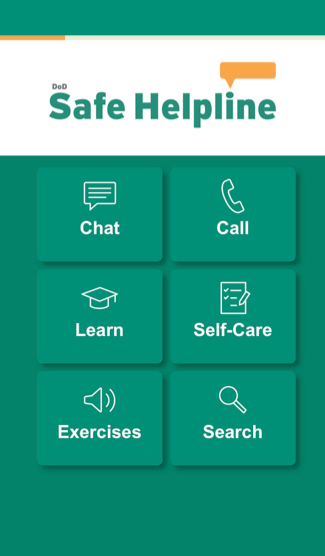
Safe Helpline app home screen

How can the Safe Helpline app help me?

We’ve designed the app to give you a way to access any resource within the app directly from the home screen.

Chat: Access one-on-one support through the Online Helpline, 24/7 and chat directly with a Safe Helpline staff member.

Call: Connect directly to a Safe Helpline staff member for one-on-one support through the Telephone Helpline, 24/7. You can choose to make the call using Voice over IP (VoIP) or by using your cellular data. Using VoIP might be a good option for Service members who are OCONUS and may not have access to cellular service in their current location.

Learn: Within this section of the Safe Helpline app, you can access our self-paced educational programs to learn how to address the effects of sexual assault, how to support a survivor and ways Safe Helpline can support you or someone you know. All of these education programs can be completed anonymously by the user. You’ll also be able to access scenarios to give you tangible ways to step-in and support others.

Self-Care: The app allows you to easily create and use a customized self-care plan with specially designed self-care exercises. Once downloaded, you can come back to view your plan and exercises at any time, even without an Internet connection.

How do the self-care plans work?

The self-care plan is created by answering a series of six questions designed to help you focus and identify how you are feeling at that moment. Questions are answered on a sliding scale of zero (never) to five (always), and the app will recommend different exercises based on your responses. There are no “good” or “bad” answers to these questions, and responses can vary from day to day, depending on how you are feeling.

Once you’ve answered the questions on the plan, the app will suggest self-care exercises. The exercises include:

  • Guided breathing
  • Guided muscle relaxation
  • Imagining yourself at the beach
  • Focusing on the present
  • Soothing sounds, such as sounds of the forest and sounds of rain falling

We recognize the importance of keeping your information safe, so we’ve also set up a security feature that allows you to lock your self-care plans behind a privacy wall using a 6-digit pin of your choosing.

Journaling:

The Safe Helpline app allows you to journal directly in the app with weekly prompts. Taking some time out of your week to journal can give you a moment for reflection and an opportunity for self-care. You can also choose to skip any prompts or just write freely depending on how you are feeling. Some of the questions include:

  • When do you feel the most energized?
  • What do you want to let go of this week?
  • What are three things that you would do if you weren’t afraid?

Like the self-care plans, the journal entries you save are protected by a privacy wall and will allow you to lock your information behind a 6-digit pin of your choosing. You can also access and refer back to your journal without an Internet connection.

Coloring Book:

Sometimes focusing on a mindless activity can help you process difficult emotions and be grounded in the present.  To help with this, another self-care activity available on the app is a collection of six designs, ranging from easy to difficult, that allow you to paint or color your own works of art.

How is the Safe Helpline app secure, and is activity on the app traceable by third parties?

As with all Safe Helpline services, your privacy is of utmost importance, and the technology behind the Safe Helpline app was created by RAINN to protect your safety and anonymity by ensuring that no personally identifiable information (PII) is collected.

The following precautions have been implemented to protect your privacy when using the app:

  • The app does not require an email address or any of your contact information when it is initially downloaded.
  • You have the ability to set up a pin code to protect the information you record in the self-care plans, the journal, and completed coloring book designs.
  • No information on how you use the app is ever collected or shared by Safe Helpline. This includes how often you use the app, who uses the app, or where you use the app.
  • If you are concerned that someone may be able to access the app, you can delete all journal entries, self-care plans, and completed coloring books by simply deleting the app.

While Safe Helpline has taken the steps outlined above to help increase the safety and anonymity of Safe Helpline app users, please remember that if you are using the app on a DoD or other work-related device, your employer may be able to track your usage of this app. In addition, similarly to a paper journal, Safe Helpline app journal entries may be admissible during court proceedings.

REPORT RETALIATION

Military Feedback Form

If you have questions, comments, or complaints about the services on your installation/base or provided by a Sexual Assault Response Coordinator (SARC), victim advocate or other military staff or personnel, please use this feedback form. You can submit the form anonymously if you prefer. The information you provide on this form will be forwarded to the DoD Sexual Assault Prevention and Response Office (SAPRO).

Retaliation

If you believe you have experienced or witnessed retaliation in any form from a peer, supervisor, or someone in your chain of command following a report of sexual assault, you can share the retaliation allegations with SAPRO using this form.

If you would like to submit a retaliation report, please report directly to the Department of Defense Inspector General (DoD IG) here.

For members of the Coast Guard who have experienced retaliation, the Department of Homeland Security (DHS) IG will accept retaliation complaints as falling within the scope of their responsibilities for Whistleblower protection. Coast Guard Members who have experienced retaliation can contact the DHS IG by calling 1-800-323-8603 (toll-free) or access the Allegation Form online.

Retaliation Reporting Options to learn more about how to report relation and your options : https://www.safehelpline.org/reporting-option

RESOURCE LINKS


For Responders

I work with Survivors

For Leadership

I am a Commander

For Supporters of Survivors

I am a Friend, Family Member, Colleague

For Service Members Leaving the Military

I am a Transitioning Service Member

For Survivors

I am a Transitioning Service Member


Mar
6
Fri
2026
00 – Hotline – Veterans Crisis Line – 988 then Press 1 – Resources for Veterans and Active Military and Families
Mar 6 all-day

Free, 24/7, confidential support is a click away.

The Veterans Crisis Line can help even if you’re not enrolled in VA benefits or health care.

Call the new veterans crisis line’s Number –  988 then Press 1

Chat online Use this Link  – ONLINE CHAT

TEXT us at 838255


More Crisis Lines and Warm Lines

Women Veterans Hotline: 855-829-663

Vet Center Call Center: 877-WAR-VETS (927-8387)

U.S. Department of Veterans Affairs (VA) Caregiver Support Line: 855-260-3274

Lines for Life Military Help Line:  Call 1-888-457-4838

Senior Loneliness Line:  Call 503-200-1633The

Trevor Project:  866-488-7386


Veteran Resource Navigator


The VA Resource Navigator is a simple tool. It helps you access and understands the VA benefits you’ve earned. This go-to guide provides trusted web links, phone numbers, and QR codes to VA services and benefits.

Find information about:

  • VA Locations

  • Records

  • Health Care

  • Disability and Benefits

  • Education and Training

  • Housing Assistance

  • Careers and Employment

  • Family member, caregiver, and survivor benefits

  • Pension

  • Burials and Memorials

Download your own copy by clicking the Resources link or image below. Pass this website along to others so they too can learn about the VA Resource Navigator.


https://www.prevention.va.gov/PCL/PCL-VA-Navigator.asp


VA Resource Navigator thumbnail


LOCATE VETERANS SERVICES IN OREGON

OREGON DEPARTMENT OF VETERANS AFFAIRS

Who Is a Veteran?

Aging Veterans

Caregivers

Homeless Veterans

Justice-Involved Veterans

LGBTQ+ Veterans

Student Veterans

Trauma Information

Tribal Veterans

Veterans in Crisis

Women Veterans


Find Services by County and Throughout the state 


National Resource Directory (NRD)

https://nrd.gov/

The National Resource Directory (NRD) is a resource website that connects wounded warriors, Service Members, Veterans, their families, and caregivers to programs and services that support them. The NRD is hosted, managed, maintained, sustained and developed by the Defense Health Agency’s Recovery Coordination Program.

It provides access to services and resources at the national, state and local levels to support recovery, rehabilitation and community reintegration. Visitors can find information on a variety of topics that supply an abundance of vetted resources. For help finding resources on the site, visit the How to Use this site section of the NRD. Please see below for some of our major categories.


The National Recovery Directory is a partnership among the Departments of Defense, Labor, and Veterans Affairs. Information contained within the NRD is from federal, state, and local government agencies; Veteran and military service organizations; non-profit and community-based organizations; academic institutions and professional associations that provide assistance to wounded warriors and their families.

GLOSSARIES

Find definitions to commonly used terms in VA, DoD, DOL, and other federal government agencies.

NRD FACT SHEET

Get to know your NRD: why it was created, who operates it, and all the resources meant for you.

KEY CONTACTS

Find contacts in the Departments of Defense, Labor, and Veterans Affairs and Military Services.

Dual Diagnosis Anonymous

DDA Veterans Page

“You protected us, now we support you!”


https://ddainc.org/dda-veterans-page/


DDA was founded by a highly decorated veteran, Corbett Monica. After serving in the Vietnam War, like other veterans, returning to home only find anguish, trauma, and remorse. After suffering from severe PTSD, OCD, survivors guilt, and addictions, Corbett found a way to transcend from destructive means with the inception of Dual Diagnosis Anonymous (DDA) providing hope and recovery through our peer support which is now his legacy.

Culturally responsive DDA’s Veterans meetings are intended to provide a safe venue to be open about depression, post-traumatic stress, alcohol and drug use, abuse, and addiction as well as serve as a resource for navigation of the telehealth system, It will encourage healthy solutions for adapting to the changing times. Specifically. the project will Improve access for Veterans and military service members to dual diagnosis services through the creation of on-line recovery support groups and on-line DDA meetings.

This project will serve Veterans throughout the state and is beginning outreach through Veterans publications, local newspapers, the VA, Veterans websites, list services, and anything else that will help identify Oregonians who can use the services.

More Ways To Connect

Give our Central Office a call at (503)-222-6484

Other Resources

Veterans Crisis Line:  https://www.veteranscrisisline.net/

Join our Private Online Group

DDA Veterans Resource Group and Chatroom:

US DEPARTMENT OF VETERANS AFFAIRS

PTSD: National Center for PTSD

https://www.ptsd.va.gov/

We are the world’s leading research and educational center of excellence on PTSD and traumatic stress.

PTSD is a mental health problem that some people develop after experiencing or witnessing a life-threatening or traumatic event. If symptoms last more than a few months, it may be PTSD. The good news is that there are effective treatments. Use these links to for information and assistance.

Understand PTSD Section
Treatment Section
Get Help Section
Family and Friends Section


Improving Health and Building Readiness. Anytime, Anywhere – Always

We are an integrated combat support agency, with a global team of nearly 130,000 civilians and military personnel, serving 9.5M beneficiaries and supporting 700+ hospitals and clinics in the Military Health System.

As a part of the Military Health System, we’re privileged to manage a global health system. Through TRICARE, we deliver health care to 9.5 million patients around the world. In our role as a Combat Support Agency, we provide medical support to the Army, Navy and Air Force.


USE THIS LINK TO FIND CARE


Military Children Resources

Military kids face unique psychological challenges related to military life. Compared to their non-military peers, military kids are many times more likely to move multiple times during their school careers and have a parent absent for long periods of time in potentially dangerous locations – factors that can greatly stress military kids’ mental health.

The Defense Health Agency maintains two online resources to support military children, use the links provided below:

  • Sesame Street for Military Families is a free, bilingual (English and Spanish) website where families can find information and multimedia resources on the topics of military deployments, multiple deployments, homecomings, injuries, grief, and self-expression.


RESOURCES ORGANIZED BY TOPIC

Behavioral Health

Burial & Survivor Assistance

Business & Entrepreneurship

Claims & Benefits

Education

Emergency Aid

Employment & Workforce

Family & Caregivers

Health Care

Housing & Homeless Services

Justice & Legal

Long-Term Care & Senior Support

Recreation

Service & Advocacy Organizations

Special Advocacy

Transportation


05 – Warmline – DoD – Department of Defense – Safe Helpline – Helpline 877-995-5247, One-On-One Chat, Report Retaliation, Resources – 24/7 @ Phone, Text
Mar 6 all-day


SAFE Helpline Number on Black background


DoD Safe Helpline is the sole secure, confidential, and anonymous crisis support service specially designed for members of the Department of Defense community affected by sexual assault.

Safe Helpline Serves

Active Duty Army, Navy, Marine Corps, and Air Force Reserve component (Army National Guard, Army Reserve, Navy Reserve, Marine Corps Reserve, Air National Guard, Air Force Reserve, and DHS’s Coast Guard Reserve) members and their families.


Telephone Helpline

Need help?

Call 877-995-5247 to be connected with a trained, confidential
Safe Helpline staff member, 24/7.

DSN users can call Safe Helpline by dialing 877-995-5247.

For those unable to call toll-free or DSN, call 202-540-5962.

OCONUS Service members can call the Telephone Helpline for free from
anywhere in the world by using Voice over IP (VoIP) technology from
theSafe Helpline App.

live-help-img

Online Helpline

Need help?

Visitonline.safehelpline.org or download the Safe Helpline
app
to chat one-on-one with a trained Safe Helpline staff member
through an anonymous, secure instant-messaging format 24/7.

How can the Online Helpline help me?

You can chat one-on-one with a Safe Helpline staff member
to access a range of support services including:

  • Anonymous, confidential, crisis intervention services
  • Emotional support
  • Referrals to both military and civilian resources in your area— sexual assault response coordinators (SARCs)/sexual assault prevention and response victim advocates (SAPR VAs), Chaplain, Legal, Medical/Behavioral health care services, military police, Veterans Crisis Line, local civilian sexual assault service providers, and many others.
  • Information on military-specific policies, such as reporting options (Restricted and Unrestricted)
  • Information for family and friends of survivors
  • Information for leadership

Safe Helpline App

Safe Helpline appWhat is the Safe Helpline app?

Itunes Store Badge      Google play icon

The Safe Helpline app is a free mobile resource created to meet the unique needs of members of the Department of Defense community affected by sexual assault. By downloading the app, you can access 24/7 support through Safe Helpline’s Telephone and Online Helplines, get information and resources to help address the short- and long-term effects of sexual assault, as well as practical exercises, to help you manage your self-care. We also recognize that for many survivors stationed outside of the United States (OCONUS) additional limitations may arise when accessing resources, which is why the Safe Helpline app has been designed to give survivors access to a variety of support services and self-care exercises in a free, and convenient way.

Safe Helpline app home screen

How can the Safe Helpline app help me?

We’ve designed the app to give you a way to access any resource within the app directly from the home screen.

Chat: Access one-on-one support through the Online Helpline, 24/7 and chat directly with a Safe Helpline staff member.

Call: Connect directly to a Safe Helpline staff member for one-on-one support through the Telephone Helpline, 24/7. You can choose to make the call using Voice over IP (VoIP) or by using your cellular data. Using VoIP might be a good option for Service members who are OCONUS and may not have access to cellular service in their current location.

Learn: Within this section of the Safe Helpline app, you can access our self-paced educational programs to learn how to address the effects of sexual assault, how to support a survivor and ways Safe Helpline can support you or someone you know. All of these education programs can be completed anonymously by the user. You’ll also be able to access scenarios to give you tangible ways to step-in and support others.

Self-Care: The app allows you to easily create and use a customized self-care plan with specially designed self-care exercises. Once downloaded, you can come back to view your plan and exercises at any time, even without an Internet connection.

How do the self-care plans work?

The self-care plan is created by answering a series of six questions designed to help you focus and identify how you are feeling at that moment. Questions are answered on a sliding scale of zero (never) to five (always), and the app will recommend different exercises based on your responses. There are no “good” or “bad” answers to these questions, and responses can vary from day to day, depending on how you are feeling.

Once you’ve answered the questions on the plan, the app will suggest self-care exercises. The exercises include:

  • Guided breathing
  • Guided muscle relaxation
  • Imagining yourself at the beach
  • Focusing on the present
  • Soothing sounds, such as sounds of the forest and sounds of rain falling

We recognize the importance of keeping your information safe, so we’ve also set up a security feature that allows you to lock your self-care plans behind a privacy wall using a 6-digit pin of your choosing.

Journaling:

The Safe Helpline app allows you to journal directly in the app with weekly prompts. Taking some time out of your week to journal can give you a moment for reflection and an opportunity for self-care. You can also choose to skip any prompts or just write freely depending on how you are feeling. Some of the questions include:

  • When do you feel the most energized?
  • What do you want to let go of this week?
  • What are three things that you would do if you weren’t afraid?

Like the self-care plans, the journal entries you save are protected by a privacy wall and will allow you to lock your information behind a 6-digit pin of your choosing. You can also access and refer back to your journal without an Internet connection.

Coloring Book:

Sometimes focusing on a mindless activity can help you process difficult emotions and be grounded in the present.  To help with this, another self-care activity available on the app is a collection of six designs, ranging from easy to difficult, that allow you to paint or color your own works of art.

How is the Safe Helpline app secure, and is activity on the app traceable by third parties?

As with all Safe Helpline services, your privacy is of utmost importance, and the technology behind the Safe Helpline app was created by RAINN to protect your safety and anonymity by ensuring that no personally identifiable information (PII) is collected.

The following precautions have been implemented to protect your privacy when using the app:

  • The app does not require an email address or any of your contact information when it is initially downloaded.
  • You have the ability to set up a pin code to protect the information you record in the self-care plans, the journal, and completed coloring book designs.
  • No information on how you use the app is ever collected or shared by Safe Helpline. This includes how often you use the app, who uses the app, or where you use the app.
  • If you are concerned that someone may be able to access the app, you can delete all journal entries, self-care plans, and completed coloring books by simply deleting the app.

While Safe Helpline has taken the steps outlined above to help increase the safety and anonymity of Safe Helpline app users, please remember that if you are using the app on a DoD or other work-related device, your employer may be able to track your usage of this app. In addition, similarly to a paper journal, Safe Helpline app journal entries may be admissible during court proceedings.

REPORT RETALIATION

Military Feedback Form

If you have questions, comments, or complaints about the services on your installation/base or provided by a Sexual Assault Response Coordinator (SARC), victim advocate or other military staff or personnel, please use this feedback form. You can submit the form anonymously if you prefer. The information you provide on this form will be forwarded to the DoD Sexual Assault Prevention and Response Office (SAPRO).

Retaliation

If you believe you have experienced or witnessed retaliation in any form from a peer, supervisor, or someone in your chain of command following a report of sexual assault, you can share the retaliation allegations with SAPRO using this form.

If you would like to submit a retaliation report, please report directly to the Department of Defense Inspector General (DoD IG) here.

For members of the Coast Guard who have experienced retaliation, the Department of Homeland Security (DHS) IG will accept retaliation complaints as falling within the scope of their responsibilities for Whistleblower protection. Coast Guard Members who have experienced retaliation can contact the DHS IG by calling 1-800-323-8603 (toll-free) or access the Allegation Form online.

Retaliation Reporting Options to learn more about how to report relation and your options : https://www.safehelpline.org/reporting-option

RESOURCE LINKS


For Responders

I work with Survivors

For Leadership

I am a Commander

For Supporters of Survivors

I am a Friend, Family Member, Colleague

For Service Members Leaving the Military

I am a Transitioning Service Member

For Survivors

I am a Transitioning Service Member


Mar
7
Sat
2026
00 – Hotline – Veterans Crisis Line – 988 then Press 1 – Resources for Veterans and Active Military and Families
Mar 7 all-day

Free, 24/7, confidential support is a click away.

The Veterans Crisis Line can help even if you’re not enrolled in VA benefits or health care.

Call the new veterans crisis line’s Number –  988 then Press 1

Chat online Use this Link  – ONLINE CHAT

TEXT us at 838255


More Crisis Lines and Warm Lines

Women Veterans Hotline: 855-829-663

Vet Center Call Center: 877-WAR-VETS (927-8387)

U.S. Department of Veterans Affairs (VA) Caregiver Support Line: 855-260-3274

Lines for Life Military Help Line:  Call 1-888-457-4838

Senior Loneliness Line:  Call 503-200-1633The

Trevor Project:  866-488-7386


Veteran Resource Navigator


The VA Resource Navigator is a simple tool. It helps you access and understands the VA benefits you’ve earned. This go-to guide provides trusted web links, phone numbers, and QR codes to VA services and benefits.

Find information about:

  • VA Locations

  • Records

  • Health Care

  • Disability and Benefits

  • Education and Training

  • Housing Assistance

  • Careers and Employment

  • Family member, caregiver, and survivor benefits

  • Pension

  • Burials and Memorials

Download your own copy by clicking the Resources link or image below. Pass this website along to others so they too can learn about the VA Resource Navigator.


https://www.prevention.va.gov/PCL/PCL-VA-Navigator.asp


VA Resource Navigator thumbnail


LOCATE VETERANS SERVICES IN OREGON

OREGON DEPARTMENT OF VETERANS AFFAIRS

Who Is a Veteran?

Aging Veterans

Caregivers

Homeless Veterans

Justice-Involved Veterans

LGBTQ+ Veterans

Student Veterans

Trauma Information

Tribal Veterans

Veterans in Crisis

Women Veterans


Find Services by County and Throughout the state 


National Resource Directory (NRD)

https://nrd.gov/

The National Resource Directory (NRD) is a resource website that connects wounded warriors, Service Members, Veterans, their families, and caregivers to programs and services that support them. The NRD is hosted, managed, maintained, sustained and developed by the Defense Health Agency’s Recovery Coordination Program.

It provides access to services and resources at the national, state and local levels to support recovery, rehabilitation and community reintegration. Visitors can find information on a variety of topics that supply an abundance of vetted resources. For help finding resources on the site, visit the How to Use this site section of the NRD. Please see below for some of our major categories.


The National Recovery Directory is a partnership among the Departments of Defense, Labor, and Veterans Affairs. Information contained within the NRD is from federal, state, and local government agencies; Veteran and military service organizations; non-profit and community-based organizations; academic institutions and professional associations that provide assistance to wounded warriors and their families.

GLOSSARIES

Find definitions to commonly used terms in VA, DoD, DOL, and other federal government agencies.

NRD FACT SHEET

Get to know your NRD: why it was created, who operates it, and all the resources meant for you.

KEY CONTACTS

Find contacts in the Departments of Defense, Labor, and Veterans Affairs and Military Services.

Dual Diagnosis Anonymous

DDA Veterans Page

“You protected us, now we support you!”


https://ddainc.org/dda-veterans-page/


DDA was founded by a highly decorated veteran, Corbett Monica. After serving in the Vietnam War, like other veterans, returning to home only find anguish, trauma, and remorse. After suffering from severe PTSD, OCD, survivors guilt, and addictions, Corbett found a way to transcend from destructive means with the inception of Dual Diagnosis Anonymous (DDA) providing hope and recovery through our peer support which is now his legacy.

Culturally responsive DDA’s Veterans meetings are intended to provide a safe venue to be open about depression, post-traumatic stress, alcohol and drug use, abuse, and addiction as well as serve as a resource for navigation of the telehealth system, It will encourage healthy solutions for adapting to the changing times. Specifically. the project will Improve access for Veterans and military service members to dual diagnosis services through the creation of on-line recovery support groups and on-line DDA meetings.

This project will serve Veterans throughout the state and is beginning outreach through Veterans publications, local newspapers, the VA, Veterans websites, list services, and anything else that will help identify Oregonians who can use the services.

More Ways To Connect

Give our Central Office a call at (503)-222-6484

Other Resources

Veterans Crisis Line:  https://www.veteranscrisisline.net/

Join our Private Online Group

DDA Veterans Resource Group and Chatroom:

US DEPARTMENT OF VETERANS AFFAIRS

PTSD: National Center for PTSD

https://www.ptsd.va.gov/

We are the world’s leading research and educational center of excellence on PTSD and traumatic stress.

PTSD is a mental health problem that some people develop after experiencing or witnessing a life-threatening or traumatic event. If symptoms last more than a few months, it may be PTSD. The good news is that there are effective treatments. Use these links to for information and assistance.

Understand PTSD Section
Treatment Section
Get Help Section
Family and Friends Section


Improving Health and Building Readiness. Anytime, Anywhere – Always

We are an integrated combat support agency, with a global team of nearly 130,000 civilians and military personnel, serving 9.5M beneficiaries and supporting 700+ hospitals and clinics in the Military Health System.

As a part of the Military Health System, we’re privileged to manage a global health system. Through TRICARE, we deliver health care to 9.5 million patients around the world. In our role as a Combat Support Agency, we provide medical support to the Army, Navy and Air Force.


USE THIS LINK TO FIND CARE


Military Children Resources

Military kids face unique psychological challenges related to military life. Compared to their non-military peers, military kids are many times more likely to move multiple times during their school careers and have a parent absent for long periods of time in potentially dangerous locations – factors that can greatly stress military kids’ mental health.

The Defense Health Agency maintains two online resources to support military children, use the links provided below:

  • Sesame Street for Military Families is a free, bilingual (English and Spanish) website where families can find information and multimedia resources on the topics of military deployments, multiple deployments, homecomings, injuries, grief, and self-expression.


RESOURCES ORGANIZED BY TOPIC

Behavioral Health

Burial & Survivor Assistance

Business & Entrepreneurship

Claims & Benefits

Education

Emergency Aid

Employment & Workforce

Family & Caregivers

Health Care

Housing & Homeless Services

Justice & Legal

Long-Term Care & Senior Support

Recreation

Service & Advocacy Organizations

Special Advocacy

Transportation


05 – Warmline – DoD – Department of Defense – Safe Helpline – Helpline 877-995-5247, One-On-One Chat, Report Retaliation, Resources – 24/7 @ Phone, Text
Mar 7 all-day


SAFE Helpline Number on Black background


DoD Safe Helpline is the sole secure, confidential, and anonymous crisis support service specially designed for members of the Department of Defense community affected by sexual assault.

Safe Helpline Serves

Active Duty Army, Navy, Marine Corps, and Air Force Reserve component (Army National Guard, Army Reserve, Navy Reserve, Marine Corps Reserve, Air National Guard, Air Force Reserve, and DHS’s Coast Guard Reserve) members and their families.


Telephone Helpline

Need help?

Call 877-995-5247 to be connected with a trained, confidential
Safe Helpline staff member, 24/7.

DSN users can call Safe Helpline by dialing 877-995-5247.

For those unable to call toll-free or DSN, call 202-540-5962.

OCONUS Service members can call the Telephone Helpline for free from
anywhere in the world by using Voice over IP (VoIP) technology from
theSafe Helpline App.

live-help-img

Online Helpline

Need help?

Visitonline.safehelpline.org or download the Safe Helpline
app
to chat one-on-one with a trained Safe Helpline staff member
through an anonymous, secure instant-messaging format 24/7.

How can the Online Helpline help me?

You can chat one-on-one with a Safe Helpline staff member
to access a range of support services including:

  • Anonymous, confidential, crisis intervention services
  • Emotional support
  • Referrals to both military and civilian resources in your area— sexual assault response coordinators (SARCs)/sexual assault prevention and response victim advocates (SAPR VAs), Chaplain, Legal, Medical/Behavioral health care services, military police, Veterans Crisis Line, local civilian sexual assault service providers, and many others.
  • Information on military-specific policies, such as reporting options (Restricted and Unrestricted)
  • Information for family and friends of survivors
  • Information for leadership

Safe Helpline App

Safe Helpline appWhat is the Safe Helpline app?

Itunes Store Badge      Google play icon

The Safe Helpline app is a free mobile resource created to meet the unique needs of members of the Department of Defense community affected by sexual assault. By downloading the app, you can access 24/7 support through Safe Helpline’s Telephone and Online Helplines, get information and resources to help address the short- and long-term effects of sexual assault, as well as practical exercises, to help you manage your self-care. We also recognize that for many survivors stationed outside of the United States (OCONUS) additional limitations may arise when accessing resources, which is why the Safe Helpline app has been designed to give survivors access to a variety of support services and self-care exercises in a free, and convenient way.

Safe Helpline app home screen

How can the Safe Helpline app help me?

We’ve designed the app to give you a way to access any resource within the app directly from the home screen.

Chat: Access one-on-one support through the Online Helpline, 24/7 and chat directly with a Safe Helpline staff member.

Call: Connect directly to a Safe Helpline staff member for one-on-one support through the Telephone Helpline, 24/7. You can choose to make the call using Voice over IP (VoIP) or by using your cellular data. Using VoIP might be a good option for Service members who are OCONUS and may not have access to cellular service in their current location.

Learn: Within this section of the Safe Helpline app, you can access our self-paced educational programs to learn how to address the effects of sexual assault, how to support a survivor and ways Safe Helpline can support you or someone you know. All of these education programs can be completed anonymously by the user. You’ll also be able to access scenarios to give you tangible ways to step-in and support others.

Self-Care: The app allows you to easily create and use a customized self-care plan with specially designed self-care exercises. Once downloaded, you can come back to view your plan and exercises at any time, even without an Internet connection.

How do the self-care plans work?

The self-care plan is created by answering a series of six questions designed to help you focus and identify how you are feeling at that moment. Questions are answered on a sliding scale of zero (never) to five (always), and the app will recommend different exercises based on your responses. There are no “good” or “bad” answers to these questions, and responses can vary from day to day, depending on how you are feeling.

Once you’ve answered the questions on the plan, the app will suggest self-care exercises. The exercises include:

  • Guided breathing
  • Guided muscle relaxation
  • Imagining yourself at the beach
  • Focusing on the present
  • Soothing sounds, such as sounds of the forest and sounds of rain falling

We recognize the importance of keeping your information safe, so we’ve also set up a security feature that allows you to lock your self-care plans behind a privacy wall using a 6-digit pin of your choosing.

Journaling:

The Safe Helpline app allows you to journal directly in the app with weekly prompts. Taking some time out of your week to journal can give you a moment for reflection and an opportunity for self-care. You can also choose to skip any prompts or just write freely depending on how you are feeling. Some of the questions include:

  • When do you feel the most energized?
  • What do you want to let go of this week?
  • What are three things that you would do if you weren’t afraid?

Like the self-care plans, the journal entries you save are protected by a privacy wall and will allow you to lock your information behind a 6-digit pin of your choosing. You can also access and refer back to your journal without an Internet connection.

Coloring Book:

Sometimes focusing on a mindless activity can help you process difficult emotions and be grounded in the present.  To help with this, another self-care activity available on the app is a collection of six designs, ranging from easy to difficult, that allow you to paint or color your own works of art.

How is the Safe Helpline app secure, and is activity on the app traceable by third parties?

As with all Safe Helpline services, your privacy is of utmost importance, and the technology behind the Safe Helpline app was created by RAINN to protect your safety and anonymity by ensuring that no personally identifiable information (PII) is collected.

The following precautions have been implemented to protect your privacy when using the app:

  • The app does not require an email address or any of your contact information when it is initially downloaded.
  • You have the ability to set up a pin code to protect the information you record in the self-care plans, the journal, and completed coloring book designs.
  • No information on how you use the app is ever collected or shared by Safe Helpline. This includes how often you use the app, who uses the app, or where you use the app.
  • If you are concerned that someone may be able to access the app, you can delete all journal entries, self-care plans, and completed coloring books by simply deleting the app.

While Safe Helpline has taken the steps outlined above to help increase the safety and anonymity of Safe Helpline app users, please remember that if you are using the app on a DoD or other work-related device, your employer may be able to track your usage of this app. In addition, similarly to a paper journal, Safe Helpline app journal entries may be admissible during court proceedings.

REPORT RETALIATION

Military Feedback Form

If you have questions, comments, or complaints about the services on your installation/base or provided by a Sexual Assault Response Coordinator (SARC), victim advocate or other military staff or personnel, please use this feedback form. You can submit the form anonymously if you prefer. The information you provide on this form will be forwarded to the DoD Sexual Assault Prevention and Response Office (SAPRO).

Retaliation

If you believe you have experienced or witnessed retaliation in any form from a peer, supervisor, or someone in your chain of command following a report of sexual assault, you can share the retaliation allegations with SAPRO using this form.

If you would like to submit a retaliation report, please report directly to the Department of Defense Inspector General (DoD IG) here.

For members of the Coast Guard who have experienced retaliation, the Department of Homeland Security (DHS) IG will accept retaliation complaints as falling within the scope of their responsibilities for Whistleblower protection. Coast Guard Members who have experienced retaliation can contact the DHS IG by calling 1-800-323-8603 (toll-free) or access the Allegation Form online.

Retaliation Reporting Options to learn more about how to report relation and your options : https://www.safehelpline.org/reporting-option

RESOURCE LINKS


For Responders

I work with Survivors

For Leadership

I am a Commander

For Supporters of Survivors

I am a Friend, Family Member, Colleague

For Service Members Leaving the Military

I am a Transitioning Service Member

For Survivors

I am a Transitioning Service Member


Mar
8
Sun
2026
00 – Hotline – Veterans Crisis Line – 988 then Press 1 – Resources for Veterans and Active Military and Families
Mar 8 – Mar 9 all-day

Free, 24/7, confidential support is a click away.

The Veterans Crisis Line can help even if you’re not enrolled in VA benefits or health care.

Call the new veterans crisis line’s Number –  988 then Press 1

Chat online Use this Link  – ONLINE CHAT

TEXT us at 838255


More Crisis Lines and Warm Lines

Women Veterans Hotline: 855-829-663

Vet Center Call Center: 877-WAR-VETS (927-8387)

U.S. Department of Veterans Affairs (VA) Caregiver Support Line: 855-260-3274

Lines for Life Military Help Line:  Call 1-888-457-4838

Senior Loneliness Line:  Call 503-200-1633The

Trevor Project:  866-488-7386


Veteran Resource Navigator


The VA Resource Navigator is a simple tool. It helps you access and understands the VA benefits you’ve earned. This go-to guide provides trusted web links, phone numbers, and QR codes to VA services and benefits.

Find information about:

  • VA Locations

  • Records

  • Health Care

  • Disability and Benefits

  • Education and Training

  • Housing Assistance

  • Careers and Employment

  • Family member, caregiver, and survivor benefits

  • Pension

  • Burials and Memorials

Download your own copy by clicking the Resources link or image below. Pass this website along to others so they too can learn about the VA Resource Navigator.


https://www.prevention.va.gov/PCL/PCL-VA-Navigator.asp


VA Resource Navigator thumbnail


LOCATE VETERANS SERVICES IN OREGON

OREGON DEPARTMENT OF VETERANS AFFAIRS

Who Is a Veteran?

Aging Veterans

Caregivers

Homeless Veterans

Justice-Involved Veterans

LGBTQ+ Veterans

Student Veterans

Trauma Information

Tribal Veterans

Veterans in Crisis

Women Veterans


Find Services by County and Throughout the state 


National Resource Directory (NRD)

https://nrd.gov/

The National Resource Directory (NRD) is a resource website that connects wounded warriors, Service Members, Veterans, their families, and caregivers to programs and services that support them. The NRD is hosted, managed, maintained, sustained and developed by the Defense Health Agency’s Recovery Coordination Program.

It provides access to services and resources at the national, state and local levels to support recovery, rehabilitation and community reintegration. Visitors can find information on a variety of topics that supply an abundance of vetted resources. For help finding resources on the site, visit the How to Use this site section of the NRD. Please see below for some of our major categories.


The National Recovery Directory is a partnership among the Departments of Defense, Labor, and Veterans Affairs. Information contained within the NRD is from federal, state, and local government agencies; Veteran and military service organizations; non-profit and community-based organizations; academic institutions and professional associations that provide assistance to wounded warriors and their families.

GLOSSARIES

Find definitions to commonly used terms in VA, DoD, DOL, and other federal government agencies.

NRD FACT SHEET

Get to know your NRD: why it was created, who operates it, and all the resources meant for you.

KEY CONTACTS

Find contacts in the Departments of Defense, Labor, and Veterans Affairs and Military Services.

Dual Diagnosis Anonymous

DDA Veterans Page

“You protected us, now we support you!”


https://ddainc.org/dda-veterans-page/


DDA was founded by a highly decorated veteran, Corbett Monica. After serving in the Vietnam War, like other veterans, returning to home only find anguish, trauma, and remorse. After suffering from severe PTSD, OCD, survivors guilt, and addictions, Corbett found a way to transcend from destructive means with the inception of Dual Diagnosis Anonymous (DDA) providing hope and recovery through our peer support which is now his legacy.

Culturally responsive DDA’s Veterans meetings are intended to provide a safe venue to be open about depression, post-traumatic stress, alcohol and drug use, abuse, and addiction as well as serve as a resource for navigation of the telehealth system, It will encourage healthy solutions for adapting to the changing times. Specifically. the project will Improve access for Veterans and military service members to dual diagnosis services through the creation of on-line recovery support groups and on-line DDA meetings.

This project will serve Veterans throughout the state and is beginning outreach through Veterans publications, local newspapers, the VA, Veterans websites, list services, and anything else that will help identify Oregonians who can use the services.

More Ways To Connect

Give our Central Office a call at (503)-222-6484

Other Resources

Veterans Crisis Line:  https://www.veteranscrisisline.net/

Join our Private Online Group

DDA Veterans Resource Group and Chatroom:

US DEPARTMENT OF VETERANS AFFAIRS

PTSD: National Center for PTSD

https://www.ptsd.va.gov/

We are the world’s leading research and educational center of excellence on PTSD and traumatic stress.

PTSD is a mental health problem that some people develop after experiencing or witnessing a life-threatening or traumatic event. If symptoms last more than a few months, it may be PTSD. The good news is that there are effective treatments. Use these links to for information and assistance.

Understand PTSD Section
Treatment Section
Get Help Section
Family and Friends Section


Improving Health and Building Readiness. Anytime, Anywhere – Always

We are an integrated combat support agency, with a global team of nearly 130,000 civilians and military personnel, serving 9.5M beneficiaries and supporting 700+ hospitals and clinics in the Military Health System.

As a part of the Military Health System, we’re privileged to manage a global health system. Through TRICARE, we deliver health care to 9.5 million patients around the world. In our role as a Combat Support Agency, we provide medical support to the Army, Navy and Air Force.


USE THIS LINK TO FIND CARE


Military Children Resources

Military kids face unique psychological challenges related to military life. Compared to their non-military peers, military kids are many times more likely to move multiple times during their school careers and have a parent absent for long periods of time in potentially dangerous locations – factors that can greatly stress military kids’ mental health.

The Defense Health Agency maintains two online resources to support military children, use the links provided below:

  • Sesame Street for Military Families is a free, bilingual (English and Spanish) website where families can find information and multimedia resources on the topics of military deployments, multiple deployments, homecomings, injuries, grief, and self-expression.


RESOURCES ORGANIZED BY TOPIC

Behavioral Health

Burial & Survivor Assistance

Business & Entrepreneurship

Claims & Benefits

Education

Emergency Aid

Employment & Workforce

Family & Caregivers

Health Care

Housing & Homeless Services

Justice & Legal

Long-Term Care & Senior Support

Recreation

Service & Advocacy Organizations

Special Advocacy

Transportation


05 – Warmline – DoD – Department of Defense – Safe Helpline – Helpline 877-995-5247, One-On-One Chat, Report Retaliation, Resources – 24/7 @ Phone, Text
Mar 8 – Mar 9 all-day


SAFE Helpline Number on Black background


DoD Safe Helpline is the sole secure, confidential, and anonymous crisis support service specially designed for members of the Department of Defense community affected by sexual assault.

Safe Helpline Serves

Active Duty Army, Navy, Marine Corps, and Air Force Reserve component (Army National Guard, Army Reserve, Navy Reserve, Marine Corps Reserve, Air National Guard, Air Force Reserve, and DHS’s Coast Guard Reserve) members and their families.


Telephone Helpline

Need help?

Call 877-995-5247 to be connected with a trained, confidential
Safe Helpline staff member, 24/7.

DSN users can call Safe Helpline by dialing 877-995-5247.

For those unable to call toll-free or DSN, call 202-540-5962.

OCONUS Service members can call the Telephone Helpline for free from
anywhere in the world by using Voice over IP (VoIP) technology from
theSafe Helpline App.

live-help-img

Online Helpline

Need help?

Visitonline.safehelpline.org or download the Safe Helpline
app
to chat one-on-one with a trained Safe Helpline staff member
through an anonymous, secure instant-messaging format 24/7.

How can the Online Helpline help me?

You can chat one-on-one with a Safe Helpline staff member
to access a range of support services including:

  • Anonymous, confidential, crisis intervention services
  • Emotional support
  • Referrals to both military and civilian resources in your area— sexual assault response coordinators (SARCs)/sexual assault prevention and response victim advocates (SAPR VAs), Chaplain, Legal, Medical/Behavioral health care services, military police, Veterans Crisis Line, local civilian sexual assault service providers, and many others.
  • Information on military-specific policies, such as reporting options (Restricted and Unrestricted)
  • Information for family and friends of survivors
  • Information for leadership

Safe Helpline App

Safe Helpline appWhat is the Safe Helpline app?

Itunes Store Badge      Google play icon

The Safe Helpline app is a free mobile resource created to meet the unique needs of members of the Department of Defense community affected by sexual assault. By downloading the app, you can access 24/7 support through Safe Helpline’s Telephone and Online Helplines, get information and resources to help address the short- and long-term effects of sexual assault, as well as practical exercises, to help you manage your self-care. We also recognize that for many survivors stationed outside of the United States (OCONUS) additional limitations may arise when accessing resources, which is why the Safe Helpline app has been designed to give survivors access to a variety of support services and self-care exercises in a free, and convenient way.

Safe Helpline app home screen

How can the Safe Helpline app help me?

We’ve designed the app to give you a way to access any resource within the app directly from the home screen.

Chat: Access one-on-one support through the Online Helpline, 24/7 and chat directly with a Safe Helpline staff member.

Call: Connect directly to a Safe Helpline staff member for one-on-one support through the Telephone Helpline, 24/7. You can choose to make the call using Voice over IP (VoIP) or by using your cellular data. Using VoIP might be a good option for Service members who are OCONUS and may not have access to cellular service in their current location.

Learn: Within this section of the Safe Helpline app, you can access our self-paced educational programs to learn how to address the effects of sexual assault, how to support a survivor and ways Safe Helpline can support you or someone you know. All of these education programs can be completed anonymously by the user. You’ll also be able to access scenarios to give you tangible ways to step-in and support others.

Self-Care: The app allows you to easily create and use a customized self-care plan with specially designed self-care exercises. Once downloaded, you can come back to view your plan and exercises at any time, even without an Internet connection.

How do the self-care plans work?

The self-care plan is created by answering a series of six questions designed to help you focus and identify how you are feeling at that moment. Questions are answered on a sliding scale of zero (never) to five (always), and the app will recommend different exercises based on your responses. There are no “good” or “bad” answers to these questions, and responses can vary from day to day, depending on how you are feeling.

Once you’ve answered the questions on the plan, the app will suggest self-care exercises. The exercises include:

  • Guided breathing
  • Guided muscle relaxation
  • Imagining yourself at the beach
  • Focusing on the present
  • Soothing sounds, such as sounds of the forest and sounds of rain falling

We recognize the importance of keeping your information safe, so we’ve also set up a security feature that allows you to lock your self-care plans behind a privacy wall using a 6-digit pin of your choosing.

Journaling:

The Safe Helpline app allows you to journal directly in the app with weekly prompts. Taking some time out of your week to journal can give you a moment for reflection and an opportunity for self-care. You can also choose to skip any prompts or just write freely depending on how you are feeling. Some of the questions include:

  • When do you feel the most energized?
  • What do you want to let go of this week?
  • What are three things that you would do if you weren’t afraid?

Like the self-care plans, the journal entries you save are protected by a privacy wall and will allow you to lock your information behind a 6-digit pin of your choosing. You can also access and refer back to your journal without an Internet connection.

Coloring Book:

Sometimes focusing on a mindless activity can help you process difficult emotions and be grounded in the present.  To help with this, another self-care activity available on the app is a collection of six designs, ranging from easy to difficult, that allow you to paint or color your own works of art.

How is the Safe Helpline app secure, and is activity on the app traceable by third parties?

As with all Safe Helpline services, your privacy is of utmost importance, and the technology behind the Safe Helpline app was created by RAINN to protect your safety and anonymity by ensuring that no personally identifiable information (PII) is collected.

The following precautions have been implemented to protect your privacy when using the app:

  • The app does not require an email address or any of your contact information when it is initially downloaded.
  • You have the ability to set up a pin code to protect the information you record in the self-care plans, the journal, and completed coloring book designs.
  • No information on how you use the app is ever collected or shared by Safe Helpline. This includes how often you use the app, who uses the app, or where you use the app.
  • If you are concerned that someone may be able to access the app, you can delete all journal entries, self-care plans, and completed coloring books by simply deleting the app.

While Safe Helpline has taken the steps outlined above to help increase the safety and anonymity of Safe Helpline app users, please remember that if you are using the app on a DoD or other work-related device, your employer may be able to track your usage of this app. In addition, similarly to a paper journal, Safe Helpline app journal entries may be admissible during court proceedings.

REPORT RETALIATION

Military Feedback Form

If you have questions, comments, or complaints about the services on your installation/base or provided by a Sexual Assault Response Coordinator (SARC), victim advocate or other military staff or personnel, please use this feedback form. You can submit the form anonymously if you prefer. The information you provide on this form will be forwarded to the DoD Sexual Assault Prevention and Response Office (SAPRO).

Retaliation

If you believe you have experienced or witnessed retaliation in any form from a peer, supervisor, or someone in your chain of command following a report of sexual assault, you can share the retaliation allegations with SAPRO using this form.

If you would like to submit a retaliation report, please report directly to the Department of Defense Inspector General (DoD IG) here.

For members of the Coast Guard who have experienced retaliation, the Department of Homeland Security (DHS) IG will accept retaliation complaints as falling within the scope of their responsibilities for Whistleblower protection. Coast Guard Members who have experienced retaliation can contact the DHS IG by calling 1-800-323-8603 (toll-free) or access the Allegation Form online.

Retaliation Reporting Options to learn more about how to report relation and your options : https://www.safehelpline.org/reporting-option

RESOURCE LINKS


For Responders

I work with Survivors

For Leadership

I am a Commander

For Supporters of Survivors

I am a Friend, Family Member, Colleague

For Service Members Leaving the Military

I am a Transitioning Service Member

For Survivors

I am a Transitioning Service Member


Mar
9
Mon
2026
00 – Hotline – Veterans Crisis Line – 988 then Press 1 – Resources for Veterans and Active Military and Families
Mar 9 all-day

Free, 24/7, confidential support is a click away.

The Veterans Crisis Line can help even if you’re not enrolled in VA benefits or health care.

Call the new veterans crisis line’s Number –  988 then Press 1

Chat online Use this Link  – ONLINE CHAT

TEXT us at 838255


More Crisis Lines and Warm Lines

Women Veterans Hotline: 855-829-663

Vet Center Call Center: 877-WAR-VETS (927-8387)

U.S. Department of Veterans Affairs (VA) Caregiver Support Line: 855-260-3274

Lines for Life Military Help Line:  Call 1-888-457-4838

Senior Loneliness Line:  Call 503-200-1633The

Trevor Project:  866-488-7386


Veteran Resource Navigator


The VA Resource Navigator is a simple tool. It helps you access and understands the VA benefits you’ve earned. This go-to guide provides trusted web links, phone numbers, and QR codes to VA services and benefits.

Find information about:

  • VA Locations

  • Records

  • Health Care

  • Disability and Benefits

  • Education and Training

  • Housing Assistance

  • Careers and Employment

  • Family member, caregiver, and survivor benefits

  • Pension

  • Burials and Memorials

Download your own copy by clicking the Resources link or image below. Pass this website along to others so they too can learn about the VA Resource Navigator.


https://www.prevention.va.gov/PCL/PCL-VA-Navigator.asp


VA Resource Navigator thumbnail


LOCATE VETERANS SERVICES IN OREGON

OREGON DEPARTMENT OF VETERANS AFFAIRS

Who Is a Veteran?

Aging Veterans

Caregivers

Homeless Veterans

Justice-Involved Veterans

LGBTQ+ Veterans

Student Veterans

Trauma Information

Tribal Veterans

Veterans in Crisis

Women Veterans


Find Services by County and Throughout the state 


National Resource Directory (NRD)

https://nrd.gov/

The National Resource Directory (NRD) is a resource website that connects wounded warriors, Service Members, Veterans, their families, and caregivers to programs and services that support them. The NRD is hosted, managed, maintained, sustained and developed by the Defense Health Agency’s Recovery Coordination Program.

It provides access to services and resources at the national, state and local levels to support recovery, rehabilitation and community reintegration. Visitors can find information on a variety of topics that supply an abundance of vetted resources. For help finding resources on the site, visit the How to Use this site section of the NRD. Please see below for some of our major categories.


The National Recovery Directory is a partnership among the Departments of Defense, Labor, and Veterans Affairs. Information contained within the NRD is from federal, state, and local government agencies; Veteran and military service organizations; non-profit and community-based organizations; academic institutions and professional associations that provide assistance to wounded warriors and their families.

GLOSSARIES

Find definitions to commonly used terms in VA, DoD, DOL, and other federal government agencies.

NRD FACT SHEET

Get to know your NRD: why it was created, who operates it, and all the resources meant for you.

KEY CONTACTS

Find contacts in the Departments of Defense, Labor, and Veterans Affairs and Military Services.

Dual Diagnosis Anonymous

DDA Veterans Page

“You protected us, now we support you!”


https://ddainc.org/dda-veterans-page/


DDA was founded by a highly decorated veteran, Corbett Monica. After serving in the Vietnam War, like other veterans, returning to home only find anguish, trauma, and remorse. After suffering from severe PTSD, OCD, survivors guilt, and addictions, Corbett found a way to transcend from destructive means with the inception of Dual Diagnosis Anonymous (DDA) providing hope and recovery through our peer support which is now his legacy.

Culturally responsive DDA’s Veterans meetings are intended to provide a safe venue to be open about depression, post-traumatic stress, alcohol and drug use, abuse, and addiction as well as serve as a resource for navigation of the telehealth system, It will encourage healthy solutions for adapting to the changing times. Specifically. the project will Improve access for Veterans and military service members to dual diagnosis services through the creation of on-line recovery support groups and on-line DDA meetings.

This project will serve Veterans throughout the state and is beginning outreach through Veterans publications, local newspapers, the VA, Veterans websites, list services, and anything else that will help identify Oregonians who can use the services.

More Ways To Connect

Give our Central Office a call at (503)-222-6484

Other Resources

Veterans Crisis Line:  https://www.veteranscrisisline.net/

Join our Private Online Group

DDA Veterans Resource Group and Chatroom:

US DEPARTMENT OF VETERANS AFFAIRS

PTSD: National Center for PTSD

https://www.ptsd.va.gov/

We are the world’s leading research and educational center of excellence on PTSD and traumatic stress.

PTSD is a mental health problem that some people develop after experiencing or witnessing a life-threatening or traumatic event. If symptoms last more than a few months, it may be PTSD. The good news is that there are effective treatments. Use these links to for information and assistance.

Understand PTSD Section
Treatment Section
Get Help Section
Family and Friends Section


Improving Health and Building Readiness. Anytime, Anywhere – Always

We are an integrated combat support agency, with a global team of nearly 130,000 civilians and military personnel, serving 9.5M beneficiaries and supporting 700+ hospitals and clinics in the Military Health System.

As a part of the Military Health System, we’re privileged to manage a global health system. Through TRICARE, we deliver health care to 9.5 million patients around the world. In our role as a Combat Support Agency, we provide medical support to the Army, Navy and Air Force.


USE THIS LINK TO FIND CARE


Military Children Resources

Military kids face unique psychological challenges related to military life. Compared to their non-military peers, military kids are many times more likely to move multiple times during their school careers and have a parent absent for long periods of time in potentially dangerous locations – factors that can greatly stress military kids’ mental health.

The Defense Health Agency maintains two online resources to support military children, use the links provided below:

  • Sesame Street for Military Families is a free, bilingual (English and Spanish) website where families can find information and multimedia resources on the topics of military deployments, multiple deployments, homecomings, injuries, grief, and self-expression.


RESOURCES ORGANIZED BY TOPIC

Behavioral Health

Burial & Survivor Assistance

Business & Entrepreneurship

Claims & Benefits

Education

Emergency Aid

Employment & Workforce

Family & Caregivers

Health Care

Housing & Homeless Services

Justice & Legal

Long-Term Care & Senior Support

Recreation

Service & Advocacy Organizations

Special Advocacy

Transportation


05 – Warmline – DoD – Department of Defense – Safe Helpline – Helpline 877-995-5247, One-On-One Chat, Report Retaliation, Resources – 24/7 @ Phone, Text
Mar 9 all-day


SAFE Helpline Number on Black background


DoD Safe Helpline is the sole secure, confidential, and anonymous crisis support service specially designed for members of the Department of Defense community affected by sexual assault.

Safe Helpline Serves

Active Duty Army, Navy, Marine Corps, and Air Force Reserve component (Army National Guard, Army Reserve, Navy Reserve, Marine Corps Reserve, Air National Guard, Air Force Reserve, and DHS’s Coast Guard Reserve) members and their families.


Telephone Helpline

Need help?

Call 877-995-5247 to be connected with a trained, confidential
Safe Helpline staff member, 24/7.

DSN users can call Safe Helpline by dialing 877-995-5247.

For those unable to call toll-free or DSN, call 202-540-5962.

OCONUS Service members can call the Telephone Helpline for free from
anywhere in the world by using Voice over IP (VoIP) technology from
theSafe Helpline App.

live-help-img

Online Helpline

Need help?

Visitonline.safehelpline.org or download the Safe Helpline
app
to chat one-on-one with a trained Safe Helpline staff member
through an anonymous, secure instant-messaging format 24/7.

How can the Online Helpline help me?

You can chat one-on-one with a Safe Helpline staff member
to access a range of support services including:

  • Anonymous, confidential, crisis intervention services
  • Emotional support
  • Referrals to both military and civilian resources in your area— sexual assault response coordinators (SARCs)/sexual assault prevention and response victim advocates (SAPR VAs), Chaplain, Legal, Medical/Behavioral health care services, military police, Veterans Crisis Line, local civilian sexual assault service providers, and many others.
  • Information on military-specific policies, such as reporting options (Restricted and Unrestricted)
  • Information for family and friends of survivors
  • Information for leadership

Safe Helpline App

Safe Helpline appWhat is the Safe Helpline app?

Itunes Store Badge      Google play icon

The Safe Helpline app is a free mobile resource created to meet the unique needs of members of the Department of Defense community affected by sexual assault. By downloading the app, you can access 24/7 support through Safe Helpline’s Telephone and Online Helplines, get information and resources to help address the short- and long-term effects of sexual assault, as well as practical exercises, to help you manage your self-care. We also recognize that for many survivors stationed outside of the United States (OCONUS) additional limitations may arise when accessing resources, which is why the Safe Helpline app has been designed to give survivors access to a variety of support services and self-care exercises in a free, and convenient way.

Safe Helpline app home screen

How can the Safe Helpline app help me?

We’ve designed the app to give you a way to access any resource within the app directly from the home screen.

Chat: Access one-on-one support through the Online Helpline, 24/7 and chat directly with a Safe Helpline staff member.

Call: Connect directly to a Safe Helpline staff member for one-on-one support through the Telephone Helpline, 24/7. You can choose to make the call using Voice over IP (VoIP) or by using your cellular data. Using VoIP might be a good option for Service members who are OCONUS and may not have access to cellular service in their current location.

Learn: Within this section of the Safe Helpline app, you can access our self-paced educational programs to learn how to address the effects of sexual assault, how to support a survivor and ways Safe Helpline can support you or someone you know. All of these education programs can be completed anonymously by the user. You’ll also be able to access scenarios to give you tangible ways to step-in and support others.

Self-Care: The app allows you to easily create and use a customized self-care plan with specially designed self-care exercises. Once downloaded, you can come back to view your plan and exercises at any time, even without an Internet connection.

How do the self-care plans work?

The self-care plan is created by answering a series of six questions designed to help you focus and identify how you are feeling at that moment. Questions are answered on a sliding scale of zero (never) to five (always), and the app will recommend different exercises based on your responses. There are no “good” or “bad” answers to these questions, and responses can vary from day to day, depending on how you are feeling.

Once you’ve answered the questions on the plan, the app will suggest self-care exercises. The exercises include:

  • Guided breathing
  • Guided muscle relaxation
  • Imagining yourself at the beach
  • Focusing on the present
  • Soothing sounds, such as sounds of the forest and sounds of rain falling

We recognize the importance of keeping your information safe, so we’ve also set up a security feature that allows you to lock your self-care plans behind a privacy wall using a 6-digit pin of your choosing.

Journaling:

The Safe Helpline app allows you to journal directly in the app with weekly prompts. Taking some time out of your week to journal can give you a moment for reflection and an opportunity for self-care. You can also choose to skip any prompts or just write freely depending on how you are feeling. Some of the questions include:

  • When do you feel the most energized?
  • What do you want to let go of this week?
  • What are three things that you would do if you weren’t afraid?

Like the self-care plans, the journal entries you save are protected by a privacy wall and will allow you to lock your information behind a 6-digit pin of your choosing. You can also access and refer back to your journal without an Internet connection.

Coloring Book:

Sometimes focusing on a mindless activity can help you process difficult emotions and be grounded in the present.  To help with this, another self-care activity available on the app is a collection of six designs, ranging from easy to difficult, that allow you to paint or color your own works of art.

How is the Safe Helpline app secure, and is activity on the app traceable by third parties?

As with all Safe Helpline services, your privacy is of utmost importance, and the technology behind the Safe Helpline app was created by RAINN to protect your safety and anonymity by ensuring that no personally identifiable information (PII) is collected.

The following precautions have been implemented to protect your privacy when using the app:

  • The app does not require an email address or any of your contact information when it is initially downloaded.
  • You have the ability to set up a pin code to protect the information you record in the self-care plans, the journal, and completed coloring book designs.
  • No information on how you use the app is ever collected or shared by Safe Helpline. This includes how often you use the app, who uses the app, or where you use the app.
  • If you are concerned that someone may be able to access the app, you can delete all journal entries, self-care plans, and completed coloring books by simply deleting the app.

While Safe Helpline has taken the steps outlined above to help increase the safety and anonymity of Safe Helpline app users, please remember that if you are using the app on a DoD or other work-related device, your employer may be able to track your usage of this app. In addition, similarly to a paper journal, Safe Helpline app journal entries may be admissible during court proceedings.

REPORT RETALIATION

Military Feedback Form

If you have questions, comments, or complaints about the services on your installation/base or provided by a Sexual Assault Response Coordinator (SARC), victim advocate or other military staff or personnel, please use this feedback form. You can submit the form anonymously if you prefer. The information you provide on this form will be forwarded to the DoD Sexual Assault Prevention and Response Office (SAPRO).

Retaliation

If you believe you have experienced or witnessed retaliation in any form from a peer, supervisor, or someone in your chain of command following a report of sexual assault, you can share the retaliation allegations with SAPRO using this form.

If you would like to submit a retaliation report, please report directly to the Department of Defense Inspector General (DoD IG) here.

For members of the Coast Guard who have experienced retaliation, the Department of Homeland Security (DHS) IG will accept retaliation complaints as falling within the scope of their responsibilities for Whistleblower protection. Coast Guard Members who have experienced retaliation can contact the DHS IG by calling 1-800-323-8603 (toll-free) or access the Allegation Form online.

Retaliation Reporting Options to learn more about how to report relation and your options : https://www.safehelpline.org/reporting-option

RESOURCE LINKS


For Responders

I work with Survivors

For Leadership

I am a Commander

For Supporters of Survivors

I am a Friend, Family Member, Colleague

For Service Members Leaving the Military

I am a Transitioning Service Member

For Survivors

I am a Transitioning Service Member


Mar
10
Tue
2026
00 – Hotline – Veterans Crisis Line – 988 then Press 1 – Resources for Veterans and Active Military and Families
Mar 10 all-day

Free, 24/7, confidential support is a click away.

The Veterans Crisis Line can help even if you’re not enrolled in VA benefits or health care.

Call the new veterans crisis line’s Number –  988 then Press 1

Chat online Use this Link  – ONLINE CHAT

TEXT us at 838255


More Crisis Lines and Warm Lines

Women Veterans Hotline: 855-829-663

Vet Center Call Center: 877-WAR-VETS (927-8387)

U.S. Department of Veterans Affairs (VA) Caregiver Support Line: 855-260-3274

Lines for Life Military Help Line:  Call 1-888-457-4838

Senior Loneliness Line:  Call 503-200-1633The

Trevor Project:  866-488-7386


Veteran Resource Navigator


The VA Resource Navigator is a simple tool. It helps you access and understands the VA benefits you’ve earned. This go-to guide provides trusted web links, phone numbers, and QR codes to VA services and benefits.

Find information about:

  • VA Locations

  • Records

  • Health Care

  • Disability and Benefits

  • Education and Training

  • Housing Assistance

  • Careers and Employment

  • Family member, caregiver, and survivor benefits

  • Pension

  • Burials and Memorials

Download your own copy by clicking the Resources link or image below. Pass this website along to others so they too can learn about the VA Resource Navigator.


https://www.prevention.va.gov/PCL/PCL-VA-Navigator.asp


VA Resource Navigator thumbnail


LOCATE VETERANS SERVICES IN OREGON

OREGON DEPARTMENT OF VETERANS AFFAIRS

Who Is a Veteran?

Aging Veterans

Caregivers

Homeless Veterans

Justice-Involved Veterans

LGBTQ+ Veterans

Student Veterans

Trauma Information

Tribal Veterans

Veterans in Crisis

Women Veterans


Find Services by County and Throughout the state 


National Resource Directory (NRD)

https://nrd.gov/

The National Resource Directory (NRD) is a resource website that connects wounded warriors, Service Members, Veterans, their families, and caregivers to programs and services that support them. The NRD is hosted, managed, maintained, sustained and developed by the Defense Health Agency’s Recovery Coordination Program.

It provides access to services and resources at the national, state and local levels to support recovery, rehabilitation and community reintegration. Visitors can find information on a variety of topics that supply an abundance of vetted resources. For help finding resources on the site, visit the How to Use this site section of the NRD. Please see below for some of our major categories.


The National Recovery Directory is a partnership among the Departments of Defense, Labor, and Veterans Affairs. Information contained within the NRD is from federal, state, and local government agencies; Veteran and military service organizations; non-profit and community-based organizations; academic institutions and professional associations that provide assistance to wounded warriors and their families.

GLOSSARIES

Find definitions to commonly used terms in VA, DoD, DOL, and other federal government agencies.

NRD FACT SHEET

Get to know your NRD: why it was created, who operates it, and all the resources meant for you.

KEY CONTACTS

Find contacts in the Departments of Defense, Labor, and Veterans Affairs and Military Services.

Dual Diagnosis Anonymous

DDA Veterans Page

“You protected us, now we support you!”


https://ddainc.org/dda-veterans-page/


DDA was founded by a highly decorated veteran, Corbett Monica. After serving in the Vietnam War, like other veterans, returning to home only find anguish, trauma, and remorse. After suffering from severe PTSD, OCD, survivors guilt, and addictions, Corbett found a way to transcend from destructive means with the inception of Dual Diagnosis Anonymous (DDA) providing hope and recovery through our peer support which is now his legacy.

Culturally responsive DDA’s Veterans meetings are intended to provide a safe venue to be open about depression, post-traumatic stress, alcohol and drug use, abuse, and addiction as well as serve as a resource for navigation of the telehealth system, It will encourage healthy solutions for adapting to the changing times. Specifically. the project will Improve access for Veterans and military service members to dual diagnosis services through the creation of on-line recovery support groups and on-line DDA meetings.

This project will serve Veterans throughout the state and is beginning outreach through Veterans publications, local newspapers, the VA, Veterans websites, list services, and anything else that will help identify Oregonians who can use the services.

More Ways To Connect

Give our Central Office a call at (503)-222-6484

Other Resources

Veterans Crisis Line:  https://www.veteranscrisisline.net/

Join our Private Online Group

DDA Veterans Resource Group and Chatroom:

US DEPARTMENT OF VETERANS AFFAIRS

PTSD: National Center for PTSD

https://www.ptsd.va.gov/

We are the world’s leading research and educational center of excellence on PTSD and traumatic stress.

PTSD is a mental health problem that some people develop after experiencing or witnessing a life-threatening or traumatic event. If symptoms last more than a few months, it may be PTSD. The good news is that there are effective treatments. Use these links to for information and assistance.

Understand PTSD Section
Treatment Section
Get Help Section
Family and Friends Section


Improving Health and Building Readiness. Anytime, Anywhere – Always

We are an integrated combat support agency, with a global team of nearly 130,000 civilians and military personnel, serving 9.5M beneficiaries and supporting 700+ hospitals and clinics in the Military Health System.

As a part of the Military Health System, we’re privileged to manage a global health system. Through TRICARE, we deliver health care to 9.5 million patients around the world. In our role as a Combat Support Agency, we provide medical support to the Army, Navy and Air Force.


USE THIS LINK TO FIND CARE


Military Children Resources

Military kids face unique psychological challenges related to military life. Compared to their non-military peers, military kids are many times more likely to move multiple times during their school careers and have a parent absent for long periods of time in potentially dangerous locations – factors that can greatly stress military kids’ mental health.

The Defense Health Agency maintains two online resources to support military children, use the links provided below:

  • Sesame Street for Military Families is a free, bilingual (English and Spanish) website where families can find information and multimedia resources on the topics of military deployments, multiple deployments, homecomings, injuries, grief, and self-expression.


RESOURCES ORGANIZED BY TOPIC

Behavioral Health

Burial & Survivor Assistance

Business & Entrepreneurship

Claims & Benefits

Education

Emergency Aid

Employment & Workforce

Family & Caregivers

Health Care

Housing & Homeless Services

Justice & Legal

Long-Term Care & Senior Support

Recreation

Service & Advocacy Organizations

Special Advocacy

Transportation


05 – Warmline – DoD – Department of Defense – Safe Helpline – Helpline 877-995-5247, One-On-One Chat, Report Retaliation, Resources – 24/7 @ Phone, Text
Mar 10 all-day


SAFE Helpline Number on Black background


DoD Safe Helpline is the sole secure, confidential, and anonymous crisis support service specially designed for members of the Department of Defense community affected by sexual assault.

Safe Helpline Serves

Active Duty Army, Navy, Marine Corps, and Air Force Reserve component (Army National Guard, Army Reserve, Navy Reserve, Marine Corps Reserve, Air National Guard, Air Force Reserve, and DHS’s Coast Guard Reserve) members and their families.


Telephone Helpline

Need help?

Call 877-995-5247 to be connected with a trained, confidential
Safe Helpline staff member, 24/7.

DSN users can call Safe Helpline by dialing 877-995-5247.

For those unable to call toll-free or DSN, call 202-540-5962.

OCONUS Service members can call the Telephone Helpline for free from
anywhere in the world by using Voice over IP (VoIP) technology from
theSafe Helpline App.

live-help-img

Online Helpline

Need help?

Visitonline.safehelpline.org or download the Safe Helpline
app
to chat one-on-one with a trained Safe Helpline staff member
through an anonymous, secure instant-messaging format 24/7.

How can the Online Helpline help me?

You can chat one-on-one with a Safe Helpline staff member
to access a range of support services including:

  • Anonymous, confidential, crisis intervention services
  • Emotional support
  • Referrals to both military and civilian resources in your area— sexual assault response coordinators (SARCs)/sexual assault prevention and response victim advocates (SAPR VAs), Chaplain, Legal, Medical/Behavioral health care services, military police, Veterans Crisis Line, local civilian sexual assault service providers, and many others.
  • Information on military-specific policies, such as reporting options (Restricted and Unrestricted)
  • Information for family and friends of survivors
  • Information for leadership

Safe Helpline App

Safe Helpline appWhat is the Safe Helpline app?

Itunes Store Badge      Google play icon

The Safe Helpline app is a free mobile resource created to meet the unique needs of members of the Department of Defense community affected by sexual assault. By downloading the app, you can access 24/7 support through Safe Helpline’s Telephone and Online Helplines, get information and resources to help address the short- and long-term effects of sexual assault, as well as practical exercises, to help you manage your self-care. We also recognize that for many survivors stationed outside of the United States (OCONUS) additional limitations may arise when accessing resources, which is why the Safe Helpline app has been designed to give survivors access to a variety of support services and self-care exercises in a free, and convenient way.

Safe Helpline app home screen

How can the Safe Helpline app help me?

We’ve designed the app to give you a way to access any resource within the app directly from the home screen.

Chat: Access one-on-one support through the Online Helpline, 24/7 and chat directly with a Safe Helpline staff member.

Call: Connect directly to a Safe Helpline staff member for one-on-one support through the Telephone Helpline, 24/7. You can choose to make the call using Voice over IP (VoIP) or by using your cellular data. Using VoIP might be a good option for Service members who are OCONUS and may not have access to cellular service in their current location.

Learn: Within this section of the Safe Helpline app, you can access our self-paced educational programs to learn how to address the effects of sexual assault, how to support a survivor and ways Safe Helpline can support you or someone you know. All of these education programs can be completed anonymously by the user. You’ll also be able to access scenarios to give you tangible ways to step-in and support others.

Self-Care: The app allows you to easily create and use a customized self-care plan with specially designed self-care exercises. Once downloaded, you can come back to view your plan and exercises at any time, even without an Internet connection.

How do the self-care plans work?

The self-care plan is created by answering a series of six questions designed to help you focus and identify how you are feeling at that moment. Questions are answered on a sliding scale of zero (never) to five (always), and the app will recommend different exercises based on your responses. There are no “good” or “bad” answers to these questions, and responses can vary from day to day, depending on how you are feeling.

Once you’ve answered the questions on the plan, the app will suggest self-care exercises. The exercises include:

  • Guided breathing
  • Guided muscle relaxation
  • Imagining yourself at the beach
  • Focusing on the present
  • Soothing sounds, such as sounds of the forest and sounds of rain falling

We recognize the importance of keeping your information safe, so we’ve also set up a security feature that allows you to lock your self-care plans behind a privacy wall using a 6-digit pin of your choosing.

Journaling:

The Safe Helpline app allows you to journal directly in the app with weekly prompts. Taking some time out of your week to journal can give you a moment for reflection and an opportunity for self-care. You can also choose to skip any prompts or just write freely depending on how you are feeling. Some of the questions include:

  • When do you feel the most energized?
  • What do you want to let go of this week?
  • What are three things that you would do if you weren’t afraid?

Like the self-care plans, the journal entries you save are protected by a privacy wall and will allow you to lock your information behind a 6-digit pin of your choosing. You can also access and refer back to your journal without an Internet connection.

Coloring Book:

Sometimes focusing on a mindless activity can help you process difficult emotions and be grounded in the present.  To help with this, another self-care activity available on the app is a collection of six designs, ranging from easy to difficult, that allow you to paint or color your own works of art.

How is the Safe Helpline app secure, and is activity on the app traceable by third parties?

As with all Safe Helpline services, your privacy is of utmost importance, and the technology behind the Safe Helpline app was created by RAINN to protect your safety and anonymity by ensuring that no personally identifiable information (PII) is collected.

The following precautions have been implemented to protect your privacy when using the app:

  • The app does not require an email address or any of your contact information when it is initially downloaded.
  • You have the ability to set up a pin code to protect the information you record in the self-care plans, the journal, and completed coloring book designs.
  • No information on how you use the app is ever collected or shared by Safe Helpline. This includes how often you use the app, who uses the app, or where you use the app.
  • If you are concerned that someone may be able to access the app, you can delete all journal entries, self-care plans, and completed coloring books by simply deleting the app.

While Safe Helpline has taken the steps outlined above to help increase the safety and anonymity of Safe Helpline app users, please remember that if you are using the app on a DoD or other work-related device, your employer may be able to track your usage of this app. In addition, similarly to a paper journal, Safe Helpline app journal entries may be admissible during court proceedings.

REPORT RETALIATION

Military Feedback Form

If you have questions, comments, or complaints about the services on your installation/base or provided by a Sexual Assault Response Coordinator (SARC), victim advocate or other military staff or personnel, please use this feedback form. You can submit the form anonymously if you prefer. The information you provide on this form will be forwarded to the DoD Sexual Assault Prevention and Response Office (SAPRO).

Retaliation

If you believe you have experienced or witnessed retaliation in any form from a peer, supervisor, or someone in your chain of command following a report of sexual assault, you can share the retaliation allegations with SAPRO using this form.

If you would like to submit a retaliation report, please report directly to the Department of Defense Inspector General (DoD IG) here.

For members of the Coast Guard who have experienced retaliation, the Department of Homeland Security (DHS) IG will accept retaliation complaints as falling within the scope of their responsibilities for Whistleblower protection. Coast Guard Members who have experienced retaliation can contact the DHS IG by calling 1-800-323-8603 (toll-free) or access the Allegation Form online.

Retaliation Reporting Options to learn more about how to report relation and your options : https://www.safehelpline.org/reporting-option

RESOURCE LINKS


For Responders

I work with Survivors

For Leadership

I am a Commander

For Supporters of Survivors

I am a Friend, Family Member, Colleague

For Service Members Leaving the Military

I am a Transitioning Service Member

For Survivors

I am a Transitioning Service Member


Mar
11
Wed
2026
00 – Hotline – Veterans Crisis Line – 988 then Press 1 – Resources for Veterans and Active Military and Families
Mar 11 all-day

Free, 24/7, confidential support is a click away.

The Veterans Crisis Line can help even if you’re not enrolled in VA benefits or health care.

Call the new veterans crisis line’s Number –  988 then Press 1

Chat online Use this Link  – ONLINE CHAT

TEXT us at 838255


More Crisis Lines and Warm Lines

Women Veterans Hotline: 855-829-663

Vet Center Call Center: 877-WAR-VETS (927-8387)

U.S. Department of Veterans Affairs (VA) Caregiver Support Line: 855-260-3274

Lines for Life Military Help Line:  Call 1-888-457-4838

Senior Loneliness Line:  Call 503-200-1633The

Trevor Project:  866-488-7386


Veteran Resource Navigator


The VA Resource Navigator is a simple tool. It helps you access and understands the VA benefits you’ve earned. This go-to guide provides trusted web links, phone numbers, and QR codes to VA services and benefits.

Find information about:

  • VA Locations

  • Records

  • Health Care

  • Disability and Benefits

  • Education and Training

  • Housing Assistance

  • Careers and Employment

  • Family member, caregiver, and survivor benefits

  • Pension

  • Burials and Memorials

Download your own copy by clicking the Resources link or image below. Pass this website along to others so they too can learn about the VA Resource Navigator.


https://www.prevention.va.gov/PCL/PCL-VA-Navigator.asp


VA Resource Navigator thumbnail


LOCATE VETERANS SERVICES IN OREGON

OREGON DEPARTMENT OF VETERANS AFFAIRS

Who Is a Veteran?

Aging Veterans

Caregivers

Homeless Veterans

Justice-Involved Veterans

LGBTQ+ Veterans

Student Veterans

Trauma Information

Tribal Veterans

Veterans in Crisis

Women Veterans


Find Services by County and Throughout the state 


National Resource Directory (NRD)

https://nrd.gov/

The National Resource Directory (NRD) is a resource website that connects wounded warriors, Service Members, Veterans, their families, and caregivers to programs and services that support them. The NRD is hosted, managed, maintained, sustained and developed by the Defense Health Agency’s Recovery Coordination Program.

It provides access to services and resources at the national, state and local levels to support recovery, rehabilitation and community reintegration. Visitors can find information on a variety of topics that supply an abundance of vetted resources. For help finding resources on the site, visit the How to Use this site section of the NRD. Please see below for some of our major categories.


The National Recovery Directory is a partnership among the Departments of Defense, Labor, and Veterans Affairs. Information contained within the NRD is from federal, state, and local government agencies; Veteran and military service organizations; non-profit and community-based organizations; academic institutions and professional associations that provide assistance to wounded warriors and their families.

GLOSSARIES

Find definitions to commonly used terms in VA, DoD, DOL, and other federal government agencies.

NRD FACT SHEET

Get to know your NRD: why it was created, who operates it, and all the resources meant for you.

KEY CONTACTS

Find contacts in the Departments of Defense, Labor, and Veterans Affairs and Military Services.

Dual Diagnosis Anonymous

DDA Veterans Page

“You protected us, now we support you!”


https://ddainc.org/dda-veterans-page/


DDA was founded by a highly decorated veteran, Corbett Monica. After serving in the Vietnam War, like other veterans, returning to home only find anguish, trauma, and remorse. After suffering from severe PTSD, OCD, survivors guilt, and addictions, Corbett found a way to transcend from destructive means with the inception of Dual Diagnosis Anonymous (DDA) providing hope and recovery through our peer support which is now his legacy.

Culturally responsive DDA’s Veterans meetings are intended to provide a safe venue to be open about depression, post-traumatic stress, alcohol and drug use, abuse, and addiction as well as serve as a resource for navigation of the telehealth system, It will encourage healthy solutions for adapting to the changing times. Specifically. the project will Improve access for Veterans and military service members to dual diagnosis services through the creation of on-line recovery support groups and on-line DDA meetings.

This project will serve Veterans throughout the state and is beginning outreach through Veterans publications, local newspapers, the VA, Veterans websites, list services, and anything else that will help identify Oregonians who can use the services.

More Ways To Connect

Give our Central Office a call at (503)-222-6484

Other Resources

Veterans Crisis Line:  https://www.veteranscrisisline.net/

Join our Private Online Group

DDA Veterans Resource Group and Chatroom:

US DEPARTMENT OF VETERANS AFFAIRS

PTSD: National Center for PTSD

https://www.ptsd.va.gov/

We are the world’s leading research and educational center of excellence on PTSD and traumatic stress.

PTSD is a mental health problem that some people develop after experiencing or witnessing a life-threatening or traumatic event. If symptoms last more than a few months, it may be PTSD. The good news is that there are effective treatments. Use these links to for information and assistance.

Understand PTSD Section
Treatment Section
Get Help Section
Family and Friends Section


Improving Health and Building Readiness. Anytime, Anywhere – Always

We are an integrated combat support agency, with a global team of nearly 130,000 civilians and military personnel, serving 9.5M beneficiaries and supporting 700+ hospitals and clinics in the Military Health System.

As a part of the Military Health System, we’re privileged to manage a global health system. Through TRICARE, we deliver health care to 9.5 million patients around the world. In our role as a Combat Support Agency, we provide medical support to the Army, Navy and Air Force.


USE THIS LINK TO FIND CARE


Military Children Resources

Military kids face unique psychological challenges related to military life. Compared to their non-military peers, military kids are many times more likely to move multiple times during their school careers and have a parent absent for long periods of time in potentially dangerous locations – factors that can greatly stress military kids’ mental health.

The Defense Health Agency maintains two online resources to support military children, use the links provided below:

  • Sesame Street for Military Families is a free, bilingual (English and Spanish) website where families can find information and multimedia resources on the topics of military deployments, multiple deployments, homecomings, injuries, grief, and self-expression.


RESOURCES ORGANIZED BY TOPIC

Behavioral Health

Burial & Survivor Assistance

Business & Entrepreneurship

Claims & Benefits

Education

Emergency Aid

Employment & Workforce

Family & Caregivers

Health Care

Housing & Homeless Services

Justice & Legal

Long-Term Care & Senior Support

Recreation

Service & Advocacy Organizations

Special Advocacy

Transportation


05 – Warmline – DoD – Department of Defense – Safe Helpline – Helpline 877-995-5247, One-On-One Chat, Report Retaliation, Resources – 24/7 @ Phone, Text
Mar 11 all-day


SAFE Helpline Number on Black background


DoD Safe Helpline is the sole secure, confidential, and anonymous crisis support service specially designed for members of the Department of Defense community affected by sexual assault.

Safe Helpline Serves

Active Duty Army, Navy, Marine Corps, and Air Force Reserve component (Army National Guard, Army Reserve, Navy Reserve, Marine Corps Reserve, Air National Guard, Air Force Reserve, and DHS’s Coast Guard Reserve) members and their families.


Telephone Helpline

Need help?

Call 877-995-5247 to be connected with a trained, confidential
Safe Helpline staff member, 24/7.

DSN users can call Safe Helpline by dialing 877-995-5247.

For those unable to call toll-free or DSN, call 202-540-5962.

OCONUS Service members can call the Telephone Helpline for free from
anywhere in the world by using Voice over IP (VoIP) technology from
theSafe Helpline App.

live-help-img

Online Helpline

Need help?

Visitonline.safehelpline.org or download the Safe Helpline
app
to chat one-on-one with a trained Safe Helpline staff member
through an anonymous, secure instant-messaging format 24/7.

How can the Online Helpline help me?

You can chat one-on-one with a Safe Helpline staff member
to access a range of support services including:

  • Anonymous, confidential, crisis intervention services
  • Emotional support
  • Referrals to both military and civilian resources in your area— sexual assault response coordinators (SARCs)/sexual assault prevention and response victim advocates (SAPR VAs), Chaplain, Legal, Medical/Behavioral health care services, military police, Veterans Crisis Line, local civilian sexual assault service providers, and many others.
  • Information on military-specific policies, such as reporting options (Restricted and Unrestricted)
  • Information for family and friends of survivors
  • Information for leadership

Safe Helpline App

Safe Helpline appWhat is the Safe Helpline app?

Itunes Store Badge      Google play icon

The Safe Helpline app is a free mobile resource created to meet the unique needs of members of the Department of Defense community affected by sexual assault. By downloading the app, you can access 24/7 support through Safe Helpline’s Telephone and Online Helplines, get information and resources to help address the short- and long-term effects of sexual assault, as well as practical exercises, to help you manage your self-care. We also recognize that for many survivors stationed outside of the United States (OCONUS) additional limitations may arise when accessing resources, which is why the Safe Helpline app has been designed to give survivors access to a variety of support services and self-care exercises in a free, and convenient way.

Safe Helpline app home screen

How can the Safe Helpline app help me?

We’ve designed the app to give you a way to access any resource within the app directly from the home screen.

Chat: Access one-on-one support through the Online Helpline, 24/7 and chat directly with a Safe Helpline staff member.

Call: Connect directly to a Safe Helpline staff member for one-on-one support through the Telephone Helpline, 24/7. You can choose to make the call using Voice over IP (VoIP) or by using your cellular data. Using VoIP might be a good option for Service members who are OCONUS and may not have access to cellular service in their current location.

Learn: Within this section of the Safe Helpline app, you can access our self-paced educational programs to learn how to address the effects of sexual assault, how to support a survivor and ways Safe Helpline can support you or someone you know. All of these education programs can be completed anonymously by the user. You’ll also be able to access scenarios to give you tangible ways to step-in and support others.

Self-Care: The app allows you to easily create and use a customized self-care plan with specially designed self-care exercises. Once downloaded, you can come back to view your plan and exercises at any time, even without an Internet connection.

How do the self-care plans work?

The self-care plan is created by answering a series of six questions designed to help you focus and identify how you are feeling at that moment. Questions are answered on a sliding scale of zero (never) to five (always), and the app will recommend different exercises based on your responses. There are no “good” or “bad” answers to these questions, and responses can vary from day to day, depending on how you are feeling.

Once you’ve answered the questions on the plan, the app will suggest self-care exercises. The exercises include:

  • Guided breathing
  • Guided muscle relaxation
  • Imagining yourself at the beach
  • Focusing on the present
  • Soothing sounds, such as sounds of the forest and sounds of rain falling

We recognize the importance of keeping your information safe, so we’ve also set up a security feature that allows you to lock your self-care plans behind a privacy wall using a 6-digit pin of your choosing.

Journaling:

The Safe Helpline app allows you to journal directly in the app with weekly prompts. Taking some time out of your week to journal can give you a moment for reflection and an opportunity for self-care. You can also choose to skip any prompts or just write freely depending on how you are feeling. Some of the questions include:

  • When do you feel the most energized?
  • What do you want to let go of this week?
  • What are three things that you would do if you weren’t afraid?

Like the self-care plans, the journal entries you save are protected by a privacy wall and will allow you to lock your information behind a 6-digit pin of your choosing. You can also access and refer back to your journal without an Internet connection.

Coloring Book:

Sometimes focusing on a mindless activity can help you process difficult emotions and be grounded in the present.  To help with this, another self-care activity available on the app is a collection of six designs, ranging from easy to difficult, that allow you to paint or color your own works of art.

How is the Safe Helpline app secure, and is activity on the app traceable by third parties?

As with all Safe Helpline services, your privacy is of utmost importance, and the technology behind the Safe Helpline app was created by RAINN to protect your safety and anonymity by ensuring that no personally identifiable information (PII) is collected.

The following precautions have been implemented to protect your privacy when using the app:

  • The app does not require an email address or any of your contact information when it is initially downloaded.
  • You have the ability to set up a pin code to protect the information you record in the self-care plans, the journal, and completed coloring book designs.
  • No information on how you use the app is ever collected or shared by Safe Helpline. This includes how often you use the app, who uses the app, or where you use the app.
  • If you are concerned that someone may be able to access the app, you can delete all journal entries, self-care plans, and completed coloring books by simply deleting the app.

While Safe Helpline has taken the steps outlined above to help increase the safety and anonymity of Safe Helpline app users, please remember that if you are using the app on a DoD or other work-related device, your employer may be able to track your usage of this app. In addition, similarly to a paper journal, Safe Helpline app journal entries may be admissible during court proceedings.

REPORT RETALIATION

Military Feedback Form

If you have questions, comments, or complaints about the services on your installation/base or provided by a Sexual Assault Response Coordinator (SARC), victim advocate or other military staff or personnel, please use this feedback form. You can submit the form anonymously if you prefer. The information you provide on this form will be forwarded to the DoD Sexual Assault Prevention and Response Office (SAPRO).

Retaliation

If you believe you have experienced or witnessed retaliation in any form from a peer, supervisor, or someone in your chain of command following a report of sexual assault, you can share the retaliation allegations with SAPRO using this form.

If you would like to submit a retaliation report, please report directly to the Department of Defense Inspector General (DoD IG) here.

For members of the Coast Guard who have experienced retaliation, the Department of Homeland Security (DHS) IG will accept retaliation complaints as falling within the scope of their responsibilities for Whistleblower protection. Coast Guard Members who have experienced retaliation can contact the DHS IG by calling 1-800-323-8603 (toll-free) or access the Allegation Form online.

Retaliation Reporting Options to learn more about how to report relation and your options : https://www.safehelpline.org/reporting-option

RESOURCE LINKS


For Responders

I work with Survivors

For Leadership

I am a Commander

For Supporters of Survivors

I am a Friend, Family Member, Colleague

For Service Members Leaving the Military

I am a Transitioning Service Member

For Survivors

I am a Transitioning Service Member


Mar
12
Thu
2026
00 – Hotline – Veterans Crisis Line – 988 then Press 1 – Resources for Veterans and Active Military and Families
Mar 12 all-day

Free, 24/7, confidential support is a click away.

The Veterans Crisis Line can help even if you’re not enrolled in VA benefits or health care.

Call the new veterans crisis line’s Number –  988 then Press 1

Chat online Use this Link  – ONLINE CHAT

TEXT us at 838255


More Crisis Lines and Warm Lines

Women Veterans Hotline: 855-829-663

Vet Center Call Center: 877-WAR-VETS (927-8387)

U.S. Department of Veterans Affairs (VA) Caregiver Support Line: 855-260-3274

Lines for Life Military Help Line:  Call 1-888-457-4838

Senior Loneliness Line:  Call 503-200-1633The

Trevor Project:  866-488-7386


Veteran Resource Navigator


The VA Resource Navigator is a simple tool. It helps you access and understands the VA benefits you’ve earned. This go-to guide provides trusted web links, phone numbers, and QR codes to VA services and benefits.

Find information about:

  • VA Locations

  • Records

  • Health Care

  • Disability and Benefits

  • Education and Training

  • Housing Assistance

  • Careers and Employment

  • Family member, caregiver, and survivor benefits

  • Pension

  • Burials and Memorials

Download your own copy by clicking the Resources link or image below. Pass this website along to others so they too can learn about the VA Resource Navigator.


https://www.prevention.va.gov/PCL/PCL-VA-Navigator.asp


VA Resource Navigator thumbnail


LOCATE VETERANS SERVICES IN OREGON

OREGON DEPARTMENT OF VETERANS AFFAIRS

Who Is a Veteran?

Aging Veterans

Caregivers

Homeless Veterans

Justice-Involved Veterans

LGBTQ+ Veterans

Student Veterans

Trauma Information

Tribal Veterans

Veterans in Crisis

Women Veterans


Find Services by County and Throughout the state 


National Resource Directory (NRD)

https://nrd.gov/

The National Resource Directory (NRD) is a resource website that connects wounded warriors, Service Members, Veterans, their families, and caregivers to programs and services that support them. The NRD is hosted, managed, maintained, sustained and developed by the Defense Health Agency’s Recovery Coordination Program.

It provides access to services and resources at the national, state and local levels to support recovery, rehabilitation and community reintegration. Visitors can find information on a variety of topics that supply an abundance of vetted resources. For help finding resources on the site, visit the How to Use this site section of the NRD. Please see below for some of our major categories.


The National Recovery Directory is a partnership among the Departments of Defense, Labor, and Veterans Affairs. Information contained within the NRD is from federal, state, and local government agencies; Veteran and military service organizations; non-profit and community-based organizations; academic institutions and professional associations that provide assistance to wounded warriors and their families.

GLOSSARIES

Find definitions to commonly used terms in VA, DoD, DOL, and other federal government agencies.

NRD FACT SHEET

Get to know your NRD: why it was created, who operates it, and all the resources meant for you.

KEY CONTACTS

Find contacts in the Departments of Defense, Labor, and Veterans Affairs and Military Services.

Dual Diagnosis Anonymous

DDA Veterans Page

“You protected us, now we support you!”


https://ddainc.org/dda-veterans-page/


DDA was founded by a highly decorated veteran, Corbett Monica. After serving in the Vietnam War, like other veterans, returning to home only find anguish, trauma, and remorse. After suffering from severe PTSD, OCD, survivors guilt, and addictions, Corbett found a way to transcend from destructive means with the inception of Dual Diagnosis Anonymous (DDA) providing hope and recovery through our peer support which is now his legacy.

Culturally responsive DDA’s Veterans meetings are intended to provide a safe venue to be open about depression, post-traumatic stress, alcohol and drug use, abuse, and addiction as well as serve as a resource for navigation of the telehealth system, It will encourage healthy solutions for adapting to the changing times. Specifically. the project will Improve access for Veterans and military service members to dual diagnosis services through the creation of on-line recovery support groups and on-line DDA meetings.

This project will serve Veterans throughout the state and is beginning outreach through Veterans publications, local newspapers, the VA, Veterans websites, list services, and anything else that will help identify Oregonians who can use the services.

More Ways To Connect

Give our Central Office a call at (503)-222-6484

Other Resources

Veterans Crisis Line:  https://www.veteranscrisisline.net/

Join our Private Online Group

DDA Veterans Resource Group and Chatroom:

US DEPARTMENT OF VETERANS AFFAIRS

PTSD: National Center for PTSD

https://www.ptsd.va.gov/

We are the world’s leading research and educational center of excellence on PTSD and traumatic stress.

PTSD is a mental health problem that some people develop after experiencing or witnessing a life-threatening or traumatic event. If symptoms last more than a few months, it may be PTSD. The good news is that there are effective treatments. Use these links to for information and assistance.

Understand PTSD Section
Treatment Section
Get Help Section
Family and Friends Section


Improving Health and Building Readiness. Anytime, Anywhere – Always

We are an integrated combat support agency, with a global team of nearly 130,000 civilians and military personnel, serving 9.5M beneficiaries and supporting 700+ hospitals and clinics in the Military Health System.

As a part of the Military Health System, we’re privileged to manage a global health system. Through TRICARE, we deliver health care to 9.5 million patients around the world. In our role as a Combat Support Agency, we provide medical support to the Army, Navy and Air Force.


USE THIS LINK TO FIND CARE


Military Children Resources

Military kids face unique psychological challenges related to military life. Compared to their non-military peers, military kids are many times more likely to move multiple times during their school careers and have a parent absent for long periods of time in potentially dangerous locations – factors that can greatly stress military kids’ mental health.

The Defense Health Agency maintains two online resources to support military children, use the links provided below:

  • Sesame Street for Military Families is a free, bilingual (English and Spanish) website where families can find information and multimedia resources on the topics of military deployments, multiple deployments, homecomings, injuries, grief, and self-expression.


RESOURCES ORGANIZED BY TOPIC

Behavioral Health

Burial & Survivor Assistance

Business & Entrepreneurship

Claims & Benefits

Education

Emergency Aid

Employment & Workforce

Family & Caregivers

Health Care

Housing & Homeless Services

Justice & Legal

Long-Term Care & Senior Support

Recreation

Service & Advocacy Organizations

Special Advocacy

Transportation


05 – Warmline – DoD – Department of Defense – Safe Helpline – Helpline 877-995-5247, One-On-One Chat, Report Retaliation, Resources – 24/7 @ Phone, Text
Mar 12 all-day


SAFE Helpline Number on Black background


DoD Safe Helpline is the sole secure, confidential, and anonymous crisis support service specially designed for members of the Department of Defense community affected by sexual assault.

Safe Helpline Serves

Active Duty Army, Navy, Marine Corps, and Air Force Reserve component (Army National Guard, Army Reserve, Navy Reserve, Marine Corps Reserve, Air National Guard, Air Force Reserve, and DHS’s Coast Guard Reserve) members and their families.


Telephone Helpline

Need help?

Call 877-995-5247 to be connected with a trained, confidential
Safe Helpline staff member, 24/7.

DSN users can call Safe Helpline by dialing 877-995-5247.

For those unable to call toll-free or DSN, call 202-540-5962.

OCONUS Service members can call the Telephone Helpline for free from
anywhere in the world by using Voice over IP (VoIP) technology from
theSafe Helpline App.

live-help-img

Online Helpline

Need help?

Visitonline.safehelpline.org or download the Safe Helpline
app
to chat one-on-one with a trained Safe Helpline staff member
through an anonymous, secure instant-messaging format 24/7.

How can the Online Helpline help me?

You can chat one-on-one with a Safe Helpline staff member
to access a range of support services including:

  • Anonymous, confidential, crisis intervention services
  • Emotional support
  • Referrals to both military and civilian resources in your area— sexual assault response coordinators (SARCs)/sexual assault prevention and response victim advocates (SAPR VAs), Chaplain, Legal, Medical/Behavioral health care services, military police, Veterans Crisis Line, local civilian sexual assault service providers, and many others.
  • Information on military-specific policies, such as reporting options (Restricted and Unrestricted)
  • Information for family and friends of survivors
  • Information for leadership

Safe Helpline App

Safe Helpline appWhat is the Safe Helpline app?

Itunes Store Badge      Google play icon

The Safe Helpline app is a free mobile resource created to meet the unique needs of members of the Department of Defense community affected by sexual assault. By downloading the app, you can access 24/7 support through Safe Helpline’s Telephone and Online Helplines, get information and resources to help address the short- and long-term effects of sexual assault, as well as practical exercises, to help you manage your self-care. We also recognize that for many survivors stationed outside of the United States (OCONUS) additional limitations may arise when accessing resources, which is why the Safe Helpline app has been designed to give survivors access to a variety of support services and self-care exercises in a free, and convenient way.

Safe Helpline app home screen

How can the Safe Helpline app help me?

We’ve designed the app to give you a way to access any resource within the app directly from the home screen.

Chat: Access one-on-one support through the Online Helpline, 24/7 and chat directly with a Safe Helpline staff member.

Call: Connect directly to a Safe Helpline staff member for one-on-one support through the Telephone Helpline, 24/7. You can choose to make the call using Voice over IP (VoIP) or by using your cellular data. Using VoIP might be a good option for Service members who are OCONUS and may not have access to cellular service in their current location.

Learn: Within this section of the Safe Helpline app, you can access our self-paced educational programs to learn how to address the effects of sexual assault, how to support a survivor and ways Safe Helpline can support you or someone you know. All of these education programs can be completed anonymously by the user. You’ll also be able to access scenarios to give you tangible ways to step-in and support others.

Self-Care: The app allows you to easily create and use a customized self-care plan with specially designed self-care exercises. Once downloaded, you can come back to view your plan and exercises at any time, even without an Internet connection.

How do the self-care plans work?

The self-care plan is created by answering a series of six questions designed to help you focus and identify how you are feeling at that moment. Questions are answered on a sliding scale of zero (never) to five (always), and the app will recommend different exercises based on your responses. There are no “good” or “bad” answers to these questions, and responses can vary from day to day, depending on how you are feeling.

Once you’ve answered the questions on the plan, the app will suggest self-care exercises. The exercises include:

  • Guided breathing
  • Guided muscle relaxation
  • Imagining yourself at the beach
  • Focusing on the present
  • Soothing sounds, such as sounds of the forest and sounds of rain falling

We recognize the importance of keeping your information safe, so we’ve also set up a security feature that allows you to lock your self-care plans behind a privacy wall using a 6-digit pin of your choosing.

Journaling:

The Safe Helpline app allows you to journal directly in the app with weekly prompts. Taking some time out of your week to journal can give you a moment for reflection and an opportunity for self-care. You can also choose to skip any prompts or just write freely depending on how you are feeling. Some of the questions include:

  • When do you feel the most energized?
  • What do you want to let go of this week?
  • What are three things that you would do if you weren’t afraid?

Like the self-care plans, the journal entries you save are protected by a privacy wall and will allow you to lock your information behind a 6-digit pin of your choosing. You can also access and refer back to your journal without an Internet connection.

Coloring Book:

Sometimes focusing on a mindless activity can help you process difficult emotions and be grounded in the present.  To help with this, another self-care activity available on the app is a collection of six designs, ranging from easy to difficult, that allow you to paint or color your own works of art.

How is the Safe Helpline app secure, and is activity on the app traceable by third parties?

As with all Safe Helpline services, your privacy is of utmost importance, and the technology behind the Safe Helpline app was created by RAINN to protect your safety and anonymity by ensuring that no personally identifiable information (PII) is collected.

The following precautions have been implemented to protect your privacy when using the app:

  • The app does not require an email address or any of your contact information when it is initially downloaded.
  • You have the ability to set up a pin code to protect the information you record in the self-care plans, the journal, and completed coloring book designs.
  • No information on how you use the app is ever collected or shared by Safe Helpline. This includes how often you use the app, who uses the app, or where you use the app.
  • If you are concerned that someone may be able to access the app, you can delete all journal entries, self-care plans, and completed coloring books by simply deleting the app.

While Safe Helpline has taken the steps outlined above to help increase the safety and anonymity of Safe Helpline app users, please remember that if you are using the app on a DoD or other work-related device, your employer may be able to track your usage of this app. In addition, similarly to a paper journal, Safe Helpline app journal entries may be admissible during court proceedings.
REPORT RETALIATION

Military Feedback Form

If you have questions, comments, or complaints about the services on your installation/base or provided by a Sexual Assault Response Coordinator (SARC), victim advocate or other military staff or personnel, please use this feedback form. You can submit the form anonymously if you prefer. The information you provide on this form will be forwarded to the DoD Sexual Assault Prevention and Response Office (SAPRO).

Retaliation

If you believe you have experienced or witnessed retaliation in any form from a peer, supervisor, or someone in your chain of command following a report of sexual assault, you can share the retaliation allegations with SAPRO using this form.

If you would like to submit a retaliation report, please report directly to the Department of Defense Inspector General (DoD IG) here.

For members of the Coast Guard who have experienced retaliation, the Department of Homeland Security (DHS) IG will accept retaliation complaints as falling within the scope of their responsibilities for Whistleblower protection. Coast Guard Members who have experienced retaliation can contact the DHS IG by calling 1-800-323-8603 (toll-free) or access the Allegation Form online.

Retaliation Reporting Options to learn more about how to report relation and your options : https://www.safehelpline.org/reporting-option

RESOURCE LINKS


For Responders

I work with Survivors

For Leadership

I am a Commander

For Supporters of Survivors

I am a Friend, Family Member, Colleague

For Service Members Leaving the Military

I am a Transitioning Service Member

For Survivors

I am a Transitioning Service Member


Mar
13
Fri
2026
00 – Hotline – Veterans Crisis Line – 988 then Press 1 – Resources for Veterans and Active Military and Families
Mar 13 all-day

Free, 24/7, confidential support is a click away.

The Veterans Crisis Line can help even if you’re not enrolled in VA benefits or health care.

Call the new veterans crisis line’s Number –  988 then Press 1

Chat online Use this Link  – ONLINE CHAT

TEXT us at 838255


More Crisis Lines and Warm Lines

Women Veterans Hotline: 855-829-663

Vet Center Call Center: 877-WAR-VETS (927-8387)

U.S. Department of Veterans Affairs (VA) Caregiver Support Line: 855-260-3274

Lines for Life Military Help Line:  Call 1-888-457-4838

Senior Loneliness Line:  Call 503-200-1633The

Trevor Project:  866-488-7386


Veteran Resource Navigator


The VA Resource Navigator is a simple tool. It helps you access and understands the VA benefits you’ve earned. This go-to guide provides trusted web links, phone numbers, and QR codes to VA services and benefits.

Find information about:

  • VA Locations

  • Records

  • Health Care

  • Disability and Benefits

  • Education and Training

  • Housing Assistance

  • Careers and Employment

  • Family member, caregiver, and survivor benefits

  • Pension

  • Burials and Memorials

Download your own copy by clicking the Resources link or image below. Pass this website along to others so they too can learn about the VA Resource Navigator.


https://www.prevention.va.gov/PCL/PCL-VA-Navigator.asp


VA Resource Navigator thumbnail


LOCATE VETERANS SERVICES IN OREGON

OREGON DEPARTMENT OF VETERANS AFFAIRS

Who Is a Veteran?

Aging Veterans

Caregivers

Homeless Veterans

Justice-Involved Veterans

LGBTQ+ Veterans

Student Veterans

Trauma Information

Tribal Veterans

Veterans in Crisis

Women Veterans


Find Services by County and Throughout the state 


National Resource Directory (NRD)

https://nrd.gov/

The National Resource Directory (NRD) is a resource website that connects wounded warriors, Service Members, Veterans, their families, and caregivers to programs and services that support them. The NRD is hosted, managed, maintained, sustained and developed by the Defense Health Agency’s Recovery Coordination Program.

It provides access to services and resources at the national, state and local levels to support recovery, rehabilitation and community reintegration. Visitors can find information on a variety of topics that supply an abundance of vetted resources. For help finding resources on the site, visit the How to Use this site section of the NRD. Please see below for some of our major categories.


The National Recovery Directory is a partnership among the Departments of Defense, Labor, and Veterans Affairs. Information contained within the NRD is from federal, state, and local government agencies; Veteran and military service organizations; non-profit and community-based organizations; academic institutions and professional associations that provide assistance to wounded warriors and their families.

GLOSSARIES

Find definitions to commonly used terms in VA, DoD, DOL, and other federal government agencies.

NRD FACT SHEET

Get to know your NRD: why it was created, who operates it, and all the resources meant for you.

KEY CONTACTS

Find contacts in the Departments of Defense, Labor, and Veterans Affairs and Military Services.

Dual Diagnosis Anonymous

DDA Veterans Page

“You protected us, now we support you!”


https://ddainc.org/dda-veterans-page/


DDA was founded by a highly decorated veteran, Corbett Monica. After serving in the Vietnam War, like other veterans, returning to home only find anguish, trauma, and remorse. After suffering from severe PTSD, OCD, survivors guilt, and addictions, Corbett found a way to transcend from destructive means with the inception of Dual Diagnosis Anonymous (DDA) providing hope and recovery through our peer support which is now his legacy.

Culturally responsive DDA’s Veterans meetings are intended to provide a safe venue to be open about depression, post-traumatic stress, alcohol and drug use, abuse, and addiction as well as serve as a resource for navigation of the telehealth system, It will encourage healthy solutions for adapting to the changing times. Specifically. the project will Improve access for Veterans and military service members to dual diagnosis services through the creation of on-line recovery support groups and on-line DDA meetings.

This project will serve Veterans throughout the state and is beginning outreach through Veterans publications, local newspapers, the VA, Veterans websites, list services, and anything else that will help identify Oregonians who can use the services.

More Ways To Connect

Give our Central Office a call at (503)-222-6484

Other Resources

Veterans Crisis Line:  https://www.veteranscrisisline.net/

Join our Private Online Group

DDA Veterans Resource Group and Chatroom:

US DEPARTMENT OF VETERANS AFFAIRS

PTSD: National Center for PTSD

https://www.ptsd.va.gov/

We are the world’s leading research and educational center of excellence on PTSD and traumatic stress.

PTSD is a mental health problem that some people develop after experiencing or witnessing a life-threatening or traumatic event. If symptoms last more than a few months, it may be PTSD. The good news is that there are effective treatments. Use these links to for information and assistance.

Understand PTSD Section
Treatment Section
Get Help Section
Family and Friends Section


Improving Health and Building Readiness. Anytime, Anywhere – Always

We are an integrated combat support agency, with a global team of nearly 130,000 civilians and military personnel, serving 9.5M beneficiaries and supporting 700+ hospitals and clinics in the Military Health System.

As a part of the Military Health System, we’re privileged to manage a global health system. Through TRICARE, we deliver health care to 9.5 million patients around the world. In our role as a Combat Support Agency, we provide medical support to the Army, Navy and Air Force.


USE THIS LINK TO FIND CARE


Military Children Resources

Military kids face unique psychological challenges related to military life. Compared to their non-military peers, military kids are many times more likely to move multiple times during their school careers and have a parent absent for long periods of time in potentially dangerous locations – factors that can greatly stress military kids’ mental health.

The Defense Health Agency maintains two online resources to support military children, use the links provided below:

  • Sesame Street for Military Families is a free, bilingual (English and Spanish) website where families can find information and multimedia resources on the topics of military deployments, multiple deployments, homecomings, injuries, grief, and self-expression.


RESOURCES ORGANIZED BY TOPIC

Behavioral Health

Burial & Survivor Assistance

Business & Entrepreneurship

Claims & Benefits

Education

Emergency Aid

Employment & Workforce

Family & Caregivers

Health Care

Housing & Homeless Services

Justice & Legal

Long-Term Care & Senior Support

Recreation

Service & Advocacy Organizations

Special Advocacy

Transportation


05 – Warmline – DoD – Department of Defense – Safe Helpline – Helpline 877-995-5247, One-On-One Chat, Report Retaliation, Resources – 24/7 @ Phone, Text
Mar 13 all-day


SAFE Helpline Number on Black background


DoD Safe Helpline is the sole secure, confidential, and anonymous crisis support service specially designed for members of the Department of Defense community affected by sexual assault.

Safe Helpline Serves

Active Duty Army, Navy, Marine Corps, and Air Force Reserve component (Army National Guard, Army Reserve, Navy Reserve, Marine Corps Reserve, Air National Guard, Air Force Reserve, and DHS’s Coast Guard Reserve) members and their families.


Telephone Helpline

Need help?

Call 877-995-5247 to be connected with a trained, confidential
Safe Helpline staff member, 24/7.

DSN users can call Safe Helpline by dialing 877-995-5247.

For those unable to call toll-free or DSN, call 202-540-5962.

OCONUS Service members can call the Telephone Helpline for free from
anywhere in the world by using Voice over IP (VoIP) technology from
theSafe Helpline App.

live-help-img

Online Helpline

Need help?

Visitonline.safehelpline.org or download the Safe Helpline
app
to chat one-on-one with a trained Safe Helpline staff member
through an anonymous, secure instant-messaging format 24/7.

How can the Online Helpline help me?

You can chat one-on-one with a Safe Helpline staff member
to access a range of support services including:

  • Anonymous, confidential, crisis intervention services
  • Emotional support
  • Referrals to both military and civilian resources in your area— sexual assault response coordinators (SARCs)/sexual assault prevention and response victim advocates (SAPR VAs), Chaplain, Legal, Medical/Behavioral health care services, military police, Veterans Crisis Line, local civilian sexual assault service providers, and many others.
  • Information on military-specific policies, such as reporting options (Restricted and Unrestricted)
  • Information for family and friends of survivors
  • Information for leadership

Safe Helpline App

Safe Helpline appWhat is the Safe Helpline app?

Itunes Store Badge      Google play icon

The Safe Helpline app is a free mobile resource created to meet the unique needs of members of the Department of Defense community affected by sexual assault. By downloading the app, you can access 24/7 support through Safe Helpline’s Telephone and Online Helplines, get information and resources to help address the short- and long-term effects of sexual assault, as well as practical exercises, to help you manage your self-care. We also recognize that for many survivors stationed outside of the United States (OCONUS) additional limitations may arise when accessing resources, which is why the Safe Helpline app has been designed to give survivors access to a variety of support services and self-care exercises in a free, and convenient way.

Safe Helpline app home screen

How can the Safe Helpline app help me?

We’ve designed the app to give you a way to access any resource within the app directly from the home screen.

Chat: Access one-on-one support through the Online Helpline, 24/7 and chat directly with a Safe Helpline staff member.

Call: Connect directly to a Safe Helpline staff member for one-on-one support through the Telephone Helpline, 24/7. You can choose to make the call using Voice over IP (VoIP) or by using your cellular data. Using VoIP might be a good option for Service members who are OCONUS and may not have access to cellular service in their current location.

Learn: Within this section of the Safe Helpline app, you can access our self-paced educational programs to learn how to address the effects of sexual assault, how to support a survivor and ways Safe Helpline can support you or someone you know. All of these education programs can be completed anonymously by the user. You’ll also be able to access scenarios to give you tangible ways to step-in and support others.

Self-Care: The app allows you to easily create and use a customized self-care plan with specially designed self-care exercises. Once downloaded, you can come back to view your plan and exercises at any time, even without an Internet connection.

How do the self-care plans work?

The self-care plan is created by answering a series of six questions designed to help you focus and identify how you are feeling at that moment. Questions are answered on a sliding scale of zero (never) to five (always), and the app will recommend different exercises based on your responses. There are no “good” or “bad” answers to these questions, and responses can vary from day to day, depending on how you are feeling.

Once you’ve answered the questions on the plan, the app will suggest self-care exercises. The exercises include:

  • Guided breathing
  • Guided muscle relaxation
  • Imagining yourself at the beach
  • Focusing on the present
  • Soothing sounds, such as sounds of the forest and sounds of rain falling

We recognize the importance of keeping your information safe, so we’ve also set up a security feature that allows you to lock your self-care plans behind a privacy wall using a 6-digit pin of your choosing.

Journaling:

The Safe Helpline app allows you to journal directly in the app with weekly prompts. Taking some time out of your week to journal can give you a moment for reflection and an opportunity for self-care. You can also choose to skip any prompts or just write freely depending on how you are feeling. Some of the questions include:

  • When do you feel the most energized?
  • What do you want to let go of this week?
  • What are three things that you would do if you weren’t afraid?

Like the self-care plans, the journal entries you save are protected by a privacy wall and will allow you to lock your information behind a 6-digit pin of your choosing. You can also access and refer back to your journal without an Internet connection.

Coloring Book:

Sometimes focusing on a mindless activity can help you process difficult emotions and be grounded in the present.  To help with this, another self-care activity available on the app is a collection of six designs, ranging from easy to difficult, that allow you to paint or color your own works of art.

How is the Safe Helpline app secure, and is activity on the app traceable by third parties?

As with all Safe Helpline services, your privacy is of utmost importance, and the technology behind the Safe Helpline app was created by RAINN to protect your safety and anonymity by ensuring that no personally identifiable information (PII) is collected.

The following precautions have been implemented to protect your privacy when using the app:

  • The app does not require an email address or any of your contact information when it is initially downloaded.
  • You have the ability to set up a pin code to protect the information you record in the self-care plans, the journal, and completed coloring book designs.
  • No information on how you use the app is ever collected or shared by Safe Helpline. This includes how often you use the app, who uses the app, or where you use the app.
  • If you are concerned that someone may be able to access the app, you can delete all journal entries, self-care plans, and completed coloring books by simply deleting the app.

While Safe Helpline has taken the steps outlined above to help increase the safety and anonymity of Safe Helpline app users, please remember that if you are using the app on a DoD or other work-related device, your employer may be able to track your usage of this app. In addition, similarly to a paper journal, Safe Helpline app journal entries may be admissible during court proceedings.
REPORT RETALIATION

Military Feedback Form

If you have questions, comments, or complaints about the services on your installation/base or provided by a Sexual Assault Response Coordinator (SARC), victim advocate or other military staff or personnel, please use this feedback form. You can submit the form anonymously if you prefer. The information you provide on this form will be forwarded to the DoD Sexual Assault Prevention and Response Office (SAPRO).

Retaliation

If you believe you have experienced or witnessed retaliation in any form from a peer, supervisor, or someone in your chain of command following a report of sexual assault, you can share the retaliation allegations with SAPRO using this form.

If you would like to submit a retaliation report, please report directly to the Department of Defense Inspector General (DoD IG) here.

For members of the Coast Guard who have experienced retaliation, the Department of Homeland Security (DHS) IG will accept retaliation complaints as falling within the scope of their responsibilities for Whistleblower protection. Coast Guard Members who have experienced retaliation can contact the DHS IG by calling 1-800-323-8603 (toll-free) or access the Allegation Form online.

Retaliation Reporting Options to learn more about how to report relation and your options : https://www.safehelpline.org/reporting-option

RESOURCE LINKS


For Responders

I work with Survivors

For Leadership

I am a Commander

For Supporters of Survivors

I am a Friend, Family Member, Colleague

For Service Members Leaving the Military

I am a Transitioning Service Member

For Survivors

I am a Transitioning Service Member


Mar
14
Sat
2026
00 – Hotline – Veterans Crisis Line – 988 then Press 1 – Resources for Veterans and Active Military and Families
Mar 14 all-day

Free, 24/7, confidential support is a click away.

The Veterans Crisis Line can help even if you’re not enrolled in VA benefits or health care.

Call the new veterans crisis line’s Number –  988 then Press 1

Chat online Use this Link  – ONLINE CHAT

TEXT us at 838255


More Crisis Lines and Warm Lines

Women Veterans Hotline: 855-829-663

Vet Center Call Center: 877-WAR-VETS (927-8387)

U.S. Department of Veterans Affairs (VA) Caregiver Support Line: 855-260-3274

Lines for Life Military Help Line:  Call 1-888-457-4838

Senior Loneliness Line:  Call 503-200-1633The

Trevor Project:  866-488-7386


Veteran Resource Navigator


The VA Resource Navigator is a simple tool. It helps you access and understands the VA benefits you’ve earned. This go-to guide provides trusted web links, phone numbers, and QR codes to VA services and benefits.

Find information about:

  • VA Locations

  • Records

  • Health Care

  • Disability and Benefits

  • Education and Training

  • Housing Assistance

  • Careers and Employment

  • Family member, caregiver, and survivor benefits

  • Pension

  • Burials and Memorials

Download your own copy by clicking the Resources link or image below. Pass this website along to others so they too can learn about the VA Resource Navigator.


https://www.prevention.va.gov/PCL/PCL-VA-Navigator.asp


VA Resource Navigator thumbnail


LOCATE VETERANS SERVICES IN OREGON

OREGON DEPARTMENT OF VETERANS AFFAIRS

Who Is a Veteran?

Aging Veterans

Caregivers

Homeless Veterans

Justice-Involved Veterans

LGBTQ+ Veterans

Student Veterans

Trauma Information

Tribal Veterans

Veterans in Crisis

Women Veterans


Find Services by County and Throughout the state 


National Resource Directory (NRD)

https://nrd.gov/

The National Resource Directory (NRD) is a resource website that connects wounded warriors, Service Members, Veterans, their families, and caregivers to programs and services that support them. The NRD is hosted, managed, maintained, sustained and developed by the Defense Health Agency’s Recovery Coordination Program.

It provides access to services and resources at the national, state and local levels to support recovery, rehabilitation and community reintegration. Visitors can find information on a variety of topics that supply an abundance of vetted resources. For help finding resources on the site, visit the How to Use this site section of the NRD. Please see below for some of our major categories.


The National Recovery Directory is a partnership among the Departments of Defense, Labor, and Veterans Affairs. Information contained within the NRD is from federal, state, and local government agencies; Veteran and military service organizations; non-profit and community-based organizations; academic institutions and professional associations that provide assistance to wounded warriors and their families.

GLOSSARIES

Find definitions to commonly used terms in VA, DoD, DOL, and other federal government agencies.

NRD FACT SHEET

Get to know your NRD: why it was created, who operates it, and all the resources meant for you.

KEY CONTACTS

Find contacts in the Departments of Defense, Labor, and Veterans Affairs and Military Services.

Dual Diagnosis Anonymous

DDA Veterans Page

“You protected us, now we support you!”


https://ddainc.org/dda-veterans-page/


DDA was founded by a highly decorated veteran, Corbett Monica. After serving in the Vietnam War, like other veterans, returning to home only find anguish, trauma, and remorse. After suffering from severe PTSD, OCD, survivors guilt, and addictions, Corbett found a way to transcend from destructive means with the inception of Dual Diagnosis Anonymous (DDA) providing hope and recovery through our peer support which is now his legacy.

Culturally responsive DDA’s Veterans meetings are intended to provide a safe venue to be open about depression, post-traumatic stress, alcohol and drug use, abuse, and addiction as well as serve as a resource for navigation of the telehealth system, It will encourage healthy solutions for adapting to the changing times. Specifically. the project will Improve access for Veterans and military service members to dual diagnosis services through the creation of on-line recovery support groups and on-line DDA meetings.

This project will serve Veterans throughout the state and is beginning outreach through Veterans publications, local newspapers, the VA, Veterans websites, list services, and anything else that will help identify Oregonians who can use the services.

More Ways To Connect

Give our Central Office a call at (503)-222-6484

Other Resources

Veterans Crisis Line:  https://www.veteranscrisisline.net/

Join our Private Online Group

DDA Veterans Resource Group and Chatroom:

US DEPARTMENT OF VETERANS AFFAIRS

PTSD: National Center for PTSD

https://www.ptsd.va.gov/

We are the world’s leading research and educational center of excellence on PTSD and traumatic stress.

PTSD is a mental health problem that some people develop after experiencing or witnessing a life-threatening or traumatic event. If symptoms last more than a few months, it may be PTSD. The good news is that there are effective treatments. Use these links to for information and assistance.

Understand PTSD Section
Treatment Section
Get Help Section
Family and Friends Section


Improving Health and Building Readiness. Anytime, Anywhere – Always

We are an integrated combat support agency, with a global team of nearly 130,000 civilians and military personnel, serving 9.5M beneficiaries and supporting 700+ hospitals and clinics in the Military Health System.

As a part of the Military Health System, we’re privileged to manage a global health system. Through TRICARE, we deliver health care to 9.5 million patients around the world. In our role as a Combat Support Agency, we provide medical support to the Army, Navy and Air Force.


USE THIS LINK TO FIND CARE


Military Children Resources

Military kids face unique psychological challenges related to military life. Compared to their non-military peers, military kids are many times more likely to move multiple times during their school careers and have a parent absent for long periods of time in potentially dangerous locations – factors that can greatly stress military kids’ mental health.

The Defense Health Agency maintains two online resources to support military children, use the links provided below:

  • Sesame Street for Military Families is a free, bilingual (English and Spanish) website where families can find information and multimedia resources on the topics of military deployments, multiple deployments, homecomings, injuries, grief, and self-expression.


RESOURCES ORGANIZED BY TOPIC

Behavioral Health

Burial & Survivor Assistance

Business & Entrepreneurship

Claims & Benefits

Education

Emergency Aid

Employment & Workforce

Family & Caregivers

Health Care

Housing & Homeless Services

Justice & Legal

Long-Term Care & Senior Support

Recreation

Service & Advocacy Organizations

Special Advocacy

Transportation


05 – Warmline – DoD – Department of Defense – Safe Helpline – Helpline 877-995-5247, One-On-One Chat, Report Retaliation, Resources – 24/7 @ Phone, Text
Mar 14 all-day


SAFE Helpline Number on Black background


DoD Safe Helpline is the sole secure, confidential, and anonymous crisis support service specially designed for members of the Department of Defense community affected by sexual assault.

Safe Helpline Serves

Active Duty Army, Navy, Marine Corps, and Air Force Reserve component (Army National Guard, Army Reserve, Navy Reserve, Marine Corps Reserve, Air National Guard, Air Force Reserve, and DHS’s Coast Guard Reserve) members and their families.


Telephone Helpline

Need help?

Call 877-995-5247 to be connected with a trained, confidential
Safe Helpline staff member, 24/7.

DSN users can call Safe Helpline by dialing 877-995-5247.

For those unable to call toll-free or DSN, call 202-540-5962.

OCONUS Service members can call the Telephone Helpline for free from
anywhere in the world by using Voice over IP (VoIP) technology from
theSafe Helpline App.

live-help-img

Online Helpline

Need help?

Visitonline.safehelpline.org or download the Safe Helpline
app
to chat one-on-one with a trained Safe Helpline staff member
through an anonymous, secure instant-messaging format 24/7.

How can the Online Helpline help me?

You can chat one-on-one with a Safe Helpline staff member
to access a range of support services including:

  • Anonymous, confidential, crisis intervention services
  • Emotional support
  • Referrals to both military and civilian resources in your area— sexual assault response coordinators (SARCs)/sexual assault prevention and response victim advocates (SAPR VAs), Chaplain, Legal, Medical/Behavioral health care services, military police, Veterans Crisis Line, local civilian sexual assault service providers, and many others.
  • Information on military-specific policies, such as reporting options (Restricted and Unrestricted)
  • Information for family and friends of survivors
  • Information for leadership

Safe Helpline App

Safe Helpline appWhat is the Safe Helpline app?

Itunes Store Badge      Google play icon

The Safe Helpline app is a free mobile resource created to meet the unique needs of members of the Department of Defense community affected by sexual assault. By downloading the app, you can access 24/7 support through Safe Helpline’s Telephone and Online Helplines, get information and resources to help address the short- and long-term effects of sexual assault, as well as practical exercises, to help you manage your self-care. We also recognize that for many survivors stationed outside of the United States (OCONUS) additional limitations may arise when accessing resources, which is why the Safe Helpline app has been designed to give survivors access to a variety of support services and self-care exercises in a free, and convenient way.

Safe Helpline app home screen

How can the Safe Helpline app help me?

We’ve designed the app to give you a way to access any resource within the app directly from the home screen.

Chat: Access one-on-one support through the Online Helpline, 24/7 and chat directly with a Safe Helpline staff member.

Call: Connect directly to a Safe Helpline staff member for one-on-one support through the Telephone Helpline, 24/7. You can choose to make the call using Voice over IP (VoIP) or by using your cellular data. Using VoIP might be a good option for Service members who are OCONUS and may not have access to cellular service in their current location.

Learn: Within this section of the Safe Helpline app, you can access our self-paced educational programs to learn how to address the effects of sexual assault, how to support a survivor and ways Safe Helpline can support you or someone you know. All of these education programs can be completed anonymously by the user. You’ll also be able to access scenarios to give you tangible ways to step-in and support others.

Self-Care: The app allows you to easily create and use a customized self-care plan with specially designed self-care exercises. Once downloaded, you can come back to view your plan and exercises at any time, even without an Internet connection.

How do the self-care plans work?

The self-care plan is created by answering a series of six questions designed to help you focus and identify how you are feeling at that moment. Questions are answered on a sliding scale of zero (never) to five (always), and the app will recommend different exercises based on your responses. There are no “good” or “bad” answers to these questions, and responses can vary from day to day, depending on how you are feeling.

Once you’ve answered the questions on the plan, the app will suggest self-care exercises. The exercises include:

  • Guided breathing
  • Guided muscle relaxation
  • Imagining yourself at the beach
  • Focusing on the present
  • Soothing sounds, such as sounds of the forest and sounds of rain falling

We recognize the importance of keeping your information safe, so we’ve also set up a security feature that allows you to lock your self-care plans behind a privacy wall using a 6-digit pin of your choosing.

Journaling:

The Safe Helpline app allows you to journal directly in the app with weekly prompts. Taking some time out of your week to journal can give you a moment for reflection and an opportunity for self-care. You can also choose to skip any prompts or just write freely depending on how you are feeling. Some of the questions include:

  • When do you feel the most energized?
  • What do you want to let go of this week?
  • What are three things that you would do if you weren’t afraid?

Like the self-care plans, the journal entries you save are protected by a privacy wall and will allow you to lock your information behind a 6-digit pin of your choosing. You can also access and refer back to your journal without an Internet connection.

Coloring Book:

Sometimes focusing on a mindless activity can help you process difficult emotions and be grounded in the present.  To help with this, another self-care activity available on the app is a collection of six designs, ranging from easy to difficult, that allow you to paint or color your own works of art.

How is the Safe Helpline app secure, and is activity on the app traceable by third parties?

As with all Safe Helpline services, your privacy is of utmost importance, and the technology behind the Safe Helpline app was created by RAINN to protect your safety and anonymity by ensuring that no personally identifiable information (PII) is collected.

The following precautions have been implemented to protect your privacy when using the app:

  • The app does not require an email address or any of your contact information when it is initially downloaded.
  • You have the ability to set up a pin code to protect the information you record in the self-care plans, the journal, and completed coloring book designs.
  • No information on how you use the app is ever collected or shared by Safe Helpline. This includes how often you use the app, who uses the app, or where you use the app.
  • If you are concerned that someone may be able to access the app, you can delete all journal entries, self-care plans, and completed coloring books by simply deleting the app.

While Safe Helpline has taken the steps outlined above to help increase the safety and anonymity of Safe Helpline app users, please remember that if you are using the app on a DoD or other work-related device, your employer may be able to track your usage of this app. In addition, similarly to a paper journal, Safe Helpline app journal entries may be admissible during court proceedings.

REPORT RETALIATION

Military Feedback Form

If you have questions, comments, or complaints about the services on your installation/base or provided by a Sexual Assault Response Coordinator (SARC), victim advocate or other military staff or personnel, please use this feedback form. You can submit the form anonymously if you prefer. The information you provide on this form will be forwarded to the DoD Sexual Assault Prevention and Response Office (SAPRO).

Retaliation

If you believe you have experienced or witnessed retaliation in any form from a peer, supervisor, or someone in your chain of command following a report of sexual assault, you can share the retaliation allegations with SAPRO using this form.

If you would like to submit a retaliation report, please report directly to the Department of Defense Inspector General (DoD IG) here.

For members of the Coast Guard who have experienced retaliation, the Department of Homeland Security (DHS) IG will accept retaliation complaints as falling within the scope of their responsibilities for Whistleblower protection. Coast Guard Members who have experienced retaliation can contact the DHS IG by calling 1-800-323-8603 (toll-free) or access the Allegation Form online.

Retaliation Reporting Options to learn more about how to report relation and your options : https://www.safehelpline.org/reporting-option

RESOURCE LINKS


For Responders

I work with Survivors

For Leadership

I am a Commander

For Supporters of Survivors

I am a Friend, Family Member, Colleague

For Service Members Leaving the Military

I am a Transitioning Service Member

For Survivors

I am a Transitioning Service Member


Mar
15
Sun
2026
00 – Hotline – Veterans Crisis Line – 988 then Press 1 – Resources for Veterans and Active Military and Families
Mar 15 all-day

Free, 24/7, confidential support is a click away.

The Veterans Crisis Line can help even if you’re not enrolled in VA benefits or health care.

Call the new veterans crisis line’s Number –  988 then Press 1

Chat online Use this Link  – ONLINE CHAT

TEXT us at 838255


More Crisis Lines and Warm Lines

Women Veterans Hotline: 855-829-663

Vet Center Call Center: 877-WAR-VETS (927-8387)

U.S. Department of Veterans Affairs (VA) Caregiver Support Line: 855-260-3274

Lines for Life Military Help Line:  Call 1-888-457-4838

Senior Loneliness Line:  Call 503-200-1633The

Trevor Project:  866-488-7386


Veteran Resource Navigator


The VA Resource Navigator is a simple tool. It helps you access and understands the VA benefits you’ve earned. This go-to guide provides trusted web links, phone numbers, and QR codes to VA services and benefits.

Find information about:

  • VA Locations

  • Records

  • Health Care

  • Disability and Benefits

  • Education and Training

  • Housing Assistance

  • Careers and Employment

  • Family member, caregiver, and survivor benefits

  • Pension

  • Burials and Memorials

Download your own copy by clicking the Resources link or image below. Pass this website along to others so they too can learn about the VA Resource Navigator.


https://www.prevention.va.gov/PCL/PCL-VA-Navigator.asp


VA Resource Navigator thumbnail


LOCATE VETERANS SERVICES IN OREGON

OREGON DEPARTMENT OF VETERANS AFFAIRS

Who Is a Veteran?

Aging Veterans

Caregivers

Homeless Veterans

Justice-Involved Veterans

LGBTQ+ Veterans

Student Veterans

Trauma Information

Tribal Veterans

Veterans in Crisis

Women Veterans


Find Services by County and Throughout the state 


National Resource Directory (NRD)

https://nrd.gov/

The National Resource Directory (NRD) is a resource website that connects wounded warriors, Service Members, Veterans, their families, and caregivers to programs and services that support them. The NRD is hosted, managed, maintained, sustained and developed by the Defense Health Agency’s Recovery Coordination Program.

It provides access to services and resources at the national, state and local levels to support recovery, rehabilitation and community reintegration. Visitors can find information on a variety of topics that supply an abundance of vetted resources. For help finding resources on the site, visit the How to Use this site section of the NRD. Please see below for some of our major categories.


The National Recovery Directory is a partnership among the Departments of Defense, Labor, and Veterans Affairs. Information contained within the NRD is from federal, state, and local government agencies; Veteran and military service organizations; non-profit and community-based organizations; academic institutions and professional associations that provide assistance to wounded warriors and their families.

GLOSSARIES

Find definitions to commonly used terms in VA, DoD, DOL, and other federal government agencies.

NRD FACT SHEET

Get to know your NRD: why it was created, who operates it, and all the resources meant for you.

KEY CONTACTS

Find contacts in the Departments of Defense, Labor, and Veterans Affairs and Military Services.

Dual Diagnosis Anonymous

DDA Veterans Page

“You protected us, now we support you!”


https://ddainc.org/dda-veterans-page/


DDA was founded by a highly decorated veteran, Corbett Monica. After serving in the Vietnam War, like other veterans, returning to home only find anguish, trauma, and remorse. After suffering from severe PTSD, OCD, survivors guilt, and addictions, Corbett found a way to transcend from destructive means with the inception of Dual Diagnosis Anonymous (DDA) providing hope and recovery through our peer support which is now his legacy.

Culturally responsive DDA’s Veterans meetings are intended to provide a safe venue to be open about depression, post-traumatic stress, alcohol and drug use, abuse, and addiction as well as serve as a resource for navigation of the telehealth system, It will encourage healthy solutions for adapting to the changing times. Specifically. the project will Improve access for Veterans and military service members to dual diagnosis services through the creation of on-line recovery support groups and on-line DDA meetings.

This project will serve Veterans throughout the state and is beginning outreach through Veterans publications, local newspapers, the VA, Veterans websites, list services, and anything else that will help identify Oregonians who can use the services.

More Ways To Connect

Give our Central Office a call at (503)-222-6484

Other Resources

Veterans Crisis Line:  https://www.veteranscrisisline.net/

Join our Private Online Group

DDA Veterans Resource Group and Chatroom:

US DEPARTMENT OF VETERANS AFFAIRS

PTSD: National Center for PTSD

https://www.ptsd.va.gov/

We are the world’s leading research and educational center of excellence on PTSD and traumatic stress.

PTSD is a mental health problem that some people develop after experiencing or witnessing a life-threatening or traumatic event. If symptoms last more than a few months, it may be PTSD. The good news is that there are effective treatments. Use these links to for information and assistance.

Understand PTSD Section
Treatment Section
Get Help Section
Family and Friends Section


Improving Health and Building Readiness. Anytime, Anywhere – Always

We are an integrated combat support agency, with a global team of nearly 130,000 civilians and military personnel, serving 9.5M beneficiaries and supporting 700+ hospitals and clinics in the Military Health System.

As a part of the Military Health System, we’re privileged to manage a global health system. Through TRICARE, we deliver health care to 9.5 million patients around the world. In our role as a Combat Support Agency, we provide medical support to the Army, Navy and Air Force.


USE THIS LINK TO FIND CARE


Military Children Resources

Military kids face unique psychological challenges related to military life. Compared to their non-military peers, military kids are many times more likely to move multiple times during their school careers and have a parent absent for long periods of time in potentially dangerous locations – factors that can greatly stress military kids’ mental health.

The Defense Health Agency maintains two online resources to support military children, use the links provided below:

  • Sesame Street for Military Families is a free, bilingual (English and Spanish) website where families can find information and multimedia resources on the topics of military deployments, multiple deployments, homecomings, injuries, grief, and self-expression.


RESOURCES ORGANIZED BY TOPIC

Behavioral Health

Burial & Survivor Assistance

Business & Entrepreneurship

Claims & Benefits

Education

Emergency Aid

Employment & Workforce

Family & Caregivers

Health Care

Housing & Homeless Services

Justice & Legal

Long-Term Care & Senior Support

Recreation

Service & Advocacy Organizations

Special Advocacy

Transportation


05 – Warmline – DoD – Department of Defense – Safe Helpline – Helpline 877-995-5247, One-On-One Chat, Report Retaliation, Resources – 24/7 @ Phone, Text
Mar 15 all-day


SAFE Helpline Number on Black background


DoD Safe Helpline is the sole secure, confidential, and anonymous crisis support service specially designed for members of the Department of Defense community affected by sexual assault.

Safe Helpline Serves

Active Duty Army, Navy, Marine Corps, and Air Force Reserve component (Army National Guard, Army Reserve, Navy Reserve, Marine Corps Reserve, Air National Guard, Air Force Reserve, and DHS’s Coast Guard Reserve) members and their families.


Telephone Helpline

Need help?

Call 877-995-5247 to be connected with a trained, confidential
Safe Helpline staff member, 24/7.

DSN users can call Safe Helpline by dialing 877-995-5247.

For those unable to call toll-free or DSN, call 202-540-5962.

OCONUS Service members can call the Telephone Helpline for free from
anywhere in the world by using Voice over IP (VoIP) technology from
theSafe Helpline App.

live-help-img

Online Helpline

Need help?

Visitonline.safehelpline.org or download the Safe Helpline
app
to chat one-on-one with a trained Safe Helpline staff member
through an anonymous, secure instant-messaging format 24/7.

How can the Online Helpline help me?

You can chat one-on-one with a Safe Helpline staff member
to access a range of support services including:

  • Anonymous, confidential, crisis intervention services
  • Emotional support
  • Referrals to both military and civilian resources in your area— sexual assault response coordinators (SARCs)/sexual assault prevention and response victim advocates (SAPR VAs), Chaplain, Legal, Medical/Behavioral health care services, military police, Veterans Crisis Line, local civilian sexual assault service providers, and many others.
  • Information on military-specific policies, such as reporting options (Restricted and Unrestricted)
  • Information for family and friends of survivors
  • Information for leadership

Safe Helpline App

Safe Helpline appWhat is the Safe Helpline app?

Itunes Store Badge      Google play icon

The Safe Helpline app is a free mobile resource created to meet the unique needs of members of the Department of Defense community affected by sexual assault. By downloading the app, you can access 24/7 support through Safe Helpline’s Telephone and Online Helplines, get information and resources to help address the short- and long-term effects of sexual assault, as well as practical exercises, to help you manage your self-care. We also recognize that for many survivors stationed outside of the United States (OCONUS) additional limitations may arise when accessing resources, which is why the Safe Helpline app has been designed to give survivors access to a variety of support services and self-care exercises in a free, and convenient way.

Safe Helpline app home screen

How can the Safe Helpline app help me?

We’ve designed the app to give you a way to access any resource within the app directly from the home screen.

Chat: Access one-on-one support through the Online Helpline, 24/7 and chat directly with a Safe Helpline staff member.

Call: Connect directly to a Safe Helpline staff member for one-on-one support through the Telephone Helpline, 24/7. You can choose to make the call using Voice over IP (VoIP) or by using your cellular data. Using VoIP might be a good option for Service members who are OCONUS and may not have access to cellular service in their current location.

Learn: Within this section of the Safe Helpline app, you can access our self-paced educational programs to learn how to address the effects of sexual assault, how to support a survivor and ways Safe Helpline can support you or someone you know. All of these education programs can be completed anonymously by the user. You’ll also be able to access scenarios to give you tangible ways to step-in and support others.

Self-Care: The app allows you to easily create and use a customized self-care plan with specially designed self-care exercises. Once downloaded, you can come back to view your plan and exercises at any time, even without an Internet connection.

How do the self-care plans work?

The self-care plan is created by answering a series of six questions designed to help you focus and identify how you are feeling at that moment. Questions are answered on a sliding scale of zero (never) to five (always), and the app will recommend different exercises based on your responses. There are no “good” or “bad” answers to these questions, and responses can vary from day to day, depending on how you are feeling.

Once you’ve answered the questions on the plan, the app will suggest self-care exercises. The exercises include:

  • Guided breathing
  • Guided muscle relaxation
  • Imagining yourself at the beach
  • Focusing on the present
  • Soothing sounds, such as sounds of the forest and sounds of rain falling

We recognize the importance of keeping your information safe, so we’ve also set up a security feature that allows you to lock your self-care plans behind a privacy wall using a 6-digit pin of your choosing.

Journaling:

The Safe Helpline app allows you to journal directly in the app with weekly prompts. Taking some time out of your week to journal can give you a moment for reflection and an opportunity for self-care. You can also choose to skip any prompts or just write freely depending on how you are feeling. Some of the questions include:

  • When do you feel the most energized?
  • What do you want to let go of this week?
  • What are three things that you would do if you weren’t afraid?

Like the self-care plans, the journal entries you save are protected by a privacy wall and will allow you to lock your information behind a 6-digit pin of your choosing. You can also access and refer back to your journal without an Internet connection.

Coloring Book:

Sometimes focusing on a mindless activity can help you process difficult emotions and be grounded in the present.  To help with this, another self-care activity available on the app is a collection of six designs, ranging from easy to difficult, that allow you to paint or color your own works of art.

How is the Safe Helpline app secure, and is activity on the app traceable by third parties?

As with all Safe Helpline services, your privacy is of utmost importance, and the technology behind the Safe Helpline app was created by RAINN to protect your safety and anonymity by ensuring that no personally identifiable information (PII) is collected.

The following precautions have been implemented to protect your privacy when using the app:

  • The app does not require an email address or any of your contact information when it is initially downloaded.
  • You have the ability to set up a pin code to protect the information you record in the self-care plans, the journal, and completed coloring book designs.
  • No information on how you use the app is ever collected or shared by Safe Helpline. This includes how often you use the app, who uses the app, or where you use the app.
  • If you are concerned that someone may be able to access the app, you can delete all journal entries, self-care plans, and completed coloring books by simply deleting the app.

While Safe Helpline has taken the steps outlined above to help increase the safety and anonymity of Safe Helpline app users, please remember that if you are using the app on a DoD or other work-related device, your employer may be able to track your usage of this app. In addition, similarly to a paper journal, Safe Helpline app journal entries may be admissible during court proceedings.

REPORT RETALIATION

Military Feedback Form

If you have questions, comments, or complaints about the services on your installation/base or provided by a Sexual Assault Response Coordinator (SARC), victim advocate or other military staff or personnel, please use this feedback form. You can submit the form anonymously if you prefer. The information you provide on this form will be forwarded to the DoD Sexual Assault Prevention and Response Office (SAPRO).

Retaliation

If you believe you have experienced or witnessed retaliation in any form from a peer, supervisor, or someone in your chain of command following a report of sexual assault, you can share the retaliation allegations with SAPRO using this form.

If you would like to submit a retaliation report, please report directly to the Department of Defense Inspector General (DoD IG) here.

For members of the Coast Guard who have experienced retaliation, the Department of Homeland Security (DHS) IG will accept retaliation complaints as falling within the scope of their responsibilities for Whistleblower protection. Coast Guard Members who have experienced retaliation can contact the DHS IG by calling 1-800-323-8603 (toll-free) or access the Allegation Form online.

Retaliation Reporting Options to learn more about how to report relation and your options : https://www.safehelpline.org/reporting-option

RESOURCE LINKS


For Responders

I work with Survivors

For Leadership

I am a Commander

For Supporters of Survivors

I am a Friend, Family Member, Colleague

For Service Members Leaving the Military

I am a Transitioning Service Member

For Survivors

I am a Transitioning Service Member


Mar
16
Mon
2026
00 – Hotline – Veterans Crisis Line – 988 then Press 1 – Resources for Veterans and Active Military and Families
Mar 16 all-day

Free, 24/7, confidential support is a click away.

The Veterans Crisis Line can help even if you’re not enrolled in VA benefits or health care.

Call the new veterans crisis line’s Number –  988 then Press 1

Chat online Use this Link  – ONLINE CHAT

TEXT us at 838255


More Crisis Lines and Warm Lines

Women Veterans Hotline: 855-829-663

Vet Center Call Center: 877-WAR-VETS (927-8387)

U.S. Department of Veterans Affairs (VA) Caregiver Support Line: 855-260-3274

Lines for Life Military Help Line:  Call 1-888-457-4838

Senior Loneliness Line:  Call 503-200-1633The

Trevor Project:  866-488-7386


Veteran Resource Navigator


The VA Resource Navigator is a simple tool. It helps you access and understands the VA benefits you’ve earned. This go-to guide provides trusted web links, phone numbers, and QR codes to VA services and benefits.

Find information about:

  • VA Locations

  • Records

  • Health Care

  • Disability and Benefits

  • Education and Training

  • Housing Assistance

  • Careers and Employment

  • Family member, caregiver, and survivor benefits

  • Pension

  • Burials and Memorials

Download your own copy by clicking the Resources link or image below. Pass this website along to others so they too can learn about the VA Resource Navigator.


https://www.prevention.va.gov/PCL/PCL-VA-Navigator.asp


VA Resource Navigator thumbnail


LOCATE VETERANS SERVICES IN OREGON

OREGON DEPARTMENT OF VETERANS AFFAIRS

Who Is a Veteran?

Aging Veterans

Caregivers

Homeless Veterans

Justice-Involved Veterans

LGBTQ+ Veterans

Student Veterans

Trauma Information

Tribal Veterans

Veterans in Crisis

Women Veterans


Find Services by County and Throughout the state 


National Resource Directory (NRD)

https://nrd.gov/

The National Resource Directory (NRD) is a resource website that connects wounded warriors, Service Members, Veterans, their families, and caregivers to programs and services that support them. The NRD is hosted, managed, maintained, sustained and developed by the Defense Health Agency’s Recovery Coordination Program.

It provides access to services and resources at the national, state and local levels to support recovery, rehabilitation and community reintegration. Visitors can find information on a variety of topics that supply an abundance of vetted resources. For help finding resources on the site, visit the How to Use this site section of the NRD. Please see below for some of our major categories.


The National Recovery Directory is a partnership among the Departments of Defense, Labor, and Veterans Affairs. Information contained within the NRD is from federal, state, and local government agencies; Veteran and military service organizations; non-profit and community-based organizations; academic institutions and professional associations that provide assistance to wounded warriors and their families.

GLOSSARIES

Find definitions to commonly used terms in VA, DoD, DOL, and other federal government agencies.

NRD FACT SHEET

Get to know your NRD: why it was created, who operates it, and all the resources meant for you.

KEY CONTACTS

Find contacts in the Departments of Defense, Labor, and Veterans Affairs and Military Services.

Dual Diagnosis Anonymous

DDA Veterans Page

“You protected us, now we support you!”


https://ddainc.org/dda-veterans-page/


DDA was founded by a highly decorated veteran, Corbett Monica. After serving in the Vietnam War, like other veterans, returning to home only find anguish, trauma, and remorse. After suffering from severe PTSD, OCD, survivors guilt, and addictions, Corbett found a way to transcend from destructive means with the inception of Dual Diagnosis Anonymous (DDA) providing hope and recovery through our peer support which is now his legacy.

Culturally responsive DDA’s Veterans meetings are intended to provide a safe venue to be open about depression, post-traumatic stress, alcohol and drug use, abuse, and addiction as well as serve as a resource for navigation of the telehealth system, It will encourage healthy solutions for adapting to the changing times. Specifically. the project will Improve access for Veterans and military service members to dual diagnosis services through the creation of on-line recovery support groups and on-line DDA meetings.

This project will serve Veterans throughout the state and is beginning outreach through Veterans publications, local newspapers, the VA, Veterans websites, list services, and anything else that will help identify Oregonians who can use the services.

More Ways To Connect

Give our Central Office a call at (503)-222-6484

Other Resources

Veterans Crisis Line:  https://www.veteranscrisisline.net/

Join our Private Online Group

DDA Veterans Resource Group and Chatroom:

US DEPARTMENT OF VETERANS AFFAIRS

PTSD: National Center for PTSD

https://www.ptsd.va.gov/

We are the world’s leading research and educational center of excellence on PTSD and traumatic stress.

PTSD is a mental health problem that some people develop after experiencing or witnessing a life-threatening or traumatic event. If symptoms last more than a few months, it may be PTSD. The good news is that there are effective treatments. Use these links to for information and assistance.

Understand PTSD Section
Treatment Section
Get Help Section
Family and Friends Section


Improving Health and Building Readiness. Anytime, Anywhere – Always

We are an integrated combat support agency, with a global team of nearly 130,000 civilians and military personnel, serving 9.5M beneficiaries and supporting 700+ hospitals and clinics in the Military Health System.

As a part of the Military Health System, we’re privileged to manage a global health system. Through TRICARE, we deliver health care to 9.5 million patients around the world. In our role as a Combat Support Agency, we provide medical support to the Army, Navy and Air Force.


USE THIS LINK TO FIND CARE


Military Children Resources

Military kids face unique psychological challenges related to military life. Compared to their non-military peers, military kids are many times more likely to move multiple times during their school careers and have a parent absent for long periods of time in potentially dangerous locations – factors that can greatly stress military kids’ mental health.

The Defense Health Agency maintains two online resources to support military children, use the links provided below:

  • Sesame Street for Military Families is a free, bilingual (English and Spanish) website where families can find information and multimedia resources on the topics of military deployments, multiple deployments, homecomings, injuries, grief, and self-expression.


RESOURCES ORGANIZED BY TOPIC

Behavioral Health

Burial & Survivor Assistance

Business & Entrepreneurship

Claims & Benefits

Education

Emergency Aid

Employment & Workforce

Family & Caregivers

Health Care

Housing & Homeless Services

Justice & Legal

Long-Term Care & Senior Support

Recreation

Service & Advocacy Organizations

Special Advocacy

Transportation


05 – Warmline – DoD – Department of Defense – Safe Helpline – Helpline 877-995-5247, One-On-One Chat, Report Retaliation, Resources – 24/7 @ Phone, Text
Mar 16 all-day


SAFE Helpline Number on Black background


DoD Safe Helpline is the sole secure, confidential, and anonymous crisis support service specially designed for members of the Department of Defense community affected by sexual assault.

Safe Helpline Serves

Active Duty Army, Navy, Marine Corps, and Air Force Reserve component (Army National Guard, Army Reserve, Navy Reserve, Marine Corps Reserve, Air National Guard, Air Force Reserve, and DHS’s Coast Guard Reserve) members and their families.


Telephone Helpline

Need help?

Call 877-995-5247 to be connected with a trained, confidential
Safe Helpline staff member, 24/7.

DSN users can call Safe Helpline by dialing 877-995-5247.

For those unable to call toll-free or DSN, call 202-540-5962.

OCONUS Service members can call the Telephone Helpline for free from
anywhere in the world by using Voice over IP (VoIP) technology from
theSafe Helpline App.

live-help-img

Online Helpline

Need help?

Visitonline.safehelpline.org or download the Safe Helpline
app
to chat one-on-one with a trained Safe Helpline staff member
through an anonymous, secure instant-messaging format 24/7.

How can the Online Helpline help me?

You can chat one-on-one with a Safe Helpline staff member
to access a range of support services including:

  • Anonymous, confidential, crisis intervention services
  • Emotional support
  • Referrals to both military and civilian resources in your area— sexual assault response coordinators (SARCs)/sexual assault prevention and response victim advocates (SAPR VAs), Chaplain, Legal, Medical/Behavioral health care services, military police, Veterans Crisis Line, local civilian sexual assault service providers, and many others.
  • Information on military-specific policies, such as reporting options (Restricted and Unrestricted)
  • Information for family and friends of survivors
  • Information for leadership

Safe Helpline App

Safe Helpline appWhat is the Safe Helpline app?

Itunes Store Badge      Google play icon

The Safe Helpline app is a free mobile resource created to meet the unique needs of members of the Department of Defense community affected by sexual assault. By downloading the app, you can access 24/7 support through Safe Helpline’s Telephone and Online Helplines, get information and resources to help address the short- and long-term effects of sexual assault, as well as practical exercises, to help you manage your self-care. We also recognize that for many survivors stationed outside of the United States (OCONUS) additional limitations may arise when accessing resources, which is why the Safe Helpline app has been designed to give survivors access to a variety of support services and self-care exercises in a free, and convenient way.

Safe Helpline app home screen

How can the Safe Helpline app help me?

We’ve designed the app to give you a way to access any resource within the app directly from the home screen.

Chat: Access one-on-one support through the Online Helpline, 24/7 and chat directly with a Safe Helpline staff member.

Call: Connect directly to a Safe Helpline staff member for one-on-one support through the Telephone Helpline, 24/7. You can choose to make the call using Voice over IP (VoIP) or by using your cellular data. Using VoIP might be a good option for Service members who are OCONUS and may not have access to cellular service in their current location.

Learn: Within this section of the Safe Helpline app, you can access our self-paced educational programs to learn how to address the effects of sexual assault, how to support a survivor and ways Safe Helpline can support you or someone you know. All of these education programs can be completed anonymously by the user. You’ll also be able to access scenarios to give you tangible ways to step-in and support others.

Self-Care: The app allows you to easily create and use a customized self-care plan with specially designed self-care exercises. Once downloaded, you can come back to view your plan and exercises at any time, even without an Internet connection.

How do the self-care plans work?

The self-care plan is created by answering a series of six questions designed to help you focus and identify how you are feeling at that moment. Questions are answered on a sliding scale of zero (never) to five (always), and the app will recommend different exercises based on your responses. There are no “good” or “bad” answers to these questions, and responses can vary from day to day, depending on how you are feeling.

Once you’ve answered the questions on the plan, the app will suggest self-care exercises. The exercises include:

  • Guided breathing
  • Guided muscle relaxation
  • Imagining yourself at the beach
  • Focusing on the present
  • Soothing sounds, such as sounds of the forest and sounds of rain falling

We recognize the importance of keeping your information safe, so we’ve also set up a security feature that allows you to lock your self-care plans behind a privacy wall using a 6-digit pin of your choosing.

Journaling:

The Safe Helpline app allows you to journal directly in the app with weekly prompts. Taking some time out of your week to journal can give you a moment for reflection and an opportunity for self-care. You can also choose to skip any prompts or just write freely depending on how you are feeling. Some of the questions include:

  • When do you feel the most energized?
  • What do you want to let go of this week?
  • What are three things that you would do if you weren’t afraid?

Like the self-care plans, the journal entries you save are protected by a privacy wall and will allow you to lock your information behind a 6-digit pin of your choosing. You can also access and refer back to your journal without an Internet connection.

Coloring Book:

Sometimes focusing on a mindless activity can help you process difficult emotions and be grounded in the present.  To help with this, another self-care activity available on the app is a collection of six designs, ranging from easy to difficult, that allow you to paint or color your own works of art.

How is the Safe Helpline app secure, and is activity on the app traceable by third parties?

As with all Safe Helpline services, your privacy is of utmost importance, and the technology behind the Safe Helpline app was created by RAINN to protect your safety and anonymity by ensuring that no personally identifiable information (PII) is collected.

The following precautions have been implemented to protect your privacy when using the app:

  • The app does not require an email address or any of your contact information when it is initially downloaded.
  • You have the ability to set up a pin code to protect the information you record in the self-care plans, the journal, and completed coloring book designs.
  • No information on how you use the app is ever collected or shared by Safe Helpline. This includes how often you use the app, who uses the app, or where you use the app.
  • If you are concerned that someone may be able to access the app, you can delete all journal entries, self-care plans, and completed coloring books by simply deleting the app.

While Safe Helpline has taken the steps outlined above to help increase the safety and anonymity of Safe Helpline app users, please remember that if you are using the app on a DoD or other work-related device, your employer may be able to track your usage of this app. In addition, similarly to a paper journal, Safe Helpline app journal entries may be admissible during court proceedings.

REPORT RETALIATION

Military Feedback Form

If you have questions, comments, or complaints about the services on your installation/base or provided by a Sexual Assault Response Coordinator (SARC), victim advocate or other military staff or personnel, please use this feedback form. You can submit the form anonymously if you prefer. The information you provide on this form will be forwarded to the DoD Sexual Assault Prevention and Response Office (SAPRO).

Retaliation

If you believe you have experienced or witnessed retaliation in any form from a peer, supervisor, or someone in your chain of command following a report of sexual assault, you can share the retaliation allegations with SAPRO using this form.

If you would like to submit a retaliation report, please report directly to the Department of Defense Inspector General (DoD IG) here.

For members of the Coast Guard who have experienced retaliation, the Department of Homeland Security (DHS) IG will accept retaliation complaints as falling within the scope of their responsibilities for Whistleblower protection. Coast Guard Members who have experienced retaliation can contact the DHS IG by calling 1-800-323-8603 (toll-free) or access the Allegation Form online.

Retaliation Reporting Options to learn more about how to report relation and your options : https://www.safehelpline.org/reporting-option

RESOURCE LINKS


For Responders

I work with Survivors

For Leadership

I am a Commander

For Supporters of Survivors

I am a Friend, Family Member, Colleague

For Service Members Leaving the Military

I am a Transitioning Service Member

For Survivors

I am a Transitioning Service Member


Mar
17
Tue
2026
00 – Hotline – Veterans Crisis Line – 988 then Press 1 – Resources for Veterans and Active Military and Families
Mar 17 all-day

Free, 24/7, confidential support is a click away.

The Veterans Crisis Line can help even if you’re not enrolled in VA benefits or health care.

Call the new veterans crisis line’s Number –  988 then Press 1

Chat online Use this Link  – ONLINE CHAT

TEXT us at 838255


More Crisis Lines and Warm Lines

Women Veterans Hotline: 855-829-663

Vet Center Call Center: 877-WAR-VETS (927-8387)

U.S. Department of Veterans Affairs (VA) Caregiver Support Line: 855-260-3274

Lines for Life Military Help Line:  Call 1-888-457-4838

Senior Loneliness Line:  Call 503-200-1633The

Trevor Project:  866-488-7386


Veteran Resource Navigator


The VA Resource Navigator is a simple tool. It helps you access and understands the VA benefits you’ve earned. This go-to guide provides trusted web links, phone numbers, and QR codes to VA services and benefits.

Find information about:

  • VA Locations

  • Records

  • Health Care

  • Disability and Benefits

  • Education and Training

  • Housing Assistance

  • Careers and Employment

  • Family member, caregiver, and survivor benefits

  • Pension

  • Burials and Memorials

Download your own copy by clicking the Resources link or image below. Pass this website along to others so they too can learn about the VA Resource Navigator.


https://www.prevention.va.gov/PCL/PCL-VA-Navigator.asp


VA Resource Navigator thumbnail


LOCATE VETERANS SERVICES IN OREGON

OREGON DEPARTMENT OF VETERANS AFFAIRS

Who Is a Veteran?

Aging Veterans

Caregivers

Homeless Veterans

Justice-Involved Veterans

LGBTQ+ Veterans

Student Veterans

Trauma Information

Tribal Veterans

Veterans in Crisis

Women Veterans


Find Services by County and Throughout the state 


National Resource Directory (NRD)

https://nrd.gov/

The National Resource Directory (NRD) is a resource website that connects wounded warriors, Service Members, Veterans, their families, and caregivers to programs and services that support them. The NRD is hosted, managed, maintained, sustained and developed by the Defense Health Agency’s Recovery Coordination Program.

It provides access to services and resources at the national, state and local levels to support recovery, rehabilitation and community reintegration. Visitors can find information on a variety of topics that supply an abundance of vetted resources. For help finding resources on the site, visit the How to Use this site section of the NRD. Please see below for some of our major categories.


The National Recovery Directory is a partnership among the Departments of Defense, Labor, and Veterans Affairs. Information contained within the NRD is from federal, state, and local government agencies; Veteran and military service organizations; non-profit and community-based organizations; academic institutions and professional associations that provide assistance to wounded warriors and their families.

GLOSSARIES

Find definitions to commonly used terms in VA, DoD, DOL, and other federal government agencies.

NRD FACT SHEET

Get to know your NRD: why it was created, who operates it, and all the resources meant for you.

KEY CONTACTS

Find contacts in the Departments of Defense, Labor, and Veterans Affairs and Military Services.

Dual Diagnosis Anonymous

DDA Veterans Page

“You protected us, now we support you!”


https://ddainc.org/dda-veterans-page/


DDA was founded by a highly decorated veteran, Corbett Monica. After serving in the Vietnam War, like other veterans, returning to home only find anguish, trauma, and remorse. After suffering from severe PTSD, OCD, survivors guilt, and addictions, Corbett found a way to transcend from destructive means with the inception of Dual Diagnosis Anonymous (DDA) providing hope and recovery through our peer support which is now his legacy.

Culturally responsive DDA’s Veterans meetings are intended to provide a safe venue to be open about depression, post-traumatic stress, alcohol and drug use, abuse, and addiction as well as serve as a resource for navigation of the telehealth system, It will encourage healthy solutions for adapting to the changing times. Specifically. the project will Improve access for Veterans and military service members to dual diagnosis services through the creation of on-line recovery support groups and on-line DDA meetings.

This project will serve Veterans throughout the state and is beginning outreach through Veterans publications, local newspapers, the VA, Veterans websites, list services, and anything else that will help identify Oregonians who can use the services.

More Ways To Connect

Give our Central Office a call at (503)-222-6484

Other Resources

Veterans Crisis Line:  https://www.veteranscrisisline.net/

Join our Private Online Group

DDA Veterans Resource Group and Chatroom:

US DEPARTMENT OF VETERANS AFFAIRS

PTSD: National Center for PTSD

https://www.ptsd.va.gov/

We are the world’s leading research and educational center of excellence on PTSD and traumatic stress.

PTSD is a mental health problem that some people develop after experiencing or witnessing a life-threatening or traumatic event. If symptoms last more than a few months, it may be PTSD. The good news is that there are effective treatments. Use these links to for information and assistance.

Understand PTSD Section
Treatment Section
Get Help Section
Family and Friends Section


Improving Health and Building Readiness. Anytime, Anywhere – Always

We are an integrated combat support agency, with a global team of nearly 130,000 civilians and military personnel, serving 9.5M beneficiaries and supporting 700+ hospitals and clinics in the Military Health System.

As a part of the Military Health System, we’re privileged to manage a global health system. Through TRICARE, we deliver health care to 9.5 million patients around the world. In our role as a Combat Support Agency, we provide medical support to the Army, Navy and Air Force.


USE THIS LINK TO FIND CARE


Military Children Resources

Military kids face unique psychological challenges related to military life. Compared to their non-military peers, military kids are many times more likely to move multiple times during their school careers and have a parent absent for long periods of time in potentially dangerous locations – factors that can greatly stress military kids’ mental health.

The Defense Health Agency maintains two online resources to support military children, use the links provided below:

  • Sesame Street for Military Families is a free, bilingual (English and Spanish) website where families can find information and multimedia resources on the topics of military deployments, multiple deployments, homecomings, injuries, grief, and self-expression.


RESOURCES ORGANIZED BY TOPIC

Behavioral Health

Burial & Survivor Assistance

Business & Entrepreneurship

Claims & Benefits

Education

Emergency Aid

Employment & Workforce

Family & Caregivers

Health Care

Housing & Homeless Services

Justice & Legal

Long-Term Care & Senior Support

Recreation

Service & Advocacy Organizations

Special Advocacy

Transportation