PeerGalaxy Original Calendar

Welcome to PeerGalaxy Calendar featuring over 336,800+ monthly offerings of FREE telephone- and online-accessible peer support, recovery support, and wellness activities!  Plus 50+ warmlines, helplines, chatlines, and hotlines.  Plus workshops, webinars, job postings, resources, observances, special events, consumer input opportunities and more.

WE ARE PEER FOR YOU!

Click the Accessibility Button on the right side, halfway down in the middle, for enhanced viewing and/or access options!  Click the Translate Button in the lower left corner for language options. 

Your use of this site is subject to the Privacy Policy, Terms and Conditions of Use.

If you have an event to add, email us: [email protected]

Training Opportunities in July 2020
List Provided Courtesy of State of Oregon, Oregon Health Authority
Click here to download PDF Format, 16 pages

Calendar Event Sorting

At the top, the 24/7/365 SAMHSA Disaster Helpline and similar links.

Next, Bundled “All Day” Events

Some organizations (like 12 step recovery programs, AA, NA, AlAnon, etc.) have so many events happening throughout the day that they need to be in a bundled listing to spare endless scrolling.  Often there is a link to look up events by zip code and other criteria.

Lastly, Time-Specific Events

So you can see what’s happening in the next hours, time specific events are tagged and listed by start time from 12:01am early morning to 11:59pm late night.  There can be events and warmlines operating in different time zones, though we try to list all in Oregon’s Pacific Time Zone.

Page Advancement

The calendar displays ~50 listings per page.  To advance to next page with ~50 more listings, click the right arrow in the lower left corner of the calendar


Screenshot image of the page advancing arrows at the bottom of the calendar, lower left corner.
Apr
15
Wed
2026
00 – Helpline – SAMHSA Disaster Distress Helpline @ (800) 985-5990 (Multilingual) or (800) 846-8517 (TTY) – 24/7-Weekdays & Weekends
Apr 15 all-day

e

Disaster Distress Helpline

SAMHSA’s Disaster Distress Helpline provides 24/7, 365-day-a-year crisis counseling and support to people experiencing emotional distress related to natural or human-caused disasters.

The Disaster Distress Helpline, 1-800-985-5990, is a 24/7, 365-day-a-year, national hotline dedicated to providing immediate crisis counseling for people who are experiencing emotional distress related to any natural or human-caused disaster. This toll-free, multilingual, and confidential crisis support service is available to all residents in the United States and its territories. Stress, anxiety, and other depression-like symptoms are common reactions after a disaster. Call 1-800-985-5990 or text TalkWithUs to 66746 to connect with a trained crisis counselor.

Who Should Contact the Disaster Distress Helpline?

This crisis support service is for anyone experiencing emotional distress related to disasters such as:

The Disaster Distress Helpline also answers calls and texts related to infectious disease outbreaks, such as the Ebola outbreak, incidents of community unrest, and other traumatic events.

The impact of crises may affect people in different ways. Learn how to recognize the warning signs and risk factors for emotional distress related to natural and human-caused disasters.

The Disaster Distress Helpline is open to everyone. This includes survivors of disasters; loved ones of victims; first responders; rescue, recovery, and relief workers; clergy; and parents and caregivers. You may call for yourself or on behalf of someone else.

Call or Text

From the United States and its territories, call 1-800-985-5990 to connect with a trained crisis counselor, 24/7. Spanish-speakers can call the hotline and press “2” for 24/7 bilingual support.

Callers to the hotline can also connect with counselors in over 100 other languages via 3rd-party interpretation services; to connect with a counselor in your primary language, simply indicate your preferred language to the responding counselor and she/he will connect to a live interpreter (interpretation in less commonly-spoken languages may require calling back at an appointed time). Learn more and download information about the Disaster Distress Helpline in 30 of the most commonly-spoken languages in the U.S.

To connect with a live DDH crisis counselor 24/7 via SMS, from the 50 states text “TalkWithUs” for English or “Hablanos” for Spanish to 66746. Spanish-speakers from Puerto Rico can text “Hablanos” to 1-787-339-2663.

Texting is subscription-based and only involves a few steps:

  1. Enroll in the service by texting TalkWithUs or Hablanos exactly as written. It’s important to do this before sending your first text message because otherwise the enrollment may fail, and you will not be able to speak with a counselor, or you may accidentally subscribe to another service.
  2. Look for confirmation that your subscription was successful. You will receive a Success! message if it was.
  3. To unsubscribe, text Stop or Unsubscribe to 66746 (or 1-787-339-2663 from Puerto Rico) at any time. For help, text Help to 66746 (or 1-787-339-2663 from Puerto Rico).

Standard text and data message rates will apply when texting from mobile phones. International text and data rates may apply from within U.S. territories and free association nations. SAMHSA will not sell your phone numbers to other parties.

The Disaster Distress Helpline’s TTY number 1-800-846-8517 is available 24/7 to Deaf and hard of hearing individuals, who can also utilize the texting options or their preferred Relay service (including 7-1-1) to connect with the main DDH hotline 1-800-985-5990, 24/7.

DDH Online Peer Support Communities

In an effort to broaden our reach to disaster survivors and emergency responders, the Disaster Distress Helpline has developed online peer support communities through Facebook Groups for those who have experienced a natural or human-caused disaster. These online communities offer opportunities for survivors and responders to connect with others who have experienced similar events, share accurate information and trusted resources, and help one another continue to heal from the effects of a traumatic event.

What Does it Offer?

The purpose of DDH Online Peer Support Communities is to create enhanced opportunities for survivors and responders of disaster to come together for mutual aid and emotional support.

DDH Online Peer Support Communities Also Include:

Trained Peer Supporters

DDH Online Peer Support includes trained peer supporters who assist with group moderation and vetting resources. In addition to community forums, our goal is also to create purposeful discussions lead by peer supporters with specific themes and relevant topics. While each survivor and responder’s experiences are unique, being with peers who have had a similar experience can promote connection, offer new ways of coping, and build a foundation of trust.

Peer support does not take the place of therapy or counseling. The opportunity to provide mutual aid and support to others who have faced similar challenges, when and where they need it, offers hope that healing and recovery is possible after a disaster.

Immediate Crisis Support

All DDH Online Peer Support Communities are monitored 24/7 by a designated DDH crisis center where crisis counselors are available to talk to members who may be in emotional distress and need crisis support. Members can talk to a counselor at any time of the day or night via Crisis Support Over Messenger (CSOM).

Available Communities

Survivors and Responders of the COVID-19 Pandemic 

DDH Online Peer Support Communities offer peer support for anyone who identifies as a survivor or responder of the COVID-19 pandemic. Both survivors and responders can come together for mutual aid, to share trusted resources, and to help one another continue to heal from the effects of a national pandemic. Survivors and responders may include but are not limited to, any healthcare workers, emergency responders, parents/caregivers, educators, individuals who have lost loved ones, people who are dealing with “Long-haul COVID”, those impacted by job loss or economic hardship during the pandemic, and anyone else who has been significantly impacted by the COVID-19 pandemic. DDH-trained Peer Supporters are also available to listen and offer validation and encouragement. Additionally, they provide structured moderation within the community to engage members in meaningful discussions on relevant topics and offer timely and trusted resources. To join our Facebook group dedicated to Survivors and Responders of the COVID-19 Pandemic, click here.

Survivors of Mass Violence

DDH Online Peer Support Communities offer peer support for survivors of mass violence in the United States including mass shootings, terrorist attacks, or other large-scale community violence. Survivors and loved ones who have experienced mass violence can connect with one another and provide emotional support in the aftermath of a mass violence incident, including how to cope with activating events and memorials, self-care strategies, and challenges with daily living. DDH-trained Peer Supporters are available to listen to members, and offer validation and encouragement. They also provide structured moderation to engage members in meaningful discussions on relevant topics and provide timely and trusted resources. If you are a survivor or the loved one of a survivor of mass violence and need support, please join our Facebook group by requesting to be a member here.

Other Inquiries

If you’re not in immediate need of crisis counseling support and would like to contact us for other reasons, send an email. Contact us for:

  • Technical problems. If you encountered a technical problem while trying to contact the Disaster Distress Helpline, please include your name and preferred contact information in your email if you wish to receive a reply.
  • Provider inquiries. Providers with specific inquiries about technical assistance and support, requests for materials, and exploring collaborations are encouraged to send an email.
  • Feedback. To provide feedback about your experience reaching out to the Disaster Distress Helpline, send an email describing your experience and SAMHSA will look into the matter. Please include your name and preferred contact information if you wish to receive a reply.
  • Social media inquiries. Email us with questions about the Disaster Distress Helpline’s use of social media.
  • All media inquiries. Members of the media with questions about the Disaster Distress Helpline are encouraged to call the SAMHSA Media Services Team at 1-240-276-2130.

Our staff appreciate hearing from people about their experiences. SAMHSA takes feedback about our services, whether it is positive or negative, very seriously.

SAMHSA also encourages public promotion of the Disaster Distress Helpline. Anyone can use the Disaster Distress Helpline logo and telephone number on their website and link to the Disaster Distress Helpline’s materials and social media properties.

Call 211 for information about disaster-related evacuations, shelters, food and clothing distribution, volunteer opportunities, and other resources and referrals. Or visit the national 211 Call Center Search website to find the 211 information and referral center nearest you.

Last Updated: 11/11/2019

Deaf/Hard of Hearing & Spanish

Deaf/Hard of Hearing

Spanish Speakers

Twitter Tweets:

Facebook

Follow the Disaster Distress Helpline on Facebook.

00 – Hotline – 988 Suicide and Crisis Lifeline – 24/7
Apr 15 all-day
00 - Hotline - 988 Suicide and Crisis Lifeline - 24/7


If you need to talk, the 988 Lifeline is here.

At the 988 Suicide & Crisis Lifeline, we understand that life’s challenges can sometimes be difficult. Whether you’re facing mental health struggles, emotional distress, alcohol or drug use concerns, or just need someone to talk to, our caring counselors are here for you. You are not alone.


What to Expect

Using the 988 Lifeline is free. When you call, text, or chat the 988 Lifeline, your conversation is confidential. The 988 Lifeline provides you judgment-free care. Connecting with someone can help save your life.

Calling the 988 Lifeline

Here is what you can expect when making a call to the 988 Lifeline.
Step 1 of 5

First, you’ll hear a message that gives you service selection options.

Listen to the pre-recorded message (mp3).
Step 2 of 5

We’ll play some hold music while you are connected to a counselor with our Spanish-language, LGBTQI+ services, or your local 988 Lifeline contact center. For veterans, the phone will ring until a counselor can answer your call.
Step 3 of 5

A counselor will say hello and introduce themselves.
Step 4 of 5

Your skilled counselor will ask you if you are safe.
Step 5 of 5

After they ask about your safety, your counselor will listen to you, understand how your problem is affecting you, provide support, and share any resources that may be helpful.


Chatting with the 988 Lifeline

Here is what you can expect when starting a chat with the 988 Lifeline.

Step 1 of 6

After clicking “Chat With Us,” a new window with a brief survey will open. This survey helps our counselors understand how to best support you and takes less than 5 minutes to complete.

Step 2 of 6

When you click “Start a Chat”, you are accepting our Terms of Service.

Step 3 of 6

You will then see a screen that indicates we are connecting you to a counselor.

Step 4 of 6

A counselor will say hello and introduce themselves.

Step 5 of 6

Your skilled counselor will ask if you are safe.

Step 6 of 6

After they ask about your safety, they will be calm and comforting, listen to you, and provide support. They may also share helpful resources.


Texting with the 988 Lifeline

Here is what you can expect when texting the 988 Lifeline.

Step 1 of 7

When you send a text to 988, you will be given options to connect with a counselor from the Veterans, Spanish-language, LGBTQI+ service, or the main 988 Lifeline.

Step 2 of 7

When you text “next” you will be accepting our Terms of Service.

Step 3 of 7

You will then need to complete a brief survey to help your counselor understand how they can best support you.

Step 4 of 7

You’ll receive a “wait” message with optional questions while we connect you to a counselor.

Step 5 of 7

Your counselor will say hello and introduce themselves.

Step 6 of 7

Your skilled counselor will ask if you are safe.

Step 7 of 7

After they ask about your safety, they will be calm and comforting, listen to you, and provide support. They may also share helpful resources.


00 – Hotline – TDH – The Deaf Hotline – Deaf Survivors ASL Hotline – (855) 812-1001 – Domestic Violence, Sexual Assault, Stalking, and Abuse – 24/7 @ Phone
Apr 15 all-day


DEAF HOTLINE

Domestic Violence Crisis Support for Deaf Survivors — Confidential · ASL-Accessible · FREE

“Accessibility, confidentiality, and integrity are of great importance to our services. Our advocacy is survivor-centric.”

CALL: 1-855-812-1001

For Deaf and Hard of Hearing Survivors of Domestic Violence, Sexual Assault, Stalking, and Abuse

CRISIS SUPPORT LINE

24/7 Deaf Survivors ASL Hotline

Reach a culturally-adept, trained advocate in American Sign Language at any hour of the day or night — call 1-855-812-1001. Whether you need safety planning, crisis intervention, emotional support, or just have questions about your situation, advocates are here for you. Available 24 hours a day · 7 days a week · FREE · Confidential.


ONLINE RESOURCES & GUIDES

Healthy Relationships — ASL Educational Materials

Browse ASL video resources on building and maintaining healthy relationships. Visit deafhotline.org to access the full library. Available 24 hours a day · 7 days a week · FREE.

About Abuse — Anti-Abuse Education

Explore accessible information on domestic violence, sexual assault, harassment, stalking, and other forms of abuse. Available 24 hours a day · 7 days a week · FREE. Visit deafhotline.org.

Safety Planning Resources

Access practical tips for creating a safety plan to de-escalate a crisis or leave an abusive relationship safely. Available 24 hours a day · 7 days a week · FREE. Visit deafhotline.org.


ADDITIONAL RESOURCES

deafhotline.org — Main website: crisis support, education, safety planning, and contact form for Deaf survivors

thehotline.org — National Domestic Violence Hotline — broader DV resources and referrals (partner organization)

adwas.org — Abused Deaf Women’s Advocacy Services (ADWAS) — local advocacy, shelter, and support services for Deaf survivors in Washington State


ABOUT DEAF HOTLINE

The Deaf Hotline — formally the National Deaf Hotline of ADWAS — is a partnership between Abused Deaf Women’s Advocacy Services (ADWAS) and the National Domestic Violence Hotline, serving Deaf survivors locally in Washington State and nationally since 2003. In 2017 the hotline expanded to full 24/7 availability and has since produced educational materials and provided trainings for advocates and service providers. Deaf Hotline advocates specialize in culturally-competent, survivor-centric crisis support, safety planning, relationship education, and referrals — all in American Sign Language.


DISCLAIMER: All services listed are confidential and completely free. Information is shared as a courtesy and is not a substitute for legal advice, professional treatment, or emergency services. If a person is in immediate danger, call 911 or contact local law enforcement. For mental health emergencies, call or text 988 (Suicide & Crisis Lifeline).


00 – Hotline – Veterans Crisis Line – 988 then Press 1 – Resources for Veterans and Active Military and Families
Apr 15 all-day

Free, 24/7, confidential support is a click away.

The Veterans Crisis Line can help even if you’re not enrolled in VA benefits or health care.

Call the new veterans crisis line’s Number –  988 then Press 1

Chat online Use this Link  – ONLINE CHAT

TEXT us at 838255


More Crisis Lines and Warm Lines

Women Veterans Hotline: 855-829-663

Vet Center Call Center: 877-WAR-VETS (927-8387)

U.S. Department of Veterans Affairs (VA) Caregiver Support Line: 855-260-3274

Lines for Life Military Help Line:  Call 1-888-457-4838

Senior Loneliness Line:  Call 503-200-1633The

Trevor Project:  866-488-7386


Veteran Resource Navigator


The VA Resource Navigator is a simple tool. It helps you access and understands the VA benefits you’ve earned. This go-to guide provides trusted web links, phone numbers, and QR codes to VA services and benefits.

Find information about:

  • VA Locations

  • Records

  • Health Care

  • Disability and Benefits

  • Education and Training

  • Housing Assistance

  • Careers and Employment

  • Family member, caregiver, and survivor benefits

  • Pension

  • Burials and Memorials

Download your own copy by clicking the Resources link or image below. Pass this website along to others so they too can learn about the VA Resource Navigator.


https://www.prevention.va.gov/PCL/PCL-VA-Navigator.asp


VA Resource Navigator thumbnail


LOCATE VETERANS SERVICES IN OREGON

OREGON DEPARTMENT OF VETERANS AFFAIRS

Who Is a Veteran?

Aging Veterans

Caregivers

Homeless Veterans

Justice-Involved Veterans

LGBTQ+ Veterans

Student Veterans

Trauma Information

Tribal Veterans

Veterans in Crisis

Women Veterans


Find Services by County and Throughout the state 


National Resource Directory (NRD)

https://nrd.gov/

The National Resource Directory (NRD) is a resource website that connects wounded warriors, Service Members, Veterans, their families, and caregivers to programs and services that support them. The NRD is hosted, managed, maintained, sustained and developed by the Defense Health Agency’s Recovery Coordination Program.

It provides access to services and resources at the national, state and local levels to support recovery, rehabilitation and community reintegration. Visitors can find information on a variety of topics that supply an abundance of vetted resources. For help finding resources on the site, visit the How to Use this site section of the NRD. Please see below for some of our major categories.


The National Recovery Directory is a partnership among the Departments of Defense, Labor, and Veterans Affairs. Information contained within the NRD is from federal, state, and local government agencies; Veteran and military service organizations; non-profit and community-based organizations; academic institutions and professional associations that provide assistance to wounded warriors and their families.

GLOSSARIES

Find definitions to commonly used terms in VA, DoD, DOL, and other federal government agencies.

NRD FACT SHEET

Get to know your NRD: why it was created, who operates it, and all the resources meant for you.

KEY CONTACTS

Find contacts in the Departments of Defense, Labor, and Veterans Affairs and Military Services.

Dual Diagnosis Anonymous

DDA Veterans Page

“You protected us, now we support you!”


https://ddainc.org/dda-veterans-page/


DDA was founded by a highly decorated veteran, Corbett Monica. After serving in the Vietnam War, like other veterans, returning to home only find anguish, trauma, and remorse. After suffering from severe PTSD, OCD, survivors guilt, and addictions, Corbett found a way to transcend from destructive means with the inception of Dual Diagnosis Anonymous (DDA) providing hope and recovery through our peer support which is now his legacy.

Culturally responsive DDA’s Veterans meetings are intended to provide a safe venue to be open about depression, post-traumatic stress, alcohol and drug use, abuse, and addiction as well as serve as a resource for navigation of the telehealth system, It will encourage healthy solutions for adapting to the changing times. Specifically. the project will Improve access for Veterans and military service members to dual diagnosis services through the creation of on-line recovery support groups and on-line DDA meetings.

This project will serve Veterans throughout the state and is beginning outreach through Veterans publications, local newspapers, the VA, Veterans websites, list services, and anything else that will help identify Oregonians who can use the services.

More Ways To Connect

Give our Central Office a call at (503)-222-6484

Other Resources

Veterans Crisis Line:  https://www.veteranscrisisline.net/

Join our Private Online Group

DDA Veterans Resource Group and Chatroom:

US DEPARTMENT OF VETERANS AFFAIRS

PTSD: National Center for PTSD

https://www.ptsd.va.gov/

We are the world’s leading research and educational center of excellence on PTSD and traumatic stress.

PTSD is a mental health problem that some people develop after experiencing or witnessing a life-threatening or traumatic event. If symptoms last more than a few months, it may be PTSD. The good news is that there are effective treatments. Use these links to for information and assistance.

Understand PTSD Section
Treatment Section
Get Help Section
Family and Friends Section


Improving Health and Building Readiness. Anytime, Anywhere – Always

We are an integrated combat support agency, with a global team of nearly 130,000 civilians and military personnel, serving 9.5M beneficiaries and supporting 700+ hospitals and clinics in the Military Health System.

As a part of the Military Health System, we’re privileged to manage a global health system. Through TRICARE, we deliver health care to 9.5 million patients around the world. In our role as a Combat Support Agency, we provide medical support to the Army, Navy and Air Force.


USE THIS LINK TO FIND CARE


Military Children Resources

Military kids face unique psychological challenges related to military life. Compared to their non-military peers, military kids are many times more likely to move multiple times during their school careers and have a parent absent for long periods of time in potentially dangerous locations – factors that can greatly stress military kids’ mental health.

The Defense Health Agency maintains two online resources to support military children, use the links provided below:

  • Sesame Street for Military Families is a free, bilingual (English and Spanish) website where families can find information and multimedia resources on the topics of military deployments, multiple deployments, homecomings, injuries, grief, and self-expression.


RESOURCES ORGANIZED BY TOPIC

Behavioral Health

Burial & Survivor Assistance

Business & Entrepreneurship

Claims & Benefits

Education

Emergency Aid

Employment & Workforce

Family & Caregivers

Health Care

Housing & Homeless Services

Justice & Legal

Long-Term Care & Senior Support

Recreation

Service & Advocacy Organizations

Special Advocacy

Transportation


01 – Helpline – CTL – Crisis Text Line – Text Connect to 741741, Chat, Whatsapp – 24/7 @ Text Line
Apr 15 all-day


CRISIS TEXT LINE

Text Connect to 741741 for free confidential Support

Crisis Text Line serves anyone facing mental health challenges, providing access to free, 24/7, confidential support through communication channels people know and trust.


Share 741741

Crisis Text Line provides free, 24/7 support via text message. We spend our days (and nights!) helping texters and how we can reach people in their moments of crisis. And, we couldn’t do it without you! Use these digital assets and printable materials to get the word out about 741741.

What To Know

Before you paint the town 741741, there are a few things you should know about Crisis Text Line. Here’s the nitty-gritty:

What is Crisis Text Line? Crisis Text Line is free, 24/7 crisis support by text message.

How does it work? When someone is in crisis, they can text HOME to 741741 to connect with a Crisis Counselor who will help them move from a hot moment to cool and calm.

Who are Crisis Counselors? They are trained volunteers who—with the support of full-time Crisis Text Line staff—use active listening, collaborative problem solving, and safety planning to help texters in their moment of crisis.


01 – Helpline – STAND! – Stand for Families Free of VIolence – 888-215-555 – 24/7 @ Phone
Apr 15 all-day
01 - Helpline - STAND! - Stand for Families Free of VIolence - 888-215-555 - 24/7 @ Phone


Immediate Crisis Support Services

1-888-215-5555

Advocates are available 24/7 on our hotline (888-215-5555) to provide immediate emotional support, safety planning & assessments, screenings for STAND! services, information, and linkages to additional supportive resources.

If unable to call, advocates are also accessible within several community agencies across Contra Costa County  via email ([email protected]).


About Us

STAND! For Families Free of Violence is committed to promoting safe and strong families. Our approach to eliminating family violence is well-rounded and community-wide. In addition to providing a complete spectrum of prevention, intervention, and treatment programs, we also enlist the efforts of local residents, partners, and institutions, all of whom are striving with us to stop domestic violence and child abuse.

STAND! is a founding member of the Alliance to End Abuse initiative, a cross-sector organization working to help solve domestic violence, sexual assault, and child abuse. However, we cannot achieve our mission without the help of every individual, every school, every faith community, every neighborhood, and every business.

01 – Helpline – STIP – Stop It Now! – Helpline – Adults – 1-888-773-8368 – Monday though Friday @ Phone
Apr 15 all-day
01 - Helpline - STIP - Stop It Now! - Helpline  - Adults - 1-888-773-8368 - Monday though Friday @ Phone


Stop It Now! Helpline – Adults 21+

Child Sexual Abuse Prevention – Free, Confidential Support


GET HELP NOW

CALL: 1.888.PREVENT (1-888-773-8368)

For Adults 21 and Older


Stop It Now! provides free, confidential support and information to adults with questions or concerns about child sexual abuse. Our helpline offers phone, email, and chat services, plus an interactive Online Help Center and Ask Now! advice column.

HELPLINE HOURS (PACIFIC TIME)

Monday: 9:00 AM – 5:00 PM PT (12:00 PM – 8:00 PM ET)

Tuesday: 9:00 AM – 3:00 PM PT (12:00 PM – 6:00 PM ET)

Wednesday: 9:00 AM – 3:00 PM PT (12:00 PM – 6:00 PM ET)

Thursday: 7:00 AM – 3:00 PM PT (10:00 AM – 6:00 PM ET)

Friday: 9:00 AM – 3:00 PM PT (12:00 PM – 6:00 PM ET)

Closed: Saturdays and Sundays

Note: Hours subject to change


HOW TO REACH US

Phone: 1.888.PREVENT (1-888-773-8368)

Talk directly with a trained helpline counselor during business hours

Email:

Get a response within 3 business days

https://www.stopitnow.org/get-immediate-help

Chat:

Chat with a helpline consultant online during helpline hours

https://www.stopitnow.org/get-immediate-help

Online Help Center (24/7):

Search by concern for immediate information and guidance

https://stopitnow.org/resources/search-by-concern

Ask Now! Advice Column:

Read answers to common questions

https://www.stopitnow.org/advice-column


WHO WE HELP

Stop It Now! supports anyone with questions or concerns about child sexual abuse:

  • Parents and caregivers
  • Teachers and school staff
  • Extended family members
  • Mental health professionals
  • Youth organization staff
  • Church members and leaders
  • Adults worried about themselves
  • Anyone seeking to prevent abuse before it happens

OUR HELPLINE COUNSELORS

Trained helpline counselors provide:

  • Support, resources, feedback and next step guidance
  • Help with problem-solving
  • Assistance addressing barriers to safe decision making
  • Accurate information to help determine next steps
  • Links to other organizations or therapists as needed


Note: Counselors are not therapists and do not provide therapy or ongoing mental health treatment.

ADDITIONAL RESOURCES

Main Website: https://stopitnow.org/

Prevention Tools: https://stopitnow.org/resources

Training Programs: https://stopitnow.org/circles-of-safety


About Stop It Now!

Stop It Now! is a program of Klingberg Family Services with over 30 years of experience helping keep children safe from sexual harm.

60% of our helpline callers contact us before abuse occurs – evidence that our services help prevent harm before it happens.


Note: All services are confidential and completely free. Not a substitute for legal advice, professional treatment, or emergency services.

Emergency: If a child is in immediate danger, call 911 or contact local law enforcement or child protective services.

01 – Helpline – STIP – Stop! It Now – What’s Ok – Young Adult Helpline – 1-888-773-8368 – Monday though Friday @ Phone
Apr 15 all-day
01 - Helpline - STIP - Stop! It Now - What's Ok - Young Adult Helpline - 1-888-773-8368 - Monday though Friday @ Phone


Whats OK

Young Adult Support for Sexual Health & Safety

Ages 14-21 | Free, Confidential, Non-Judgmental


Have questions about sexual thoughts, feelings, or behaviors? Not sure if something is OK? You’re not alone, and we’re here to help – no judgment, no lectures, just real support.

REACH OUT NOW

📱 TEXT: WHATSOK to 1.888.532.0550

📞 CALL: 1.888.PREVENT (1-888-773-8368)

You can also chat or email us anytime

WHEN TO REACH OUT

WhatsOK is here for you if you’re wondering about:

Your Own Questions:

  • Sexual thoughts or feelings that confuse you
  • Wondering if you crossed a boundary
  • Concerns about your attractions
  • Questions about what’s normal vs. concerning
  • Feeling pressured to do sexual things

Worried About a Friend:

  • A friend told you about concerning sexual thoughts
  • You’re worried about someone’s behavior
  • Not sure how to help or what to say

Online Safety:

  • Questions about porn, sexting, or nude photos
  • Concerns about CSAM, lolicon, hentai, or shotacon
  • Technology-facilitated abuse or AI exploitation
  • Online relationships and safety

Understanding Boundaries:

  • What is and isn’t consent
  • Age differences in relationships
  • Sexual health and safety
  • What makes a relationship healthy vs. unhealthy

WHEN WE’RE AVAILABLE

Live Support Hours (Pacific Time):

Monday: 9:00 AM – 5:00 PM PT

Tuesday: 9:00 AM – 3:00 PM PT

Wednesday: 9:00 AM – 3:00 PM PT

Thursday: 7:00 AM – 3:00 PM PT

Friday: 9:00 AM – 3:00 PM PT


Email us anytime – we’ll respond within 3 days

Browse our website 24/7 for instant answers


HOW TO CONNECT WITH US

💬 Text (Best for quick chats):

Text WHATSOK to 1.888.532.0550

Message back and forth with a counselor (15-45 min conversations)


📞 Phone:

Call 1.888.PREVENT (1-888-773-8368)

Talk live with a counselor during helpline hours


💻 Chat:

https://www.whatsok.org/ask

Live chat during helpline hours


📧 Email:

https://www.whatsok.org/ask

Send us a message anytime – we respond within 3 days


🌐 Browse Resources:

https://www.whatsok.org

Read blogs, FAQs, and stories from other youth (available 24/7)


WHAT TO EXPECT WHEN YOU REACH OUT

  1. Quick Connection

Wait times are usually under 5 minutes. You’ll get a message that a counselor will be with you soon.

  1. Tell Us What We Need to Know

We’ll ask what to call you, your age, and what state/country you’re in. You don’t need to share your real name or any identifying details.

  1. Ask Whatever You Need

Share what feels comfortable at your own pace. No pressure. We’ve heard it all before – nothing will shock us.

  1. Get Support & Resources

We’ll give you accurate info about sexual safety, help you think through next steps, and connect you with resources if you want them.


WHO YOU’LL BE TALKING TO

Our counselors are trained professionals who specialize in:

  • Sexual health and development
  • Healthy vs. concerning sexual behaviors
  • Relationships and consent
  • Trauma and abuse prevention


We’re here to help – not to judge, lecture, or pressure you.


What we can do:

✓ Listen and support you

✓ Give accurate information

✓ Help you think through options

✓ Connect you with resources


What we can’t do:

✗ Provide ongoing therapy

✗ Give legal or medical advice

✗ Make referrals to specific local therapists


YOUR PRIVACY IS PROTECTED

Everything is confidential:

  • We don’t use caller or text IDs
  • Chat IP addresses are invisible to us
  • You don’t need to give your real name
  • You don’t need to share addresses or phone numbers

Important to know: If you tell us someone is being hurt right now or a crime is happening, we may be legally required to report it. We’ll be upfront with you about this.


WHY WHATSOK IS DIFFERENT

Built BY youth, FOR youth:

We have a Youth Advisory Council (ages 14-21) who help shape our services. They make sure we’re using language that makes sense, covering topics that matter, and creating a space where you actually want to reach out.

No shame, no judgment:

Sexual development is complicated. Having questions is normal. Feeling confused is normal. We get it, and we’re here to help – not to make you feel worse.

Focused on prevention:

We believe that getting help early – when you’re just questioning or concerned – can prevent harm and help you stay on a healthy path. It takes courage to reach out, and we respect that.


ABOUT WHATSOK

WhatsOK launched in 2021 as a specialized resource for young people ages 14-21. We’re a program of Stop It Now! (Klingberg Family Services), funded by World Childhood Foundation.

Since 2021, we’ve helped over 800 young people through our helpline and reached thousands more through our website resources.


Website: https://www.whatsok.org

Email: [email protected]

Parents/Adults: If you’re 21+, check out Stop It Now! at stopitnow.org

Remember: All our services are completely free. No one should ever have to pay to get help or ask questions.

Emergency: If you or someone else is in immediate danger, call 911.

05 – Helpline – AAC – American Addiction Centers – National Drug Helpline – 24/7
Apr 15 all-day

Call the helpline and put yourself on the path to recovery. Get private, confidential help from trusted professionals day and night.

1-844-289-0879

The National Drug Hotline at (844) 289-0879 is available 24/7 throughout the year. You can call for yourself or your loved one. Seeking help for yourself or a friend or family member can make a big difference.

Your call is always free and 100% confidential, with a trusted advisor who has helped many people just like you. Call for yourself or a loved one. We remain open day and night, 365 days a year to ensure we are there when you are ready to seek help. Call (844) 289-0879 or continue to browse our website for more information.


05 – Helpline – CTL – Crisis Text Line – How to Cope with Self Harm – Text Connect to 741741 for free confidential support – 24/7 @ Text Line
Apr 15 all-day


How to Cope with Self Harm

Text Connect to 741741 for free confidential Support

We all need healthy ways to cope with the hard stuff. We’re here to help you find a healthy alternative to self-harm.


Understanding Self-Harm

For some people, when depression and anxiety lead to a tornado of emotions, they turn to self-harm looking for a release. Self-harm and self-injury are any forms of hurting oneself to cope. Sometimes, when people self-harm, they do not do so as a suicide attempt. Rather, they inflict pain as a way to release painful emotions.

Common Types of Self-Harm

Self-harm can manifest differently for everyone. And, the ways people may inflict harm upon themselves extend far beyond the usual news media references such as cutting. Simply, self-harm is anything and everything someone can do to purposely hurt their body.

Here are some of the most common types of self-injury:

  • Cutting
  • Scratching
  • Burning
  • Carving words or symbols into the skin
  • Hitting or punching oneself (including banging one’s head or other body parts against another surface)
  • Piercing the skin with sharp objects such as hairpins
  • Pulling out hair
  • Picking at existing wounds

Recognizing the Signs of Self-Harm

Stigma creates shame and embarrassment, making it hard for people who self harm to get help. So, look out for yourself and for your pals. If you suspect that someone in your life is doing it, here are some warning signs to keep top of mind:

  • Scars
  • Fresh cuts, burns, scratches, or bruises
  • Rubbing an area excessively to create a burn
  • Having sharp objects on hand
  • Wearing long sleeves or long pants, even in hot weather
  • Difficulties with interpersonal relationships
  • Persistent questions about personal identity
  • Behavioral and emotional instability, impulsiveness, or unpredictability
  • Saying that they feel helpless, hopeless, or worthless

Crisis Text Line can help you deal with self-injury. Text a Crisis Counselor at 741741, or use the mobile text button below.

How to Cope With Self-Harm

Emotions can be really painful sometimes. It’s totally normal to need ways to cope with and process the hard things in your life. If you are using harming yourself to manage your emotions, we’re here for you. And, we want to help keep you safe.

Here are some ways to push through, process, and cope with your emotions.

  • Text someone you trust or a counselor to help you cool down. If you’re dealing with painful emotions, we’re here to help. Send us a text to connect with a real human and strategize healthy coping mechanisms to manage your emotions. Text CONNECT to 741741 to  reach a real human.
  • Get creative.  Did you know that  making art can help people process emotions? So, next time you’re feeling like harming yourself, grab your sharpie and doodle your worries away. A bonus: you can totally suck at it and still reap the same rewards.
  • Meditate or breathe deeply. Keeping yourself safe from self-injury is all about finding healthy alternatives to work through the hard stuff. Researchers found taking time to re-center through meditation to be a powerful way to find your cool and calm. Try using an app like Headspace to get on the meditation bandwagon.
  • Talk to a professional. Self-injury of any form is serious. And, while the intention behind self-injury usually is not death, it can still be dangerous—both physically and emotionally. Talking to someone who can help you find alternatives is incredibly important. Of course, you can start by texting us. Also, consider telling someone you know who can help you connect with a professional.

Why Do People Self-Harm?

Let’s start with this: everyone needs a way to cope with their emotions. People who have turned to hurting themselves as their coping mechanism to manage their emotions.

So, people might self-harm to:

  • Process difficult emotions
  • Distract themselves from their negative feelings
  • Feel something physical, particularly if they are feeling numb
  • Develop a sense of control over their lives
  • Punish themselves for perceived faults
  • Express emotions that they are unable to share

Effects of Self-Harm

Self-harm can be seriously dangerous—physically, emotionally, socially, all of it.

Physical Effects of Self-Harm

  • Permanent scars
  • Uncontrolled bleeding
  • Risk of infection or severe injury

Emotional Effects of Self-Harm

  • Guilt, shame, or emotional numbness
  • A diminished sense of self, including feeling helpless or worthless
  • Addiction to the behavior

Social Effects of Self-Harm

  • Avoiding friends and loved ones
  • Becoming ostracized from loved ones who may not understand
  • Interpersonal difficulty from lying to others about injuries

Recovering from Self-Harm

A lot of people who self-harm do so because they are dealing with painful emotions. If this applies to you—we believe in you and recognize your pain. Because painful emotions are at the root of it, quite often recovering involves addressing emotions.

Breaking away from the cycle of harming yourself can feel like a huge climb. It involves breaking a habit that has once brought comfort from pain. But, it is not impossible. Here are some steps to set you up for success:

  • Understand your triggers. Name your reason for hurting yourself and your reason for quitting. Ask yourself: “What do I feel before, during, and after self-injury? Which of those emotions do I actively seek out, and which are harmful?”
  • Replace harmful behaviors. For example, if you harm yourself for the physical sensation, seek other ways of releasing endorphins, like exercise. For real, try throwing a few punches at a kickboxing class or tapping it back in a spin class with the *perfect* playlist. If you SH to express your emotions, practice expressing them in words by writing them down. Grab a pen and your favorite notebook, or start typing away in your notes app.
  • Address underlying emotions. Explore the feelings that lead you to want to hurt yourself. If it’s guilt, where is that guilt coming from? Maybe try finding a therapist—there are pros trained specifically to help with this.
  • Build a support system. Let a friend, family member, or trusted adult know what you’re going through and that you need their support. Opening up to people can be easier said than done. Here’s a place to start: “I’m having a hard time processing some painful emotions and I could use your support right now.”

Getting healthy—both in your brain and in your body—takes hard work. You got this. And, we believe in you.

Text a Crisis Counselor at 741471 or use the mobile click to text button below.  Crisis Text Line is free, 24/7 and confidential. You’re not alone.


05 – Helpline – PANON – Parents Anonymous – National Parents & Youth Helpline – (855) 427-2736 – 24/7 Weekdays & Weekends @ Online Via Zoom
Apr 15 all-day
05 - Helpline - PANON - Parents Anonymous - National Parents & Youth Helpline - (855) 427-2736 - 24/7 Weekdays & Weekends @ Online Via Zoom


National Parent & Youth Helpline

(855) 427-2736

Real LIFE help from real LIVE people

Our goal is to provide support and guidance to everyone in need of support.


If you are struggling as a parent, caregiver, child, or youth, the helpline is here as a dedicated resource for those seeking immediate support and guidance 24 hours a day, 7 days a week.

Whether you are in the midst of a personal challenge or just need someone to talk to, the Helpline’s dedicated specialists are always ready to assist.
Call, text or live chat. Always free. Always human.
Always ready to listen.
ABOUT PARENTS ANONYMOUS

Asking for Help is a Sign of Strength®

Since 1969, Parents Anonymous® Inc. has supported the personal growth journey of millions of Parents, Children, and Youth across the nation, building on the strengths of families and communities through well-documented, proven results Parents Anonymous® Programs, Services, and Initiatives. Parents Anonymous® began through the extraordinary vision of Jolly K.—a mother working to overcome obstacles and foster positive development for her children—and clinical social worker Leonard Lieber. The Parents Anonymous® Family Strengthening Program includes the Helpline and Free Weekly Support Groups for Adults with separate developmental and age-appropriate Groups for their Children and Youth.

According to the Federal Title IV-E Prevention Clearinghouse, Parents Anonymous® is the only program in the nation that effectively improves parenting, promotes well-being, and reduces substance use while supporting child safety for children and youth of all ages

Parents Anonymous® Inc. also operates various other services and initiatives such as Medi-Cal Peer Support, Prevention Education Program, United Mental Health Promoters, Shared Leadership® in Action, Strengthening Families San Gabriel ValleyCalifornia Peer Parent Network, and National Leadership Certification. Parents Anonymous® Inc. is committed to fostering positive outcomes for families and communities by providing supportive opportunities for everyone.

Ongoing research and evaluation are essential to strengthening families and communities, ensuring a future where all individuals have the opportunity to thrive. Parents Anonymous® Programs, Initiatives, Staff, and Volunteers promote a culture of personal responsibility, mutual respect, and strong family foundations. By fostering resilience and supporting parents, children, and youth, these programs contribute to lasting positive change that uplifts families and neighborhoods across the country.


05 – Hotline – 988 and Alternative Supports for LGBTQ+ Young Adults in Crisis
Apr 15 all-day
05 - Hotline - 988 and Alternative Supports for LGBTQ+ Young Adults in Crisis


Specific LGBTQ+ Support for Young Adults was Removed from 988 Lifeline

988 will still take calls; additional resources below.

Effective July 17, 2025

The 988 Suicide & Crisis Lifeline is removing the “Press 3” option that connected LGBTQ+ youth to specialized, affirming counselors.

This change is the result of a federal budget cuts which eliminated funding for LGBTQ-specific services. General 988 support remains available, but LGBTQ+ youth will no longer have direct access to trained LGBTQ+ crisis counselors.

988 will still answer calls from everyone, but it will no longer offer identity-specific crisis support.

Alternatives for LGBTQ+ Youth in Crisis

  • The Trevor Project

Crisis support for LGBTQ+ youth (24/7)
Call: 1-866-488-7386
Text: START to 678678
Chat: thetrevorproject.org

  • Trans Lifeline

Peer-led crisis support for trans people (no non-consensual rescue)
Call: 877-565-8860
Website: translifeline.org

  • Q Chat Space

Live-chat support groups for LGBTQ+ youth (ages 13–19)
Website: qchatspace.org

  • LGBT National Youth Talkline

Confidential peer support (ages 25 & under)
Call: 1-800-246-7743
Website: lgbthotline.org

  • BlackLine

Peer support line prioritizing BIPOC and LGBTQ+ communities
Call: 1-800-604-5841
Website: callblackline.com

  • StrongHearts Native Helpline

Support for Native LGBTQ+ individuals experiencing crisis or abuse
Call or Text: 1-844-762-8483
Website: strongheartshelpline.org

  • Rainbow Youth Project USA

Mental health crisis support and advocacy for LGBTQ+ youth
Call: 1-317-643-4888
Website: rainbowyouthproject.org

Disclaimer: We do not provide emergency services. This information is provided solely as a courtesy without warranty or guarantee of any kind whatsoever.

05 – Hotline – Boys Town National Hot Line – A 24/7 crisis, resource and referral number for kids and parents – 1-800-448-3000 – Text VOICE to 20121 @ Phone
Apr 15 all-day


Increasing Outreach to Teens

Teens are more connected than ever ​before and the Boys Town National Hotline® at 800-448-3000 is right there with them.

In addition to calling, teens can now text VOICE to 20121 or email [email protected] any day, any time to speak with a trained counselor.

Online resources are also available at yourlifeyourvoice.org.


05 – Hotline – CTS – Calltosafety Crisis Line – (888) 235-5333 – 24/7 Weekdays and Weekends
Apr 15 all-day
05 - Hotline - CTS - Calltosafety Crisis Line - (888) 235-5333 - 24/7 Weekdays and Weekends


CalltoSaftey

Crisis Line – 24/7

1.888.235.5333


What’s it like to call the crisis line?

Call to Safety supports all survivors, and friends, family and community members who care. When you call the crisis line, an advocate will answer your call as quickly as possible. At Call to Safety, we are dedicated to supporting you in empowering yourself as you seek safety and healing. For us, this means providing services that return power and control to you, and promote self-love, self-trust, and self-worth.

Call to Safety advocates will offer you crisis intervention, emotional support, information and referrals to other services. Your advocate will hold a space to truly listen, and respond with compassion and skill. Every caller has access to our international language bank, which can translate any language.

If you’re curious about whether to call or reach out – know we are always here for you. EVERYONE deserves a life free of domestic and sexual violence. Whether you are experiencing violence now or experienced violence long ago, we are here to support you.  We understand that these issues impact people from every race, religion, ability, gender, sexual orientation, and class. We also know that violence can take many forms: emotional abuse, threats of harm, financial control, isolation and blame. Call to Safety is here for all survivors.


05 – Hotline – LBTQ2SIA+ CRISIS CALL & TEXT SERVICES GUIDE – 24/7 Weekdays & Weekends
Apr 15 all-day


 2SLGBT+ CRISIS CALL & TEXT SERVICES GUIDE

YOUR GUIDE TO CRISIS CALL & TEXT SERVICES


988 Suicide and Crisis Lifeline Crisis Text Line                           Youthline
Text or cal l988 Text “NATIVE” to 741741 Call 877-968-8491 or text” teen2teen” to 839863
Available 24/7 Available 24/7 Available 24/7, youth peers answering from 4pm-10pm PST.
Connects to Crisis Counselor Connects to Crisis Counselor Connects to youth peer counselors  native youth peer counselors available
For Any Person For Any Person For Youth
For any mental health Crisis For any mental health Crisis For any mental health crisis or general emotional support
Formerly known as the Suicide Prevention Lifeline, operated by SAMHSA Operated by Crisis Text Line Operated by Lines for Life


05 – Hotline – NHTH – National Human Trafficking Hotline – 1-888-373-7888 – Confidential – 24/7 @ phone
Apr 15 all-day
05 - Hotline - NHTH - National Human Trafficking Hotline - 1-888-373-7888 - Confidential - 24/7 @ phone


National Human Trafficking Hotline

Contact the National Human Trafficking Hotline

Do you want to get out of the life?
Are you being forced to work against your will?
Or threatened or tricked by your boss?
Do you know someone who may be?

Call: 1-888-373-7888

Text: “BeFree” (233733)

Live Chat: https://HumanTraffickingHotline.org

You can:
• Get help
• Report a tip
• Find services
• Learn about your options

Available 24/7, toll-free, confidential, in 200+ languages.

Operated by Polaris with support from the U.S. Department of Health and Human Services, Administration for Children and Families.


05 – Hotline – Oregon Recovery Center Hotline – Call (833) 975-0505 and Live Chat – 24/7 – Weekdays & Weekends @ phone
Apr 15 all-day
05 - Hotline - Oregon Recovery Center Hotline - Call (833) 975-0505 and Live Chat - 24/7 - Weekdays & Weekends @ phone


Oregon Recovery Center Hotline

Reach out.

We’re here for you, 24 hours a day, 7 days a week. The Oregon Recovery Center Hotline is a free and confidential statewide resource that can connect you to harm reduction, treatment, recovery, and supportive services.


Call Now – (833) 975 – 0505
or
Use this Link For Live Chat
https://orrecoverycenterhotline.org/

Connecting you to the services you need.

When you call us or chat with us online, you’ll talk to one of our caring, trained Peer Support Specialists. We can help you decide what kind of services you need by asking you a few questions, and we can connect you to them through your local Behavioral Health Resource Network (BHRN). Learn more about the kind of services available to you

Received a fine for possession?

If you received a citation for possessing small amounts of drugs in Oregon (called a “Class E violation”), you can have the fine waived by calling the Oregon Recovery Center Hotline and completing a health assessment.

1. Call us at (833) 975-0505. Our trained Peer Support Specialists will provide a screening for substance use, mental health and other supportive service referrals you might need.

2. Once the screening is complete, we will refer you to appropriate services.

3. We will email you a letter that confirms you have completed the health assessment. Bring it to court to waive your fine.

Harm reduction

Harm reduction saves lives. These services keep people who use drugs, like fentanyl or alcohol, safe by offering non-judgmental care that improves their quality of life and health, prevents and manages injury and disease, and prevents fatal overdoses. Harm reduction honors the dignity and wellbeing of each person.

Treatment

Treatment combines medical care, like supporting people through withdrawal symptoms or starting medication that helps with cravings, with services that help you learn coping skills. Treatment can happen in an inpatient or outpatient setting, and you and your treatment provider decide together what kind of treatment is right for you.

Recovery

Being in recovery means making changes over time that can help you feel better, live life on your own terms, and work toward reaching your goals. Recovery looks different for everyone and might include medication-assisted treatment, self-help or support groups, recovery coaching, or being part of recovery communities.

Supportive services

A person’s recovery is best supported when they have everything they need to live well. In addition to substance use services, services like housing support, employment assistance, and food insecurity services are also available.

Behavioral Health Resource Networks (BHRNs)

Behavioral Health Resource Networks (BHRNs) are networks of organizations that provide trauma-informed, culturally specific services to people who need treatment and support for substance use concerns. The services they provide include screening for substance use disorder, substance use disorder treatment, harm reduction services, and peer support services. They also screen for health and social service needs, including housing support. Each county and Tribal area in Oregon has at least one BHRN.


05 – Línea de Ayuda – PANON – Parents Anonymous – Línea Nacional de Ayuda para Padres y Jóvenes – (855) 427-2736 – Disponible 24/7 @ Online Via Zoom
Apr 15 all-day
05 - Línea de Ayuda - PANON - Parents Anonymous - Línea Nacional de Ayuda para Padres y Jóvenes - (855) 427-2736 - Disponible 24/7 @ Online Via Zoom


Línea Nacional de Ayuda para Padres y Jóvenes

(855) 427-2736

Ayuda REAL de personas REALES

Nuestro objetivo es brindar apoyo y orientación a todas las personas que lo necesiten.

Si estás pasando por dificultades como madre, padre, cuidador, niño o joven, esta línea de ayuda es un recurso dedicado para quienes buscan apoyo y orientación inmediata, disponible las 24 horas del día, los 7 días de la semana.

Ya sea que estés enfrentando un desafío personal o simplemente necesites a alguien con quien hablar, los especialistas de la Línea de Ayuda están siempre listos para ayudarte.
Llama, envía un mensaje de texto o chatea en vivo. Siempre gratis. Siempre humano.
Siempre listos para escuchar.


SOBRE PARENTS ANONYMOUS
Pedir ayuda es una señal de fortaleza®

Desde 1969, Parents Anonymous® Inc. ha apoyado el crecimiento personal de millones de padres, madres, niños, niñas y jóvenes en todo el país, fortaleciendo a las familias y comunidades a través de programas, servicios e iniciativas con resultados comprobados.

Parents Anonymous® nació gracias a la visión extraordinaria de Jolly K.—una madre que buscaba superar obstáculos y fomentar el desarrollo positivo de sus hijos—y del trabajador social clínico Leonard Lieber.

El Programa de Fortalecimiento Familiar de Parents Anonymous® incluye la Línea de Ayuda y Grupos de Apoyo Semanales Gratuitos para Personas Adultas, con Grupos separados según el desarrollo y la edad para sus Hijos, Hijas y Jóvenes.

Según el Federal Title IV-E Prevention Clearinghouse, Parents Anonymous® es el único programa en el país que mejora efectivamente la crianza, promueve el bienestar, y reduce el consumo de sustancias mientras apoya la seguridad de niños, niñas y jóvenes de todas las edades.

Parents Anonymous® Inc. también opera otros servicios e iniciativas como:

  • Apoyo entre Pares Medi-Cal
  • Programa de Educación para la Prevención
  • Promotores de Salud Mental Unidos
  • Liderazgo Compartido® en Acción
  • Fortaleciendo Familias en el Valle de San Gabriel
  • Red de Padres Compañeros de California
  • Certificación Nacional de Liderazgo

Parents Anonymous® Inc. está comprometido con promover resultados positivos para familias y comunidades mediante oportunidades de apoyo para todas las personas.

La investigación y evaluación continua son esenciales para fortalecer familias y comunidades, garantizando un futuro en el que todas las personas tengan la oportunidad de prosperar. Los programas, iniciativas, personal y voluntariado de Parents Anonymous® fomentan una cultura de responsabilidad personal, respeto mutuo y bases familiares sólidas.

Al fortalecer la resiliencia y apoyar a madres, padres, niños, niñas y jóvenes, estos programas contribuyen a un cambio positivo duradero que impulsa a las familias y comunidades de todo el país.


05 – Warmline – AgriStress Helpline – Mental Health Support for Oregon Farmers / Farmworkers – call or text (833) 987-2474 – 24/7 – Weekdays & Weekends @ toll free
Apr 15 all-day
05 - Warmline - AgriStress Helpline - Mental Health Support for Oregon Farmers / Farmworkers - call or text (833) 987-2474 - 24/7 - Weekdays & Weekends @ toll free


Mental health support available 24/7 to Oregon farmworkers

call or text (833) 987-2474

People can call the AgriStress Helpline when they are in a crisis, need resources, are concerned about a loved one or just need someone to talk to. Calls are answered within 30 seconds, and all callers are screened for suicidality and offered a 24-hour follow-up call.

The Oregon AgriStress Helpline is available 24/7. If you or someone you love is struggling, call or text (833) 987-2474. The phone line can be accessed in up to 160 languages with the help of interpreters, and the text line offers English, Spanish and Vietnamese.

The helpline’s crisis specialists understand the culture, values, stressors and lived experiences of agriculture, forestry, and fishing workers. They can also offer local mental health resources specific to these industries.


05 – Warmline – CBL – Call BlackLine – Support for the Black, Black LGBTQ+, Brown, Native and Muslim Community – Call or Text @ 1-800-604-5841 Toll Free – 24/7
Apr 15 all-day


1 (800) 604-5841

BlackLine® provides a space for peer support, counseling, witnessing and affirming the lived experiences to folxs who are most impacted by systematic oppression with an LGBTQ+ Black Femme Lens.

Call BlackLine® prioritizes BIPOC
(Black, Indigenous and People of Color).By us for us.

Announcing the Call BlackLine® App!

Now available in Apple’s App Store® and Google Play™


05 – Warmline – Childhelp National Child Abuse Hotline – 1-800-422-4453 – Confidential – 24/7 @ text/chat
Apr 15 all-day
05 – Warmline – DoD – Department of Defense – Safe Helpline – Helpline 877-995-5247, One-On-One Chat, Report Retaliation, Resources – 24/7 @ Phone, Text
Apr 15 all-day


SAFE Helpline Number on Black background


DoD Safe Helpline is the sole secure, confidential, and anonymous crisis support service specially designed for members of the Department of Defense community affected by sexual assault.

Safe Helpline Serves

Active Duty Army, Navy, Marine Corps, and Air Force Reserve component (Army National Guard, Army Reserve, Navy Reserve, Marine Corps Reserve, Air National Guard, Air Force Reserve, and DHS’s Coast Guard Reserve) members and their families.


Telephone Helpline

Need help?

Call 877-995-5247 to be connected with a trained, confidential
Safe Helpline staff member, 24/7.

DSN users can call Safe Helpline by dialing 877-995-5247.

For those unable to call toll-free or DSN, call 202-540-5962.

OCONUS Service members can call the Telephone Helpline for free from
anywhere in the world by using Voice over IP (VoIP) technology from
theSafe Helpline App.

live-help-img

Online Helpline

Need help?

Visitonline.safehelpline.org or download the Safe Helpline
app
to chat one-on-one with a trained Safe Helpline staff member
through an anonymous, secure instant-messaging format 24/7.

How can the Online Helpline help me?

You can chat one-on-one with a Safe Helpline staff member
to access a range of support services including:

  • Anonymous, confidential, crisis intervention services
  • Emotional support
  • Referrals to both military and civilian resources in your area— sexual assault response coordinators (SARCs)/sexual assault prevention and response victim advocates (SAPR VAs), Chaplain, Legal, Medical/Behavioral health care services, military police, Veterans Crisis Line, local civilian sexual assault service providers, and many others.
  • Information on military-specific policies, such as reporting options (Restricted and Unrestricted)
  • Information for family and friends of survivors
  • Information for leadership

Safe Helpline App

Safe Helpline appWhat is the Safe Helpline app?

Itunes Store Badge      Google play icon

The Safe Helpline app is a free mobile resource created to meet the unique needs of members of the Department of Defense community affected by sexual assault. By downloading the app, you can access 24/7 support through Safe Helpline’s Telephone and Online Helplines, get information and resources to help address the short- and long-term effects of sexual assault, as well as practical exercises, to help you manage your self-care. We also recognize that for many survivors stationed outside of the United States (OCONUS) additional limitations may arise when accessing resources, which is why the Safe Helpline app has been designed to give survivors access to a variety of support services and self-care exercises in a free, and convenient way.

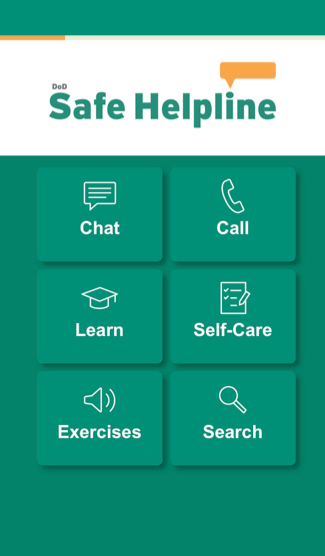
Safe Helpline app home screen

How can the Safe Helpline app help me?

We’ve designed the app to give you a way to access any resource within the app directly from the home screen.

Chat: Access one-on-one support through the Online Helpline, 24/7 and chat directly with a Safe Helpline staff member.

Call: Connect directly to a Safe Helpline staff member for one-on-one support through the Telephone Helpline, 24/7. You can choose to make the call using Voice over IP (VoIP) or by using your cellular data. Using VoIP might be a good option for Service members who are OCONUS and may not have access to cellular service in their current location.

Learn: Within this section of the Safe Helpline app, you can access our self-paced educational programs to learn how to address the effects of sexual assault, how to support a survivor and ways Safe Helpline can support you or someone you know. All of these education programs can be completed anonymously by the user. You’ll also be able to access scenarios to give you tangible ways to step-in and support others.

Self-Care: The app allows you to easily create and use a customized self-care plan with specially designed self-care exercises. Once downloaded, you can come back to view your plan and exercises at any time, even without an Internet connection.

How do the self-care plans work?

The self-care plan is created by answering a series of six questions designed to help you focus and identify how you are feeling at that moment. Questions are answered on a sliding scale of zero (never) to five (always), and the app will recommend different exercises based on your responses. There are no “good” or “bad” answers to these questions, and responses can vary from day to day, depending on how you are feeling.

Once you’ve answered the questions on the plan, the app will suggest self-care exercises. The exercises include:

  • Guided breathing
  • Guided muscle relaxation
  • Imagining yourself at the beach
  • Focusing on the present
  • Soothing sounds, such as sounds of the forest and sounds of rain falling

We recognize the importance of keeping your information safe, so we’ve also set up a security feature that allows you to lock your self-care plans behind a privacy wall using a 6-digit pin of your choosing.

Journaling:

The Safe Helpline app allows you to journal directly in the app with weekly prompts. Taking some time out of your week to journal can give you a moment for reflection and an opportunity for self-care. You can also choose to skip any prompts or just write freely depending on how you are feeling. Some of the questions include:

  • When do you feel the most energized?
  • What do you want to let go of this week?
  • What are three things that you would do if you weren’t afraid?

Like the self-care plans, the journal entries you save are protected by a privacy wall and will allow you to lock your information behind a 6-digit pin of your choosing. You can also access and refer back to your journal without an Internet connection.

Coloring Book:

Sometimes focusing on a mindless activity can help you process difficult emotions and be grounded in the present.  To help with this, another self-care activity available on the app is a collection of six designs, ranging from easy to difficult, that allow you to paint or color your own works of art.

How is the Safe Helpline app secure, and is activity on the app traceable by third parties?

As with all Safe Helpline services, your privacy is of utmost importance, and the technology behind the Safe Helpline app was created by RAINN to protect your safety and anonymity by ensuring that no personally identifiable information (PII) is collected.

The following precautions have been implemented to protect your privacy when using the app:

  • The app does not require an email address or any of your contact information when it is initially downloaded.
  • You have the ability to set up a pin code to protect the information you record in the self-care plans, the journal, and completed coloring book designs.
  • No information on how you use the app is ever collected or shared by Safe Helpline. This includes how often you use the app, who uses the app, or where you use the app.
  • If you are concerned that someone may be able to access the app, you can delete all journal entries, self-care plans, and completed coloring books by simply deleting the app.

While Safe Helpline has taken the steps outlined above to help increase the safety and anonymity of Safe Helpline app users, please remember that if you are using the app on a DoD or other work-related device, your employer may be able to track your usage of this app. In addition, similarly to a paper journal, Safe Helpline app journal entries may be admissible during court proceedings.

REPORT RETALIATION

Military Feedback Form

If you have questions, comments, or complaints about the services on your installation/base or provided by a Sexual Assault Response Coordinator (SARC), victim advocate or other military staff or personnel, please use this feedback form. You can submit the form anonymously if you prefer. The information you provide on this form will be forwarded to the DoD Sexual Assault Prevention and Response Office (SAPRO).

Retaliation

If you believe you have experienced or witnessed retaliation in any form from a peer, supervisor, or someone in your chain of command following a report of sexual assault, you can share the retaliation allegations with SAPRO using this form.

If you would like to submit a retaliation report, please report directly to the Department of Defense Inspector General (DoD IG) here.

For members of the Coast Guard who have experienced retaliation, the Department of Homeland Security (DHS) IG will accept retaliation complaints as falling within the scope of their responsibilities for Whistleblower protection. Coast Guard Members who have experienced retaliation can contact the DHS IG by calling 1-800-323-8603 (toll-free) or access the Allegation Form online.

Retaliation Reporting Options to learn more about how to report relation and your options : https://www.safehelpline.org/reporting-option

RESOURCE LINKS


For Responders

I work with Survivors

For Leadership

I am a Commander

For Supporters of Survivors

I am a Friend, Family Member, Colleague

For Service Members Leaving the Military

I am a Transitioning Service Member

For Survivors

I am a Transitioning Service Member


05 – Warmline – FP – Front Porch – Well Connected – Available 365 days a year – Free of Charge to Participants 60 and Up – Daily @ Phone and Online
Apr 15 all-day
05 - Warmline - FP - Front Porch - Well Connected - Available 365 days a year - Free of Charge to Participants 60 and Up - Daily @ Phone and Online


Welcome to Well Connected

Call us directly at 877-797-7299.

Well Connected is a nationwide phone and online community that brings people age 60+
together to learn, laugh, and share experiences from the comfort of home.

Well Connected is a Front Porch service and is free of charge to individual members Front Porch is a not-for-profit organization dedicated to empowering individuals to live connected and fulfilled lives through community and innovation.

This is a community where you can explore, laugh, learn, and share experiences, building caring friendships along the way.

Well Connected is available 365 days a year, free of charge to participants 60 and up.

Call us directly at 877-797-7299.


Find a welcoming community and opportunities to engage with other older adults by phone or online. Our rewarding offerings include art, travel, music, reading, writing, support, meditation and more.

Catalog

Register Online

These programs are available by phone and online, for free, nationwide.
Questions? We’re here to help: 877-797-7299 / [email protected]


05 – Warmline – GA – Gamblers Anonymous and more – (855) 222-5542 – Weekdays and Weekends @ Phone
Apr 15 all-day


GAMBLERS ANONYMOUS is a fellowship of men and women who share their experience, strength and hope with each other that they may solve their common problem and help others to recover from a gambling problem.

The only requirement for membership is a desire to stop gambling.

There are no dues or fees for Gamblers Anonymous membership; we are self-supporting through our own contributions. Gamblers Anonymous is not allied with any sect, denomination, politics, organization or institution; does not wish to engage in any controversy; neither endorses nor opposes any cause. Our primary purpose is to stop gambling and to help other compulsive gamblers do the same.”

From the Gamblers Anonymous Website:

Types of Meetings

Closed Meeting:
Only those with a gambling problem, or those who think they may have a gambling problem, and have a desire to stop gambling, may attend and participate.

Modified Closed Meeting:
Same as a “Closed Meeting” but the members would vote to include certain groups such as health professionals, guests attending with first time members, and persons with other addictions in need of a meeting

Open Meeting:
Spouses, family, and friends of the gambler are welcome
to attend and observe the meeting.

Chat:
https://m2.icarol.com/ConsumerRegistration.aspx?org=66046&pid=454&cc=en-US

Gamblers Anonymous:
http://www.gamblersanonymous.org/ga/locations/zip/table/0/na/na/na/21401/50?#gmap-nodemap-gmap0

National GA Telephone Meetings
Day and Time
Call-in Number and Meeting Code
Contact Email

Sunday 6pm PT
1-712-770-5338 code 836083 #
[email protected]

Monday 6pm PT
1-712-770-4925 code 554671 #
[email protected]

Tuesday 6pm PT
1-712-770-4943 code 253824 #
[email protected]

Wednesday 6pm PT
1-712-770-4160 code 611704 #
[email protected]

Thursday 6pm PT
1-712-770-4981 code 872853 #
[email protected]

Friday Noon PT
1-712-770-4979 code 703758 #
[email protected] (TBD)

Friday 6pm PT
1-712-770-4996 code 595094 #
[email protected]

Saturday 6pm PT
1-712-770-5335 code 491301 #
[email protected]

Gamblers Anonymous 12-Steps Virtual Online Support Groups in California:

https://gasteps.org/virtual-meeting-directory

Gamblers Anonymous Support Groups in Oregon:
http://www.gamblersanonymous.org/ga/locations/state/table/OR/na/na/na/na/10?#gmap-nodemap-gmap0

Gamblers Anonymous Hotlines Website:
http://www.gamblersanonymous.org/ga/hotlines

Oregon Toll-Free Hotline Number:
1-855-2CALLGA (855-222-5542)

Gam-Anon for Family and Friends Website:
http://www.gam-anon.org/
http://www.gamblersanonymous.org/ga/content/gam-anon-help-family-friends

05 – Warmline – IOA – Institute on Aging – Friendship Line – 888-670-1360 – 24/7 @ Toll Free Number
Apr 15 all-day
05 - Warmline - IOA - Institute on Aging - Friendship Line - 888-670-1360  -  24/7 @ Toll Free Number


Friendship Line

24/7 Emotional Support

Call Us Anytime: 888.670.1360

Day & Time: Daily · 24/7
Platform: Phone
Call Anytime: 888-670-1360

Description

Free, confidential emotional support through friendly conversation, active listening, and crisis intervention. The Friendship Line reduces isolation and offers real human connection—no appointments, applications, or pressure.

Who Is Eligible to Call

  • Adults age 60+

    • Adults with disabilities (any age)

    • Caregivers seeking emotional support or guidance

    Primary service focus is California; callers from outside the state are welcomed.

What’s Available

  • Friendly conversation & emotional support

    • Crisis intervention & suicide prevention

    • Grief and loss support

    • Ongoing outreach / regular check-in calls (by request)

Registration & Provider

Registration Link: https://www.ioaging.org/services/friendship-line/

Provider Website: https://www.ioaging.org