PeerGalaxy Original Calendar

Welcome to PeerGalaxy Calendar featuring over 336,800+ monthly offerings of FREE telephone- and online-accessible peer support, recovery support, and wellness activities!  Plus 50+ warmlines, helplines, chatlines, and hotlines.  Plus workshops, webinars, job postings, resources, observances, special events, consumer input opportunities and more.

WE ARE PEER FOR YOU!

Click the Accessibility Button on the right side, halfway down in the middle, for enhanced viewing and/or access options!  Click the Translate Button in the lower left corner for language options. 

Your use of this site is subject to the Privacy Policy, Terms and Conditions of Use.

If you have an event to add, email us: [email protected]

Training Opportunities in July 2020
List Provided Courtesy of State of Oregon, Oregon Health Authority
Click here to download PDF Format, 16 pages

Calendar Event Sorting

At the top, the 24/7/365 SAMHSA Disaster Helpline and similar links.

Next, Bundled “All Day” Events

Some organizations (like 12 step recovery programs, AA, NA, AlAnon, etc.) have so many events happening throughout the day that they need to be in a bundled listing to spare endless scrolling.  Often there is a link to look up events by zip code and other criteria.

Lastly, Time-Specific Events

So you can see what’s happening in the next hours, time specific events are tagged and listed by start time from 12:01am early morning to 11:59pm late night.  There can be events and warmlines operating in different time zones, though we try to list all in Oregon’s Pacific Time Zone.

Page Advancement

The calendar displays ~50 listings per page.  To advance to next page with ~50 more listings, click the right arrow in the lower left corner of the calendar


Screenshot image of the page advancing arrows at the bottom of the calendar, lower left corner.
Aug
12
Wed
2026
01 – Helpline – CTL – Crisis Text Line – Text Connect to 741741, Chat, Whatsapp – 24/7 @ Text Line
Aug 12 all-day


CRISIS TEXT LINE

Text Connect to 741741 for free confidential Support

Crisis Text Line serves anyone facing mental health challenges, providing access to free, 24/7, confidential support through communication channels people know and trust.


Share 741741

Crisis Text Line provides free, 24/7 support via text message. We spend our days (and nights!) helping texters and how we can reach people in their moments of crisis. And, we couldn’t do it without you! Use these digital assets and printable materials to get the word out about 741741.

What To Know

Before you paint the town 741741, there are a few things you should know about Crisis Text Line. Here’s the nitty-gritty:

What is Crisis Text Line? Crisis Text Line is free, 24/7 crisis support by text message.

How does it work? When someone is in crisis, they can text HOME to 741741 to connect with a Crisis Counselor who will help them move from a hot moment to cool and calm.

Who are Crisis Counselors? They are trained volunteers who—with the support of full-time Crisis Text Line staff—use active listening, collaborative problem solving, and safety planning to help texters in their moment of crisis.


05 – Helpline – CTL – Crisis Text Line – How to Cope with Self Harm – Text Connect to 741741 for free confidential support – 24/7 @ Text Line
Aug 12 all-day


How to Cope with Self Harm

Text Connect to 741741 for free confidential Support

We all need healthy ways to cope with the hard stuff. We’re here to help you find a healthy alternative to self-harm.


Understanding Self-Harm

For some people, when depression and anxiety lead to a tornado of emotions, they turn to self-harm looking for a release. Self-harm and self-injury are any forms of hurting oneself to cope. Sometimes, when people self-harm, they do not do so as a suicide attempt. Rather, they inflict pain as a way to release painful emotions.

Common Types of Self-Harm

Self-harm can manifest differently for everyone. And, the ways people may inflict harm upon themselves extend far beyond the usual news media references such as cutting. Simply, self-harm is anything and everything someone can do to purposely hurt their body.

Here are some of the most common types of self-injury:

  • Cutting
  • Scratching
  • Burning
  • Carving words or symbols into the skin
  • Hitting or punching oneself (including banging one’s head or other body parts against another surface)
  • Piercing the skin with sharp objects such as hairpins
  • Pulling out hair
  • Picking at existing wounds

Recognizing the Signs of Self-Harm

Stigma creates shame and embarrassment, making it hard for people who self harm to get help. So, look out for yourself and for your pals. If you suspect that someone in your life is doing it, here are some warning signs to keep top of mind:

  • Scars
  • Fresh cuts, burns, scratches, or bruises
  • Rubbing an area excessively to create a burn
  • Having sharp objects on hand
  • Wearing long sleeves or long pants, even in hot weather
  • Difficulties with interpersonal relationships
  • Persistent questions about personal identity
  • Behavioral and emotional instability, impulsiveness, or unpredictability
  • Saying that they feel helpless, hopeless, or worthless

Crisis Text Line can help you deal with self-injury. Text a Crisis Counselor at 741741, or use the mobile text button below.

How to Cope With Self-Harm

Emotions can be really painful sometimes. It’s totally normal to need ways to cope with and process the hard things in your life. If you are using harming yourself to manage your emotions, we’re here for you. And, we want to help keep you safe.

Here are some ways to push through, process, and cope with your emotions.

  • Text someone you trust or a counselor to help you cool down. If you’re dealing with painful emotions, we’re here to help. Send us a text to connect with a real human and strategize healthy coping mechanisms to manage your emotions. Text CONNECT to 741741 to  reach a real human.
  • Get creative.  Did you know that  making art can help people process emotions? So, next time you’re feeling like harming yourself, grab your sharpie and doodle your worries away. A bonus: you can totally suck at it and still reap the same rewards.
  • Meditate or breathe deeply. Keeping yourself safe from self-injury is all about finding healthy alternatives to work through the hard stuff. Researchers found taking time to re-center through meditation to be a powerful way to find your cool and calm. Try using an app like Headspace to get on the meditation bandwagon.
  • Talk to a professional. Self-injury of any form is serious. And, while the intention behind self-injury usually is not death, it can still be dangerous—both physically and emotionally. Talking to someone who can help you find alternatives is incredibly important. Of course, you can start by texting us. Also, consider telling someone you know who can help you connect with a professional.

Why Do People Self-Harm?

Let’s start with this: everyone needs a way to cope with their emotions. People who have turned to hurting themselves as their coping mechanism to manage their emotions.

So, people might self-harm to:

  • Process difficult emotions
  • Distract themselves from their negative feelings
  • Feel something physical, particularly if they are feeling numb
  • Develop a sense of control over their lives
  • Punish themselves for perceived faults
  • Express emotions that they are unable to share

Effects of Self-Harm

Self-harm can be seriously dangerous—physically, emotionally, socially, all of it.

Physical Effects of Self-Harm

  • Permanent scars
  • Uncontrolled bleeding
  • Risk of infection or severe injury

Emotional Effects of Self-Harm

  • Guilt, shame, or emotional numbness
  • A diminished sense of self, including feeling helpless or worthless
  • Addiction to the behavior

Social Effects of Self-Harm

  • Avoiding friends and loved ones
  • Becoming ostracized from loved ones who may not understand
  • Interpersonal difficulty from lying to others about injuries

Recovering from Self-Harm

A lot of people who self-harm do so because they are dealing with painful emotions. If this applies to you—we believe in you and recognize your pain. Because painful emotions are at the root of it, quite often recovering involves addressing emotions.

Breaking away from the cycle of harming yourself can feel like a huge climb. It involves breaking a habit that has once brought comfort from pain. But, it is not impossible. Here are some steps to set you up for success:

  • Understand your triggers. Name your reason for hurting yourself and your reason for quitting. Ask yourself: “What do I feel before, during, and after self-injury? Which of those emotions do I actively seek out, and which are harmful?”
  • Replace harmful behaviors. For example, if you harm yourself for the physical sensation, seek other ways of releasing endorphins, like exercise. For real, try throwing a few punches at a kickboxing class or tapping it back in a spin class with the *perfect* playlist. If you SH to express your emotions, practice expressing them in words by writing them down. Grab a pen and your favorite notebook, or start typing away in your notes app.
  • Address underlying emotions. Explore the feelings that lead you to want to hurt yourself. If it’s guilt, where is that guilt coming from? Maybe try finding a therapist—there are pros trained specifically to help with this.
  • Build a support system. Let a friend, family member, or trusted adult know what you’re going through and that you need their support. Opening up to people can be easier said than done. Here’s a place to start: “I’m having a hard time processing some painful emotions and I could use your support right now.”

Getting healthy—both in your brain and in your body—takes hard work. You got this. And, we believe in you.

Text a Crisis Counselor at 741471 or use the mobile click to text button below.  Crisis Text Line is free, 24/7 and confidential. You’re not alone.


05 – Warmline – DoD – Department of Defense – Safe Helpline – Helpline 877-995-5247, One-On-One Chat, Report Retaliation, Resources – 24/7 @ Phone, Text
Aug 12 all-day


SAFE Helpline Number on Black background


DoD Safe Helpline is the sole secure, confidential, and anonymous crisis support service specially designed for members of the Department of Defense community affected by sexual assault.

Safe Helpline Serves

Active Duty Army, Navy, Marine Corps, and Air Force Reserve component (Army National Guard, Army Reserve, Navy Reserve, Marine Corps Reserve, Air National Guard, Air Force Reserve, and DHS’s Coast Guard Reserve) members and their families.


Telephone Helpline

Need help?

Call 877-995-5247 to be connected with a trained, confidential
Safe Helpline staff member, 24/7.

DSN users can call Safe Helpline by dialing 877-995-5247.

For those unable to call toll-free or DSN, call 202-540-5962.

OCONUS Service members can call the Telephone Helpline for free from
anywhere in the world by using Voice over IP (VoIP) technology from
theSafe Helpline App.

live-help-img

Online Helpline

Need help?

Visitonline.safehelpline.org or download the Safe Helpline
app
to chat one-on-one with a trained Safe Helpline staff member
through an anonymous, secure instant-messaging format 24/7.

How can the Online Helpline help me?

You can chat one-on-one with a Safe Helpline staff member
to access a range of support services including:

  • Anonymous, confidential, crisis intervention services
  • Emotional support
  • Referrals to both military and civilian resources in your area— sexual assault response coordinators (SARCs)/sexual assault prevention and response victim advocates (SAPR VAs), Chaplain, Legal, Medical/Behavioral health care services, military police, Veterans Crisis Line, local civilian sexual assault service providers, and many others.
  • Information on military-specific policies, such as reporting options (Restricted and Unrestricted)
  • Information for family and friends of survivors
  • Information for leadership

Safe Helpline App

Safe Helpline appWhat is the Safe Helpline app?

Itunes Store Badge      Google play icon

The Safe Helpline app is a free mobile resource created to meet the unique needs of members of the Department of Defense community affected by sexual assault. By downloading the app, you can access 24/7 support through Safe Helpline’s Telephone and Online Helplines, get information and resources to help address the short- and long-term effects of sexual assault, as well as practical exercises, to help you manage your self-care. We also recognize that for many survivors stationed outside of the United States (OCONUS) additional limitations may arise when accessing resources, which is why the Safe Helpline app has been designed to give survivors access to a variety of support services and self-care exercises in a free, and convenient way.
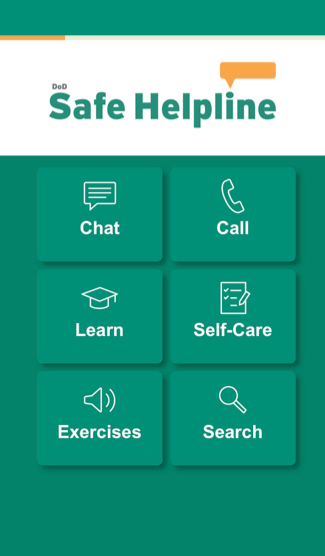
Safe Helpline app home screen

How can the Safe Helpline app help me?

We’ve designed the app to give you a way to access any resource within the app directly from the home screen.

Chat: Access one-on-one support through the Online Helpline, 24/7 and chat directly with a Safe Helpline staff member.

Call: Connect directly to a Safe Helpline staff member for one-on-one support through the Telephone Helpline, 24/7. You can choose to make the call using Voice over IP (VoIP) or by using your cellular data. Using VoIP might be a good option for Service members who are OCONUS and may not have access to cellular service in their current location.

Learn: Within this section of the Safe Helpline app, you can access our self-paced educational programs to learn how to address the effects of sexual assault, how to support a survivor and ways Safe Helpline can support you or someone you know. All of these education programs can be completed anonymously by the user. You’ll also be able to access scenarios to give you tangible ways to step-in and support others.

Self-Care: The app allows you to easily create and use a customized self-care plan with specially designed self-care exercises. Once downloaded, you can come back to view your plan and exercises at any time, even without an Internet connection.

How do the self-care plans work?

The self-care plan is created by answering a series of six questions designed to help you focus and identify how you are feeling at that moment. Questions are answered on a sliding scale of zero (never) to five (always), and the app will recommend different exercises based on your responses. There are no “good” or “bad” answers to these questions, and responses can vary from day to day, depending on how you are feeling.

Once you’ve answered the questions on the plan, the app will suggest self-care exercises. The exercises include:

  • Guided breathing
  • Guided muscle relaxation
  • Imagining yourself at the beach
  • Focusing on the present
  • Soothing sounds, such as sounds of the forest and sounds of rain falling

We recognize the importance of keeping your information safe, so we’ve also set up a security feature that allows you to lock your self-care plans behind a privacy wall using a 6-digit pin of your choosing.

Journaling:

The Safe Helpline app allows you to journal directly in the app with weekly prompts. Taking some time out of your week to journal can give you a moment for reflection and an opportunity for self-care. You can also choose to skip any prompts or just write freely depending on how you are feeling. Some of the questions include:

  • When do you feel the most energized?
  • What do you want to let go of this week?
  • What are three things that you would do if you weren’t afraid?

Like the self-care plans, the journal entries you save are protected by a privacy wall and will allow you to lock your information behind a 6-digit pin of your choosing. You can also access and refer back to your journal without an Internet connection.

Coloring Book:

Sometimes focusing on a mindless activity can help you process difficult emotions and be grounded in the present.  To help with this, another self-care activity available on the app is a collection of six designs, ranging from easy to difficult, that allow you to paint or color your own works of art.

How is the Safe Helpline app secure, and is activity on the app traceable by third parties?

As with all Safe Helpline services, your privacy is of utmost importance, and the technology behind the Safe Helpline app was created by RAINN to protect your safety and anonymity by ensuring that no personally identifiable information (PII) is collected.

The following precautions have been implemented to protect your privacy when using the app:

  • The app does not require an email address or any of your contact information when it is initially downloaded.
  • You have the ability to set up a pin code to protect the information you record in the self-care plans, the journal, and completed coloring book designs.
  • No information on how you use the app is ever collected or shared by Safe Helpline. This includes how often you use the app, who uses the app, or where you use the app.
  • If you are concerned that someone may be able to access the app, you can delete all journal entries, self-care plans, and completed coloring books by simply deleting the app.

While Safe Helpline has taken the steps outlined above to help increase the safety and anonymity of Safe Helpline app users, please remember that if you are using the app on a DoD or other work-related device, your employer may be able to track your usage of this app. In addition, similarly to a paper journal, Safe Helpline app journal entries may be admissible during court proceedings.

REPORT RETALIATION

Military Feedback Form

If you have questions, comments, or complaints about the services on your installation/base or provided by a Sexual Assault Response Coordinator (SARC), victim advocate or other military staff or personnel, please use this feedback form. You can submit the form anonymously if you prefer. The information you provide on this form will be forwarded to the DoD Sexual Assault Prevention and Response Office (SAPRO).

Retaliation

If you believe you have experienced or witnessed retaliation in any form from a peer, supervisor, or someone in your chain of command following a report of sexual assault, you can share the retaliation allegations with SAPRO using this form.

If you would like to submit a retaliation report, please report directly to the Department of Defense Inspector General (DoD IG) here.

For members of the Coast Guard who have experienced retaliation, the Department of Homeland Security (DHS) IG will accept retaliation complaints as falling within the scope of their responsibilities for Whistleblower protection. Coast Guard Members who have experienced retaliation can contact the DHS IG by calling 1-800-323-8603 (toll-free) or access the Allegation Form online.

Retaliation Reporting Options to learn more about how to report relation and your options : https://www.safehelpline.org/reporting-option

RESOURCE LINKS


For Responders

I work with Survivors

For Leadership

I am a Commander

For Supporters of Survivors

I am a Friend, Family Member, Colleague

For Service Members Leaving the Military

I am a Transitioning Service Member

For Survivors

I am a Transitioning Service Member


05 – Warmline – V4W – VETS4WARRIORS – Confidential Peer Support – 855-838 -8255 – Chat, Email, Request a Call – 24/7 – Weekdays & Weekends @ Phone
Aug 12 all-day
05 - Warmline - V4W -  VETS4WARRIORS - Confidential Peer Support - 855-838 -8255 - Chat, Email, Request a Call - 24/7 - Weekdays & Weekends @ Phone


VETS4WARRIORS

884-838-8255

Vets4Warriors is the nation’s leading 24/7 military peer support program staffed by veterans. We provide immediate, confidential, ongoing support to every member of the US military community, helping before challenges turn into crises.


Call

855-838-8255

Someone is available right now to answer your call Speak to a Veteran Support Specialist 24/7/365 Confidential peer support and resources for the military community

Chat, Email, Request A Call

Go to this Link to chat live with a peer, connect by email, or request a call. A peer will contact you as soon as possible.

CONNECT TESTIMONIALS

WARRIOR STORIES

Our stories are what keep us connected

USE THIS LINK FOR STORIES ABOUT OUR VETERANS


NEWS ROOM

Watch Connect, and Share

USE THIS LINK FOR VIDEO THAT INSPIRE AND CONNECT

Video Gallery


LRSR – LifeRing Secular Recovery – 24 Hour Recovery Chat Room – 24/7 @ Online Via Zoom
Aug 12 all-day
LRSR - LifeRing Secular Recovery - 24 Hour Recovery Chat Room - 24/7 @ Online Via Zoom


 LifeRing Secular Recovery

24 Hour Recovery Chat Room

 LifeRing Secular Recovery is an organization of people who share practical experiences and sobriety support. There are as many ways to live free of illicit or non-medically indicated drugs and alcohol as there are stories of successful sober people.

Many LifeRing members attend other kinds of meetings or recovery programs, and we honor those decisions. Our meetings, whether in person or online, consist of addicts using their Sober Self to connect with the Sober Self of other addicts. We share advice, understanding, and encouragement. We focus primarily on our current lives, not on the hurts and damages of the past. Two addicts, talking Sober-Self to Sober-Self, learn from each other, and gain strength from each other.


Chat Room

To enter the 24-hour Chat Room by clicking on the above or using this link: https://meet56243352.adobeconnect.com/r522ss7kd94t/.

A chat registration screen will first appear. Enter your personalized screenname to enter the room.  This chat room is sometimes not hosted so be cautious of whom you are talking to and never give out any personal information.

For Guidelines on chat room rules, download the LifeRing Document

For help, email [email protected]

SC – Senior Chatters – Senior Chat Rooms For Just the Over 50’s
Aug 12 all-day
SC - Senior Chatters - Senior Chat Rooms For Just the Over 50's


Senior Chatters – Online Community for 50+

About Senior Chatters:
Senior Chatters is a free, members-only online platform for people aged 50 and over. vv

Join the Community:

  1. Go to the registration page: https://seniorchatters.co.uk/register/
  2. Enter your email, confirm it, create a password, and choose a nickname.
  3. Submit the form to create your account.
  4. Log in and start chatting in the chat rooms or private messages.

Key Features:

  • Chat Rooms: Real-time conversations with peers in age-specific rooms.
  • Private Messaging: One-on-one chats with other members.
  • Blogs & Activity Streams: Share thoughts and experiences.
  • Photo Albums: Showcase hobbies, travels, or life events.
  • Games & Quizzes: Interactive fun to engage with the community.

Safety & Moderation:
Profiles are manually checked to ensure authenticity and a secure environment free from scammers.

Learn More: https://seniorchatters.co.uk/


SC – Senior Chatters – Senior Chat Rooms For Just the Over 50’s
Aug 12 all-day
SC - Senior Chatters - Senior Chat Rooms For Just the Over 50's


Senior Chatters – Online Community for 50+

About Senior Chatters:
Senior Chatters is a free, members-only online platform for people aged 50 and over. It allows older adults to connect, socialize, and make friends through chat rooms, private messaging, and community activities in a safe and welcoming environment.

Join the Community:

  1. Go to the registration page: https://seniorchatters.co.uk/register/
  2. Enter your email, confirm it, create a password, and choose a nickname.
  3. Submit the form to create your account.
  4. Log in and start chatting in the chat rooms or private messages.

Key Features:

  • Chat Rooms: Real-time conversations with peers in age-specific rooms.
  • Private Messaging: One-on-one chats with other members.
  • Blogs & Activity Streams: Share thoughts and experiences.
  • Photo Albums: Showcase hobbies, travels, or life events.
  • Games & Quizzes: Interactive fun to engage with the community.

Safety & Moderation:
Profiles are manually checked to ensure authenticity and a secure environment free from scammers.

Learn More: https://seniorchatters.co.uk/


Stitch – Online platform for adults over 50 – virtual activities, and connection – daily @ Toll Free Number
Aug 12 all-day
Stitch - Online platform for adults over 50 - virtual activities, and connection - daily @ Toll Free Number


Stitch

Online Community for Adults 50+

About Stitch:
Stitch is a free online platform for adults over 50 to find companionship, join virtual activities, and connect with like-minded peers. It provides a safe, moderated environment for socializing without leaving home.

Join the Community:

  1. Visit the Stitch registration page: https://www.stitch.net/app/signup
  2. Enter your email, create a password, and provide basic profile details.
  3. Verify your account through the confirmation email.
  4. Log in to access online groups, virtual events, and messaging features.

Key Online Features:

  • Virtual Activities & Events: Participate in online dinners, discussion groups, webinars, and hobby-based meetups.
  • Interest-Based Online Communities: Join groups focused on topics like travel, wellness, books, or games.
  • Messaging & Forums: Chat with members individually or in group discussions to build friendships online.

Safety & Privacy:
All members are verified to be over 50, and Stitch uses secure encryption to protect personal information.

Learn More: https://www.stitch.net/


Televeda – Virtual Events and Classes @ online register for details
Aug 12 all-day
Televeda - Virtual Events and Classes @ online register for details


Televenda

Televeda offers a range of free, virtual classes designed to promote wellness, creativity, and social connection among older adults. These interactive sessions are accessible from home via any internet-enabled device, with no downloads or passwords required.

Virtual Offerings

  • Fitness & Movement: Engage in Zumba Gold, chair yoga, strength training, and Tai Chi classes tailored for all fitness levels. televeda.com

  • Creative Arts: Participate in online painting, Zentangle, and creative writing workshops that encourage self-expression and relaxation. televeda.com

  • Games & Social Activities: Join in free online bingo, brain games, and book clubs to stay mentally active and socially connected. televeda.com

How to Join

  • Create a free account at Televeda to Join use this link:   JOIN CLASS

05 – Hotline – LGBT National Help Center – LGBT National Youth Talkline – 800-246-7743 – Mon – Fri @ Phone
Aug 12 @ 11:00 am – 8:00 pm
05 - Hotline - LGBT National Help Center - LGBT National Youth Talkline - 800-246-7743 - Mon - Fri @ Phone


LGBT National Hotline
888-246-7743

Hours

Mon – Fri:
11 AM – 8 PM/pacific time
2 PM – 11 PM/eastern time


On the LGBT National Hotline, we provide a confidential safe space where callers of any age can speak about sexual orientation or gender identity/expression issues. This includes coming out issues, relationship concerns, bullying, workplace issues, HIV/AIDS anxiety, safer sex information, suicide, and much more.

Sometimes you just need to be heard. We’re here. You deserve respect, support, affirmation, and acceptance.

We don’t give advice, and we never tell you what you should do. Ultimately, those choices are yours to make, but we are here to help you on your journey.

  • Our highly trained & dedicated LGBTQIA+ volunteers are here to provide free & confidential services.
  • We offer support, information, and local resources throughout the United States and beyond.
  • We don’t report calls to outside organizations.
  • We answer all of our own calls, we don’t outsource.


CLICK HERE TO BEGIN YOUR CHAT


Aug
13
Thu
2026
01 – Helpline – CTL – Crisis Text Line – Text Connect to 741741, Chat, Whatsapp – 24/7 @ Text Line
Aug 13 all-day


CRISIS TEXT LINE

Text Connect to 741741 for free confidential Support

Crisis Text Line serves anyone facing mental health challenges, providing access to free, 24/7, confidential support through communication channels people know and trust.


Share 741741

Crisis Text Line provides free, 24/7 support via text message. We spend our days (and nights!) helping texters and how we can reach people in their moments of crisis. And, we couldn’t do it without you! Use these digital assets and printable materials to get the word out about 741741.

What To Know

Before you paint the town 741741, there are a few things you should know about Crisis Text Line. Here’s the nitty-gritty:

What is Crisis Text Line? Crisis Text Line is free, 24/7 crisis support by text message.

How does it work? When someone is in crisis, they can text HOME to 741741 to connect with a Crisis Counselor who will help them move from a hot moment to cool and calm.

Who are Crisis Counselors? They are trained volunteers who—with the support of full-time Crisis Text Line staff—use active listening, collaborative problem solving, and safety planning to help texters in their moment of crisis.


05 – Helpline – CTL – Crisis Text Line – How to Cope with Self Harm – Text Connect to 741741 for free confidential support – 24/7 @ Text Line
Aug 13 all-day


How to Cope with Self Harm

Text Connect to 741741 for free confidential Support

We all need healthy ways to cope with the hard stuff. We’re here to help you find a healthy alternative to self-harm.


Understanding Self-Harm

For some people, when depression and anxiety lead to a tornado of emotions, they turn to self-harm looking for a release. Self-harm and self-injury are any forms of hurting oneself to cope. Sometimes, when people self-harm, they do not do so as a suicide attempt. Rather, they inflict pain as a way to release painful emotions.

Common Types of Self-Harm

Self-harm can manifest differently for everyone. And, the ways people may inflict harm upon themselves extend far beyond the usual news media references such as cutting. Simply, self-harm is anything and everything someone can do to purposely hurt their body.

Here are some of the most common types of self-injury:

  • Cutting
  • Scratching
  • Burning
  • Carving words or symbols into the skin
  • Hitting or punching oneself (including banging one’s head or other body parts against another surface)
  • Piercing the skin with sharp objects such as hairpins
  • Pulling out hair
  • Picking at existing wounds

Recognizing the Signs of Self-Harm

Stigma creates shame and embarrassment, making it hard for people who self harm to get help. So, look out for yourself and for your pals. If you suspect that someone in your life is doing it, here are some warning signs to keep top of mind:

  • Scars
  • Fresh cuts, burns, scratches, or bruises
  • Rubbing an area excessively to create a burn
  • Having sharp objects on hand
  • Wearing long sleeves or long pants, even in hot weather
  • Difficulties with interpersonal relationships
  • Persistent questions about personal identity
  • Behavioral and emotional instability, impulsiveness, or unpredictability
  • Saying that they feel helpless, hopeless, or worthless

Crisis Text Line can help you deal with self-injury. Text a Crisis Counselor at 741741, or use the mobile text button below.

How to Cope With Self-Harm

Emotions can be really painful sometimes. It’s totally normal to need ways to cope with and process the hard things in your life. If you are using harming yourself to manage your emotions, we’re here for you. And, we want to help keep you safe.

Here are some ways to push through, process, and cope with your emotions.

  • Text someone you trust or a counselor to help you cool down. If you’re dealing with painful emotions, we’re here to help. Send us a text to connect with a real human and strategize healthy coping mechanisms to manage your emotions. Text CONNECT to 741741 to  reach a real human.
  • Get creative.  Did you know that  making art can help people process emotions? So, next time you’re feeling like harming yourself, grab your sharpie and doodle your worries away. A bonus: you can totally suck at it and still reap the same rewards.
  • Meditate or breathe deeply. Keeping yourself safe from self-injury is all about finding healthy alternatives to work through the hard stuff. Researchers found taking time to re-center through meditation to be a powerful way to find your cool and calm. Try using an app like Headspace to get on the meditation bandwagon.
  • Talk to a professional. Self-injury of any form is serious. And, while the intention behind self-injury usually is not death, it can still be dangerous—both physically and emotionally. Talking to someone who can help you find alternatives is incredibly important. Of course, you can start by texting us. Also, consider telling someone you know who can help you connect with a professional.

Why Do People Self-Harm?

Let’s start with this: everyone needs a way to cope with their emotions. People who have turned to hurting themselves as their coping mechanism to manage their emotions.

So, people might self-harm to:

  • Process difficult emotions
  • Distract themselves from their negative feelings
  • Feel something physical, particularly if they are feeling numb
  • Develop a sense of control over their lives
  • Punish themselves for perceived faults
  • Express emotions that they are unable to share

Effects of Self-Harm

Self-harm can be seriously dangerous—physically, emotionally, socially, all of it.

Physical Effects of Self-Harm

  • Permanent scars
  • Uncontrolled bleeding
  • Risk of infection or severe injury

Emotional Effects of Self-Harm

  • Guilt, shame, or emotional numbness
  • A diminished sense of self, including feeling helpless or worthless
  • Addiction to the behavior

Social Effects of Self-Harm

  • Avoiding friends and loved ones
  • Becoming ostracized from loved ones who may not understand
  • Interpersonal difficulty from lying to others about injuries

Recovering from Self-Harm

A lot of people who self-harm do so because they are dealing with painful emotions. If this applies to you—we believe in you and recognize your pain. Because painful emotions are at the root of it, quite often recovering involves addressing emotions.

Breaking away from the cycle of harming yourself can feel like a huge climb. It involves breaking a habit that has once brought comfort from pain. But, it is not impossible. Here are some steps to set you up for success:

  • Understand your triggers. Name your reason for hurting yourself and your reason for quitting. Ask yourself: “What do I feel before, during, and after self-injury? Which of those emotions do I actively seek out, and which are harmful?”
  • Replace harmful behaviors. For example, if you harm yourself for the physical sensation, seek other ways of releasing endorphins, like exercise. For real, try throwing a few punches at a kickboxing class or tapping it back in a spin class with the *perfect* playlist. If you SH to express your emotions, practice expressing them in words by writing them down. Grab a pen and your favorite notebook, or start typing away in your notes app.
  • Address underlying emotions. Explore the feelings that lead you to want to hurt yourself. If it’s guilt, where is that guilt coming from? Maybe try finding a therapist—there are pros trained specifically to help with this.
  • Build a support system. Let a friend, family member, or trusted adult know what you’re going through and that you need their support. Opening up to people can be easier said than done. Here’s a place to start: “I’m having a hard time processing some painful emotions and I could use your support right now.”

Getting healthy—both in your brain and in your body—takes hard work. You got this. And, we believe in you.

Text a Crisis Counselor at 741471 or use the mobile click to text button below.  Crisis Text Line is free, 24/7 and confidential. You’re not alone.


05 – Warmline – DoD – Department of Defense – Safe Helpline – Helpline 877-995-5247, One-On-One Chat, Report Retaliation, Resources – 24/7 @ Phone, Text
Aug 13 all-day


SAFE Helpline Number on Black background


DoD Safe Helpline is the sole secure, confidential, and anonymous crisis support service specially designed for members of the Department of Defense community affected by sexual assault.

Safe Helpline Serves

Active Duty Army, Navy, Marine Corps, and Air Force Reserve component (Army National Guard, Army Reserve, Navy Reserve, Marine Corps Reserve, Air National Guard, Air Force Reserve, and DHS’s Coast Guard Reserve) members and their families.


Telephone Helpline

Need help?

Call 877-995-5247 to be connected with a trained, confidential
Safe Helpline staff member, 24/7.

DSN users can call Safe Helpline by dialing 877-995-5247.

For those unable to call toll-free or DSN, call 202-540-5962.

OCONUS Service members can call the Telephone Helpline for free from
anywhere in the world by using Voice over IP (VoIP) technology from
theSafe Helpline App.

live-help-img

Online Helpline

Need help?

Visitonline.safehelpline.org or download the Safe Helpline
app
to chat one-on-one with a trained Safe Helpline staff member
through an anonymous, secure instant-messaging format 24/7.

How can the Online Helpline help me?

You can chat one-on-one with a Safe Helpline staff member
to access a range of support services including:

  • Anonymous, confidential, crisis intervention services
  • Emotional support
  • Referrals to both military and civilian resources in your area— sexual assault response coordinators (SARCs)/sexual assault prevention and response victim advocates (SAPR VAs), Chaplain, Legal, Medical/Behavioral health care services, military police, Veterans Crisis Line, local civilian sexual assault service providers, and many others.
  • Information on military-specific policies, such as reporting options (Restricted and Unrestricted)
  • Information for family and friends of survivors
  • Information for leadership

Safe Helpline App

Safe Helpline appWhat is the Safe Helpline app?

Itunes Store Badge      Google play icon

The Safe Helpline app is a free mobile resource created to meet the unique needs of members of the Department of Defense community affected by sexual assault. By downloading the app, you can access 24/7 support through Safe Helpline’s Telephone and Online Helplines, get information and resources to help address the short- and long-term effects of sexual assault, as well as practical exercises, to help you manage your self-care. We also recognize that for many survivors stationed outside of the United States (OCONUS) additional limitations may arise when accessing resources, which is why the Safe Helpline app has been designed to give survivors access to a variety of support services and self-care exercises in a free, and convenient way.

Safe Helpline app home screen

How can the Safe Helpline app help me?

We’ve designed the app to give you a way to access any resource within the app directly from the home screen.

Chat: Access one-on-one support through the Online Helpline, 24/7 and chat directly with a Safe Helpline staff member.

Call: Connect directly to a Safe Helpline staff member for one-on-one support through the Telephone Helpline, 24/7. You can choose to make the call using Voice over IP (VoIP) or by using your cellular data. Using VoIP might be a good option for Service members who are OCONUS and may not have access to cellular service in their current location.

Learn: Within this section of the Safe Helpline app, you can access our self-paced educational programs to learn how to address the effects of sexual assault, how to support a survivor and ways Safe Helpline can support you or someone you know. All of these education programs can be completed anonymously by the user. You’ll also be able to access scenarios to give you tangible ways to step-in and support others.

Self-Care: The app allows you to easily create and use a customized self-care plan with specially designed self-care exercises. Once downloaded, you can come back to view your plan and exercises at any time, even without an Internet connection.

How do the self-care plans work?

The self-care plan is created by answering a series of six questions designed to help you focus and identify how you are feeling at that moment. Questions are answered on a sliding scale of zero (never) to five (always), and the app will recommend different exercises based on your responses. There are no “good” or “bad” answers to these questions, and responses can vary from day to day, depending on how you are feeling.

Once you’ve answered the questions on the plan, the app will suggest self-care exercises. The exercises include:

  • Guided breathing
  • Guided muscle relaxation
  • Imagining yourself at the beach
  • Focusing on the present
  • Soothing sounds, such as sounds of the forest and sounds of rain falling

We recognize the importance of keeping your information safe, so we’ve also set up a security feature that allows you to lock your self-care plans behind a privacy wall using a 6-digit pin of your choosing.

Journaling:

The Safe Helpline app allows you to journal directly in the app with weekly prompts. Taking some time out of your week to journal can give you a moment for reflection and an opportunity for self-care. You can also choose to skip any prompts or just write freely depending on how you are feeling. Some of the questions include:

  • When do you feel the most energized?
  • What do you want to let go of this week?
  • What are three things that you would do if you weren’t afraid?

Like the self-care plans, the journal entries you save are protected by a privacy wall and will allow you to lock your information behind a 6-digit pin of your choosing. You can also access and refer back to your journal without an Internet connection.

Coloring Book:

Sometimes focusing on a mindless activity can help you process difficult emotions and be grounded in the present.  To help with this, another self-care activity available on the app is a collection of six designs, ranging from easy to difficult, that allow you to paint or color your own works of art.

How is the Safe Helpline app secure, and is activity on the app traceable by third parties?

As with all Safe Helpline services, your privacy is of utmost importance, and the technology behind the Safe Helpline app was created by RAINN to protect your safety and anonymity by ensuring that no personally identifiable information (PII) is collected.

The following precautions have been implemented to protect your privacy when using the app:

  • The app does not require an email address or any of your contact information when it is initially downloaded.
  • You have the ability to set up a pin code to protect the information you record in the self-care plans, the journal, and completed coloring book designs.
  • No information on how you use the app is ever collected or shared by Safe Helpline. This includes how often you use the app, who uses the app, or where you use the app.
  • If you are concerned that someone may be able to access the app, you can delete all journal entries, self-care plans, and completed coloring books by simply deleting the app.

While Safe Helpline has taken the steps outlined above to help increase the safety and anonymity of Safe Helpline app users, please remember that if you are using the app on a DoD or other work-related device, your employer may be able to track your usage of this app. In addition, similarly to a paper journal, Safe Helpline app journal entries may be admissible during court proceedings.

REPORT RETALIATION

Military Feedback Form

If you have questions, comments, or complaints about the services on your installation/base or provided by a Sexual Assault Response Coordinator (SARC), victim advocate or other military staff or personnel, please use this feedback form. You can submit the form anonymously if you prefer. The information you provide on this form will be forwarded to the DoD Sexual Assault Prevention and Response Office (SAPRO).

Retaliation

If you believe you have experienced or witnessed retaliation in any form from a peer, supervisor, or someone in your chain of command following a report of sexual assault, you can share the retaliation allegations with SAPRO using this form.

If you would like to submit a retaliation report, please report directly to the Department of Defense Inspector General (DoD IG) here.

For members of the Coast Guard who have experienced retaliation, the Department of Homeland Security (DHS) IG will accept retaliation complaints as falling within the scope of their responsibilities for Whistleblower protection. Coast Guard Members who have experienced retaliation can contact the DHS IG by calling 1-800-323-8603 (toll-free) or access the Allegation Form online.

Retaliation Reporting Options to learn more about how to report relation and your options : https://www.safehelpline.org/reporting-option

RESOURCE LINKS


For Responders

I work with Survivors

For Leadership

I am a Commander

For Supporters of Survivors

I am a Friend, Family Member, Colleague

For Service Members Leaving the Military

I am a Transitioning Service Member

For Survivors

I am a Transitioning Service Member


05 – Warmline – V4W – VETS4WARRIORS – Confidential Peer Support – 855-838 -8255 – Chat, Email, Request a Call – 24/7 – Weekdays & Weekends @ Phone
Aug 13 all-day
05 - Warmline - V4W -  VETS4WARRIORS - Confidential Peer Support - 855-838 -8255 - Chat, Email, Request a Call - 24/7 - Weekdays & Weekends @ Phone


VETS4WARRIORS

884-838-8255

Vets4Warriors is the nation’s leading 24/7 military peer support program staffed by veterans. We provide immediate, confidential, ongoing support to every member of the US military community, helping before challenges turn into crises.


Call

855-838-8255

Someone is available right now to answer your call Speak to a Veteran Support Specialist 24/7/365 Confidential peer support and resources for the military community

Chat, Email, Request A Call

Go to this Link to chat live with a peer, connect by email, or request a call. A peer will contact you as soon as possible.

CONNECT TESTIMONIALS

WARRIOR STORIES

Our stories are what keep us connected

USE THIS LINK FOR STORIES ABOUT OUR VETERANS


NEWS ROOM

Watch Connect, and Share

USE THIS LINK FOR VIDEO THAT INSPIRE AND CONNECT

Video Gallery


LRSR – LifeRing Secular Recovery – 24 Hour Recovery Chat Room – 24/7 @ Online Via Zoom
Aug 13 all-day
LRSR - LifeRing Secular Recovery - 24 Hour Recovery Chat Room - 24/7 @ Online Via Zoom


 LifeRing Secular Recovery

24 Hour Recovery Chat Room

 LifeRing Secular Recovery is an organization of people who share practical experiences and sobriety support. There are as many ways to live free of illicit or non-medically indicated drugs and alcohol as there are stories of successful sober people.

Many LifeRing members attend other kinds of meetings or recovery programs, and we honor those decisions. Our meetings, whether in person or online, consist of addicts using their Sober Self to connect with the Sober Self of other addicts. We share advice, understanding, and encouragement. We focus primarily on our current lives, not on the hurts and damages of the past. Two addicts, talking Sober-Self to Sober-Self, learn from each other, and gain strength from each other.


Chat Room

To enter the 24-hour Chat Room by clicking on the above or using this link: https://meet56243352.adobeconnect.com/r522ss7kd94t/.

A chat registration screen will first appear. Enter your personalized screenname to enter the room.  This chat room is sometimes not hosted so be cautious of whom you are talking to and never give out any personal information.

For Guidelines on chat room rules, download the LifeRing Document

For help, email [email protected]

SC – Senior Chatters – Senior Chat Rooms For Just the Over 50’s
Aug 13 all-day
SC - Senior Chatters - Senior Chat Rooms For Just the Over 50's


Senior Chatters – Online Community for 50+

About Senior Chatters:
Senior Chatters is a free, members-only online platform for people aged 50 and over. vv

Join the Community:

  1. Go to the registration page: https://seniorchatters.co.uk/register/
  2. Enter your email, confirm it, create a password, and choose a nickname.
  3. Submit the form to create your account.
  4. Log in and start chatting in the chat rooms or private messages.

Key Features:

  • Chat Rooms: Real-time conversations with peers in age-specific rooms.
  • Private Messaging: One-on-one chats with other members.
  • Blogs & Activity Streams: Share thoughts and experiences.
  • Photo Albums: Showcase hobbies, travels, or life events.
  • Games & Quizzes: Interactive fun to engage with the community.

Safety & Moderation:
Profiles are manually checked to ensure authenticity and a secure environment free from scammers.

Learn More: https://seniorchatters.co.uk/


SC – Senior Chatters – Senior Chat Rooms For Just the Over 50’s
Aug 13 all-day
SC - Senior Chatters - Senior Chat Rooms For Just the Over 50's


Senior Chatters – Online Community for 50+

About Senior Chatters:
Senior Chatters is a free, members-only online platform for people aged 50 and over. It allows older adults to connect, socialize, and make friends through chat rooms, private messaging, and community activities in a safe and welcoming environment.

Join the Community:

  1. Go to the registration page: https://seniorchatters.co.uk/register/
  2. Enter your email, confirm it, create a password, and choose a nickname.
  3. Submit the form to create your account.
  4. Log in and start chatting in the chat rooms or private messages.

Key Features:

  • Chat Rooms: Real-time conversations with peers in age-specific rooms.
  • Private Messaging: One-on-one chats with other members.
  • Blogs & Activity Streams: Share thoughts and experiences.
  • Photo Albums: Showcase hobbies, travels, or life events.
  • Games & Quizzes: Interactive fun to engage with the community.

Safety & Moderation:
Profiles are manually checked to ensure authenticity and a secure environment free from scammers.

Learn More: https://seniorchatters.co.uk/


Stitch – Online platform for adults over 50 – virtual activities, and connection – daily @ Toll Free Number
Aug 13 all-day
Stitch - Online platform for adults over 50 - virtual activities, and connection - daily @ Toll Free Number


Stitch

Online Community for Adults 50+

About Stitch:
Stitch is a free online platform for adults over 50 to find companionship, join virtual activities, and connect with like-minded peers. It provides a safe, moderated environment for socializing without leaving home.

Join the Community:

  1. Visit the Stitch registration page: https://www.stitch.net/app/signup
  2. Enter your email, create a password, and provide basic profile details.
  3. Verify your account through the confirmation email.
  4. Log in to access online groups, virtual events, and messaging features.

Key Online Features:

  • Virtual Activities & Events: Participate in online dinners, discussion groups, webinars, and hobby-based meetups.
  • Interest-Based Online Communities: Join groups focused on topics like travel, wellness, books, or games.
  • Messaging & Forums: Chat with members individually or in group discussions to build friendships online.

Safety & Privacy:
All members are verified to be over 50, and Stitch uses secure encryption to protect personal information.

Learn More: https://www.stitch.net/


Televeda – Virtual Events and Classes @ online register for details
Aug 13 all-day
Televeda - Virtual Events and Classes @ online register for details


Televenda

Televeda offers a range of free, virtual classes designed to promote wellness, creativity, and social connection among older adults. These interactive sessions are accessible from home via any internet-enabled device, with no downloads or passwords required.

Virtual Offerings

  • Fitness & Movement: Engage in Zumba Gold, chair yoga, strength training, and Tai Chi classes tailored for all fitness levels. televeda.com

  • Creative Arts: Participate in online painting, Zentangle, and creative writing workshops that encourage self-expression and relaxation. televeda.com

  • Games & Social Activities: Join in free online bingo, brain games, and book clubs to stay mentally active and socially connected. televeda.com

How to Join

  • Create a free account at Televeda to Join use this link:   JOIN CLASS

05 – Hotline – LGBT National Help Center – LGBT National Youth Talkline – 800-246-7743 – Mon – Fri @ Phone
Aug 13 @ 11:00 am – 8:00 pm
05 - Hotline - LGBT National Help Center - LGBT National Youth Talkline - 800-246-7743 - Mon - Fri @ Phone


LGBT National Hotline
888-246-7743

Hours

Mon – Fri:
11 AM – 8 PM/pacific time
2 PM – 11 PM/eastern time


On the LGBT National Hotline, we provide a confidential safe space where callers of any age can speak about sexual orientation or gender identity/expression issues. This includes coming out issues, relationship concerns, bullying, workplace issues, HIV/AIDS anxiety, safer sex information, suicide, and much more.

Sometimes you just need to be heard. We’re here. You deserve respect, support, affirmation, and acceptance.

We don’t give advice, and we never tell you what you should do. Ultimately, those choices are yours to make, but we are here to help you on your journey.

  • Our highly trained & dedicated LGBTQIA+ volunteers are here to provide free & confidential services.
  • We offer support, information, and local resources throughout the United States and beyond.
  • We don’t report calls to outside organizations.
  • We answer all of our own calls, we don’t outsource.


CLICK HERE TO BEGIN YOUR CHAT


Advocates – Afternoon Peer Support Group – Thursdays @ Online Via ZOOM
Aug 13 @ 12:00 pm – 1:00 pm
Advocates - Afternoon Peer Support Group - Thursdays @ Online Via ZOOM

Afternoon Peer Support

11AM to 12PM PST


General support for whatever guests would like or need to talk about!

  • Facilitator: Mark Durkin

  • Zoom Link

  • Zoom Meeting ID: 967 6536 7014

  • Zoom Passcode: 971127

  • Zoom Dial-in: 1 646 558 8656


Advocates -Alternate Perceptions: A Hearing Voices Network Group – Thursdays @ Online Via ZOOM
Aug 13 @ 12:00 pm – 1:00 pm
Advocates -Alternate Perceptions: A Hearing Voices Network Group - Thursdays @ Online Via ZOOM


Alternate Perceptions: A Hearing Voices Network Group

Thursdays 12 – 1PM PST

A space for people to speak and connect over experiencing reality in ways that others may not perceive.

Open, but not limited to those who may hear, see or feel things that others do not or those who have beliefs that may not fit into the mainstream belief system.

Aug
14
Fri
2026
01 – Helpline – CTL – Crisis Text Line – Text Connect to 741741, Chat, Whatsapp – 24/7 @ Text Line
Aug 14 all-day


CRISIS TEXT LINE

Text Connect to 741741 for free confidential Support

Crisis Text Line serves anyone facing mental health challenges, providing access to free, 24/7, confidential support through communication channels people know and trust.


Share 741741

Crisis Text Line provides free, 24/7 support via text message. We spend our days (and nights!) helping texters and how we can reach people in their moments of crisis. And, we couldn’t do it without you! Use these digital assets and printable materials to get the word out about 741741.

What To Know

Before you paint the town 741741, there are a few things you should know about Crisis Text Line. Here’s the nitty-gritty:

What is Crisis Text Line? Crisis Text Line is free, 24/7 crisis support by text message.

How does it work? When someone is in crisis, they can text HOME to 741741 to connect with a Crisis Counselor who will help them move from a hot moment to cool and calm.

Who are Crisis Counselors? They are trained volunteers who—with the support of full-time Crisis Text Line staff—use active listening, collaborative problem solving, and safety planning to help texters in their moment of crisis.


05 – Helpline – CTL – Crisis Text Line – How to Cope with Self Harm – Text Connect to 741741 for free confidential support – 24/7 @ Text Line
Aug 14 all-day


How to Cope with Self Harm

Text Connect to 741741 for free confidential Support

We all need healthy ways to cope with the hard stuff. We’re here to help you find a healthy alternative to self-harm.


Understanding Self-Harm

For some people, when depression and anxiety lead to a tornado of emotions, they turn to self-harm looking for a release. Self-harm and self-injury are any forms of hurting oneself to cope. Sometimes, when people self-harm, they do not do so as a suicide attempt. Rather, they inflict pain as a way to release painful emotions.

Common Types of Self-Harm

Self-harm can manifest differently for everyone. And, the ways people may inflict harm upon themselves extend far beyond the usual news media references such as cutting. Simply, self-harm is anything and everything someone can do to purposely hurt their body.

Here are some of the most common types of self-injury:

  • Cutting
  • Scratching
  • Burning
  • Carving words or symbols into the skin
  • Hitting or punching oneself (including banging one’s head or other body parts against another surface)
  • Piercing the skin with sharp objects such as hairpins
  • Pulling out hair
  • Picking at existing wounds

Recognizing the Signs of Self-Harm

Stigma creates shame and embarrassment, making it hard for people who self harm to get help. So, look out for yourself and for your pals. If you suspect that someone in your life is doing it, here are some warning signs to keep top of mind:

  • Scars
  • Fresh cuts, burns, scratches, or bruises
  • Rubbing an area excessively to create a burn
  • Having sharp objects on hand
  • Wearing long sleeves or long pants, even in hot weather
  • Difficulties with interpersonal relationships
  • Persistent questions about personal identity
  • Behavioral and emotional instability, impulsiveness, or unpredictability
  • Saying that they feel helpless, hopeless, or worthless

Crisis Text Line can help you deal with self-injury. Text a Crisis Counselor at 741741, or use the mobile text button below.

How to Cope With Self-Harm

Emotions can be really painful sometimes. It’s totally normal to need ways to cope with and process the hard things in your life. If you are using harming yourself to manage your emotions, we’re here for you. And, we want to help keep you safe.

Here are some ways to push through, process, and cope with your emotions.

  • Text someone you trust or a counselor to help you cool down. If you’re dealing with painful emotions, we’re here to help. Send us a text to connect with a real human and strategize healthy coping mechanisms to manage your emotions. Text CONNECT to 741741 to  reach a real human.
  • Get creative.  Did you know that  making art can help people process emotions? So, next time you’re feeling like harming yourself, grab your sharpie and doodle your worries away. A bonus: you can totally suck at it and still reap the same rewards.
  • Meditate or breathe deeply. Keeping yourself safe from self-injury is all about finding healthy alternatives to work through the hard stuff. Researchers found taking time to re-center through meditation to be a powerful way to find your cool and calm. Try using an app like Headspace to get on the meditation bandwagon.
  • Talk to a professional. Self-injury of any form is serious. And, while the intention behind self-injury usually is not death, it can still be dangerous—both physically and emotionally. Talking to someone who can help you find alternatives is incredibly important. Of course, you can start by texting us. Also, consider telling someone you know who can help you connect with a professional.

Why Do People Self-Harm?

Let’s start with this: everyone needs a way to cope with their emotions. People who have turned to hurting themselves as their coping mechanism to manage their emotions.

So, people might self-harm to:

  • Process difficult emotions
  • Distract themselves from their negative feelings
  • Feel something physical, particularly if they are feeling numb
  • Develop a sense of control over their lives
  • Punish themselves for perceived faults
  • Express emotions that they are unable to share

Effects of Self-Harm

Self-harm can be seriously dangerous—physically, emotionally, socially, all of it.

Physical Effects of Self-Harm

  • Permanent scars
  • Uncontrolled bleeding
  • Risk of infection or severe injury

Emotional Effects of Self-Harm

  • Guilt, shame, or emotional numbness
  • A diminished sense of self, including feeling helpless or worthless
  • Addiction to the behavior

Social Effects of Self-Harm

  • Avoiding friends and loved ones
  • Becoming ostracized from loved ones who may not understand
  • Interpersonal difficulty from lying to others about injuries

Recovering from Self-Harm

A lot of people who self-harm do so because they are dealing with painful emotions. If this applies to you—we believe in you and recognize your pain. Because painful emotions are at the root of it, quite often recovering involves addressing emotions.

Breaking away from the cycle of harming yourself can feel like a huge climb. It involves breaking a habit that has once brought comfort from pain. But, it is not impossible. Here are some steps to set you up for success:

  • Understand your triggers. Name your reason for hurting yourself and your reason for quitting. Ask yourself: “What do I feel before, during, and after self-injury? Which of those emotions do I actively seek out, and which are harmful?”
  • Replace harmful behaviors. For example, if you harm yourself for the physical sensation, seek other ways of releasing endorphins, like exercise. For real, try throwing a few punches at a kickboxing class or tapping it back in a spin class with the *perfect* playlist. If you SH to express your emotions, practice expressing them in words by writing them down. Grab a pen and your favorite notebook, or start typing away in your notes app.
  • Address underlying emotions. Explore the feelings that lead you to want to hurt yourself. If it’s guilt, where is that guilt coming from? Maybe try finding a therapist—there are pros trained specifically to help with this.
  • Build a support system. Let a friend, family member, or trusted adult know what you’re going through and that you need their support. Opening up to people can be easier said than done. Here’s a place to start: “I’m having a hard time processing some painful emotions and I could use your support right now.”

Getting healthy—both in your brain and in your body—takes hard work. You got this. And, we believe in you.

Text a Crisis Counselor at 741471 or use the mobile click to text button below.  Crisis Text Line is free, 24/7 and confidential. You’re not alone.


05 – Warmline – DoD – Department of Defense – Safe Helpline – Helpline 877-995-5247, One-On-One Chat, Report Retaliation, Resources – 24/7 @ Phone, Text
Aug 14 all-day


SAFE Helpline Number on Black background


DoD Safe Helpline is the sole secure, confidential, and anonymous crisis support service specially designed for members of the Department of Defense community affected by sexual assault.

Safe Helpline Serves

Active Duty Army, Navy, Marine Corps, and Air Force Reserve component (Army National Guard, Army Reserve, Navy Reserve, Marine Corps Reserve, Air National Guard, Air Force Reserve, and DHS’s Coast Guard Reserve) members and their families.


Telephone Helpline

Need help?

Call 877-995-5247 to be connected with a trained, confidential
Safe Helpline staff member, 24/7.

DSN users can call Safe Helpline by dialing 877-995-5247.

For those unable to call toll-free or DSN, call 202-540-5962.

OCONUS Service members can call the Telephone Helpline for free from
anywhere in the world by using Voice over IP (VoIP) technology from
theSafe Helpline App.

live-help-img

Online Helpline

Need help?

Visitonline.safehelpline.org or download the Safe Helpline
app
to chat one-on-one with a trained Safe Helpline staff member
through an anonymous, secure instant-messaging format 24/7.

How can the Online Helpline help me?

You can chat one-on-one with a Safe Helpline staff member
to access a range of support services including:

  • Anonymous, confidential, crisis intervention services
  • Emotional support
  • Referrals to both military and civilian resources in your area— sexual assault response coordinators (SARCs)/sexual assault prevention and response victim advocates (SAPR VAs), Chaplain, Legal, Medical/Behavioral health care services, military police, Veterans Crisis Line, local civilian sexual assault service providers, and many others.
  • Information on military-specific policies, such as reporting options (Restricted and Unrestricted)
  • Information for family and friends of survivors
  • Information for leadership

Safe Helpline App

Safe Helpline appWhat is the Safe Helpline app?

Itunes Store Badge      Google play icon

The Safe Helpline app is a free mobile resource created to meet the unique needs of members of the Department of Defense community affected by sexual assault. By downloading the app, you can access 24/7 support through Safe Helpline’s Telephone and Online Helplines, get information and resources to help address the short- and long-term effects of sexual assault, as well as practical exercises, to help you manage your self-care. We also recognize that for many survivors stationed outside of the United States (OCONUS) additional limitations may arise when accessing resources, which is why the Safe Helpline app has been designed to give survivors access to a variety of support services and self-care exercises in a free, and convenient way.

Safe Helpline app home screen

How can the Safe Helpline app help me?

We’ve designed the app to give you a way to access any resource within the app directly from the home screen.

Chat: Access one-on-one support through the Online Helpline, 24/7 and chat directly with a Safe Helpline staff member.

Call: Connect directly to a Safe Helpline staff member for one-on-one support through the Telephone Helpline, 24/7. You can choose to make the call using Voice over IP (VoIP) or by using your cellular data. Using VoIP might be a good option for Service members who are OCONUS and may not have access to cellular service in their current location.

Learn: Within this section of the Safe Helpline app, you can access our self-paced educational programs to learn how to address the effects of sexual assault, how to support a survivor and ways Safe Helpline can support you or someone you know. All of these education programs can be completed anonymously by the user. You’ll also be able to access scenarios to give you tangible ways to step-in and support others.

Self-Care: The app allows you to easily create and use a customized self-care plan with specially designed self-care exercises. Once downloaded, you can come back to view your plan and exercises at any time, even without an Internet connection.

How do the self-care plans work?

The self-care plan is created by answering a series of six questions designed to help you focus and identify how you are feeling at that moment. Questions are answered on a sliding scale of zero (never) to five (always), and the app will recommend different exercises based on your responses. There are no “good” or “bad” answers to these questions, and responses can vary from day to day, depending on how you are feeling.

Once you’ve answered the questions on the plan, the app will suggest self-care exercises. The exercises include:

  • Guided breathing
  • Guided muscle relaxation
  • Imagining yourself at the beach
  • Focusing on the present
  • Soothing sounds, such as sounds of the forest and sounds of rain falling

We recognize the importance of keeping your information safe, so we’ve also set up a security feature that allows you to lock your self-care plans behind a privacy wall using a 6-digit pin of your choosing.

Journaling:

The Safe Helpline app allows you to journal directly in the app with weekly prompts. Taking some time out of your week to journal can give you a moment for reflection and an opportunity for self-care. You can also choose to skip any prompts or just write freely depending on how you are feeling. Some of the questions include:

  • When do you feel the most energized?
  • What do you want to let go of this week?
  • What are three things that you would do if you weren’t afraid?

Like the self-care plans, the journal entries you save are protected by a privacy wall and will allow you to lock your information behind a 6-digit pin of your choosing. You can also access and refer back to your journal without an Internet connection.

Coloring Book:

Sometimes focusing on a mindless activity can help you process difficult emotions and be grounded in the present.  To help with this, another self-care activity available on the app is a collection of six designs, ranging from easy to difficult, that allow you to paint or color your own works of art.

How is the Safe Helpline app secure, and is activity on the app traceable by third parties?

As with all Safe Helpline services, your privacy is of utmost importance, and the technology behind the Safe Helpline app was created by RAINN to protect your safety and anonymity by ensuring that no personally identifiable information (PII) is collected.

The following precautions have been implemented to protect your privacy when using the app:

  • The app does not require an email address or any of your contact information when it is initially downloaded.
  • You have the ability to set up a pin code to protect the information you record in the self-care plans, the journal, and completed coloring book designs.
  • No information on how you use the app is ever collected or shared by Safe Helpline. This includes how often you use the app, who uses the app, or where you use the app.
  • If you are concerned that someone may be able to access the app, you can delete all journal entries, self-care plans, and completed coloring books by simply deleting the app.

While Safe Helpline has taken the steps outlined above to help increase the safety and anonymity of Safe Helpline app users, please remember that if you are using the app on a DoD or other work-related device, your employer may be able to track your usage of this app. In addition, similarly to a paper journal, Safe Helpline app journal entries may be admissible during court proceedings.

REPORT RETALIATION

Military Feedback Form

If you have questions, comments, or complaints about the services on your installation/base or provided by a Sexual Assault Response Coordinator (SARC), victim advocate or other military staff or personnel, please use this feedback form. You can submit the form anonymously if you prefer. The information you provide on this form will be forwarded to the DoD Sexual Assault Prevention and Response Office (SAPRO).

Retaliation

If you believe you have experienced or witnessed retaliation in any form from a peer, supervisor, or someone in your chain of command following a report of sexual assault, you can share the retaliation allegations with SAPRO using this form.

If you would like to submit a retaliation report, please report directly to the Department of Defense Inspector General (DoD IG) here.

For members of the Coast Guard who have experienced retaliation, the Department of Homeland Security (DHS) IG will accept retaliation complaints as falling within the scope of their responsibilities for Whistleblower protection. Coast Guard Members who have experienced retaliation can contact the DHS IG by calling 1-800-323-8603 (toll-free) or access the Allegation Form online.

Retaliation Reporting Options to learn more about how to report relation and your options : https://www.safehelpline.org/reporting-option

RESOURCE LINKS


For Responders

I work with Survivors

For Leadership

I am a Commander

For Supporters of Survivors

I am a Friend, Family Member, Colleague

For Service Members Leaving the Military

I am a Transitioning Service Member

For Survivors

I am a Transitioning Service Member