PeerGalaxy Original Calendar

Welcome to PeerGalaxy Calendar featuring over 336,800+ monthly offerings of FREE telephone- and online-accessible peer support, recovery support, and wellness activities!  Plus 50+ warmlines, helplines, chatlines, and hotlines.  Plus workshops, webinars, job postings, resources, observances, special events, consumer input opportunities and more.

WE ARE PEER FOR YOU!

Click the Accessibility Button on the right side, halfway down in the middle, for enhanced viewing and/or access options!  Click the Translate Button in the lower left corner for language options. 

Your use of this site is subject to the Privacy Policy, Terms and Conditions of Use.

If you have an event to add, email us: [email protected]

Training Opportunities in July 2020
List Provided Courtesy of State of Oregon, Oregon Health Authority
Click here to download PDF Format, 16 pages

Calendar Event Sorting

At the top, the 24/7/365 SAMHSA Disaster Helpline and similar links.

Next, Bundled “All Day” Events

Some organizations (like 12 step recovery programs, AA, NA, AlAnon, etc.) have so many events happening throughout the day that they need to be in a bundled listing to spare endless scrolling.  Often there is a link to look up events by zip code and other criteria.

Lastly, Time-Specific Events

So you can see what’s happening in the next hours, time specific events are tagged and listed by start time from 12:01am early morning to 11:59pm late night.  There can be events and warmlines operating in different time zones, though we try to list all in Oregon’s Pacific Time Zone.

Page Advancement

The calendar displays ~50 listings per page.  To advance to next page with ~50 more listings, click the right arrow in the lower left corner of the calendar


Screenshot image of the page advancing arrows at the bottom of the calendar, lower left corner.
Nov
3
Tue
2026
00 – Helpline – SAMHSA Disaster Distress Helpline @ (800) 985-5990 (Multilingual) or (800) 846-8517 (TTY) – 24/7-Weekdays & Weekends
Nov 3 all-day
00 - Helpline - SAMHSA Disaster Distress Helpline @ (800) 985-5990 (Multilingual) or (800) 846-8517 (TTY) - 24/7-Weekdays & Weekends


Disaster Distress Helpline

SAMHSA’s Disaster Distress Helpline provides 24/7, 365-day-a-year crisis counseling and support to people experiencing emotional distress related to natural or human-caused disasters.

The Disaster Distress Helpline, 1-800-985-5990, is a 24/7, 365-day-a-year, national hotline dedicated to providing immediate crisis counseling for people who are experiencing emotional distress related to any natural or human-caused disaster. This toll-free, multilingual, and confidential crisis support service is available to all residents in the United States and its territories. Stress, anxiety, and other depression-like symptoms are common reactions after a disaster. Call 1-800-985-5990 or text TalkWithUs to 66746 to connect with a trained crisis counselor.

Who Should Contact the Disaster Distress Helpline?

This crisis support service is for anyone experiencing emotional distress related to disasters such as:

The Disaster Distress Helpline also answers calls and texts related to infectious disease outbreaks, such as the Ebola outbreak, incidents of community unrest, and other traumatic events.

The impact of crises may affect people in different ways. Learn how to recognize the warning signs and risk factors for emotional distress related to natural and human-caused disasters.

The Disaster Distress Helpline is open to everyone. This includes survivors of disasters; loved ones of victims; first responders; rescue, recovery, and relief workers; clergy; and parents and caregivers. You may call for yourself or on behalf of someone else.

Call or Text

From the United States and its territories, call 1-800-985-5990 to connect with a trained crisis counselor, 24/7. Spanish-speakers can call the hotline and press “2” for 24/7 bilingual support.

Callers to the hotline can also connect with counselors in over 100 other languages via 3rd-party interpretation services; to connect with a counselor in your primary language, simply indicate your preferred language to the responding counselor and she/he will connect to a live interpreter (interpretation in less commonly-spoken languages may require calling back at an appointed time). Learn more and download information about the Disaster Distress Helpline in 30 of the most commonly-spoken languages in the U.S.

To connect with a live DDH crisis counselor 24/7 via SMS, from the 50 states text “TalkWithUs” for English or “Hablanos” for Spanish to 66746. Spanish-speakers from Puerto Rico can text “Hablanos” to 1-787-339-2663.

Texting is subscription-based and only involves a few steps:

  1. Enroll in the service by texting TalkWithUs or Hablanos exactly as written. It’s important to do this before sending your first text message because otherwise the enrollment may fail, and you will not be able to speak with a counselor, or you may accidentally subscribe to another service.
  2. Look for confirmation that your subscription was successful. You will receive a Success! message if it was.
  3. To unsubscribe, text Stop or Unsubscribe to 66746 (or 1-787-339-2663 from Puerto Rico) at any time. For help, text Help to 66746 (or 1-787-339-2663 from Puerto Rico).

Standard text and data message rates will apply when texting from mobile phones. International text and data rates may apply from within U.S. territories and free association nations. SAMHSA will not sell your phone numbers to other parties.

The Disaster Distress Helpline’s TTY number 1-800-846-8517 is available 24/7 to Deaf and hard of hearing individuals, who can also utilize the texting options or their preferred Relay service (including 7-1-1) to connect with the main DDH hotline 1-800-985-5990, 24/7.

DDH Online Peer Support Communities


In an effort to broaden our reach to disaster survivors and emergency responders, the Disaster Distress Helpline has developed online peer support communities through Facebook Groups for those who have experienced a natural or human-caused disaster. These online communities offer opportunities for survivors and responders to connect with others who have experienced similar events, share accurate information and trusted resources, and help one another continue to heal from the effects of a traumatic event.

What Does it Offer?

The purpose of DDH Online Peer Support Communities is to create enhanced opportunities for survivors and responders of disaster to come together for mutual aid and emotional support.

DDH Online Peer Support Communities Also Include:

Trained Peer Supporters

DDH Online Peer Support includes trained peer supporters who assist with group moderation and vetting resources. In addition to community forums, our goal is also to create purposeful discussions lead by peer supporters with specific themes and relevant topics. While each survivor and responder’s experiences are unique, being with peers who have had a similar experience can promote connection, offer new ways of coping, and build a foundation of trust.

Peer support does not take the place of therapy or counseling. The opportunity to provide mutual aid and support to others who have faced similar challenges, when and where they need it, offers hope that healing and recovery is possible after a disaster.

Immediate Crisis Support

All DDH Online Peer Support Communities are monitored 24/7 by a designated DDH crisis center where crisis counselors are available to talk to members who may be in emotional distress and need crisis support. Members can talk to a counselor at any time of the day or night via Crisis Support Over Messenger (CSOM).

Available Communities

Survivors and Responders of the COVID-19 Pandemic 

DDH Online Peer Support Communities offer peer support for anyone who identifies as a survivor or responder of the COVID-19 pandemic. Both survivors and responders can come together for mutual aid, to share trusted resources, and to help one another continue to heal from the effects of a national pandemic. Survivors and responders may include but are not limited to, any healthcare workers, emergency responders, parents/caregivers, educators, individuals who have lost loved ones, people who are dealing with “Long-haul COVID”, those impacted by job loss or economic hardship during the pandemic, and anyone else who has been significantly impacted by the COVID-19 pandemic. DDH-trained Peer Supporters are also available to listen and offer validation and encouragement. Additionally, they provide structured moderation within the community to engage members in meaningful discussions on relevant topics and offer timely and trusted resources. To join our Facebook group dedicated to Survivors and Responders of the COVID-19 Pandemic, click here.

Survivors of Mass Violence

DDH Online Peer Support Communities offer peer support for survivors of mass violence in the United States including mass shootings, terrorist attacks, or other large-scale community violence. Survivors and loved ones who have experienced mass violence can connect with one another and provide emotional support in the aftermath of a mass violence incident, including how to cope with activating events and memorials, self-care strategies, and challenges with daily living. DDH-trained Peer Supporters are available to listen to members, and offer validation and encouragement. They also provide structured moderation to engage members in meaningful discussions on relevant topics and provide timely and trusted resources. If you are a survivor or the loved one of a survivor of mass violence and need support, please join our Facebook group by requesting to be a member here.

Other Inquiries

If you’re not in immediate need of crisis counseling support and would like to contact us for other reasons, send an email. Contact us for:

  • Technical problems. If you encountered a technical problem while trying to contact the Disaster Distress Helpline, please include your name and preferred contact information in your email if you wish to receive a reply.
  • Provider inquiries. Providers with specific inquiries about technical assistance and support, requests for materials, and exploring collaborations are encouraged to send an email.
  • Feedback. To provide feedback about your experience reaching out to the Disaster Distress Helpline, send an email describing your experience and SAMHSA will look into the matter. Please include your name and preferred contact information if you wish to receive a reply.
  • Social media inquiries. Email us with questions about the Disaster Distress Helpline’s use of social media.
  • All media inquiries. Members of the media with questions about the Disaster Distress Helpline are encouraged to call the SAMHSA Media Services Team at 1-240-276-2130.

Our staff appreciate hearing from people about their experiences. SAMHSA takes feedback about our services, whether it is positive or negative, very seriously.

SAMHSA also encourages public promotion of the Disaster Distress Helpline. Anyone can use the Disaster Distress Helpline logo and telephone number on their website and link to the Disaster Distress Helpline’s materials and social media properties.

Call 211 for information about disaster-related evacuations, shelters, food and clothing distribution, volunteer opportunities, and other resources and referrals. Or visit the national 211 Call Center Search website to find the 211 information and referral center nearest you.

Last Updated: 11/11/2019

Deaf/Hard of Hearing & Spanish

Deaf/Hard of Hearing

Spanish Speakers

Twitter Tweets:

Facebook

Follow the Disaster Distress Helpline on Facebook.

00 – Hotline – 988 Suicide and Crisis Lifeline – 24/7
Nov 3 all-day
00 - Hotline - 988 Suicide and Crisis Lifeline - 24/7


If you need to talk, the 988 Lifeline is here.

At the 988 Suicide & Crisis Lifeline, we understand that life’s challenges can sometimes be difficult. Whether you’re facing mental health struggles, emotional distress, alcohol or drug use concerns, or just need someone to talk to, our caring counselors are here for you. You are not alone.


What to Expect

Using the 988 Lifeline is free. When you call, text, or chat the 988 Lifeline, your conversation is confidential. The 988 Lifeline provides you judgment-free care. Connecting with someone can help save your life.

Calling the 988 Lifeline

Here is what you can expect when making a call to the 988 Lifeline.
Step 1 of 5

First, you’ll hear a message that gives you service selection options.

Listen to the pre-recorded message (mp3).
Step 2 of 5

We’ll play some hold music while you are connected to a counselor with our Spanish-language, LGBTQI+ services, or your local 988 Lifeline contact center. For veterans, the phone will ring until a counselor can answer your call.
Step 3 of 5

A counselor will say hello and introduce themselves.
Step 4 of 5

Your skilled counselor will ask you if you are safe.
Step 5 of 5

After they ask about your safety, your counselor will listen to you, understand how your problem is affecting you, provide support, and share any resources that may be helpful.


Chatting with the 988 Lifeline

Here is what you can expect when starting a chat with the 988 Lifeline.

Step 1 of 6

After clicking “Chat With Us,” a new window with a brief survey will open. This survey helps our counselors understand how to best support you and takes less than 5 minutes to complete.

Step 2 of 6

When you click “Start a Chat”, you are accepting our Terms of Service.

Step 3 of 6

You will then see a screen that indicates we are connecting you to a counselor.

Step 4 of 6

A counselor will say hello and introduce themselves.

Step 5 of 6

Your skilled counselor will ask if you are safe.

Step 6 of 6

After they ask about your safety, they will be calm and comforting, listen to you, and provide support. They may also share helpful resources.


Texting with the 988 Lifeline

Here is what you can expect when texting the 988 Lifeline.

Step 1 of 7

When you send a text to 988, you will be given options to connect with a counselor from the Veterans, Spanish-language, LGBTQI+ service, or the main 988 Lifeline.

Step 2 of 7

When you text “next” you will be accepting our Terms of Service.

Step 3 of 7

You will then need to complete a brief survey to help your counselor understand how they can best support you.

Step 4 of 7

You’ll receive a “wait” message with optional questions while we connect you to a counselor.

Step 5 of 7

Your counselor will say hello and introduce themselves.

Step 6 of 7

Your skilled counselor will ask if you are safe.

Step 7 of 7

After they ask about your safety, they will be calm and comforting, listen to you, and provide support. They may also share helpful resources.


01 Helpline – NCPC – National Capital Poison Center – Poison Help: Free 24/7 Guidance for Poison Emergencies – 1-800-222-1222 – 24/7
Nov 3 all-day
01 Helpline - NCPC - National Capital Poison Center - Poison Help: Free 24/7 Guidance for Poison Emergencies - 1-800-222-1222  - 24/7


Poison Help: Free 24/7 Guidance for Poison Emergencies

Reach out right away for any possible poisoning, even a minor or unexpected encounter with a medicine, product, plant, or creature.

Get free, confidential guidance any time, day or night, either online through webPOISONCONTROL or by phone at your regional poison center.

Primary Resources

webPOISONCONTROL — Get help online · Free, confidential, fully-automated triage tool available 24/7; provides a recommendation in under 3 minutes based on age, substance, amount, and symptoms.

Poison Control Phone Line — 1-800-222-1222 · Routes to the poison center serving your region; free, expert, and confidential, available 24/7.

Poison Control Website — poison.org · Central hub for poison prevention information, first aid guidance, and the webPOISONCONTROL tool.

Educational & Resource Programs

First Aid for Poisonings — Read the guide · Immediate steps to take before help arrives.

Is It a Poison? Substance Library — Search the library · Searchable articles on the safety of specific substances.

How to Get Help Online or by Phone — Learn more · Overview of both ways to reach Poison Control.

The Poison Post® Newsletter — Subscribe · Free quarterly e-newsletter with poison prevention tips.

Poison Control App — Apple App Store · Google Play

Support Services & Contact Information

Feedback Survey — Share your thoughts

Donate — Support Poison Control · Donations to this 501(c)(3) organization fund free, confidential poison emergency guidance.

Administrative & Media Inquiries — 202-362-3867 or email · For administrative or media inquiries only; not for poisoning advice.

About National Capital Poison Center

The National Capital Poison Center (NCPC) was founded in 1980 at the request of the Metropolitan Washington Council of Governments and is an independent 501(c)(3) nonprofit affiliated with The George Washington University School of Medicine; it closed its telephone call center in 2025 to become the nation’s first fully-automated, all-digital Poison Control.

Its mission is to prevent poisonings, save lives, and limit injury from poisoning by providing free, expert guidance 24/7.

NCPC serves the general public across the entire United States through webPOISONCONTROL, with more than half of reported cases involving children younger than six years old.

Its services include online triage guidance for poison exposures, poison prevention education, and hazard detection and surveillance work with regulators and industry.

Disclaimer: This listing is shared for community information only. The event is organized and hosted by the listed organization, not by PeerGalaxy. Dates, times, and access links are subject to change — please confirm details with the organizer before attending.


04 – Resources – Statewide Weather & Fire Conditions Report Active NWS Watches, Warnings & Advisories · Fire, Flood & Coastal Conditions
Nov 3 all-day
04 - Resources -  Statewide Weather & Fire Conditions Report Active NWS Watches, Warnings & Advisories · Fire, Flood & Coastal Conditions


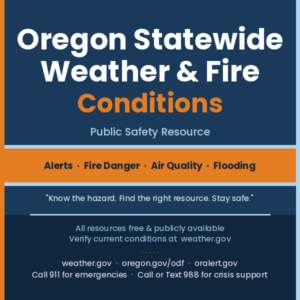
OREGON STATEWIDE WEATHER & FIRE CONDITIONS

Public Safety Resource · Weather Alerts · Fire Danger · Air Quality · Flooding

“Know the hazard. Find the right resource. Stay safe.”

All resources listed are free and publicly available · Verify current conditions directly with official sources below

CALL 911

For anyone experiencing an active wildfire, flooding, or immediate threat to life or property

CALL OR TEXT 988

For anyone in emotional distress or mental health crisis related to a disaster or evacuation · Free · Confidential · 24/7

YOUR FIRST THREE STEPS WHEN A HAZARD IS POSSIBLE

1 · Check NWS Active Alerts for Oregon  NWS Oregon Active Alerts

Every active watch, warning, and advisory in Oregon — in one place. Check here first whenever you hear about a hazard in your area.

2 · Check Your Fire Danger Level and Burn Restrictions  ODF Fire Restrictions Interactive Map

Tap your location on the interactive map to see your local fire danger level and whether any burn restrictions apply. Works on mobile. Check before any outdoor burning — any time of year.

3 · Sign Up for County Emergency Alerts  Oregon Emergency Alert Registration

Register your phone and home address so wildfire, flood, and evacuation alerts reach you directly — without having to check anything. Takes less than two minutes.

NWS ALERT TYPE DEFINITIONS

When a hazard is issued for your area, it will carry one of these labels. Knowing what each term means tells you how urgently to act.

🔴  WARNING

Hazardous conditions are occurring or imminent. Take protective action NOW — do not wait.

🟡  WATCH

Conditions are favorable for a hazard to develop. Prepare now and monitor updates closely.

🟠  ADVISORY

Conditions will be hazardous but below warning thresholds. Use extra caution outdoors.

🔵  SPECIAL WEATHER STATEMENT

Noteworthy conditions that require public awareness but do not meet warning or advisory thresholds. Stay aware and check for updates.

🏖  BEACH HAZARDS STATEMENT

Dangerous ocean or beach conditions — sneaker waves, rip currents, or extreme surf. Stay well back from the water’s edge regardless of how calm the ocean looks.

🔥  RED FLAG WARNING

Critical fire weather: low humidity + high winds + dry fuels = extreme fire danger. No outdoor burning of any kind. Avoid all spark-producing activity.

🌊  SMALL CRAFT ADVISORY

Hazardous conditions for small vessels. Inexperienced mariners should stay off coastal and Columbia River Bar waters until the advisory expires.

💧  FLOOD WATCH

Flooding is possible. Prepare now — know your evacuation route and monitor river gauge levels.

💧  FLOOD WARNING

Flooding is occurring or imminent. Move to higher ground now. Turn Around, Don’t Drown — never drive through a flooded road.

FIRE DANGER LEVELS — WHAT THEY MEAN

The Oregon Department of Forestry uses a five-level fire danger scale. Your local level determines which activities may be restricted on public and private forestlands. Danger levels can vary significantly over short distances — always check your specific location on the ODF map before any outdoor burning or spark-producing activity.

  • LOW

Fires are unlikely to start or spread rapidly. Normal outdoor caution applies.

  • MODERATE

Fires can start and spread under dry or windy conditions. Use caution near any ignition source outdoors.

  • HIGH

Fires start easily and spread quickly. Check ODF burn restrictions before any outdoor burning. Debris fires must be fully extinguished — never left to smolder.

  • VERY HIGH

Fires start very easily from almost any spark. Outdoor burning is typically prohibited. Check ODF restrictions for your specific location before any outdoor activity.

  • EXTREME

Maximum fire danger. Any fire can quickly become uncontrollable. All outdoor burning prohibited. Avoid all spark-producing activity entirely.

Check your current fire danger level and burn restrictions:  ODF Fire Restrictions Interactive Map

OREGON SEASONAL HAZARD GUIDE

Oregon faces different hazards throughout the year. Use this guide to know what to watch for in any given season and which resources to check most closely.

❄  WINTER — December through February

Ice storms and freezing rain in the Willamette Valley · Heavy snow in the Cascades and eastern Oregon · Coastal wind events and large surf · Sneaker waves year-round · River flooding from rain-on-snow events

🌱  SPRING — March through May

Early Red Flag fire weather as fuels dry before green-up · Snowmelt flooding along Cascade-fed rivers · Prescribed burn smoke · High surf and sneaker waves on the coast

🔥  SUMMER — June through September

Wildfire season peaks statewide · Red Flag Warnings common in south-central and eastern Oregon · Smoke events affecting air quality across the state · Extreme heat in the Willamette Valley and eastern Oregon · Lightning-caused fires in the mountains

🍂  FALL — October through November

Wildfires may remain active into October · Coastal wind events return · Early ice and snow in the mountains · Transition back to rainy-season flooding risk · First major wind events of the season

REGIONAL HAZARD CONTEXT

Western Oregon & Portland Metro

Willamette Valley weather is generally mild but can shift quickly. Watch for winter ice storms and wind events that cause widespread power outages, summer heat waves, and river flooding during rain-on-snow events in the mountains. The Columbia River Gorge is a natural wind corridor — conditions there can be dramatically different from surrounding areas.

Oregon Coast

Sneaker waves are the leading cause of ocean drowning deaths on the Oregon coast and occur year-round — including on days when the surf appears completely calm. Stay well back from the water’s edge. Never turn your back on the ocean. Stay off rocks, jetties, and logs at the surf line at all times. Watch for NWS Beach Hazards Statements before any coastal visit. The Columbia River Bar is one of the most hazardous river mouths in North America — always check bar conditions with the U.S. Coast Guard before any crossing attempt.

South-Central Oregon — Lake, Klamath & Harney Counties

This region is among Oregon’s most fire-prone. Red Flag Warnings are common in spring and summer when low humidity, high winds, and dry grass create extreme ignition conditions. The pre-green-up period in late winter and early spring — before new vegetation replaces last year’s dead grass — is particularly dangerous. Even a small spark can start a fast-moving fire. Always check ODF restrictions before any outdoor burning or use of spark-producing equipment.

Central Oregon — Bend, Redmond, Prineville, Madras

Central Oregon’s dry high-desert climate means fire risk arrives early and persists late into the season. Prescribed burns on the Deschutes and Ochoco national forests and the Crooked River National Grassland can produce smoke affecting communities along the Highway 26 and Highway 97 corridors. Check air quality at oregon.gov/deq before extended outdoor activity whenever smoke is visible.

Eastern Oregon

Eastern Oregon faces both wildfire risk and flash flood potential. Summer thunderstorms over the Blue Mountains and Wallowas can produce lightning-caused fires and rapid runoff into steep canyon drainages. Rivers fed by east-slope snowpack — including the John Day, Malheur, Owyhee, and Deschutes — can rise quickly during spring snowmelt events. Check river gauges at water.noaa.gov before recreating near any waterway.

Southern Oregon — Rogue Valley, Medford, Ashland, Grants Pass

Southern Oregon sits in a fire-prone interface zone where forested mountains meet populated valleys. Fire season can begin as early as June and extend into October. Smoke from both Oregon and northern California wildfires regularly affects air quality in late summer. Years with below-average snowpack significantly increase fire risk beginning as early as spring.

WILDFIRE SMOKE & AIR QUALITY GUIDE

Wildfire smoke contains fine particles that penetrate deep into the lungs and cannot be filtered by an ordinary dust mask. Groups at elevated risk include children, older adults, pregnant women, and anyone with heart or lung conditions. Check air quality before any outdoor activity during a smoke event — conditions can change within hours.

Air Quality Index (AQI) — What the Colors Mean

  • GREEN (0–50) — Good

Air quality is satisfactory. Outdoor activity is fine for everyone.

  • YELLOW (51–100) — Moderate

Sensitive groups should consider limiting prolonged outdoor exertion.

  • ORANGE (101–150) — Unhealthy for Sensitive Groups

Children, older adults, and anyone with heart or lung conditions should reduce time outdoors.

  • RED (151–200) — Unhealthy

Everyone should reduce prolonged outdoor exertion. Sensitive groups should remain indoors.

  • PURPLE (201–300) — Very Unhealthy

Avoid all outdoor activity. Keep windows and doors closed.

  • MAROON (301+) — Hazardous

Health emergency conditions. Everyone should stay indoors with windows closed.

Simple indoor air filtration during a smoke event:  Tape a MERV-13 furnace filter to the back of a standard box fan. This creates an effective air cleaner at very low cost and is safe to run with windows closed.

Check current air quality:  Oregon DEQ Air Quality Index  ·  AirNow.gov  ·  OregonAIR Mobile App

NO CELL SERVICE OR INTERNET? USE NOAA WEATHER RADIO

A NOAA Weather Radio receiver broadcasts continuous NWS alerts, weather forecasts, fire weather warnings, and emergency messages 24 hours a day · 7 days a week on 162.400 – 162.550 MHz. It is the most reliable alert system for rural Oregon when cell coverage or internet is unavailable. A dedicated receiver is required — available at hardware and electronics retailers for under $30. Find the transmitter frequency for your location at weather.gov/nwr.

MONITOR & STAY INFORMED — COMPLETE RESOURCE LIST

All resources below are free and publicly available 24 hours a day · 7 days a week unless otherwise noted.

WEATHER — WATCHES, WARNINGS & FORECASTS

NWS Active Alerts — All of Oregon

Every active NWS watch, warning, and advisory currently in effect anywhere in Oregon — in one place. Check here first.

NWS Portland — Western Oregon

Current alerts and forecasts for the Portland metro, Willamette Valley, northern coast, and Columbia River Gorge.

NWS Medford — Southern Oregon

Alerts and forecasts for the Rogue Valley, Klamath Basin, Crater Lake area, and south-central Oregon.

NWS Pendleton — Eastern & Central Oregon

Alerts and forecasts for eastern Oregon, the Blue Mountains, Cascades east slopes, and the central Oregon high desert.

NOAA Marine Forecast — Oregon Coast

Coastal and offshore forecasts, small craft advisories, and Columbia River Bar conditions.

NOAA Weather Radio Frequency Finder

Find your local 162 MHz NOAA Weather Radio frequency. Continuous 24/7 NWS broadcasts — the most reliable alert system when cell coverage or internet fails.

FIRE DANGER, RESTRICTIONS & ACTIVE WILDFIRES

ODF Fire Danger & Burn Restrictions Map

Interactive map — tap or click your location to see your current fire danger level and active burn restrictions. Works on mobile. Check before any outdoor burning.

Oregon Dept. of Forestry — Fire & Weather

Official ODF fire weather forecasts, statewide danger ratings, and fire news and press releases.

Before You Burn — Debris Burning Check

Check daily whether outdoor debris burning is allowed in your area before lighting anything. Debris burning is the leading cause of human-caused wildfires in Oregon.

BLM Oregon & Washington — Fire Restrictions

Fire restrictions for Bureau of Land Management lands. Note: BLM restrictions may differ from ODF restrictions on adjacent land — check both for your location.

InciWeb — Active Oregon Wildfires

Active wildfire locations, acreage, containment status, road closures, and evacuation orders across Oregon.

Northwest Interagency Coordination Center

Regional fire situation reports and preparedness levels for Oregon and Washington.

AIR QUALITY & WILDFIRE SMOKE

Oregon DEQ — Air Quality Index

Real-time statewide air quality readings. Check before outdoor activity during any smoke event — especially for children, older adults, and anyone with heart or lung conditions.

AirNow.gov — Federal Air Quality

Current and forecast AQI by location. Includes smoke forecasts during wildfire events. Available 24 hours a day · 7 days a week.

OregonAIR Mobile App

Free mobile app for real-time Oregon air quality readings and alerts. Available for iOS and Android.

FLOODING & RIVER LEVELS

NOAA River Levels & Flood Monitoring

Live river gauge readings, flood stage forecasts, and inundation maps for rivers across Oregon. Enter any river name or city. Available 24 hours a day · 7 days a week.

EMERGENCY ALERTS & PREPAREDNESS

Oregon Emergency Alerts — Sign Up

Register your phone and address to receive county emergency alerts for wildfires, floods, and evacuations directly — without having to seek them out.

Oregon Office of Emergency Management

Statewide emergency preparedness resources, disaster declarations, and guidance for individuals, families, and communities.

Oregon Emergency Management — Make a Plan

Step-by-step guidance for building a household emergency plan, go-bag, and communication strategy before a disaster strikes.

KEY PHONE NUMBERS

Save these numbers before a disaster occurs. Cell networks may be congested during an active emergency.

Life-Safety Emergency

CALL: 911

For anyone experiencing or witnessing an active wildfire, flooding, structure fire, or any immediate threat to life or property.

Mental Health Crisis Line

CALL OR TEXT: 988

For anyone in emotional distress or mental health crisis related to a disaster or evacuation. Free · Confidential · Available 24 hours a day · 7 days a week.

Oregon Emergency Management — Duty Officer

CALL: 1-503-378-2911

For local emergency managers and public officials requesting state assistance during an active emergency or declared disaster.

NWS Portland — Western Oregon Recorded Forecast

CALL: 503-261-9246

For anyone in the Portland metro, Willamette Valley, or northern coast. Recorded forecast updated several times daily.

NWS Medford — Southern Oregon

CALL: 541-773-1067

For anyone in southern Oregon or the Rogue Valley seeking a current recorded forecast.

NWS Pendleton — Eastern & Central Oregon

CALL: 541-276-4493

For anyone in eastern or central Oregon seeking a current recorded forecast.

Central Oregon Fire Information Line

CALL: 1-800-523-4737

For anyone in central Oregon seeking current fire danger levels, active burn restrictions, or incident information.

NOAA Weather Radio

162.400 – 162.550 MHz  (receiver required)

For anyone in a rural area without reliable cell or internet coverage. A dedicated weather radio receiver is required — available at hardware and electronics retailers. Find your local frequency at weather.gov/nwr. Available 24 hours a day · 7 days a week.

PREPAREDNESS ACTIONS YOU CAN TAKE NOW

Sign Up for Emergency Alerts

Register at Oregon Emergency Alert Registration — oralert.gov to receive county alerts for wildfires, floods, and evacuations directly on your phone. Also enable Wireless Emergency Alerts in your phone’s notification settings — these require no registration and can reach you even without data service.

Know Your Evacuation Route

Identify at least two ways out of your neighborhood before a disaster occurs. One route may be blocked by fire or floodwater. Know where you would go and how you would reach family members if you are separated. In a fast-moving wildfire, there may be very little warning time — have your plan ready now.

Build a Go-Bag

Keep a ready bag near your door or in your vehicle during fire season. Include: prescription medications and medical supplies · copies of important documents · phone charger and backup battery · water and food for three days · cash · a change of clothing · N95 masks for smoke protection. A go-bag prepared in advance saves critical time during an emergency evacuation.

For Outdoor Burns — Check Before You Light

Debris burning is the leading cause of human-caused wildfires in Oregon — and any escaped fire can result in full liability for suppression costs, which can reach millions of dollars. Before any outdoor burn, check BeforeYouBurn.com and the ODF Fire Restrictions Map. When in doubt, do not burn.

Turn Around, Don’t Drown

Never drive through a flooded road — even if it looks passable. Just six inches of moving water can knock a person off their feet. Two feet of water can carry away most vehicles. If a road ahead is flooded, turn around and find another route. Most flood-related deaths in Oregon occur in vehicles.

Check on Neighbors

Older adults, people with disabilities, and those who live alone may not receive alerts or may need help evacuating. Check on neighbors before a known hazard arrives in your area.

DISCLAIMER: Information is shared solely as a public courtesy. All resources listed are publicly available through official government agencies. This document is not a product of, nor endorsed by, the National Weather Service, Oregon Department of Forestry, Oregon Emergency Management, or any other agency listed. Content is subject to change — always verify current conditions directly with official sources before making any decisions. This is not a substitute for official emergency broadcasts, professional weather services, or instructions from local emergency management authorities. If a person is in immediate danger, call 911. For mental health emergencies, call or text 988 (Suicide & Crisis Lifeline) — free · confidential · available 24 hours a day · 7 days a week. All services listed are free and publicly available.


04 – Resources – Oregon Tenant Information & Resources: Free Legal Help, Hotlines, and Renters’ Rights
Nov 3 all-day
04 - Resources - Oregon Tenant Information & Resources: Free Legal Help, Hotlines, and Renters' Rights


Oregon Tenant Information & Resources: Free Legal Help, Hotlines, and Renters’ Rights

Renters across Oregon facing an eviction notice, needed repairs, a rent increase, or housing discrimination can reach free, noncommercial help from legal aid programs, tenant associations, and public agencies.

Community Alliance of Tenants, Disability Rights Oregon, Fair Housing Council of Oregon, Legal Aid Services of Oregon, Manufactured Housing/Oregon State Tenants Association, Oregon Law Center, Oregon Renter’s Rights, Portland Tenants United, and the Springfield Eugene Tenant Association offer renters’ rights hotlines, free eviction defense, fair housing complaint support, recorded fair housing trainings, self-help guidebooks, and tenant organizing, alongside state, court, federal, and City of Portland resources for rental assistance, habitability, mediation, and the 2027 rent increase cap.

Community Alliance of Tenants

Community Alliance of Tenants is a statewide renters’ rights nonprofit, founded in 1996, that runs a Renters’ Rights Hotline and offers tenant education through workshops and handouts.

Programs & Services

Renters’ Rights Hotline

Hotline specialists answer renters’ questions about fair housing protections, evictions, terminations, repairs, security deposits, and rent increase limits; the line does not serve landlords. Callers dial (503) 288-0130 and leave a message, and a specialist calls back. Intake and callbacks run Monday, Wednesday, Friday, and Saturday from 1:00 p.m. to 5:00 p.m., and Tuesday from 5:00 p.m. to 8:00 p.m., Pacific time.

Eligibility: Open to Oregon renters, with priority given to renters in Southern and Central Oregon, the Mid-Valley, and the Portland Tri-County area; renters in other regions can become members for prioritized help.

Access: https://www.oregoncat.org

Resources & Links

Know Your Rights

Tenant rights information and handouts from the Community Alliance of Tenants.

Access: https://www.oregoncat.org/know-your-rights

Disability Rights Oregon

Disability Rights Oregon is the state’s Protection and Advocacy System, helping people who have a disability-related legal issue in Oregon, including housing concerns.

Programs & Services

Disability-Related Legal Help

Oregonians with a disability-related legal issue can apply online or call 503-243-2081 or 1-800-452-1694, Monday through Friday, 9:00 a.m. to 11:00 a.m. and 1:00 p.m. to 4:00 p.m. Pacific time. Services are provided by appointment only.

Access: https://www.droregon.org

Resources & Links

Fair Housing Handbook: Reasonable Accommodations & Modifications

A guide to requesting disability-related accommodations and modifications in rental housing, including assistance animals and accessible parking.

Access: https://www.droregon.org/disability-rights-oregon-resources/fair-housing-handbook-reasonable-accommodations-modifications

Fair Housing Council of Oregon

The Fair Housing Council of Oregon evaluates potential violations of the federal Fair Housing Act and related state and local laws. It is not a law office, and it refers general landlord-tenant questions to legal aid and current eviction cases to the Eviction Defense Project.

Programs & Services

Report Housing Discrimination

Renters who believe they were treated differently because of a protected status, such as race, national origin, religion, sex, familial status, disability, marital status, domestic violence survivorship, sexual orientation, gender expression, or source of income, can submit an online report to fair housing enforcement staff. Questions go to the intake line at (503) 223-8197, ext. 2, or 1-800-424-3247, ext. 2, on Thursdays from 9:00 a.m. to noon Pacific time.

Access: https://fhco.org/report-housing-discrimination/

On-Demand Resources

Fair Housing and Assistance Animals

Type: Recorded Webinar

Covers disability under the Fair Housing Act, who can have an assistance animal, which kinds of animals qualify, and how to request one.

Access: https://fhco.org/online-courses/

Fair Housing and the Intersection with Tribal Law

Type: Recorded Webinar

Duration: 1 hour, 56 minutes

Covers fair housing protected classes and how the law applies, Oregon tribal history, the unique challenges and benefits for Native American tribes, and tribal funding for housing. A Spanish recording and an English recording with ASL are also listed on FHCO’s Pre-Recorded Courses page.

Access: https://vimeo.com/1121343370

Fair Housing Discrimination in Oregon

Type: Recorded Webinar

Duration: 2 hours

Explores how Oregon’s history of displacement, segregation, and harassment shapes housing inequity today, and the current policies and practices working to address it.

Access: https://vimeo.com/1096404314

Fair Housing for Aging Populations

Type: Recorded Webinar

Duration: 54 minutes

Covers fair housing basics, the crisis of livability, and the laws that protect people with disabilities. This link opens the ASL recording; English and Spanish recordings are also listed on FHCO’s Pre-Recorded Courses page.

Access: https://vimeo.com/1010019872

Fair Housing for Immigrants and Refugees

Type: Recorded Webinar

Duration: 1 hour, 46 minutes

Covers the history of housing discrimination, the protected class of national origin, and harassment in rental housing. Spanish and ASL recordings are also listed on FHCO’s Pre-Recorded Courses page.

Access: https://vimeo.com/1079607960

Fair Housing for LGBTQIA+ Folx

Type: Recorded Webinar

Duration: 1 hour, 30 minutes

Covers fair housing basics, the protected classes of sexual orientation, gender identity, and disability, and harassment in rental housing.

Access: https://vimeo.com/1091076184

Fair Housing for Renters with Disabilities

Type: Recorded Webinar

Duration: 1 hour, 23 minutes

Covers red flags of discrimination, housing rights for people with disabilities with a focus on intellectual and developmental disabilities, and protections against hate and harassment.

Access: https://vimeo.com/1082742337

Moving Forward with a Past

Type: Recorded Webinar

Duration: 2 hours, 2 minutes

Covers fair housing basics, disability accommodations, disparate impact involving domestic violence, national origin, and criminal history, and advocating for people whose criminal history is a barrier to housing. Spanish and ASL recordings are also listed on FHCO’s Pre-Recorded Courses page.

Access: https://vimeo.com/1026265341

Legal Aid Services of Oregon

Legal Aid Services of Oregon provides free civil legal help to low-income communities across Oregon, including tenants living in substandard housing.

Programs & Services

Find a Legal Aid Office

Renters with a landlord-tenant problem can use this map to find their regional office, along with the counties served by other legal aid organizations. The Portland Regional Office can be reached at (503) 224-4086.

Eligibility: Low-income Oregonians.

Access: https://lasoregon.org/igmap/locations/

Manufactured Housing/Oregon State Tenants Association

Manufactured Housing/Oregon State Tenants Association is a statewide organization of Oregon residents who own manufactured or floating homes and rent the space beneath them, advocating for residents’ rights in parks and marinas.

Programs & Services

Membership and Resident Advocacy

Park and marina residents can join the association and find information on landlord responsibilities, evictions, disability rights, and legal help. Call 541-508-0404 for membership information. The association’s new website is in preview, so some pages lead to a contact form for now.

Access: https://oregontenants.com/

Oregon Law Center

Oregon Law Center provides free legal help to Oregonians with low incomes on matters involving their homes, livelihoods, medical care, and safety from domestic violence.

Programs & Services

Eviction Defense Project

A joint project of Legal Aid Services of Oregon, Oregon Law Center, and the Center for Non-Profit Legal Services, the Eviction Defense Project offers free legal help to low-income tenants in every Oregon county who have an eviction court case. Tenants should call 888-585-9638, email [email protected], or use the online form before their first court appearance, with their court case number and hearing date ready. Help is available regardless of immigration status, and receiving it carries no immigration consequence.

Eligibility: Low-income tenants with an active eviction court case; in Multnomah County, help may be available after a termination notice and before a case is filed. Tenants outside Multnomah County without court papers can contact their local legal aid office, and renters seeking rent assistance only should contact 211.

Access: https://oregonlawcenter.org/eviction-defense-project/

Oregon Renter’s Rights

Oregon Renter’s Rights is a resource hub for Oregon tenants offering self-help guidebooks, sample letters, and legal resources in English, Spanish, and several other languages; the guides are not a substitute for legal advice.

Resources & Links

Guías de Vivienda en Español

Housing guides, legal resources, and a rent increase calculator in Spanish.

Access: https://www.oregonrentersrights.org/espanol

Housing Self-Help Handbooks

Guidebooks on applications and fees, repairs and safety, discrimination protections, rent increases and relocation, termination and eviction notices, and court processes.

Access: https://www.oregonrentersrights.org/handbooks

Rent Increase Calculator

A tool for checking whether a rent increase notice is valid under Oregon law.

Access: https://www.oregonrentersrights.org/rent-calculator

Portland Tenants United

Portland Tenants United is an all-volunteer tenant union that organizes renters in the Portland metro area to challenge harmful housing policies and practices and to press for housing stability, security, and dignity. PTU cannot give legal advice or help pay rent.

Programs & Services

Join the Union

Tenants can become members of PTU and get support organizing their building into a tenant association.

Access: https://www.pdxtu.org/join_the_union

Resources & Links

Contact and Resources

A curated list of Portland-area help for evictions, repairs and inspectors, mediation, security deposits, rent assistance, free or low-cost legal help, and other local tenant unions.

Access: https://www.pdxtu.org/resources

Springfield Eugene Tenant Association

The Springfield Eugene Tenant Association is a 501(c)(3) nonprofit dedicated to renters’ rights, assisting, educating, and empowering tenants in Lane County and beyond.

Programs & Services

SETA Tenant Hotline

Renters can call 541-972-3715 and leave a voicemail at any time with a brief overview of their issue; staff research each question before returning the call, which can take up to 24 hours. Callers who have received an urgent notice should mention it so their call is prioritized. Help in Spanish is available.

Access: https://www.springfieldeugenetenantassociation.com/hotline

Resources & Links

Renters’ Rights Guides

Guides on finding a rental, moving in and security deposits, habitability and repairs, evictions and terminations, and discrimination and retaliation.

Access: https://www.springfieldeugenetenantassociation.com/renters_rights

General & Cross-Cutting Resources

Directories & Hubs

211info — https://www.211info.org · Dial 211 or 866-698-6155, or text a ZIP code to 898211, for rental assistance and other housing help; core phone hours are Monday through Friday, 8:00 a.m. to 6:00 p.m. Pacific time, and interpreters are available.

Oregon Law Help — https://oregonlawhelp.org · Free legal information on rental housing, repairs, deposits, illegal discrimination, and protections for survivors of domestic violence, sexual assault, or stalking. Find a local legal aid office: https://oregonlawhelp.org/resource/oregon-legal-aid-offices

State of Oregon Resources

Oregon Housing and Community Services, Landlord & Tenant Resources — https://www.oregon.gov/ohcs/housing-assistance/pages/landlord-tenant-resources.aspx · A referral hub for rental assistance, legal help, fair housing, manufactured home park resources, and mediation.

Oregon Housing and Community Services, Need Housing Help Now? — https://www.oregon.gov/ohcs/pages/housing-resources.aspx · Rental assistance, eviction-related help, and utility bill assistance through local Community Action Agencies.

Oregon Housing and Community Services, Housing Health & Safety — https://www.oregon.gov/ohcs/housing-assistance/pages/housing-health-safety.aspx · Explains Oregon’s habitability standards for rental housing; residents of project-based Section 8 housing can call the Oregon Health and Safety Hotline at 1-800-453-5511, option 4, Monday through Friday, 8:00 a.m. to 5:00 p.m. Pacific time.

Manufactured & Marina Communities Resource Center — https://www.oregon.gov/ohcs/mmcrc/pages/index.aspx · Information and training for tenants and landlords in manufactured home parks and marinas, with dispute resolution and mediation; hotline 1-800-453-5511, option 2.

Oregon Judicial Department, Landlord-Tenant Self-Help — https://www.courts.oregon.gov/help/pages/landlord-tenant.aspx · Tenant instructions for the eviction process and statewide court forms accepted in all circuit courts, including interactive iForms for some filings.

Oregon Bureau of Labor and Industries, Fair Housing — https://www.oregon.gov/boli/civil-rights/pages/fair-housing.aspx · Takes and investigates housing discrimination complaints; for questions, call 971-245-3844.

Oregon Department of Administrative Services, Rent Stabilization — https://www.oregon.gov/das/oea/pages/rent-stabilization.aspx · The maximum allowable rent increase for calendar year 2027 is 10%, up from 9.5% in 2026; manufactured dwelling and marina facilities with more than 30 spaces are capped at 6%. Questions about the cap go to Oregon Housing and Community Services.

Federal Resources

U.S. Department of Housing and Urban Development, Oregon — https://www.hud.gov/states/oregon · Links to the HUD Resource Locator for affordable housing, HUD-approved housing counselors at (800) 569-4287, and energy assistance for renters.

HUD Multifamily Housing Complaint Line — https://www.hud.gov/contactus/multifamily-housing-complaint · Residents of HUD-insured and HUD-assisted properties can report poor maintenance, health and safety dangers, mismanagement, or fraud at 1-800-685-8470, with specialists who speak English and Spanish.

HUD, Report Housing Discrimination — https://www.hud.gov/contactus/file-complaint · File a fair housing complaint online or call 1-800-669-9777.

City of Portland Resources

Portland Housing Bureau, Eviction Legal Defense Program — https://www.portland.gov/phb/rental-services/eviction-help-renters/eviction-legal-support-tenants · Free legal help for low-income renters (at or below 60% of Area Median Income) within Portland city limits, available as soon as a termination notice arrives; call 888-585-9638 or email [email protected].

Portland Housing Bureau, Resources for Landlords and Tenants — https://www.portland.gov/phb/rental-services/helpdesk/resources · Rental services information for Portland renters, including free landlord-tenant mediation through Resolutions NW.

Disclaimer: This listing is shared for community information only. The offerings are organized and hosted by the listed organizations, not by PeerGalaxy. Details such as dates, times, availability, and access links are subject to change — please confirm with the relevant organization before attending or applying.


05 – Hotline – Boys Town National Hot Line – A 24/7 crisis, resource and referral number for kids and parents – 1-800-448-3000 – Text VOICE to 20121 @ Phone
Nov 3 all-day


Increasing Outreach to Teens

​Teens are more connected than ever ​before and the Boys Town National Hotline® at 800-448-3000 is right there with them.

In addition to calling, teens can now text VOICE to 20121 or email [email protected] any day, any time to speak with a trained counselor.

Online resources are also available at yourlifeyourvoice.org.


05 – Hotline – NHTH – National Human Trafficking Hotline – 1-888-373-7888 – Confidential – 24/7 @ phone
Nov 3 all-day
05 - Hotline - NHTH - National Human Trafficking Hotline - 1-888-373-7888 - Confidential - 24/7 @ phone


National Human Trafficking Hotline

Contact the National Human Trafficking Hotline

Do you want to get out of the life?
Are you being forced to work against your will?
Or threatened or tricked by your boss?
Do you know someone who may be?

Call: 1-888-373-7888

Text: “BeFree” (233733)

Live Chat: https://HumanTraffickingHotline.org

You can:
• Get help
• Report a tip
• Find services
• Learn about your options

Available 24/7, toll-free, confidential, in 200+ languages.

Operated by Polaris with support from the U.S. Department of Health and Human Services, Administration for Children and Families.


05 – Hotline – Oregon Recovery Center Hotline – Call (833) 975-0505 and Live Chat – 24/7 – Weekdays & Weekends @ phone
Nov 3 all-day
05 - Hotline - Oregon Recovery Center Hotline - Call (833) 975-0505 and Live Chat - 24/7 - Weekdays & Weekends @ phone


Oregon Recovery Center Hotline

Reach out.

We’re here for you, 24 hours a day, 7 days a week. The Oregon Recovery Center Hotline is a free and confidential statewide resource that can connect you to harm reduction, treatment, recovery, and supportive services.


Call Now – (833) 975 – 0505
or
Use this Link For Live Chat
https://orrecoverycenterhotline.org/

Connecting you to the services you need.

When you call us or chat with us online, you’ll talk to one of our caring, trained Peer Support Specialists. We can help you decide what kind of services you need by asking you a few questions, and we can connect you to them through your local Behavioral Health Resource Network (BHRN). Learn more about the kind of services available to you

Received a fine for possession?

If you received a citation for possessing small amounts of drugs in Oregon (called a “Class E violation”), you can have the fine waived by calling the Oregon Recovery Center Hotline and completing a health assessment.

1. Call us at (833) 975-0505. Our trained Peer Support Specialists will provide a screening for substance use, mental health and other supportive service referrals you might need.

2. Once the screening is complete, we will refer you to appropriate services.

3. We will email you a letter that confirms you have completed the health assessment. Bring it to court to waive your fine.

Harm reduction

Harm reduction saves lives. These services keep people who use drugs, like fentanyl or alcohol, safe by offering non-judgmental care that improves their quality of life and health, prevents and manages injury and disease, and prevents fatal overdoses. Harm reduction honors the dignity and wellbeing of each person.

Treatment

Treatment combines medical care, like supporting people through withdrawal symptoms or starting medication that helps with cravings, with services that help you learn coping skills. Treatment can happen in an inpatient or outpatient setting, and you and your treatment provider decide together what kind of treatment is right for you.

Recovery

Being in recovery means making changes over time that can help you feel better, live life on your own terms, and work toward reaching your goals. Recovery looks different for everyone and might include medication-assisted treatment, self-help or support groups, recovery coaching, or being part of recovery communities.

Supportive services

A person’s recovery is best supported when they have everything they need to live well. In addition to substance use services, services like housing support, employment assistance, and food insecurity services are also available.

Behavioral Health Resource Networks (BHRNs)

Behavioral Health Resource Networks (BHRNs) are networks of organizations that provide trauma-informed, culturally specific services to people who need treatment and support for substance use concerns. The services they provide include screening for substance use disorder, substance use disorder treatment, harm reduction services, and peer support services. They also screen for health and social service needs, including housing support. Each county and Tribal area in Oregon has at least one BHRN.


05 – Warmline – DoD – Department of Defense – Safe Helpline – Helpline 877-995-5247, One-On-One Chat, Report Retaliation, Resources – 24/7 @ Phone, Text
Nov 3 all-day


SAFE Helpline Number on Black background


DoD Safe Helpline is the sole secure, confidential, and anonymous crisis support service specially designed for members of the Department of Defense community affected by sexual assault.

Safe Helpline Serves

Active Duty Army, Navy, Marine Corps, and Air Force Reserve component (Army National Guard, Army Reserve, Navy Reserve, Marine Corps Reserve, Air National Guard, Air Force Reserve, and DHS’s Coast Guard Reserve) members and their families.


Telephone Helpline

Need help?

Call 877-995-5247 to be connected with a trained, confidential
Safe Helpline staff member, 24/7.

DSN users can call Safe Helpline by dialing 877-995-5247.

For those unable to call toll-free or DSN, call 202-540-5962.

OCONUS Service members can call the Telephone Helpline for free from
anywhere in the world by using Voice over IP (VoIP) technology from
theSafe Helpline App.

live-help-img

Online Helpline

Need help?

Visitonline.safehelpline.org or download the Safe Helpline
app
to chat one-on-one with a trained Safe Helpline staff member
through an anonymous, secure instant-messaging format 24/7.

How can the Online Helpline help me?

You can chat one-on-one with a Safe Helpline staff member
to access a range of support services including:

  • Anonymous, confidential, crisis intervention services
  • Emotional support
  • Referrals to both military and civilian resources in your area— sexual assault response coordinators (SARCs)/sexual assault prevention and response victim advocates (SAPR VAs), Chaplain, Legal, Medical/Behavioral health care services, military police, Veterans Crisis Line, local civilian sexual assault service providers, and many others.
  • Information on military-specific policies, such as reporting options (Restricted and Unrestricted)
  • Information for family and friends of survivors
  • Information for leadership

Safe Helpline App

Safe Helpline appWhat is the Safe Helpline app?

Itunes Store Badge      Google play icon

The Safe Helpline app is a free mobile resource created to meet the unique needs of members of the Department of Defense community affected by sexual assault. By downloading the app, you can access 24/7 support through Safe Helpline’s Telephone and Online Helplines, get information and resources to help address the short- and long-term effects of sexual assault, as well as practical exercises, to help you manage your self-care. We also recognize that for many survivors stationed outside of the United States (OCONUS) additional limitations may arise when accessing resources, which is why the Safe Helpline app has been designed to give survivors access to a variety of support services and self-care exercises in a free, and convenient way.

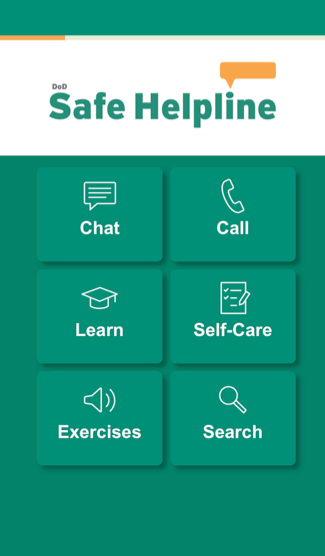
Safe Helpline app home screen

How can the Safe Helpline app help me?

We’ve designed the app to give you a way to access any resource within the app directly from the home screen.

Chat: Access one-on-one support through the Online Helpline, 24/7 and chat directly with a Safe Helpline staff member.

Call: Connect directly to a Safe Helpline staff member for one-on-one support through the Telephone Helpline, 24/7. You can choose to make the call using Voice over IP (VoIP) or by using your cellular data. Using VoIP might be a good option for Service members who are OCONUS and may not have access to cellular service in their current location.

Learn: Within this section of the Safe Helpline app, you can access our self-paced educational programs to learn how to address the effects of sexual assault, how to support a survivor and ways Safe Helpline can support you or someone you know. All of these education programs can be completed anonymously by the user. You’ll also be able to access scenarios to give you tangible ways to step-in and support others.

Self-Care: The app allows you to easily create and use a customized self-care plan with specially designed self-care exercises. Once downloaded, you can come back to view your plan and exercises at any time, even without an Internet connection.

How do the self-care plans work?

The self-care plan is created by answering a series of six questions designed to help you focus and identify how you are feeling at that moment. Questions are answered on a sliding scale of zero (never) to five (always), and the app will recommend different exercises based on your responses. There are no “good” or “bad” answers to these questions, and responses can vary from day to day, depending on how you are feeling.

Once you’ve answered the questions on the plan, the app will suggest self-care exercises. The exercises include:

  • Guided breathing
  • Guided muscle relaxation
  • Imagining yourself at the beach
  • Focusing on the present
  • Soothing sounds, such as sounds of the forest and sounds of rain falling

We recognize the importance of keeping your information safe, so we’ve also set up a security feature that allows you to lock your self-care plans behind a privacy wall using a 6-digit pin of your choosing.

Journaling:

The Safe Helpline app allows you to journal directly in the app with weekly prompts. Taking some time out of your week to journal can give you a moment for reflection and an opportunity for self-care. You can also choose to skip any prompts or just write freely depending on how you are feeling. Some of the questions include:

  • When do you feel the most energized?
  • What do you want to let go of this week?
  • What are three things that you would do if you weren’t afraid?

Like the self-care plans, the journal entries you save are protected by a privacy wall and will allow you to lock your information behind a 6-digit pin of your choosing. You can also access and refer back to your journal without an Internet connection.

Coloring Book:

Sometimes focusing on a mindless activity can help you process difficult emotions and be grounded in the present.  To help with this, another self-care activity available on the app is a collection of six designs, ranging from easy to difficult, that allow you to paint or color your own works of art.

How is the Safe Helpline app secure, and is activity on the app traceable by third parties?

As with all Safe Helpline services, your privacy is of utmost importance, and the technology behind the Safe Helpline app was created by RAINN to protect your safety and anonymity by ensuring that no personally identifiable information (PII) is collected.

The following precautions have been implemented to protect your privacy when using the app:

  • The app does not require an email address or any of your contact information when it is initially downloaded.
  • You have the ability to set up a pin code to protect the information you record in the self-care plans, the journal, and completed coloring book designs.
  • No information on how you use the app is ever collected or shared by Safe Helpline. This includes how often you use the app, who uses the app, or where you use the app.
  • If you are concerned that someone may be able to access the app, you can delete all journal entries, self-care plans, and completed coloring books by simply deleting the app.

While Safe Helpline has taken the steps outlined above to help increase the safety and anonymity of Safe Helpline app users, please remember that if you are using the app on a DoD or other work-related device, your employer may be able to track your usage of this app. In addition, similarly to a paper journal, Safe Helpline app journal entries may be admissible during court proceedings.

REPORT RETALIATION

Military Feedback Form

If you have questions, comments, or complaints about the services on your installation/base or provided by a Sexual Assault Response Coordinator (SARC), victim advocate or other military staff or personnel, please use this feedback form. You can submit the form anonymously if you prefer. The information you provide on this form will be forwarded to the DoD Sexual Assault Prevention and Response Office (SAPRO).

Retaliation

If you believe you have experienced or witnessed retaliation in any form from a peer, supervisor, or someone in your chain of command following a report of sexual assault, you can share the retaliation allegations with SAPRO using this form.

If you would like to submit a retaliation report, please report directly to the Department of Defense Inspector General (DoD IG) here.

For members of the Coast Guard who have experienced retaliation, the Department of Homeland Security (DHS) IG will accept retaliation complaints as falling within the scope of their responsibilities for Whistleblower protection. Coast Guard Members who have experienced retaliation can contact the DHS IG by calling 1-800-323-8603 (toll-free) or access the Allegation Form online.

Retaliation Reporting Options to learn more about how to report relation and your options : https://www.safehelpline.org/reporting-option

RESOURCE LINKS


For Responders

I work with Survivors

For Leadership

I am a Commander

For Supporters of Survivors

I am a Friend, Family Member, Colleague

For Service Members Leaving the Military

I am a Transitioning Service Member

For Survivors

I am a Transitioning Service Member


05 – Warmline – ODOJ – Oregon Department of Justice – Sanctuary Promise Hotline @ (844) 924-7829 (844-924-STAY) Toll Free / En Espanol (844) 626-7276 (844-6AMPARO) – 24/7 Weekdays and Weekends
Nov 3 all-day


Promise Response Hotline

Talk to Us

Whether it happened to you or to someone else, we can all help track sanctuary promise violations.

Everyone has the right to live safely in Oregon.  Oregon’s sanctuary laws promise safety, human rights, and dignity for all. If you or someone you know was targeted in violation of Oregon’s Sanctuary Promise laws, please call 1-844-924-STAY/1-844-6-AMPARO or report online at SanctuaryPromise.Oregon.gov or PromesaSantuario.Oregon.gov. On the Oregon Department of Justice’s Sanctuary Promise hotline, you can report a suspected violation, receive support, and be connected to resources. The Oregon Department of Justice may open an investigation into the violation.


Sanctuary Promise Response Hotline

1-844-924-STAY (1-844-924-7829)
Spanish Direct Line: 1-844-626-AMPARO (1-844-626-7276)

Operators are standing by
9am to 5pm Pacific time, Monday – Friday.

Interpreters in over 240 languages.

After hours? Leave a message and we’ll return your call.

We accept all Relay Calls.


Since 1987, Oregon has officially been a sanctuary state that supports immigrant and refugee communities by prioritizing human rights, dignity, and safety.

The Sanctuary Promise Act », signed into law on July 19, 2021, strengthens the existing state sanctuary laws. It restricts the collection and prohibits sharing of information related to a person’s national origin, immigration, or citizenship status. Oregon state and local public resources and personnel, including state and local government offices and law enforcement agencies, are prohibited from being used for immigration enforcement.

If you suspect a violation of Oregon’s sanctuary laws, we want to hear from you.  Suspected violations can be reported through this online portal (available in 8 languages by using the language menu in the upper right hand corner of this screen) or the Sanctuary Promise Hotline at 1-844-924-STAY (1-844-924-7829). Call us in any language.  We have a direct access Spanish language website at PromesaSantuario.Oregon.gov with a Spanish direct dial hotline at 1-844-6-AMPARO (1-844-626-7276).

To report ICE activity in the community, contact Portland Immigrant Rights Coalition, PIRC » at 1-888-622-1510.

Examples of violations to Oregon Sanctuary Promise Laws include:

  • Investigation or interrogation by police for immigration enforcement purposes;
  • Most inquiries, storing, or sharing of information about national origin, immigration, or citizenship status by police or state or local government;
  • Civil arrest without a judicial warrant/order from a court facility;
  • Arrests by federal immigration of a person on their way to or from court or while at court;
  • Police collaboration with federal authorities for immigration enforcement purposes;
  • Denial of services, benefits, or privileges to a person in jail or on probation/parole based on immigration status;
  • Police establishing coordinated traffic stops or traffic perimeters to enforce federal immigration laws; or
  • State or local government or police failing to document or report requests from a federal immigration agency relating to immigration enforcement;


Report a Sanctuary Promise Violation

Information About The Victim/Targeted Person

Note: The targeted person’s identity will not be shared publicly by ODOJ, but will be used and shared with the state/local government agency during the course of any investigation ODOJ opens. It will not be shared with federal immigration agencies or otherwise be shared to assist with immigration enforcement. If a specific person was not targeted in the violation, you can simply put “general public” as first and last names.

Use This Link to Report A Violation of the Sanctuary Promise Violation


05 – Hotline – NAF – National Abortion Federation – National Abortion Hotline – 1-800 -772-9100 – Monday – Friday @ Toll Free Number
Nov 3 @ 5:00 am – 4:00 pm


The National Abortion Hotline is the largest national, toll-free, multi-lingual Hotline for abortion provider information and financial assistance in the U.S. and Canada. We provide callers with accurate information, confidential consultation, and information on providers of quality abortion care. We also provide case management services and limited financial assistance to help you afford the cost of your care and travel-related expenses. The Hotline is free and offers services to everyone, regardless of your individual situation.


05 – Línea de ayuda – TL – Trans Lifeline Salvando Vidas – (877) 565-8860 – Lunes – Viernes – 10AM a 6PM PST @ phone
Nov 3 @ 10:00 am – 6:00 pm
05 - Línea de ayuda - TL - Trans Lifeline Salvando Vidas - (877) 565-8860 - Lunes - Viernes - 10AM a 6PM PST @ phone


LÍNEA DIRECTA

Estados Unidos (877) 565-8860

CANADÁ (877) 330-8336

Lunes – Viernes – 10AM a 6PM PST

Línea directa in español

La línea directa de Trans Lifeline es un servicio telefónico de apoyo dirigido por personas transgénero para las personas transgénero y/o que están cuestionando su género. Creemos que el mejor apoyo que las personas Trans pueden recibir es el de los miembros de la comunidad Trans con experiencias de vida compartidas.

Llámanos si necesitas a alguien Trans con quien hablar, incluso si no estás en crisis o no sabes con certeza si eres transgénero.

Marca al (877) 565-8860 en los Estados Unidos o al (877) 330-6366 en Canadá y oprime el #2 para conectarte con operadorxs que hablan español.


05 – Hotline – LGBT National Help Center – LGBT National Youth Talkline – 800-246-7743 – Mon – Fri @ Phone
Nov 3 @ 11:00 am – 8:00 pm
05 - Hotline - LGBT National Help Center - LGBT National Youth Talkline - 800-246-7743 - Mon - Fri @ Phone


LGBT National Hotline
888-246-7743

Hours

Mon – Fri:
11 AM – 8 PM/pacific time
2 PM – 11 PM/eastern time


On the LGBT National Hotline, we provide a confidential safe space where callers of any age can speak about sexual orientation or gender identity/expression issues. This includes coming out issues, relationship concerns, bullying, workplace issues, HIV/AIDS anxiety, safer sex information, suicide, and much more.

Sometimes you just need to be heard. We’re here. You deserve respect, support, affirmation, and acceptance.

We don’t give advice, and we never tell you what you should do. Ultimately, those choices are yours to make, but we are here to help you on your journey.

  • Our highly trained & dedicated LGBTQIA+ volunteers are here to provide free & confidential services.
  • We offer support, information, and local resources throughout the United States and beyond.
  • We don’t report calls to outside organizations.
  • We answer all of our own calls, we don’t outsource.


CLICK HERE TO BEGIN YOUR CHAT


05 – Warmline- LGBTNHC – LGBT NATIONAL HELP CENTER – LGBT National Coming Out Support Hotline – 888-688-5428 – Mon – Fri @ Phone
Nov 3 @ 11:00 am – 8:00 pm
05 - Warmline- LGBTNHC - LGBT NATIONAL HELP CENTER - LGBT National Coming Out Support Hotline - 888-688-5428 - Mon - Fri @ Phone

THE LGBT NATIONAL COMING OUT SUPPORT HOTLINE

888-688-5428 (888-OUT-LGBT)

Whether You are 13 or 83,

We will be Here for You

Each person is on their own journey, and how to come out, or if to come out, is a very individual choice.

Coming out can mean different things to different people. Everything starts with coming out to yourself, and that can take time and support. We are here to provide you with that support.  For some people, coming out can also include friends and family. But each person gets to make those choices in their own time.

While we never tell someone whether they should come out, we are here with you to think about those big decisions and to provide the care and safe space you deserve.

We Got You! We’re Glad You Found Us. No Matter Where You are on Your Journey, We are Here for You.

  • Our highly trained & dedicated LGBTQIA+ volunteers are here to provide free & confidential services.
  • We offer support, information, and local resources throughout the United States and beyond.
  • We don’t report calls to outside organizations.
  • We answer all of our own calls, we don’t outsource.

We provide a safe space while on a call.

All of our peer support volunteers are trained and identify as part of the LGBTQIA+ community.

Our calls are confidential. We don’t know who you are.

There are no recordings made of your conversation.

If you would like us to search for local resources near you, we might ask for your zip code/postal code or city, state, or country. We will never ask for your exact address.

Sometimes our conversations can be heavy, and a person might need to end the call. That’s ok. You will not be judged, and we’re very glad you spoke to us for the amount of time you did.

We don’t call other suicide hotlines, 911, or rescue services on your behalf. While we will not make those calls for you, we will do our best to provide you with the phone numbers to call for yourself if you choose, and we will stay on the line if you like (The exception is if you make a credible threat to someone else).

If you attempt to start a call during open hours and can’t get through, that means that all of our volunteers are currently talking with other people. Please try back in a few minutes. Should you still not be able to get through, you are always welcome to email us at [email protected].


00 – Hotline – LGBTNHC – LGBT NATIONAL HELP CENTER – LGBT National Coming Out Support Hotline – 1- 888 – 688 – 5428 – Weekdays @ Phone
Nov 3 @ 1:00 pm – 9:00 pm
00 - Hotline - LGBTNHC - LGBT NATIONAL HELP CENTER - LGBT National Coming Out Support Hotline - 1- 888 - 688 - 5428 - Weekdays @ Phone


THE LGBT NATIONAL COMING OUT SUPPORT HOTLINE

A PROGRAM OF THE LGBT NATIONAL HELP CENTER

1-888-688-5428

1-888-OUT-LGBT


LGBT National Coming Out Support Hotline
888-688-5428 (888-OUT-LGBT)

Hours

Mon – Fri:
1 PM – 9 PM/pacific time
4 PM – Midnight/eastern timeSat:
9 AM – 2 PM/pacific time
Noon – 5 PM/eastern time

You decide IF and WHEN Coming out is right for you, and you don’t have do this alone. Our LGBTQIA+ peer support volunteers are here for you.

We can help you when you are struggling with:

  • coming out to yourself
  • coming out to friends & family
  • facing fear and isolation
  • searching for local support & resources on your personal journey


05 – Warmline – LGBTNHC – LGBT National Help Center – LGBT National Youth Talkline – 800-246-7743 – Weekdays @ phone
Nov 3 @ 1:00 pm – 9:00 pm
05 - Warmline - LGBTNHC - LGBT National Help Center - LGBT National Youth Talkline - 800-246-7743 - Weekdays @ phone


LGBT National Youth Talkline
800-246-7743

Hours

Mon – Fri:
1 PM – 9 PM/pacific time
4 PM – Midnight/eastern time

Sat:
9 AM – 2 PM/pacific time
Noon – 5 PM/eastern time

We provide a confidential safe space where callers of any age can speak about sexual orientation or gender identity/expression issues. This includes coming out issues, relationship concerns, family, bullying, school issues, HIV/AIDS anxiety, safer sex information, suicide, and much more.

Sometimes you just need to be heard. We’re here. You deserve respect, support, affirmation, and acceptance.

We don’t give advice, and we never tell you what you should do. Ultimately, those choices are yours to make, but we are here to help you on your journey.

  • Our highly trained & dedicated LGBTQIA+ volunteers are here to provide free & confidential services.

  • We offer support, information, and local resources throughout the United States and beyond.

  • We don’t report calls to outside organizations.

  • We answer all of our own calls, we don’t outsource.

Nov
4
Wed
2026
00 – Helpline – SAMHSA Disaster Distress Helpline @ (800) 985-5990 (Multilingual) or (800) 846-8517 (TTY) – 24/7-Weekdays & Weekends
Nov 4 all-day
00 - Helpline - SAMHSA Disaster Distress Helpline @ (800) 985-5990 (Multilingual) or (800) 846-8517 (TTY) - 24/7-Weekdays & Weekends


Disaster Distress Helpline

SAMHSA’s Disaster Distress Helpline provides 24/7, 365-day-a-year crisis counseling and support to people experiencing emotional distress related to natural or human-caused disasters.

The Disaster Distress Helpline, 1-800-985-5990, is a 24/7, 365-day-a-year, national hotline dedicated to providing immediate crisis counseling for people who are experiencing emotional distress related to any natural or human-caused disaster. This toll-free, multilingual, and confidential crisis support service is available to all residents in the United States and its territories. Stress, anxiety, and other depression-like symptoms are common reactions after a disaster. Call 1-800-985-5990 or text TalkWithUs to 66746 to connect with a trained crisis counselor.

Who Should Contact the Disaster Distress Helpline?

This crisis support service is for anyone experiencing emotional distress related to disasters such as:

The Disaster Distress Helpline also answers calls and texts related to infectious disease outbreaks, such as the Ebola outbreak, incidents of community unrest, and other traumatic events.

The impact of crises may affect people in different ways. Learn how to recognize the warning signs and risk factors for emotional distress related to natural and human-caused disasters.

The Disaster Distress Helpline is open to everyone. This includes survivors of disasters; loved ones of victims; first responders; rescue, recovery, and relief workers; clergy; and parents and caregivers. You may call for yourself or on behalf of someone else.

Call or Text

From the United States and its territories, call 1-800-985-5990 to connect with a trained crisis counselor, 24/7. Spanish-speakers can call the hotline and press “2” for 24/7 bilingual support.

Callers to the hotline can also connect with counselors in over 100 other languages via 3rd-party interpretation services; to connect with a counselor in your primary language, simply indicate your preferred language to the responding counselor and she/he will connect to a live interpreter (interpretation in less commonly-spoken languages may require calling back at an appointed time). Learn more and download information about the Disaster Distress Helpline in 30 of the most commonly-spoken languages in the U.S.

To connect with a live DDH crisis counselor 24/7 via SMS, from the 50 states text “TalkWithUs” for English or “Hablanos” for Spanish to 66746. Spanish-speakers from Puerto Rico can text “Hablanos” to 1-787-339-2663.

Texting is subscription-based and only involves a few steps:

  1. Enroll in the service by texting TalkWithUs or Hablanos exactly as written. It’s important to do this before sending your first text message because otherwise the enrollment may fail, and you will not be able to speak with a counselor, or you may accidentally subscribe to another service.
  2. Look for confirmation that your subscription was successful. You will receive a Success! message if it was.
  3. To unsubscribe, text Stop or Unsubscribe to 66746 (or 1-787-339-2663 from Puerto Rico) at any time. For help, text Help to 66746 (or 1-787-339-2663 from Puerto Rico).

Standard text and data message rates will apply when texting from mobile phones. International text and data rates may apply from within U.S. territories and free association nations. SAMHSA will not sell your phone numbers to other parties.

The Disaster Distress Helpline’s TTY number 1-800-846-8517 is available 24/7 to Deaf and hard of hearing individuals, who can also utilize the texting options or their preferred Relay service (including 7-1-1) to connect with the main DDH hotline 1-800-985-5990, 24/7.

DDH Online Peer Support Communities


In an effort to broaden our reach to disaster survivors and emergency responders, the Disaster Distress Helpline has developed online peer support communities through Facebook Groups for those who have experienced a natural or human-caused disaster. These online communities offer opportunities for survivors and responders to connect with others who have experienced similar events, share accurate information and trusted resources, and help one another continue to heal from the effects of a traumatic event.

What Does it Offer?

The purpose of DDH Online Peer Support Communities is to create enhanced opportunities for survivors and responders of disaster to come together for mutual aid and emotional support.

DDH Online Peer Support Communities Also Include:

Trained Peer Supporters

DDH Online Peer Support includes trained peer supporters who assist with group moderation and vetting resources. In addition to community forums, our goal is also to create purposeful discussions lead by peer supporters with specific themes and relevant topics. While each survivor and responder’s experiences are unique, being with peers who have had a similar experience can promote connection, offer new ways of coping, and build a foundation of trust.

Peer support does not take the place of therapy or counseling. The opportunity to provide mutual aid and support to others who have faced similar challenges, when and where they need it, offers hope that healing and recovery is possible after a disaster.

Immediate Crisis Support

All DDH Online Peer Support Communities are monitored 24/7 by a designated DDH crisis center where crisis counselors are available to talk to members who may be in emotional distress and need crisis support. Members can talk to a counselor at any time of the day or night via Crisis Support Over Messenger (CSOM).

Available Communities

Survivors and Responders of the COVID-19 Pandemic 

DDH Online Peer Support Communities offer peer support for anyone who identifies as a survivor or responder of the COVID-19 pandemic. Both survivors and responders can come together for mutual aid, to share trusted resources, and to help one another continue to heal from the effects of a national pandemic. Survivors and responders may include but are not limited to, any healthcare workers, emergency responders, parents/caregivers, educators, individuals who have lost loved ones, people who are dealing with “Long-haul COVID”, those impacted by job loss or economic hardship during the pandemic, and anyone else who has been significantly impacted by the COVID-19 pandemic. DDH-trained Peer Supporters are also available to listen and offer validation and encouragement. Additionally, they provide structured moderation within the community to engage members in meaningful discussions on relevant topics and offer timely and trusted resources. To join our Facebook group dedicated to Survivors and Responders of the COVID-19 Pandemic, click here.

Survivors of Mass Violence

DDH Online Peer Support Communities offer peer support for survivors of mass violence in the United States including mass shootings, terrorist attacks, or other large-scale community violence. Survivors and loved ones who have experienced mass violence can connect with one another and provide emotional support in the aftermath of a mass violence incident, including how to cope with activating events and memorials, self-care strategies, and challenges with daily living. DDH-trained Peer Supporters are available to listen to members, and offer validation and encouragement. They also provide structured moderation to engage members in meaningful discussions on relevant topics and provide timely and trusted resources. If you are a survivor or the loved one of a survivor of mass violence and need support, please join our Facebook group by requesting to be a member here.

Other Inquiries

If you’re not in immediate need of crisis counseling support and would like to contact us for other reasons, send an email. Contact us for:

  • Technical problems. If you encountered a technical problem while trying to contact the Disaster Distress Helpline, please include your name and preferred contact information in your email if you wish to receive a reply.
  • Provider inquiries. Providers with specific inquiries about technical assistance and support, requests for materials, and exploring collaborations are encouraged to send an email.
  • Feedback. To provide feedback about your experience reaching out to the Disaster Distress Helpline, send an email describing your experience and SAMHSA will look into the matter. Please include your name and preferred contact information if you wish to receive a reply.
  • Social media inquiries. Email us with questions about the Disaster Distress Helpline’s use of social media.
  • All media inquiries. Members of the media with questions about the Disaster Distress Helpline are encouraged to call the SAMHSA Media Services Team at 1-240-276-2130.

Our staff appreciate hearing from people about their experiences. SAMHSA takes feedback about our services, whether it is positive or negative, very seriously.

SAMHSA also encourages public promotion of the Disaster Distress Helpline. Anyone can use the Disaster Distress Helpline logo and telephone number on their website and link to the Disaster Distress Helpline’s materials and social media properties.

Call 211 for information about disaster-related evacuations, shelters, food and clothing distribution, volunteer opportunities, and other resources and referrals. Or visit the national 211 Call Center Search website to find the 211 information and referral center nearest you.
Last Updated: 11/11/2019

Deaf/Hard of Hearing & Spanish

Deaf/Hard of Hearing

Spanish Speakers

Twitter Tweets:

Facebook

Follow the Disaster Distress Helpline on Facebook.

00 – Hotline – 988 Suicide and Crisis Lifeline – 24/7
Nov 4 all-day
00 - Hotline - 988 Suicide and Crisis Lifeline - 24/7


If you need to talk, the 988 Lifeline is here.

At the 988 Suicide & Crisis Lifeline, we understand that life’s challenges can sometimes be difficult. Whether you’re facing mental health struggles, emotional distress, alcohol or drug use concerns, or just need someone to talk to, our caring counselors are here for you. You are not alone.


What to Expect

Using the 988 Lifeline is free. When you call, text, or chat the 988 Lifeline, your conversation is confidential. The 988 Lifeline provides you judgment-free care. Connecting with someone can help save your life.

Calling the 988 Lifeline

Here is what you can expect when making a call to the 988 Lifeline.
Step 1 of 5

First, you’ll hear a message that gives you service selection options.

Listen to the pre-recorded message (mp3).
Step 2 of 5

We’ll play some hold music while you are connected to a counselor with our Spanish-language, LGBTQI+ services, or your local 988 Lifeline contact center. For veterans, the phone will ring until a counselor can answer your call.
Step 3 of 5

A counselor will say hello and introduce themselves.
Step 4 of 5

Your skilled counselor will ask you if you are safe.
Step 5 of 5

After they ask about your safety, your counselor will listen to you, understand how your problem is affecting you, provide support, and share any resources that may be helpful.


Chatting with the 988 Lifeline

Here is what you can expect when starting a chat with the 988 Lifeline.

Step 1 of 6

After clicking “Chat With Us,” a new window with a brief survey will open. This survey helps our counselors understand how to best support you and takes less than 5 minutes to complete.

Step 2 of 6

When you click “Start a Chat”, you are accepting our Terms of Service.

Step 3 of 6

You will then see a screen that indicates we are connecting you to a counselor.

Step 4 of 6

A counselor will say hello and introduce themselves.

Step 5 of 6

Your skilled counselor will ask if you are safe.

Step 6 of 6

After they ask about your safety, they will be calm and comforting, listen to you, and provide support. They may also share helpful resources.


Texting with the 988 Lifeline

Here is what you can expect when texting the 988 Lifeline.

Step 1 of 7

When you send a text to 988, you will be given options to connect with a counselor from the Veterans, Spanish-language, LGBTQI+ service, or the main 988 Lifeline.

Step 2 of 7

When you text “next” you will be accepting our Terms of Service.

Step 3 of 7

You will then need to complete a brief survey to help your counselor understand how they can best support you.

Step 4 of 7

You’ll receive a “wait” message with optional questions while we connect you to a counselor.

Step 5 of 7

Your counselor will say hello and introduce themselves.

Step 6 of 7

Your skilled counselor will ask if you are safe.

Step 7 of 7

After they ask about your safety, they will be calm and comforting, listen to you, and provide support. They may also share helpful resources.


01 Helpline – NCPC – National Capital Poison Center – Poison Help: Free 24/7 Guidance for Poison Emergencies – 1-800-222-1222 – 24/7
Nov 4 all-day
01 Helpline - NCPC - National Capital Poison Center - Poison Help: Free 24/7 Guidance for Poison Emergencies - 1-800-222-1222  - 24/7


Poison Help: Free 24/7 Guidance for Poison Emergencies

Reach out right away for any possible poisoning, even a minor or unexpected encounter with a medicine, product, plant, or creature.

Get free, confidential guidance any time, day or night, either online through webPOISONCONTROL or by phone at your regional poison center.

Primary Resources

webPOISONCONTROL — Get help online · Free, confidential, fully-automated triage tool available 24/7; provides a recommendation in under 3 minutes based on age, substance, amount, and symptoms.

Poison Control Phone Line — 1-800-222-1222 · Routes to the poison center serving your region; free, expert, and confidential, available 24/7.

Poison Control Website — poison.org · Central hub for poison prevention information, first aid guidance, and the webPOISONCONTROL tool.

Educational & Resource Programs

First Aid for Poisonings — Read the guide · Immediate steps to take before help arrives.

Is It a Poison? Substance Library — Search the library · Searchable articles on the safety of specific substances.

How to Get Help Online or by Phone — Learn more · Overview of both ways to reach Poison Control.

The Poison Post® Newsletter — Subscribe · Free quarterly e-newsletter with poison prevention tips.

Poison Control App — Apple App Store · Google Play

Support Services & Contact Information

Feedback Survey — Share your thoughts

Donate — Support Poison Control · Donations to this 501(c)(3) organization fund free, confidential poison emergency guidance.

Administrative & Media Inquiries — 202-362-3867 or email · For administrative or media inquiries only; not for poisoning advice.

About National Capital Poison Center

The National Capital Poison Center (NCPC) was founded in 1980 at the request of the Metropolitan Washington Council of Governments and is an independent 501(c)(3) nonprofit affiliated with The George Washington University School of Medicine; it closed its telephone call center in 2025 to become the nation’s first fully-automated, all-digital Poison Control.

Its mission is to prevent poisonings, save lives, and limit injury from poisoning by providing free, expert guidance 24/7.

NCPC serves the general public across the entire United States through webPOISONCONTROL, with more than half of reported cases involving children younger than six years old.

Its services include online triage guidance for poison exposures, poison prevention education, and hazard detection and surveillance work with regulators and industry.

Disclaimer: This listing is shared for community information only. The event is organized and hosted by the listed organization, not by PeerGalaxy. Dates, times, and access links are subject to change — please confirm details with the organizer before attending.


04 – Resources – Statewide Weather & Fire Conditions Report Active NWS Watches, Warnings & Advisories · Fire, Flood & Coastal Conditions
Nov 4 all-day
04 - Resources -  Statewide Weather & Fire Conditions Report Active NWS Watches, Warnings & Advisories · Fire, Flood & Coastal Conditions


OREGON STATEWIDE WEATHER & FIRE CONDITIONS

Public Safety Resource · Weather Alerts · Fire Danger · Air Quality · Flooding

“Know the hazard. Find the right resource. Stay safe.”

All resources listed are free and publicly available · Verify current conditions directly with official sources below

CALL 911

For anyone experiencing an active wildfire, flooding, or immediate threat to life or property

CALL OR TEXT 988

For anyone in emotional distress or mental health crisis related to a disaster or evacuation · Free · Confidential · 24/7

YOUR FIRST THREE STEPS WHEN A HAZARD IS POSSIBLE

1 · Check NWS Active Alerts for Oregon  NWS Oregon Active Alerts

Every active watch, warning, and advisory in Oregon — in one place. Check here first whenever you hear about a hazard in your area.

2 · Check Your Fire Danger Level and Burn Restrictions  ODF Fire Restrictions Interactive Map

Tap your location on the interactive map to see your local fire danger level and whether any burn restrictions apply. Works on mobile. Check before any outdoor burning — any time of year.

3 · Sign Up for County Emergency Alerts  Oregon Emergency Alert Registration

Register your phone and home address so wildfire, flood, and evacuation alerts reach you directly — without having to check anything. Takes less than two minutes.

NWS ALERT TYPE DEFINITIONS

When a hazard is issued for your area, it will carry one of these labels. Knowing what each term means tells you how urgently to act.

🔴  WARNING

Hazardous conditions are occurring or imminent. Take protective action NOW — do not wait.

🟡  WATCH

Conditions are favorable for a hazard to develop. Prepare now and monitor updates closely.

🟠  ADVISORY

Conditions will be hazardous but below warning thresholds. Use extra caution outdoors.

🔵  SPECIAL WEATHER STATEMENT

Noteworthy conditions that require public awareness but do not meet warning or advisory thresholds. Stay aware and check for updates.

🏖  BEACH HAZARDS STATEMENT

Dangerous ocean or beach conditions — sneaker waves, rip currents, or extreme surf. Stay well back from the water’s edge regardless of how calm the ocean looks.

🔥  RED FLAG WARNING

Critical fire weather: low humidity + high winds + dry fuels = extreme fire danger. No outdoor burning of any kind. Avoid all spark-producing activity.

🌊  SMALL CRAFT ADVISORY

Hazardous conditions for small vessels. Inexperienced mariners should stay off coastal and Columbia River Bar waters until the advisory expires.

💧  FLOOD WATCH

Flooding is possible. Prepare now — know your evacuation route and monitor river gauge levels.

💧  FLOOD WARNING

Flooding is occurring or imminent. Move to higher ground now. Turn Around, Don’t Drown — never drive through a flooded road.

FIRE DANGER LEVELS — WHAT THEY MEAN

The Oregon Department of Forestry uses a five-level fire danger scale. Your local level determines which activities may be restricted on public and private forestlands. Danger levels can vary significantly over short distances — always check your specific location on the ODF map before any outdoor burning or spark-producing activity.

  • LOW

Fires are unlikely to start or spread rapidly. Normal outdoor caution applies.

  • MODERATE

Fires can start and spread under dry or windy conditions. Use caution near any ignition source outdoors.

  • HIGH

Fires start easily and spread quickly. Check ODF burn restrictions before any outdoor burning. Debris fires must be fully extinguished — never left to smolder.

  • VERY HIGH

Fires start very easily from almost any spark. Outdoor burning is typically prohibited. Check ODF restrictions for your specific location before any outdoor activity.

  • EXTREME

Maximum fire danger. Any fire can quickly become uncontrollable. All outdoor burning prohibited. Avoid all spark-producing activity entirely.

Check your current fire danger level and burn restrictions:  ODF Fire Restrictions Interactive Map

OREGON SEASONAL HAZARD GUIDE

Oregon faces different hazards throughout the year. Use this guide to know what to watch for in any given season and which resources to check most closely.

❄  WINTER — December through February

Ice storms and freezing rain in the Willamette Valley · Heavy snow in the Cascades and eastern Oregon · Coastal wind events and large surf · Sneaker waves year-round · River flooding from rain-on-snow events

🌱  SPRING — March through May

Early Red Flag fire weather as fuels dry before green-up · Snowmelt flooding along Cascade-fed rivers · Prescribed burn smoke · High surf and sneaker waves on the coast

🔥  SUMMER — June through September

Wildfire season peaks statewide · Red Flag Warnings common in south-central and eastern Oregon · Smoke events affecting air quality across the state · Extreme heat in the Willamette Valley and eastern Oregon · Lightning-caused fires in the mountains

🍂  FALL — October through November

Wildfires may remain active into October · Coastal wind events return · Early ice and snow in the mountains · Transition back to rainy-season flooding risk · First major wind events of the season

REGIONAL HAZARD CONTEXT

Western Oregon & Portland Metro

Willamette Valley weather is generally mild but can shift quickly. Watch for winter ice storms and wind events that cause widespread power outages, summer heat waves, and river flooding during rain-on-snow events in the mountains. The Columbia River Gorge is a natural wind corridor — conditions there can be dramatically different from surrounding areas.

Oregon Coast

Sneaker waves are the leading cause of ocean drowning deaths on the Oregon coast and occur year-round — including on days when the surf appears completely calm. Stay well back from the water’s edge. Never turn your back on the ocean. Stay off rocks, jetties, and logs at the surf line at all times. Watch for NWS Beach Hazards Statements before any coastal visit. The Columbia River Bar is one of the most hazardous river mouths in North America — always check bar conditions with the U.S. Coast Guard before any crossing attempt.

South-Central Oregon — Lake, Klamath & Harney Counties

This region is among Oregon’s most fire-prone. Red Flag Warnings are common in spring and summer when low humidity, high winds, and dry grass create extreme ignition conditions. The pre-green-up period in late winter and early spring — before new vegetation replaces last year’s dead grass — is particularly dangerous. Even a small spark can start a fast-moving fire. Always check ODF restrictions before any outdoor burning or use of spark-producing equipment.

Central Oregon — Bend, Redmond, Prineville, Madras

Central Oregon’s dry high-desert climate means fire risk arrives early and persists late into the season. Prescribed burns on the Deschutes and Ochoco national forests and the Crooked River National Grassland can produce smoke affecting communities along the Highway 26 and Highway 97 corridors. Check air quality at oregon.gov/deq before extended outdoor activity whenever smoke is visible.

Eastern Oregon

Eastern Oregon faces both wildfire risk and flash flood potential. Summer thunderstorms over the Blue Mountains and Wallowas can produce lightning-caused fires and rapid runoff into steep canyon drainages. Rivers fed by east-slope snowpack — including the John Day, Malheur, Owyhee, and Deschutes — can rise quickly during spring snowmelt events. Check river gauges at water.noaa.gov before recreating near any waterway.

Southern Oregon — Rogue Valley, Medford, Ashland, Grants Pass

Southern Oregon sits in a fire-prone interface zone where forested mountains meet populated valleys. Fire season can begin as early as June and extend into October. Smoke from both Oregon and northern California wildfires regularly affects air quality in late summer. Years with below-average snowpack significantly increase fire risk beginning as early as spring.

WILDFIRE SMOKE & AIR QUALITY GUIDE

Wildfire smoke contains fine particles that penetrate deep into the lungs and cannot be filtered by an ordinary dust mask. Groups at elevated risk include children, older adults, pregnant women, and anyone with heart or lung conditions. Check air quality before any outdoor activity during a smoke event — conditions can change within hours.

Air Quality Index (AQI) — What the Colors Mean

  • GREEN (0–50) — Good

Air quality is satisfactory. Outdoor activity is fine for everyone.

  • YELLOW (51–100) — Moderate

Sensitive groups should consider limiting prolonged outdoor exertion.

  • ORANGE (101–150) — Unhealthy for Sensitive Groups

Children, older adults, and anyone with heart or lung conditions should reduce time outdoors.

  • RED (151–200) — Unhealthy

Everyone should reduce prolonged outdoor exertion. Sensitive groups should remain indoors.

  • PURPLE (201–300) — Very Unhealthy

Avoid all outdoor activity. Keep windows and doors closed.

  • MAROON (301+) — Hazardous

Health emergency conditions. Everyone should stay indoors with windows closed.

Simple indoor air filtration during a smoke event:  Tape a MERV-13 furnace filter to the back of a standard box fan. This creates an effective air cleaner at very low cost and is safe to run with windows closed.

Check current air quality:  Oregon DEQ Air Quality Index  ·  AirNow.gov  ·  OregonAIR Mobile App

NO CELL SERVICE OR INTERNET? USE NOAA WEATHER RADIO

A NOAA Weather Radio receiver broadcasts continuous NWS alerts, weather forecasts, fire weather warnings, and emergency messages 24 hours a day · 7 days a week on 162.400 – 162.550 MHz. It is the most reliable alert system for rural Oregon when cell coverage or internet is unavailable. A dedicated receiver is required — available at hardware and electronics retailers for under $30. Find the transmitter frequency for your location at weather.gov/nwr.

MONITOR & STAY INFORMED — COMPLETE RESOURCE LIST

All resources below are free and publicly available 24 hours a day · 7 days a week unless otherwise noted.

WEATHER — WATCHES, WARNINGS & FORECASTS

NWS Active Alerts — All of Oregon

Every active NWS watch, warning, and advisory currently in effect anywhere in Oregon — in one place. Check here first.

NWS Portland — Western Oregon

Current alerts and forecasts for the Portland metro, Willamette Valley, northern coast, and Columbia River Gorge.

NWS Medford — Southern Oregon

Alerts and forecasts for the Rogue Valley, Klamath Basin, Crater Lake area, and south-central Oregon.

NWS Pendleton — Eastern & Central Oregon

Alerts and forecasts for eastern Oregon, the Blue Mountains, Cascades east slopes, and the central Oregon high desert.

NOAA Marine Forecast — Oregon Coast

Coastal and offshore forecasts, small craft advisories, and Columbia River Bar conditions.

NOAA Weather Radio Frequency Finder

Find your local 162 MHz NOAA Weather Radio frequency. Continuous 24/7 NWS broadcasts — the most reliable alert system when cell coverage or internet fails.

FIRE DANGER, RESTRICTIONS & ACTIVE WILDFIRES

ODF Fire Danger & Burn Restrictions Map

Interactive map — tap or click your location to see your current fire danger level and active burn restrictions. Works on mobile. Check before any outdoor burning.

Oregon Dept. of Forestry — Fire & Weather

Official ODF fire weather forecasts, statewide danger ratings, and fire news and press releases.

Before You Burn — Debris Burning Check

Check daily whether outdoor debris burning is allowed in your area before lighting anything. Debris burning is the leading cause of human-caused wildfires in Oregon.

BLM Oregon & Washington — Fire Restrictions

Fire restrictions for Bureau of Land Management lands. Note: BLM restrictions may differ from ODF restrictions on adjacent land — check both for your location.

InciWeb — Active Oregon Wildfires

Active wildfire locations, acreage, containment status, road closures, and evacuation orders across Oregon.

Northwest Interagency Coordination Center

Regional fire situation reports and preparedness levels for Oregon and Washington.

AIR QUALITY & WILDFIRE SMOKE

Oregon DEQ — Air Quality Index

Real-time statewide air quality readings. Check before outdoor activity during any smoke event — especially for children, older adults, and anyone with heart or lung conditions.

AirNow.gov — Federal Air Quality

Current and forecast AQI by location. Includes smoke forecasts during wildfire events. Available 24 hours a day · 7 days a week.

OregonAIR Mobile App

Free mobile app for real-time Oregon air quality readings and alerts. Available for iOS and Android.

FLOODING & RIVER LEVELS

NOAA River Levels & Flood Monitoring

Live river gauge readings, flood stage forecasts, and inundation maps for rivers across Oregon. Enter any river name or city. Available 24 hours a day · 7 days a week.

EMERGENCY ALERTS & PREPAREDNESS

Oregon Emergency Alerts — Sign Up

Register your phone and address to receive county emergency alerts for wildfires, floods, and evacuations directly — without having to seek them out.

Oregon Office of Emergency Management

Statewide emergency preparedness resources, disaster declarations, and guidance for individuals, families, and communities.

Oregon Emergency Management — Make a Plan

Step-by-step guidance for building a household emergency plan, go-bag, and communication strategy before a disaster strikes.

KEY PHONE NUMBERS

Save these numbers before a disaster occurs. Cell networks may be congested during an active emergency.

Life-Safety Emergency

CALL: 911

For anyone experiencing or witnessing an active wildfire, flooding, structure fire, or any immediate threat to life or property.

Mental Health Crisis Line

CALL OR TEXT: 988

For anyone in emotional distress or mental health crisis related to a disaster or evacuation. Free · Confidential · Available 24 hours a day · 7 days a week.

Oregon Emergency Management — Duty Officer

CALL: 1-503-378-2911

For local emergency managers and public officials requesting state assistance during an active emergency or declared disaster.

NWS Portland — Western Oregon Recorded Forecast

CALL: 503-261-9246

For anyone in the Portland metro, Willamette Valley, or northern coast. Recorded forecast updated several times daily.

NWS Medford — Southern Oregon

CALL: 541-773-1067

For anyone in southern Oregon or the Rogue Valley seeking a current recorded forecast.

NWS Pendleton — Eastern & Central Oregon

CALL: 541-276-4493

For anyone in eastern or central Oregon seeking a current recorded forecast.

Central Oregon Fire Information Line

CALL: 1-800-523-4737

For anyone in central Oregon seeking current fire danger levels, active burn restrictions, or incident information.

NOAA Weather Radio

162.400 – 162.550 MHz  (receiver required)

For anyone in a rural area without reliable cell or internet coverage. A dedicated weather radio receiver is required — available at hardware and electronics retailers. Find your local frequency at weather.gov/nwr. Available 24 hours a day · 7 days a week.

PREPAREDNESS ACTIONS YOU CAN TAKE NOW

Sign Up for Emergency Alerts

Register at Oregon Emergency Alert Registration — oralert.gov to receive county alerts for wildfires, floods, and evacuations directly on your phone. Also enable Wireless Emergency Alerts in your phone’s notification settings — these require no registration and can reach you even without data service.

Know Your Evacuation Route

Identify at least two ways out of your neighborhood before a disaster occurs. One route may be blocked by fire or floodwater. Know where you would go and how you would reach family members if you are separated. In a fast-moving wildfire, there may be very little warning time — have your plan ready now.

Build a Go-Bag

Keep a ready bag near your door or in your vehicle during fire season. Include: prescription medications and medical supplies · copies of important documents · phone charger and backup battery · water and food for three days · cash · a change of clothing · N95 masks for smoke protection. A go-bag prepared in advance saves critical time during an emergency evacuation.

For Outdoor Burns — Check Before You Light

Debris burning is the leading cause of human-caused wildfires in Oregon — and any escaped fire can result in full liability for suppression costs, which can reach millions of dollars. Before any outdoor burn, check BeforeYouBurn.com and the ODF Fire Restrictions Map. When in doubt, do not burn.

Turn Around, Don’t Drown

Never drive through a flooded road — even if it looks passable. Just six inches of moving water can knock a person off their feet. Two feet of water can carry away most vehicles. If a road ahead is flooded, turn around and find another route. Most flood-related deaths in Oregon occur in vehicles.

Check on Neighbors

Older adults, people with disabilities, and those who live alone may not receive alerts or may need help evacuating. Check on neighbors before a known hazard arrives in your area.

DISCLAIMER: Information is shared solely as a public courtesy. All resources listed are publicly available through official government agencies. This document is not a product of, nor endorsed by, the National Weather Service, Oregon Department of Forestry, Oregon Emergency Management, or any other agency listed. Content is subject to change — always verify current conditions directly with official sources before making any decisions. This is not a substitute for official emergency broadcasts, professional weather services, or instructions from local emergency management authorities. If a person is in immediate danger, call 911. For mental health emergencies, call or text 988 (Suicide & Crisis Lifeline) — free · confidential · available 24 hours a day · 7 days a week. All services listed are free and publicly available.


04 – Resources – Oregon Tenant Information & Resources: Free Legal Help, Hotlines, and Renters’ Rights
Nov 4 all-day
04 - Resources - Oregon Tenant Information & Resources: Free Legal Help, Hotlines, and Renters' Rights


Oregon Tenant Information & Resources: Free Legal Help, Hotlines, and Renters’ Rights

Renters across Oregon facing an eviction notice, needed repairs, a rent increase, or housing discrimination can reach free, noncommercial help from legal aid programs, tenant associations, and public agencies.

Community Alliance of Tenants, Disability Rights Oregon, Fair Housing Council of Oregon, Legal Aid Services of Oregon, Manufactured Housing/Oregon State Tenants Association, Oregon Law Center, Oregon Renter’s Rights, Portland Tenants United, and the Springfield Eugene Tenant Association offer renters’ rights hotlines, free eviction defense, fair housing complaint support, recorded fair housing trainings, self-help guidebooks, and tenant organizing, alongside state, court, federal, and City of Portland resources for rental assistance, habitability, mediation, and the 2027 rent increase cap.

Community Alliance of Tenants

Community Alliance of Tenants is a statewide renters’ rights nonprofit, founded in 1996, that runs a Renters’ Rights Hotline and offers tenant education through workshops and handouts.

Programs & Services

Renters’ Rights Hotline

Hotline specialists answer renters’ questions about fair housing protections, evictions, terminations, repairs, security deposits, and rent increase limits; the line does not serve landlords. Callers dial (503) 288-0130 and leave a message, and a specialist calls back. Intake and callbacks run Monday, Wednesday, Friday, and Saturday from 1:00 p.m. to 5:00 p.m., and Tuesday from 5:00 p.m. to 8:00 p.m., Pacific time.

Eligibility: Open to Oregon renters, with priority given to renters in Southern and Central Oregon, the Mid-Valley, and the Portland Tri-County area; renters in other regions can become members for prioritized help.

Access: https://www.oregoncat.org

Resources & Links

Know Your Rights

Tenant rights information and handouts from the Community Alliance of Tenants.

Access: https://www.oregoncat.org/know-your-rights

Disability Rights Oregon

Disability Rights Oregon is the state’s Protection and Advocacy System, helping people who have a disability-related legal issue in Oregon, including housing concerns.

Programs & Services

Disability-Related Legal Help

Oregonians with a disability-related legal issue can apply online or call 503-243-2081 or 1-800-452-1694, Monday through Friday, 9:00 a.m. to 11:00 a.m. and 1:00 p.m. to 4:00 p.m. Pacific time. Services are provided by appointment only.

Access: https://www.droregon.org

Resources & Links

Fair Housing Handbook: Reasonable Accommodations & Modifications

A guide to requesting disability-related accommodations and modifications in rental housing, including assistance animals and accessible parking.

Access: https://www.droregon.org/disability-rights-oregon-resources/fair-housing-handbook-reasonable-accommodations-modifications

Fair Housing Council of Oregon

The Fair Housing Council of Oregon evaluates potential violations of the federal Fair Housing Act and related state and local laws. It is not a law office, and it refers general landlord-tenant questions to legal aid and current eviction cases to the Eviction Defense Project.

Programs & Services

Report Housing Discrimination

Renters who believe they were treated differently because of a protected status, such as race, national origin, religion, sex, familial status, disability, marital status, domestic violence survivorship, sexual orientation, gender expression, or source of income, can submit an online report to fair housing enforcement staff. Questions go to the intake line at (503) 223-8197, ext. 2, or 1-800-424-3247, ext. 2, on Thursdays from 9:00 a.m. to noon Pacific time.

Access: https://fhco.org/report-housing-discrimination/

On-Demand Resources

Fair Housing and Assistance Animals

Type: Recorded Webinar

Covers disability under the Fair Housing Act, who can have an assistance animal, which kinds of animals qualify, and how to request one.

Access: https://fhco.org/online-courses/

Fair Housing and the Intersection with Tribal Law

Type: Recorded Webinar

Duration: 1 hour, 56 minutes

Covers fair housing protected classes and how the law applies, Oregon tribal history, the unique challenges and benefits for Native American tribes, and tribal funding for housing. A Spanish recording and an English recording with ASL are also listed on FHCO’s Pre-Recorded Courses page.

Access: https://vimeo.com/1121343370

Fair Housing Discrimination in Oregon

Type: Recorded Webinar

Duration: 2 hours

Explores how Oregon’s history of displacement, segregation, and harassment shapes housing inequity today, and the current policies and practices working to address it.

Access: https://vimeo.com/1096404314

Fair Housing for Aging Populations

Type: Recorded Webinar

Duration: 54 minutes

Covers fair housing basics, the crisis of livability, and the laws that protect people with disabilities. This link opens the ASL recording; English and Spanish recordings are also listed on FHCO’s Pre-Recorded Courses page.

Access: https://vimeo.com/1010019872

Fair Housing for Immigrants and Refugees

Type: Recorded Webinar

Duration: 1 hour, 46 minutes

Covers the history of housing discrimination, the protected class of national origin, and harassment in rental housing. Spanish and ASL recordings are also listed on FHCO’s Pre-Recorded Courses page.

Access: https://vimeo.com/1079607960

Fair Housing for LGBTQIA+ Folx

Type: Recorded Webinar

Duration: 1 hour, 30 minutes

Covers fair housing basics, the protected classes of sexual orientation, gender identity, and disability, and harassment in rental housing.

Access: https://vimeo.com/1091076184

Fair Housing for Renters with Disabilities

Type: Recorded Webinar

Duration: 1 hour, 23 minutes

Covers red flags of discrimination, housing rights for people with disabilities with a focus on intellectual and developmental disabilities, and protections against hate and harassment.

Access: https://vimeo.com/1082742337

Moving Forward with a Past

Type: Recorded Webinar

Duration: 2 hours, 2 minutes

Covers fair housing basics, disability accommodations, disparate impact involving domestic violence, national origin, and criminal history, and advocating for people whose criminal history is a barrier to housing. Spanish and ASL recordings are also listed on FHCO’s Pre-Recorded Courses page.

Access: https://vimeo.com/1026265341

Legal Aid Services of Oregon

Legal Aid Services of Oregon provides free civil legal help to low-income communities across Oregon, including tenants living in substandard housing.

Programs & Services

Find a Legal Aid Office

Renters with a landlord-tenant problem can use this map to find their regional office, along with the counties served by other legal aid organizations. The Portland Regional Office can be reached at (503) 224-4086.

Eligibility: Low-income Oregonians.

Access: https://lasoregon.org/igmap/locations/

Manufactured Housing/Oregon State Tenants Association

Manufactured Housing/Oregon State Tenants Association is a statewide organization of Oregon residents who own manufactured or floating homes and rent the space beneath them, advocating for residents’ rights in parks and marinas.

Programs & Services

Membership and Resident Advocacy

Park and marina residents can join the association and find information on landlord responsibilities, evictions, disability rights, and legal help. Call 541-508-0404 for membership information. The association’s new website is in preview, so some pages lead to a contact form for now.

Access: https://oregontenants.com/

Oregon Law Center

Oregon Law Center provides free legal help to Oregonians with low incomes on matters involving their homes, livelihoods, medical care, and safety from domestic violence.

Programs & Services

Eviction Defense Project

A joint project of Legal Aid Services of Oregon, Oregon Law Center, and the Center for Non-Profit Legal Services, the Eviction Defense Project offers free legal help to low-income tenants in every Oregon county who have an eviction court case. Tenants should call 888-585-9638, email [email protected], or use the online form before their first court appearance, with their court case number and hearing date ready. Help is available regardless of immigration status, and receiving it carries no immigration consequence.

Eligibility: Low-income tenants with an active eviction court case; in Multnomah County, help may be available after a termination notice and before a case is filed. Tenants outside Multnomah County without court papers can contact their local legal aid office, and renters seeking rent assistance only should contact 211.

Access: https://oregonlawcenter.org/eviction-defense-project/

Oregon Renter’s Rights

Oregon Renter’s Rights is a resource hub for Oregon tenants offering self-help guidebooks, sample letters, and legal resources in English, Spanish, and several other languages; the guides are not a substitute for legal advice.

Resources & Links

Guías de Vivienda en Español

Housing guides, legal resources, and a rent increase calculator in Spanish.

Access: https://www.oregonrentersrights.org/espanol

Housing Self-Help Handbooks

Guidebooks on applications and fees, repairs and safety, discrimination protections, rent increases and relocation, termination and eviction notices, and court processes.

Access: https://www.oregonrentersrights.org/handbooks

Rent Increase Calculator

A tool for checking whether a rent increase notice is valid under Oregon law.

Access: https://www.oregonrentersrights.org/rent-calculator

Portland Tenants United

Portland Tenants United is an all-volunteer tenant union that organizes renters in the Portland metro area to challenge harmful housing policies and practices and to press for housing stability, security, and dignity. PTU cannot give legal advice or help pay rent.

Programs & Services

Join the Union

Tenants can become members of PTU and get support organizing their building into a tenant association.

Access: https://www.pdxtu.org/join_the_union

Resources & Links

Contact and Resources

A curated list of Portland-area help for evictions, repairs and inspectors, mediation, security deposits, rent assistance, free or low-cost legal help, and other local tenant unions.

Access: https://www.pdxtu.org/resources

Springfield Eugene Tenant Association

The Springfield Eugene Tenant Association is a 501(c)(3) nonprofit dedicated to renters’ rights, assisting, educating, and empowering tenants in Lane County and beyond.

Programs & Services

SETA Tenant Hotline

Renters can call 541-972-3715 and leave a voicemail at any time with a brief overview of their issue; staff research each question before returning the call, which can take up to 24 hours. Callers who have received an urgent notice should mention it so their call is prioritized. Help in Spanish is available.

Access: https://www.springfieldeugenetenantassociation.com/hotline

Resources & Links

Renters’ Rights Guides

Guides on finding a rental, moving in and security deposits, habitability and repairs, evictions and terminations, and discrimination and retaliation.

Access: https://www.springfieldeugenetenantassociation.com/renters_rights

General & Cross-Cutting Resources

Directories & Hubs

211info — https://www.211info.org · Dial 211 or 866-698-6155, or text a ZIP code to 898211, for rental assistance and other housing help; core phone hours are Monday through Friday, 8:00 a.m. to 6:00 p.m. Pacific time, and interpreters are available.

Oregon Law Help — https://oregonlawhelp.org · Free legal information on rental housing, repairs, deposits, illegal discrimination, and protections for survivors of domestic violence, sexual assault, or stalking. Find a local legal aid office: https://oregonlawhelp.org/resource/oregon-legal-aid-offices

State of Oregon Resources

Oregon Housing and Community Services, Landlord & Tenant Resources — https://www.oregon.gov/ohcs/housing-assistance/pages/landlord-tenant-resources.aspx · A referral hub for rental assistance, legal help, fair housing, manufactured home park resources, and mediation.

Oregon Housing and Community Services, Need Housing Help Now? — https://www.oregon.gov/ohcs/pages/housing-resources.aspx · Rental assistance, eviction-related help, and utility bill assistance through local Community Action Agencies.

Oregon Housing and Community Services, Housing Health & Safety — https://www.oregon.gov/ohcs/housing-assistance/pages/housing-health-safety.aspx · Explains Oregon’s habitability standards for rental housing; residents of project-based Section 8 housing can call the Oregon Health and Safety Hotline at 1-800-453-5511, option 4, Monday through Friday, 8:00 a.m. to 5:00 p.m. Pacific time.

Manufactured & Marina Communities Resource Center — https://www.oregon.gov/ohcs/mmcrc/pages/index.aspx · Information and training for tenants and landlords in manufactured home parks and marinas, with dispute resolution and mediation; hotline 1-800-453-5511, option 2.

Oregon Judicial Department, Landlord-Tenant Self-Help — https://www.courts.oregon.gov/help/pages/landlord-tenant.aspx · Tenant instructions for the eviction process and statewide court forms accepted in all circuit courts, including interactive iForms for some filings.

Oregon Bureau of Labor and Industries, Fair Housing — https://www.oregon.gov/boli/civil-rights/pages/fair-housing.aspx · Takes and investigates housing discrimination complaints; for questions, call 971-245-3844.

Oregon Department of Administrative Services, Rent Stabilization — https://www.oregon.gov/das/oea/pages/rent-stabilization.aspx · The maximum allowable rent increase for calendar year 2027 is 10%, up from 9.5% in 2026; manufactured dwelling and marina facilities with more than 30 spaces are capped at 6%. Questions about the cap go to Oregon Housing and Community Services.

Federal Resources

U.S. Department of Housing and Urban Development, Oregon — https://www.hud.gov/states/oregon · Links to the HUD Resource Locator for affordable housing, HUD-approved housing counselors at (800) 569-4287, and energy assistance for renters.

HUD Multifamily Housing Complaint Line — https://www.hud.gov/contactus/multifamily-housing-complaint · Residents of HUD-insured and HUD-assisted properties can report poor maintenance, health and safety dangers, mismanagement, or fraud at 1-800-685-8470, with specialists who speak English and Spanish.

HUD, Report Housing Discrimination — https://www.hud.gov/contactus/file-complaint · File a fair housing complaint online or call 1-800-669-9777.

City of Portland Resources

Portland Housing Bureau, Eviction Legal Defense Program — https://www.portland.gov/phb/rental-services/eviction-help-renters/eviction-legal-support-tenants · Free legal help for low-income renters (at or below 60% of Area Median Income) within Portland city limits, available as soon as a termination notice arrives; call 888-585-9638 or email [email protected].

Portland Housing Bureau, Resources for Landlords and Tenants — https://www.portland.gov/phb/rental-services/helpdesk/resources · Rental services information for Portland renters, including free landlord-tenant mediation through Resolutions NW.

Disclaimer: This listing is shared for community information only. The offerings are organized and hosted by the listed organizations, not by PeerGalaxy. Details such as dates, times, availability, and access links are subject to change — please confirm with the relevant organization before attending or applying.


05 – Hotline – Boys Town National Hot Line – A 24/7 crisis, resource and referral number for kids and parents – 1-800-448-3000 – Text VOICE to 20121 @ Phone
Nov 4 all-day


Increasing Outreach to Teens

​Teens are more connected than ever ​before and the Boys Town National Hotline® at 800-448-3000 is right there with them.

In addition to calling, teens can now text VOICE to 20121 or email [email protected] any day, any time to speak with a trained counselor.

Online resources are also available at yourlifeyourvoice.org.


05 – Hotline – NHTH – National Human Trafficking Hotline – 1-888-373-7888 – Confidential – 24/7 @ phone
Nov 4 all-day
05 - Hotline - NHTH - National Human Trafficking Hotline - 1-888-373-7888 - Confidential - 24/7 @ phone


National Human Trafficking Hotline

Contact the National Human Trafficking Hotline

Do you want to get out of the life?
Are you being forced to work against your will?
Or threatened or tricked by your boss?
Do you know someone who may be?

Call: 1-888-373-7888

Text: “BeFree” (233733)

Live Chat: https://HumanTraffickingHotline.org

You can:
• Get help
• Report a tip
• Find services
• Learn about your options

Available 24/7, toll-free, confidential, in 200+ languages.

Operated by Polaris with support from the U.S. Department of Health and Human Services, Administration for Children and Families.


05 – Hotline – Oregon Recovery Center Hotline – Call (833) 975-0505 and Live Chat – 24/7 – Weekdays & Weekends @ phone
Nov 4 all-day
05 - Hotline - Oregon Recovery Center Hotline - Call (833) 975-0505 and Live Chat - 24/7 - Weekdays & Weekends @ phone


Oregon Recovery Center Hotline

Reach out.

We’re here for you, 24 hours a day, 7 days a week. The Oregon Recovery Center Hotline is a free and confidential statewide resource that can connect you to harm reduction, treatment, recovery, and supportive services.


Call Now – (833) 975 – 0505
or
Use this Link For Live Chat
https://orrecoverycenterhotline.org/

Connecting you to the services you need.

When you call us or chat with us online, you’ll talk to one of our caring, trained Peer Support Specialists. We can help you decide what kind of services you need by asking you a few questions, and we can connect you to them through your local Behavioral Health Resource Network (BHRN). Learn more about the kind of services available to you

Received a fine for possession?

If you received a citation for possessing small amounts of drugs in Oregon (called a “Class E violation”), you can have the fine waived by calling the Oregon Recovery Center Hotline and completing a health assessment.

1. Call us at (833) 975-0505. Our trained Peer Support Specialists will provide a screening for substance use, mental health and other supportive service referrals you might need.

2. Once the screening is complete, we will refer you to appropriate services.

3. We will email you a letter that confirms you have completed the health assessment. Bring it to court to waive your fine.

Harm reduction

Harm reduction saves lives. These services keep people who use drugs, like fentanyl or alcohol, safe by offering non-judgmental care that improves their quality of life and health, prevents and manages injury and disease, and prevents fatal overdoses. Harm reduction honors the dignity and wellbeing of each person.

Treatment

Treatment combines medical care, like supporting people through withdrawal symptoms or starting medication that helps with cravings, with services that help you learn coping skills. Treatment can happen in an inpatient or outpatient setting, and you and your treatment provider decide together what kind of treatment is right for you.

Recovery

Being in recovery means making changes over time that can help you feel better, live life on your own terms, and work toward reaching your goals. Recovery looks different for everyone and might include medication-assisted treatment, self-help or support groups, recovery coaching, or being part of recovery communities.

Supportive services

A person’s recovery is best supported when they have everything they need to live well. In addition to substance use services, services like housing support, employment assistance, and food insecurity services are also available.

Behavioral Health Resource Networks (BHRNs)

Behavioral Health Resource Networks (BHRNs) are networks of organizations that provide trauma-informed, culturally specific services to people who need treatment and support for substance use concerns. The services they provide include screening for substance use disorder, substance use disorder treatment, harm reduction services, and peer support services. They also screen for health and social service needs, including housing support. Each county and Tribal area in Oregon has at least one BHRN.


05 – Warmline – DoD – Department of Defense – Safe Helpline – Helpline 877-995-5247, One-On-One Chat, Report Retaliation, Resources – 24/7 @ Phone, Text
Nov 4 all-day


SAFE Helpline Number on Black background


DoD Safe Helpline is the sole secure, confidential, and anonymous crisis support service specially designed for members of the Department of Defense community affected by sexual assault.

Safe Helpline Serves

Active Duty Army, Navy, Marine Corps, and Air Force Reserve component (Army National Guard, Army Reserve, Navy Reserve, Marine Corps Reserve, Air National Guard, Air Force Reserve, and DHS’s Coast Guard Reserve) members and their families.


Telephone Helpline

Need help?

Call 877-995-5247 to be connected with a trained, confidential
Safe Helpline staff member, 24/7.

DSN users can call Safe Helpline by dialing 877-995-5247.

For those unable to call toll-free or DSN, call 202-540-5962.

OCONUS Service members can call the Telephone Helpline for free from
anywhere in the world by using Voice over IP (VoIP) technology from
theSafe Helpline App.

live-help-img

Online Helpline

Need help?

Visitonline.safehelpline.org or download the Safe Helpline
app
to chat one-on-one with a trained Safe Helpline staff member
through an anonymous, secure instant-messaging format 24/7.

How can the Online Helpline help me?

You can chat one-on-one with a Safe Helpline staff member
to access a range of support services including:

  • Anonymous, confidential, crisis intervention services
  • Emotional support
  • Referrals to both military and civilian resources in your area— sexual assault response coordinators (SARCs)/sexual assault prevention and response victim advocates (SAPR VAs), Chaplain, Legal, Medical/Behavioral health care services, military police, Veterans Crisis Line, local civilian sexual assault service providers, and many others.
  • Information on military-specific policies, such as reporting options (Restricted and Unrestricted)
  • Information for family and friends of survivors
  • Information for leadership

Safe Helpline App

Safe Helpline appWhat is the Safe Helpline app?

Itunes Store Badge      Google play icon

The Safe Helpline app is a free mobile resource created to meet the unique needs of members of the Department of Defense community affected by sexual assault. By downloading the app, you can access 24/7 support through Safe Helpline’s Telephone and Online Helplines, get information and resources to help address the short- and long-term effects of sexual assault, as well as practical exercises, to help you manage your self-care. We also recognize that for many survivors stationed outside of the United States (OCONUS) additional limitations may arise when accessing resources, which is why the Safe Helpline app has been designed to give survivors access to a variety of support services and self-care exercises in a free, and convenient way.

Safe Helpline app home screen

How can the Safe Helpline app help me?

We’ve designed the app to give you a way to access any resource within the app directly from the home screen.

Chat: Access one-on-one support through the Online Helpline, 24/7 and chat directly with a Safe Helpline staff member.

Call: Connect directly to a Safe Helpline staff member for one-on-one support through the Telephone Helpline, 24/7. You can choose to make the call using Voice over IP (VoIP) or by using your cellular data. Using VoIP might be a good option for Service members who are OCONUS and may not have access to cellular service in their current location.

Learn: Within this section of the Safe Helpline app, you can access our self-paced educational programs to learn how to address the effects of sexual assault, how to support a survivor and ways Safe Helpline can support you or someone you know. All of these education programs can be completed anonymously by the user. You’ll also be able to access scenarios to give you tangible ways to step-in and support others.

Self-Care: The app allows you to easily create and use a customized self-care plan with specially designed self-care exercises. Once downloaded, you can come back to view your plan and exercises at any time, even without an Internet connection.

How do the self-care plans work?

The self-care plan is created by answering a series of six questions designed to help you focus and identify how you are feeling at that moment. Questions are answered on a sliding scale of zero (never) to five (always), and the app will recommend different exercises based on your responses. There are no “good” or “bad” answers to these questions, and responses can vary from day to day, depending on how you are feeling.

Once you’ve answered the questions on the plan, the app will suggest self-care exercises. The exercises include:

  • Guided breathing
  • Guided muscle relaxation
  • Imagining yourself at the beach
  • Focusing on the present
  • Soothing sounds, such as sounds of the forest and sounds of rain falling

We recognize the importance of keeping your information safe, so we’ve also set up a security feature that allows you to lock your self-care plans behind a privacy wall using a 6-digit pin of your choosing.

Journaling:

The Safe Helpline app allows you to journal directly in the app with weekly prompts. Taking some time out of your week to journal can give you a moment for reflection and an opportunity for self-care. You can also choose to skip any prompts or just write freely depending on how you are feeling. Some of the questions include:

  • When do you feel the most energized?
  • What do you want to let go of this week?
  • What are three things that you would do if you weren’t afraid?

Like the self-care plans, the journal entries you save are protected by a privacy wall and will allow you to lock your information behind a 6-digit pin of your choosing. You can also access and refer back to your journal without an Internet connection.

Coloring Book:

Sometimes focusing on a mindless activity can help you process difficult emotions and be grounded in the present.  To help with this, another self-care activity available on the app is a collection of six designs, ranging from easy to difficult, that allow you to paint or color your own works of art.

How is the Safe Helpline app secure, and is activity on the app traceable by third parties?

As with all Safe Helpline services, your privacy is of utmost importance, and the technology behind the Safe Helpline app was created by RAINN to protect your safety and anonymity by ensuring that no personally identifiable information (PII) is collected.

The following precautions have been implemented to protect your privacy when using the app:

  • The app does not require an email address or any of your contact information when it is initially downloaded.
  • You have the ability to set up a pin code to protect the information you record in the self-care plans, the journal, and completed coloring book designs.
  • No information on how you use the app is ever collected or shared by Safe Helpline. This includes how often you use the app, who uses the app, or where you use the app.
  • If you are concerned that someone may be able to access the app, you can delete all journal entries, self-care plans, and completed coloring books by simply deleting the app.

While Safe Helpline has taken the steps outlined above to help increase the safety and anonymity of Safe Helpline app users, please remember that if you are using the app on a DoD or other work-related device, your employer may be able to track your usage of this app. In addition, similarly to a paper journal, Safe Helpline app journal entries may be admissible during court proceedings.

REPORT RETALIATION

Military Feedback Form

If you have questions, comments, or complaints about the services on your installation/base or provided by a Sexual Assault Response Coordinator (SARC), victim advocate or other military staff or personnel, please use this feedback form. You can submit the form anonymously if you prefer. The information you provide on this form will be forwarded to the DoD Sexual Assault Prevention and Response Office (SAPRO).

Retaliation

If you believe you have experienced or witnessed retaliation in any form from a peer, supervisor, or someone in your chain of command following a report of sexual assault, you can share the retaliation allegations with SAPRO using this form.

If you would like to submit a retaliation report, please report directly to the Department of Defense Inspector General (DoD IG) here.

For members of the Coast Guard who have experienced retaliation, the Department of Homeland Security (DHS) IG will accept retaliation complaints as falling within the scope of their responsibilities for Whistleblower protection. Coast Guard Members who have experienced retaliation can contact the DHS IG by calling 1-800-323-8603 (toll-free) or access the Allegation Form online.

Retaliation Reporting Options to learn more about how to report relation and your options : https://www.safehelpline.org/reporting-option

RESOURCE LINKS


For Responders

I work with Survivors

For Leadership

I am a Commander

For Supporters of Survivors

I am a Friend, Family Member, Colleague

For Service Members Leaving the Military

I am a Transitioning Service Member

For Survivors

I am a Transitioning Service Member